❈ ❈ ❈
Medicine Shortages Amid Siege Leave People in Peril in Gaza
Malak Hijazi
Kafa Hannon, 76, struggles to access medication for her chronic illnesses.
Kafa lives with long-standing chronic conditions, including hypertension, diabetes, a thyroid disorder and joint pain. But with tight Israeli restrictions on medicine entering Gaza, she’s been forced to ration her own care.
“The last strip [of medicine] I got was two months ago, and it only had ten pills,” Kafa told The Electronic Intifada. “I was taking one pill a day instead of two, until it ran out. Since then, I haven’t taken a single dose of my blood pressure medication.”
She is far from alone.
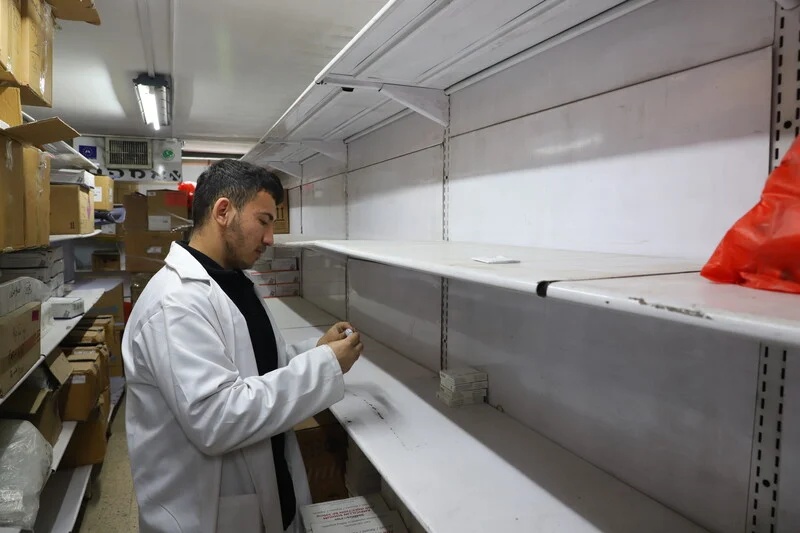
Just over half of Gaza’s medicines are out of stock, according to data from the General Directorate of Pharmacy at the Ministry of Health in Gaza, shared with The Electronic Intifada. Of 622 essential items, 312 were unavailable as of March 2026.
The shortage of medicines in Gaza is rooted in the blockade Israel imposed in Gaza in 2007, but the genocidal war that began in October 2023 pushed an already fragile system into operational collapse.
The ceasefire-that-is-not-a-ceasefire agreement that came into effect in October 2025 has brought no meaningful relief. Only 4,999 trucks entered Gaza out of 23,400 planned under the agreement, amounting to roughly 21 percent of the intended volume – and the empty shelves in pharmacies up and down Gaza bear this out.
In March, the World Health Organization’s regional director, Hanan Balkhy, warned that “stocks of essential medicines, trauma supplies and surgical consumables are critically low, and fuel shortages continue to limit hospital operations” in Gaza.
Meanwhile, Doctors without Borders reported that it has been unable to bring any supplies into Gaza since 1 January 2026. Israel has denied Medical Aid for Palestinians (MAP) access for aid since March 2025, as has UNRWA, the UN’s agency for Palestine Refugees.
Nothing’s changed
The impact is most severe among patients with chronic conditions, with approximately 60 percent of primary care medicines unavailable, according to Ministry of Health pharmacy records, forcing widespread rationing and treatment interruption.
Patients like Kafa.
“The ceasefire changed nothing,” Kafa told The Electronic Intifada in April.
The insulin she needs to manage her blood sugar arrives only intermittently, keeping her health in a state of constant disruption.
Without regular medication for her chronic conditions, the consequences are tangible. Originally from Gaza City, Kafa was displaced south before the ceasefire came into effect last year, and there she collapsed more than once.
On one occasion, she lost consciousness and vomited and was rushed to hospital. She initially believed the episode was caused by a lack of insulin, but doctors later told her it was due to the sudden interruption of her thyroid medication.
Kafa describes herself as “always sick and exhausted.” She suffers from constant headaches, and her vision, she told The Electronic Intifada, is “blurry.”
Recently, after significant effort, she obtained a single strip of thyroid medication brought from Khan Younis to Gaza City, where she lives with her daughter. She is rationing the medicine, taking one pill a day instead of two to prolong its use.
“I don’t know what I will do when it ends,” she told The Electronic Intifada
The shortage of medicine is compounded by soaring prices.
“A strip of medication used to cost around 6 shekels,” or nearly $2, she said. Now it has quadrupled in price, she added, “if you can find it at all.”
Her family members help her look through bare pharmacies every few weeks. More often than not, they return empty-handed.
The wrong dose
For Ali al-Sayed, 19, a heart condition that once required careful medical supervision has become a constant struggle with dosages, availability and uncertainty.
The young engineering student has already undergone two open-heart surgeries, the first at the age of nine and the second when he was at secondary school in 2023. Before October 2023, doctors had recommended specialist follow-up care outside Gaza.
That option disappeared with genocide.
“I was relying on a specific medication my whole life and used to get it easily from the pharmacy,” Ali told The Electronic Intifada. “Now I’m using a substitute at a different dose than what I actually need. My medication still hasn’t come in at all.”
He depends on a blood thinner that requires precise dosing and regular monitoring to prevent clotting or internal bleeding. The challenge is precision. Ali needs 3mg daily, but only 5mg tablets are available in Gaza. He will typically divide the tablets in half, as the closest possible approximation to his dose. Without proper measuring tools or consistent medical supervision, dosing errors can carry serious risks – too little and the blood clots; too much and it can cause internal bleeding.
Monitoring requires a standard international normalized ratio (INR) blood test to measure clotting levels and guide dosage. In Gaza, this is no longer reliably available.
“I can go to a hospital in Gaza City and another in Deir al-Balah in the same day,” Ali said, “and after hours of waiting they tell me the test material isn’t available and my whole day is wasted.”
On one occasion, he took three blood clot tests in different hospitals in a single day. The results varied significantly, making it difficult to determine a safe dose. He said such disruption has also affected his engineering studies.
His father, Jalal al-Sayed, a social worker, told The Electronic Intifada that one of the challenges they are facing is ensuring his son has access to appropriate food – in particular fresh fruit and vegetables.
Like medicine, deliveries of food aid into Gaza dropped dramatically after Israel and the US started their war on Iran, and what foods are available, like canned foods, are not suitable for his condition.
“There is no doctor we can reach regularly,” Jalal said. “Specialists have either left Gaza or been displaced to areas we cannot access.”
During the war, the family sometimes resorted to expired medication when no alternatives were available.
Jalal said the cumulative disruption has taken a psychological toll on his son, who is “angry and irritable all the time.”
A system dismantled
Zikri Abu Qamar, acting head of the pharmacy division at Gaza’s Ministry of Health, said that coordination for the entry of medicines for the private sector stopped entirely once Israel launched its genocidal war, leaving supply dependent almost exclusively on international organizations and without a functioning procurement system.
He said the impact varies by condition. Patients with hypertension can sometimes be switched to alternatives, but those with endocrine and other chronic conditions without substitutes face continuous deterioration.
The collapse of UNRWA in Gaza has deepened the shortage. Before the war, the UN agency’s health centers supplied medical services to more than 70 percent of Gaza’s population, who are mostly refugees. That responsibility has now largely shifted to Ministry of Health facilities.
Cold-chain requirements further complicate supply. Insulin and cancer drugs depend on refrigeration that cannot be reliably maintained at crossings, resulting in delays or rejected shipments.
“Medicine can remain for long periods at the crossing,” Abu Qamar told The Electronic Intifada. “If it degrades due to improper storage, it becomes ineffective.”
The biggest problem is a lack of supply. “What we manage to bring in does not exceed 30 to 40 percent of patients’ needs,” he said.
Yasmin al-Helou, a doctor and the director of Al-Sabra Clinic, a primary care facility in Gaza City, said the breakdown of the health system is evident daily.
“The worst feeling for a doctor,” she said, “is to stand helpless, hands tied, in the face of patients’ needs.”
Patients often discontinue treatment when medicines run out or become unaffordable, she said, leading to preventable complications including hospitalizations, intensive care admissions and avoidable deaths among people with chronic diseases.
Her clinic operates without basic supplies such as gauze, IV fluids and diagnostic tests. Israel’s attacks have gutted much of Gaza’s health infrastructure, partially or completely destroying more than 1,800 health facilities and leaving the few remaining primary care centers overwhelmed with far more patients than they were built to serve.
The reconstruction bill for Gaza’s health system is an estimated $10 billion.
“We try our hardest to provide the best care,” she said, “but with so little available and so many more patients than before the war, it is an enormous burden on medical staff.”
Under such desperate circumstances, families are left to make difficult decisions about treatment on their own.
“We live in constant anxiety,” said Jalal. “We do not know whether the dose is protecting him or putting him at risk.”
[Malak Hijazi is a Gaza-based writer. Courtesy: Electronic Intifada, an online, not-for-profit, independent, Chicago-based publication covering the Israeli–Palestinian conflict from a Palestinian perspective.]
❈ ❈ ❈
How Israel Is Weaponizing Infectious Diseases in Gaza
Salman Khan
I met a young man in his twenties in the intensive care unit at Nasser Hospital in Khan Younis, Gaza. He was the victim of an Israeli rocket attack three weeks earlier near the yellow line. His left leg was amputated above the knee, and the part of the extremity that remained had multiple external fixators in place; he also had multiple other lacerations and suffered severe abdominal trauma requiring open laparotomy, bowel resection, and ostomy placement. He was intubated and had developed a ventilator-associated pneumonia with a multidrug-resistant bacterium called Acinetobacter. He was on a combination of antibiotics that would probably be ineffective.
In Gaza, there is a lot of what we infectious disease specialists refer to as “drug-bug mismatch”—patients often get placed on antibiotics that are ineffective against the offending pathogen due to a limited antibiotic arsenal and a growing antibiotic resistance crisis.
Due in part to ongoing restrictions on the entry of lifesaving medicines by the Israeli Occupation, the antibiotic supply is severely limited in Gaza, often changing week to week based on availability of donations from the World Health Organization. Patients unnecessarily die from often treatable infections because of delays in receiving effective antibiotic therapy.
The collapse of the healthcare system, overwhelming overcrowding in and around hospitals, and breakdown of hygiene and sanitation infrastructure all conspired to facilitate the spread of multidrug-resistant bacteria and exacerbate Gaza’s antimicrobial resistance burden. Even before the genocide, Gaza suffered from high levels of antibiotic resistance, which has since accelerated. Heavy metal contamination from explosive remnants from Israeli airstrikes is also contributingto the selection of resistant bacteria in the environment.
Prior to Israel’s medicide, Gaza was home to 38 hospitals, many providing advanced specialty care; now there are only a handful of remaining hospitals functioning at a fraction of their prior capacity, for a population of over two million people in dire need.
Hospital and public health laboratory capacity is severely limited in Gaza because of targeted destruction of laboratory infrastructure and blockade of supplies by the Occupation. Microbiology laboratories struggle to perform essential, time-sensitive diagnostic tests, such as cultures to identify bacteria from various body specimens and environmental sites, and antibiotic susceptibility tests to predict the best treatment options for the individual patient and the hospital population at large. These constraints also impair infectious disease surveillance and outbreak response measures.
Infection prevention and control efforts have faced extraordinary challenges following Israeli assaults on Gaza’s hospitals and surrounding communities. Hospitals were overwhelmed with civilian casualties, making adherence to basic principles of hygiene such as handwashing, sterilization of medical equipment, and proper wound care nearly impossible. Severe overcrowding facilitated the spread of infectious diseases. Since the “ceasefire”, hospitals have continued to face severe shortages of alcohol-based hand sanitizer, solutions to sterilize medical equipment, and personal protective equipment.
The risk of infection, however, extends beyond the hospital walls. During our time in Gaza, our group of volunteers was invited by a representative of the Ministry of Health to bear witness to life in the tent camps surrounding the hospital. It struck me that each of these tents was crowded with entire families who had experienced multiple displacements. The first thing I noticed was the stench of raw sewage and garbage in the air. Debris littered the ground. Latrines were dug in the sand that would overflow when it rained. These conditions increased susceptibility to communicable respiratory, skin, and diarrheal diseases.
They also created an ideal breeding ground for rodents. One of the resident doctors at Nasser Hospital, whom I spoke with, described a cluster of leptospirosis cases on the wards in early February. Leptospirosis is a serious bacterial infection that spreads from rodents to people; infection can present with pneumonia, kidney and liver failure, and result in death without proper treatment. Extensive rainfall and flooding in the tents surrounding the hospital likely exposed people to rodent urine and feces, leading to disease transmission.
Walking down the dusty streets of Khan Younis, it became apparent to me how Israel was attempting to make life unlivable for Gazans by destroying their built environment. The air was thick with particulate matter and smoke, making breathing labored. Patients with underlying breathing conditions were especially vulnerable to respiratory viral infections like influenza and COVID and to bacterial pneumonia; I saw several patients admitted with pneumonia to Nasser Hospital.
Visiting the local grocery store, the shelves were stocked with overpriced junk food and highly processed foods. Fresh produce was rare. Even before the genocide and famine, Gaza was kept chronically food insecure, at the brink of starvation, by the Occupation. Malnutrition weakens the immune system and predisposes patients, especially young children, to infection. During my visit, I witnessed a heartbreaking scene of small children queuing up with large, empty pots outside a makeshift soup kitchen near the hospital, screaming and crying with hunger. Between manufactured malnutrition, traumatic injuries, and the burden of chronic and infectious diseases, it is not surprising that Gaza has one of the lowest life expectancies in the world.
Returning to the case of the twentysomething-year-old patient in the intensive care unit, his assault did not end with the Israeli rocket attack that tore his body apart. He was subsequently subjected to more insidious forms of violence by the Occupation: his ability to fight off infection was compromised because of malnutrition due to ongoing limitations on entry of nutritious food; he developed pneumonia from spread of bacteria in the unit due to restrictions on entry of cleaning supplies and personal protective equipment; and once he developed the pneumonia, his treatment options were severely limited due to an insufficient supply of effective antibiotics.
I encountered many such patients in Gaza. An elderly woman who developed an infected pressure ulcer on her hip from prolonged sitting on the hard floor of her tent resulting in sepsis and requiring surgical debridement and intravenous antibiotics; a young woman who developed a highly contagious parasitic infestation from scabies due to overcrowding and poor hygiene conditions in her family’s tent; another woman who developed severe gastroenteritis and diarrhea likely from drinking contaminated water leading to dehydration and kidney failure.
A discussion on the threat posed by infectious diseases in Gaza would be incomplete, however, without addressing frontline healthcare workers, who play essential roles in preventing and slowing the spread of infections in the healthcare setting. Gaza’s doctors, nurses, and infection preventionists have endured great difficulty during the genocide, facing multiple displacements and challenges in securing food and clean water. One of the doctors I spoke with, whose best friend had been killed, told me everyone in Gaza had lost someone or something precious to them.
Other hospital staff, particularly those in leadership positions, like Dr. Hussam Abu Safiya, the director of Kamal Adwan Hospital, have been kidnapped, tortured, and unlawfully detained by the Occupation, while others like Dr. Hammam Alloh, a nephrologist from Al-Shifa Hospital, have been murdered, leaving critical gaps in the healthcare workforce; such gaps have been linked to increased risk of hospital-acquired infections.
Gaza’s medical students and trainees have also been denied their right to medical education, including education and training on infection prevention and antimicrobial stewardship, over the preceding two and a half years of assault. This poses serious challenges to curbing and decelerating the emergence of antimicrobial resistance in Gaza’s teaching hospitals.
Addressing the growing threat of infectious diseases in Gaza requires bold, urgent action. Firstly, a true ceasefire must be enacted. This includes lifting restrictions on entry of lifesaving medical supplies and medicines, particularly antibiotics. Humanitarian workers must be allowed unimpeded access into Gaza and currently imprisoned healthcare workers must be freed. Patients requiring specialty care must be allowed medical evacuation—many of these patients succumb to infectious complications while awaiting safe passage. Resources must be allocated to rebuilding Gaza’s sanitation infrastructure, healthcare system, and laboratory capacity. Only with these prerequisites in place can hospital infection prevention and control and antimicrobial stewardship programs realize their full potential. Finally, the systems of apartheid and occupation that created the conditions for medicide must be dismantled; Israel must be held accountable for its genocidal actions in Gaza.
[Salman Khan, MD, MPH, is an infectious disease specialist and assistant professor of medicine at Columbia University Irving Medical Center in New York. He traveled to Gaza on a three-week medical mission in February and March 2026. He has also previously traveled on medical missions to Syria (December 2025) and the occupied West Bank (August 2025). Courtesy: Mondoweiss, an independent website devoted to informing readers about developments in Israel/Palestine and related US foreign policy.]
❈ ❈ ❈
Gaza’s Painful Journeys
Qasem Waleed El-Farra
I feel selfish sometimes if I sit in the back seat of a taxi.
The back seat is the most coveted spot in a shared taxi in Gaza, yet it is not one that a man can sit in for long.
As the driver picks up passengers along the way, men are expected to give up the back seat for women and the elderly. This is not a problem, as I also feel the obligation to make female and elderly passengers as comfortable as possible. Yet, while I’m sitting in the back seat, I pray that the driver won’t stumble upon a woman or an elderly person.
My prayers aren’t accepted, though.
As I’m ousted from the back seat, I face the uncomfortable options of either getting into the shared front seat or getting into the aqalah, or trailer, that is hitched to the back of the car.
Sitting next to the driver means being painfully wedged into the center console, my legs squeezed tightly together. When the driver shifts gears, I must also shift and lift my body to accommodate the gear stick.
Sitting on the other side, next to the window, and sharing the seat with another passenger, is a whole other story.
Half of my body is on the seat and the other half is basically out the door, which must be kept ajar to create some space. As we pass passengers and cars in the road, I must continuously open and close the door to avoid a collision.
The driver isn’t immune either from these discomforts, as he sometimes has to share his seat with a passenger.
The other passengers can hop into the open trunk or into the aqalah that is hitched to the back of the car.
Before the genocide, an aqalah would have been used to transport animals, like sheep. Now drivers cover the sides of the aqalah with nylon sheets and have installed long metal benches on both sides.
Up to 16 additional passengers are then crammed into the trailer: two stand on the hitch that connects the aqalah to the vehicle; around 10 to 12 are seated on the metal benches; and another two passengers hang and hold on to the insides of the trailer. Sometimes, to accommodate more passengers from the crowds of people who need a ride, the driver will rearrange people based on their size, gender or age.
Yet the stench and the suffocating heat inside the aqalah are not the worst things about this new method of transportation.
That long metal bench doesn’t absorb the bumps of the roads, so every sudden bump causes a violent upward push that reverberates in the hip bones.
I’ve rode the aqalah several times, and I know that for many elderly people who suffer from chronic pain in the back or knees, this ride feels like physical torture.
So, that’s around 20 to 26 passengers in one vehicle, depending on how many passengers the driver can cram in.
End of the road
Drivers have no choice but to pack their vehicles like this; it’s the only way they can afford to buy fuel, which in Gaza is exorbitantly priced due to its scarcity.
Between 70 and 80 percent of the 80,000 registered vehicles in Gaza have suffered total or partial destruction.
The Gaza Strip needs approximately 15 million liters of diesel and 2.5 million liters of gasoline per month, yet such needs are never adequately met.
According to the terms of the pseudo October 2025 ceasefire, 50 fuel trucks should be allowed into Gaza daily, amounting to at least 8,000 fuel trucks entering the Strip as of March 2026. But the Israeli authorities have allowed only 1,190 fuel trucks to enter, with most of the fuel being used in health and public services.
Even if Israel allowed in more fuel supplies, the roads that remain in Gaza are barely suitable to drive on. At least 74 percent of the road network in the Gaza Strip has been destroyed, while another 13 percent of this network was partially damaged, according to an April 2026 World Bank, EU and UN report.
The over 60 million tons of debris that are scattered across the enclave – the remains of entire blocks of homes and buildings destroyed by Israeli attacks – also obstruct routes in Gaza.
So a road that used to take 10 minutes to travel by car might now require at least an hour.
Small change
The real problem for us passengers, though, is coming up with the small change, especially coins, to pay for the ride.
The first question the driver asks is not about your destination, but rather whether you have change or not.
Some taxi drivers who cover the route between the south and north of Gaza have come to accept online transactions, either via a bank app or the electronic local wallet, PalPay. Still, those who work internally, inside a certain city or area, accept only cash.
It’s a critical moment when the driver rules whether the passenger will be awarded the “privilege” of getting into the vehicle (if they have change) or will continue to their destination on foot (if they don’t).
Every new day in Gaza starts the night before, as people look for and prepare small change for the next day.
On 29 March 2026, my mother got a message from a mutual aid organization to come the next day to their distribution site in the al-Mawasi area of Khan Younis to receive a food package. But since she has a knee problem, I told her I would go instead.
That night, I stopped by my uncle’s tent, near ours in al-Mawasi, to ask for some change. Five shekels was all I could get.
I woke up at 8 the next morning, mentally prepared, knowing that I would have to walk nearly three kilometers before either waiting in a long line to get the parcel or having to push my way through the crowd to get it.
I walked for around half an hour before reaching the distribution center, where I was greeted by a long line of about 100 to 150 people.
The line didn’t maintain its integrity for long because, nearly an hour later, a dispute broke out between people cutting in line and a man angered at them. It began as an aggressive verbal fight before it escalated into a fistfight. Some people quickly intervened and broke them up, but it was too late – the entire line was in shambles.
I had to push my way through the crowd until I found someone from my area who managed to check my mother’s identity card before handing me the package from another gate.
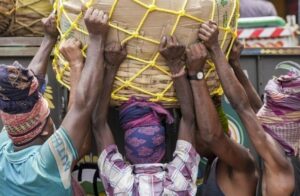
The package included a 25-kilogram sack of flour and two food parcels comprising canned beans, tomato paste, cooking oil, pasta, rice and sugar. In total, the package weighed about 60 kilograms.
Although it took me nearly an hour and a half to get the parcel that day, this would be considered quick when compared to the usual hours of waiting that people must endure to receive their aid.
Still, getting the package was not the hardest part – it was whether I would be able to get a ride back to the tent.
The trolley kid
I went outside the aid distribution site to find a ride. Several men with donkey-pulled carts and kids with hand trolleys milled about, offering rides to those who had received their aid packages.
A man with a donkey-pulled cart asked for 10 shekels, in cash: five for me and another for the package. I declined.
I haggled with other cart drivers for nearly 20 minutes under the blazing sun before a kid, Khalil, tempted me with a special offer: 10 shekels for the ride, but he would let me pay five via PalPay when we arrived at my tent.
I agreed and asked about his cart. The kid went away for a moment and then returned with a hand-pulled cart.
I was startled, mulling over how he would pull my 60-kilogram package all the way back.
I asked about his age and if he could actually do this.
He said he was 13, but I couldn’t grasp that – he was too scraggly for such an age. His face was skinny with high sunken cheekbones, and his clothes were ragged, powdered with flour.
After we secured the package in the trailer and Khalil began to pull it, I noticed that the sole of his left shoe was cut open. He pressed his foot against the ground in order to control the cart and be able to walk.
The road to my tent is so lumpy, but most of it is covered with fluffy sand that would absorb his trailer’s tiny wheels.
I felt sorry for him, and I kept switching with him to pull the cart. We stopped in the middle of the road to get some fresh water before continuing onward.
After nearly an hour, we reached my tent, and I paid him.
Khalil told me that he is the eldest son. His father is an amputee, and Khalil has taken on the burden to work hard and provide for his family.
The shape of misery
I have been displaced for nearly a year now, and I crave to know the taste of having a break – and I’m sure Khalil shares that same desire with me, probably even more desperately so.
The genocide has turned all of us into walkers; we have been on the constant move since our forcible displacements from our homes.
In December 2023, my family and I were forcibly displaced from our house east of Khan Younis to Rafah’s Tel al-Sultan area, walking under a shower of bombshells.
We didn’t go to Rafah directly. We tried to shelter in downtown Khan Younis, but then that area was issued another mass displacement order.
We roamed the streets looking for a place to shelter until we reached Rafah. We walked nearly 16 kilometers on foot that day, according to my phone’s tracker.
But that wasn’t our only displacement. We were forcibly displaced on 2 July, 16 July, 22 July, 7 August, 22 August and 7 October 2024. Each time the Israeli army withdrew, we returned to our damaged house immediately, trekking multiple times from east Khan Younis to the al-Mawasi area west of Khan Younis.
On 19 May 2025, Israel forcibly displaced all of eastern Khan Younis, and this marked the last time we were able to walk to our damaged house. We haven’t been able to go back to our neighborhood since then.
As displaced people in tents, we have walked for long distances in winter under the rain and in summer amid the sweltering heat.
Walking is the main expression of our misery in Gaza.
We walk to survive, to swiftly escape the Israeli bombardments and invasions, to provide for our families.
We walk for life.
And we walk because we have no other option but to walk; it is another form of suffering we have normalized.
[Qasem Waleed El-Farra is a writer based in Gaza. Courtesy: Electronic Intifada, an online, not-for-profit, independent, Chicago-based publication covering the Israeli–Palestinian conflict from a Palestinian perspective.]