❈ ❈ ❈
The Real NEET Crisis Lies Inside the System
Vedaant Lakhera
On May 3, 2026, the National Eligibility cum Entrance Test (NEET), India’s unified, nationwide entrance examination for undergraduate medical programmes, was conducted. In the following days, social media was flooded with reels by students celebrating the end of months, years, of relentless preparation.
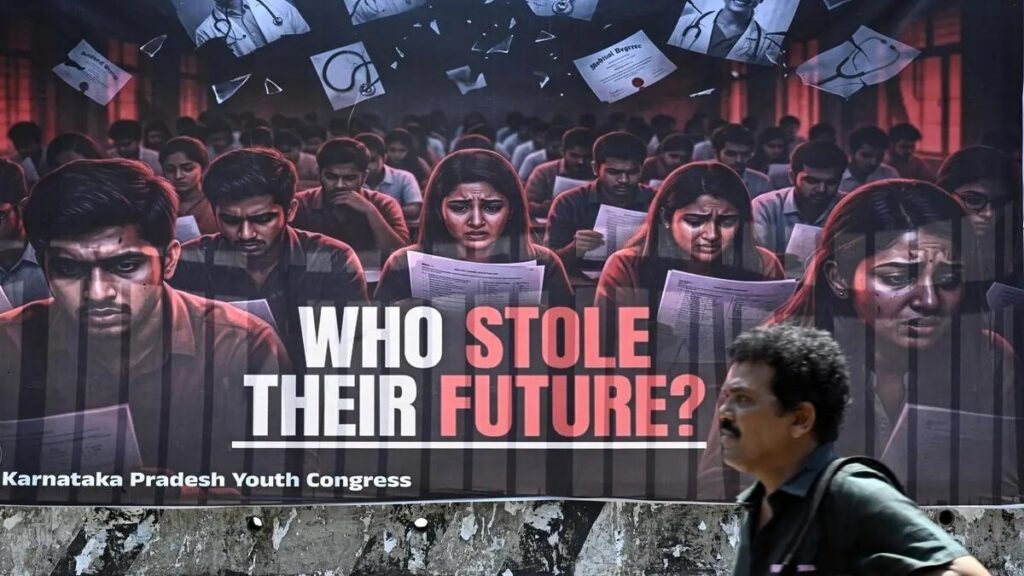
Barely two weeks later, that sense of relief had curdled into despair. On May 12, the National Testing Agency (NTA), India’s nodal body for conducting higher education entrance examinations, announced the cancellation of NEET 2026 following widespread allegations of the circulation of a “guess paper” and multiple accusations of irregularities in the original examination. Since then, at least four students have died by suicide, driven by despair.
In Rajasthan’s Sikar, 22-year-old Pradeep Meghwal died by suicide in his residence. Having spent the last three years preparing for NEET, he was reportedly confident of securing admission to a premier medical institution this year. In Uttar Pradesh’s Lakhimpur Kheri, 21-year-old Ritik Mishra ended his life, devastated by the abrupt nullification of the years of effort he had put into what was his third attempt at getting through the entrance test. In Delhi’s Azadpur, 20-year-old Anshika Pandey, who had also appeared for the third time this year after missing out on a seat by merely four marks in 2025, succumbed to the mounting distress caused by the examination’s cancellation. In Goa, a 17-year-old boy died by suicide, leaving behind a note about the crushing pressure of having to prepare for competitive examinations while keeping his passion for hockey alive.
These deaths underscore the deep fractures within a system that has, over the years, repeatedly revealed institutional failure through paper leaks and examination irregularities. The cancellation of the examination has directly impacted nearly 22.8 lakh students, who find their efforts invalidated and their futures suddenly in disarray. Of these, 13.32 lakh—nearly 58 per cent—are women. All these students were competing for only 59,416 seats.
This is not the first time that the NTA has found itself at the centre of a nationwide controversy. In 2024, shortly after NEET was conducted, reports surfaced alleging that the question paper had been leaked in Bihar and Jharkhand, triggering multiple arrests. The results too had provoked widespread suspicion after an unprecedented 67 students secured a perfect score of 720 out of 720: many of them were reportedly from the same examination centre.
The NTA said it had allotted “grace marks” to 1,563 candidates as compensation for an alleged “loss of time” at certain centres. The consequence was mathematically improbable scores such as 718 and 719. Following legal challenges and mounting public outrage, the government eventually revoked the grace marks. A limited retest was subsequently conducted on June 23, 2024, exclusively for the 1,563 affected candidates.
In July 2024, a Supreme Court bench headed by the then Chief Justice of India, D.Y. Chandrachud, heard a cluster of petitions demanding a complete nationwide re-examination. The court ultimately ruled that, although a paper leak had indeed occurred, there was no evidence pointing to a “systemic breach” or a structural collapse of the examination process. The bench refused to annul the examination in its entirety, observing that such a decision would unjustly penalise millions of candidates while severely disrupting the country’s medical education calendar. At the same time, the court directed the NTA to revise the final merit list by removing marks awarded for a disputed physics question. This correction reduced the number of perfect scorers from 67 to 17.
Failure of the NTA
In the aftermath of the 2024 controversy, the Central government initiated an investigation by the CBI and additionally constituted a high-level reform committee to overhaul and strengthen the NTA’s examination protocols. Following intense public backlash, the former NTA chief Subodh Kumar Singh was removed from the position on June 22, 2024. However, in October 2024, he was appointed as Additional Secretary and Financial Adviser in the Union Ministry of Steel before later being repatriated to his home cadre in Chhattisgarh.
He currently serves as Principal Secretary to Chhattisgarh Chief Minister Vishnu Deo Sai, with additional charge as Principal Secretary of the State’s Energy Department. To many observers, this career trajectory is yet another instance of bureaucratic rehabilitation, topped by professional ascendancy within the administrative hierarchy.
The reexamination has been scheduled for June 21, with the authorities clarifying that students will not be required to re-register for the test. Meanwhile, the CBI continues to probe what officials have described as an expansive “exam mafia” network allegedly operating across multiple States, including Rajasthan, Maharashtra, and Haryana. Multiple individuals, including a teacher and several coaching centre owners, have already been arrested in connection to the investigation.
In an attempt to overhaul the agency and introduce systemic reforms, the government has inducted four senior administrative officers into the NTA, including two Joint Secretaries who will now serve as Additional Director Generals within the organisation.
The NTA was primarily conceived as an autonomous public body with the mandate of seamlessly conducting higher education entrance examinations. Over the years, it has functioned less like a public service institution and more like an entity geared towards maximising revenue while minimising institutional accountability.
According to a Rajya Sabha committee report from 2023, the agency generated thousands of crores through examination fees but spent comparatively less on administering the examinations, thereby accumulating a substantial financial surplus. In a written reply submitted to the Rajya Sabha on July 31, 2024, Union Minister of State for Education Sukanta Majumdar presented year-wise data on the NTA’s income and expenditure since its establishment in 2018, confirming that the agency had recorded a profit of Rs.448 crore over six years.
Neha, national president of the All India Students’ Association, said: “The entire education structure has been systematically dismantled and replaced by a parallel system that does not look at education as a right but as an opportunity to make money.” She added, “This transformation has directly fuelled student suicides, particularly in coaching hubs such as Kota and other cities where lakhs of students migrate for competitive examination preparation. The centralisation of examinations, coupled with the gradual erosion of an accessible public education system, has subjected students and families to extraordinary psychological and financial strain. Families spend a substantial part of their annual savings on private coaching institutions in the hope that their children will have a stable future in a landscape marked by unemployment, inflation, and deepening economic insecurity.”
Neha pointed out that coaching centres have been repeatedly implicated in corruption scandals and paper leak controversies. “The NTA functions in tandem with these institutions in all probability. In any case, the paper leaks prove the failure of the agency,” she said.
Available data indicate that there have been 70-89 paper leak incidents across State and Central-level examinations over the past decade. Since its establishment in 2018, the NTA has been involved in at least four major examination-related controversies: NEET 2026; UGC-NET 2024, where the examination was cancelled within 24 hours of its completion following allegations of a leak; NEET 2024, which was marred by what authorities described as “localised leaks”; and JEE 2021, where an organised syndicate used remote-access software to hijack candidates’ computers.
Suresh Babu, who teaches at the Centre for Educational Studies at JNU, underscored the urgent need for a robust accountability mechanism. “The government cannot abdicate responsibility to the public at large. It must be answerable for what is happening, especially in matters of corruption. The erosion of public trust in the examination system could have profound implications for the future of education and democracy in India. The growing ‘trust deficit’ between young people and the state is already shaping how students perceive institutions, governance, merit. Repeated controversies over examinations is deepening the scepticism towards our political and educational systems. We should be cautious, keeping in mind the youth-led mobilisations in neighbouring countries such as Bangladesh and Nepal, fuelled by similar grievances,” he said.
Fundamental flaw
On May 15, Union Education Minister Dharmendra Pradhan announced that NEET-UG would transition to a fully computer-based format from 2027. Critics argue that such a move might further disadvantage students from rural and economically backward families who do not have proper digital access. According to a report published by the Unified District Information System for Education under the Ministry of Education for the 2024–25 period, only 60 per cent of government schools in India have access to computers, while 58 per cent possess Internet connectivity. Far from democratising access, the proposed shift is more likely to exacerbate urban-rural, and affluent-deprived divides.
Faizan Mustafa, the former Vice Chancellor of NALSAR University of Law, called for the immediate decentralisation of college entrance examinations, arguing that centralised tests overwhelmingly serve socially and economically privileged sections. “When we were having different examinations in different States, we produced some of the best doctors in the world. A country of our size may ideally have at least three, four, or five exams so that if a student does badly in one, they have the chance of appearing in another and saving their year,” he said. Mustafa also expressed anguish over the psychological toll of examination cancellations on students.
According to him, an examination such as NEET has a fundamental flaw: while assessing a student’s aptitude in physics, chemistry, and biology, it does nothing to find out if they possesses the aptitude, empathy, or practical skills needed to become a good doctor. “Entrance examinations across professions should be reoriented towards assessing the actual capabilities required for fields such as medicine, law, or engineering, rather than filtering candidates through an intensely competitive, memorisation-based system,” he said.
Mustafa articulated the core issue bluntly: “All common entrance tests are elitist. If I can afford coaching, I will make it. People from rural areas and those studying in regional languages are automatically at a disadvantage.” Similar conclusions were drawn by the Rajan Committee report (2021) on the impact of NEET on medical admissions in Tamil Nadu.
The call is getting louder for a comprehensive overhaul of the NTA alongside urgent efforts to decentralise entrance examinations and reassess India’s education system itself. Obviously, the crisis extends far beyond isolated incidents of paper leaks or administrative lapses. It suggests a collapse of accessibility, equity, and public trust in the education system. The incremental and reactionary measures proposed by the government fail to confront these structural issues. Therefore, they are unlikely to meaningfully resolve the crisis.
[Vedaant Lakhera is a journalist with Frontline magazine, based in New Delhi, and is an alumnus of the Indian Institute of Mass Communication, Delhi. Courtesy: Frontline, a fortnightly English language magazine published by The Hindu Group of publications headquartered in Chennai, India.]
❈ ❈ ❈
India’s Exam Fraud Bubble: 148 Cases, One Conviction in 11 Years
Ashutosh Ranka and Nice Paudel
On May 12, the Central Bureau of Investigation was handed its 18th exam fraud investigation since 2015. NEET-UG 2026, the national medical entrance examination that 22.75 lakh students had registered to sit, was cancelled hours before it was due to begin, after intelligence suggested a paper leak at a printing facility in Jaipur. The students went home. A probe was ordered and the country began waiting for a conviction that – based on the last decade of evidence – is extremely unlikely to come.
This is not a story of one single exam but a story about a system that has been failing, continuously for 20 years and a state that has consistently treated each scandal as an occasion for outrage rather than an imperative for reform.
To understand the gravity of situation, our team at Parivartan, a youth-centric social and activist organisation based in Rajasthan with focus on recent fraud in Rajasthan government exams, deployed multiple AI algorithms, analysed court orders, tracked CBI/ED investigations and went through 500+ media articles.
A comprehensive analysis of exam fraud in India between 2005 and 2026 has documented 220 incidents spanning 21 states. The cases cover paper leaks, proxy impersonation, OMR tampering, result manipulation and electronic cheating. Together, they affected an estimated 10 crore students.
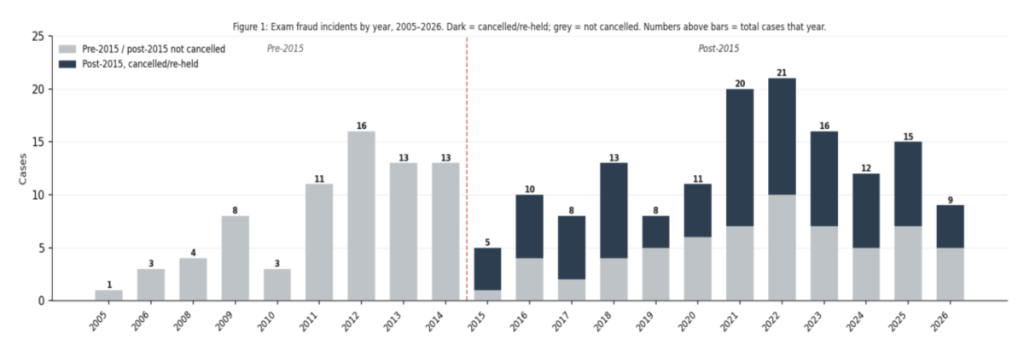
Figure 1: Exam fraud incidents by year, 2005–2026. Dark = cancelled/re-held; grey = not cancelled. Numbers above bars = total cases that year. Red dashed line = 2015 inflection.
The dataset is not evenly distributed across time. Before 2015, the team documented 72 cases, that is a rate of roughly seven per year. After 2015, that number nearly doubled – 148 cases have been documented since 2015, averaging 12 per year.
The nature of fraud has also shifted in ways that make detection harder and prevention even harder. Before 2015, paper leaks accounted for roughly 32% of documented cases but after 2015, paper leaks shot to 70% of all cases. The explanation is rather simple: “The WhatsApp era” reduced the labour cost of a leak to near zero. One corrupt employee with a phone camera at a printing 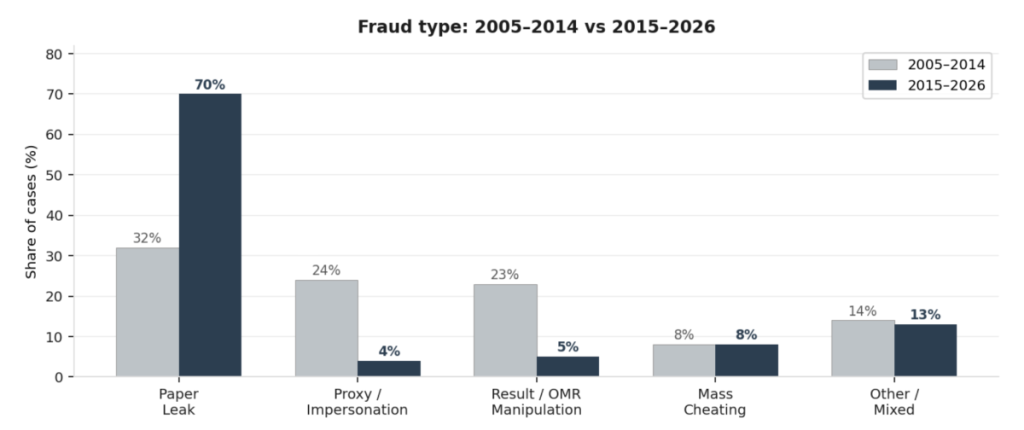 warehouse is now sufficient to compromise an examination taken by millions.
Figure 2: Fraud type composition, 2005–2014 vs 2015–2026. ‘Other/Mixed’ includes cases with multiple or uncertain fraud types.
All six anti-leak laws passed in Rajasthan, Uttarakhand, Gujarat, Odisha, Jharkhand, and at the Centre are primarily punitive. They criminalise leaks and collusion after the fact. None mandates end-to-end preventive controls across paper setting, printing, transport, scanning, and tabulation.
A geography of failure
The post 2015 surge in fraud is not spread uniformly across India. Six states account for the sharpest deterioration: Gujarat had zero documented cases before 2015 and 13 since, Uttarakhand was entirely absent from the pre 2015 dataset and now has 9 cases, Haryana moved from 2 to 10, Telangana also previously absent now has 6. Rajasthan worsened from 6 to 10, and Uttar Pradesh from 7 to 12.
Gujarat’s record warrants particular attention. The state passed two successive anti-leak laws and its worst years came after both. Asit Vora, BJP member and chairman of the Gujarat Secondary Service Selection Board, oversaw 11 consecutive documented leaks according to an investigation by The Wire. He was retained through every incident and resigned only after a criminal chargesheet was filed. Madhya Pradesh shows a nominal post 2015 decline (21 to 6 cases), reflecting the end of the Vyapam cycle rather than improved governance only 1 of its 6 post 2015 cases resulted in cancellation. Uttar Pradesh is the only state in the high fraud cluster where the problem genuinely crosses party lines, distributed across BJP, SP, and BSP governance periods.
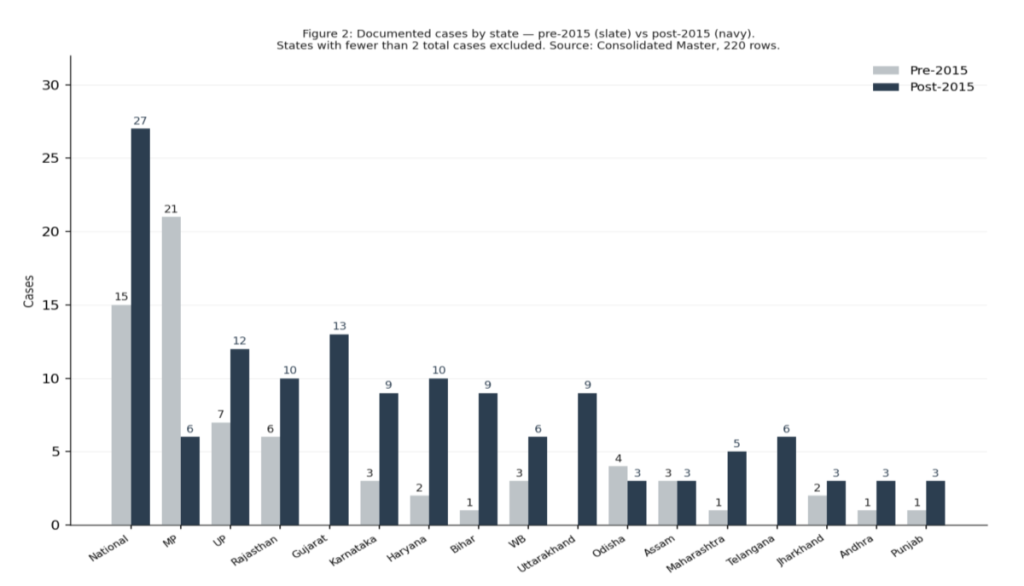
Figure 3: Documented cases by state — pre-2015 (slate) vs post-2015 (navy). States with fewer than 2 total cases excluded.
The politics of paper leaks
The data on governing parties is uncomfortable for everyone and more uncomfortable for some than others.
To be clear, exam fraud is not a BJP-only problem. It happened under Congress. It happened under BRS, AIADMK, JMM. But the data shows one party’s footprint is so dominant that it cannot be explained away as coincidence.
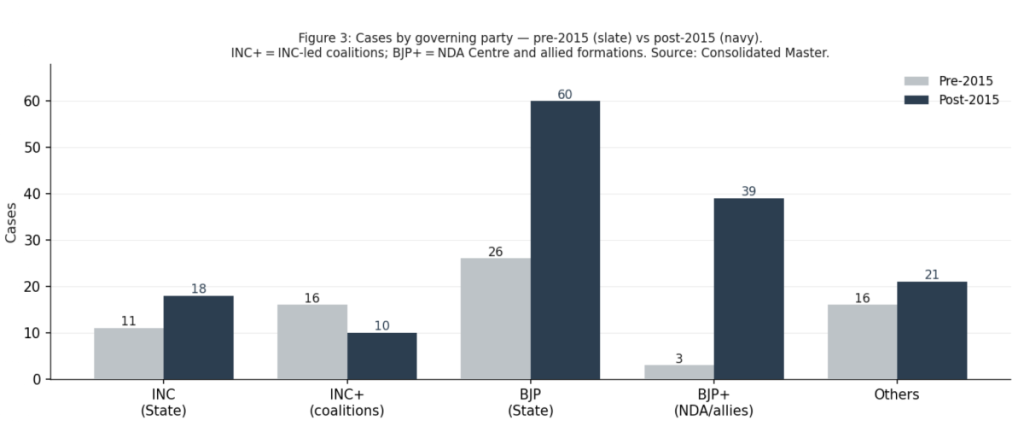
Figure 4: Cases by governing party — pre-2015 (slate) vs post-2015 (navy). INC+ = INC-led coalitions; BJP+ = NDA Centre and allied formations.
Across the entire 220 case dataset, the BJP and its NDA allies account for 128 cases (58%). The INC and its allies Figure 4: Cases by governing party — pre-2015 (slate) vs post-2015 (navy). INC+ = INC-led coalitions; BJP+ = NDA Centre and allied formations.account for 55 (25%). Post-2015, the BJP’s share rises: 99 of 148 cases (67%) occurred under BJP or NDA governance.
Post-2015 Cases (148 Total) by Governing Formation
| BJP/NDA | 99 cases (67%) |
| INC/UPA | 29 cFigure 4: Cases by governing party — pre-2015 (slate) vs post-2015 (navy). INC+ = INC-led coalitions; BJP+ = NDA Centre and allied formations.ases (20%) |
| Others | 21 cases (13%) |
The Medical Entrance Cluster: India’s Most Compromised Exam
No exam family in the dataset has been more persistently compromised than the medical entrance cluster. At least 15 distinct incidents are documented when NEET and its predecessor AIPMT, state PMTs, AIIMS PG, NBE/FMGE, and Madhya Pradesh’s Pre-PG examinations are counted together a continuous record of fraud spanning all twenty years of the study period.
The Vyapam PMT ran fraudulently across six consecutive annual cycles from 2008 to 2013, using organised impersonation networks. No exam in the cycle was cancelled at the time. The Supreme Court later upheld cancellation of 634 MBBS admissions and degrees tied to those cycles.
In 2015, the national AIPMT was cancelled and reheld after the paper circulated electronically across roughly ten states a network traced to operator Ravi Attri, who would later resurface in connection with UP leaks in 2024. The pattern of the same individuals reappearing across multiple incidents years apart is one of the dataset’s most arresting features. Each reappearance a quiet indictment of every investigation that came before
NEET-UG 2024 was the most consequential recent incident. A paper leaked in Hazaribagh and Patna. Approximately 155 students are believed to have benefited. The Supreme Court upheld the examination rather than ordering a full retest. The National Medical Commission suspended 26 MBBS students and cancelled 14 admissions.
NEET-UG 2026 cancelled on 12 May is the latest chapter. The Public Examinations (Prevention of Unfair Means) Act 2024 has been invoked, and a CBI probe ordered.
The collapse of criminal accountability
The CBI is the agency most frequently assigned to investigate exam fraud at the national level. Before 2015 it had a credible record. It convicted 10 people, including the RRB Mumbai chairman, in the 2010 railway recruitment fraud case. It convicted three people in the 2009 CRPF constable case, including a former Deputy Inspector General. In the Vyapam matter, it has produced convictions across multiple sub cases built on pre 2015 FIRs.
Since 2015, the CBI has been handed at least 17 exam fraud investigations. Its conviction record from its own post 2015 cases is zero.
- The CBI’s post 2015 record: Involved in NEET UG 2024, UGC-NET 2024, SSC CGL 2017, JEE Main 2021, WB SSC 2016, HP Police Constable 2022, Army CEE 2017, Karnataka PSI 2021, and at least nine other cases.
- Documented convictions from its own post 2015 investigations: 0. In NEET-UG 2024, the agency missed the 90-day chargesheet deadline allowing the key accused to walk free on default bail. In UGC-NET 2024, it investigated a supposed leak and then filed a closure report finding the evidence was a doctored screenshot. Over 11 lakh registered candidates had already been displaced.
The Enforcement Directorate has been involved in at least 11 post 2015 exam fraud cases through PMLA proceedings, attaching crores in alleged proceeds. It has produced zero convictions. ED prosecutions depend on the underlying criminal case being successfully prosecuted first and when state police investigations stall, the money laundering case stalls with them.
UGCNET 2024 stands as a case study in what happens what should have been an act of institutional prudence instead becomes a troubling spectacle of administrative haste. The Ministry of Education cancelled the examination the day after it was held on account of integrity compromise. However, CBI later filed its closure report in the case, saying that the case was fabricated and was just a doctored screenshot. No ministry official has been held accountable. No one who fabricated the intelligence has been charged.
The individuals the system protects
Alongside the aggregate failure is a gallery of individuals whose names appear repeatedly in fraud cases arrested, charged, and then released, sometimes with the assistance of the very political structures they are accused of having compromised.
1. Rajeev Nayan Mishra
On bail – every proceeding
Linked to four exam leaks across UP and Madhya Pradesh: UPTET 2021, NHM Staff Nurse MP 2023, UPPSC RO/ARO 2024, and UP Police Constable 2024. Operated seven shell companies; alleged co-mastermind with Ravi Attri. Named in an ED PMLA prosecution complaint in January 2026. Obtained anticipatory bail from the Allahabad high court in September 2025, partly because the ED’s own summons was procedurally defective. Rs 1.02 crore attached. Zero documented convictions.
2. Bandi Sanjay Kumar
FIR quashed – now Union minister of state
Then Telangana BJP president and Lok Sabha MP, named A-1 by Warangal Police in the Telangana SSC Class 10 Hindi paper leak (2023) and arrested at midnight from his residence. The Telangana high court quashed the FIR in 2025 for insufficient material. He denies sourcing the leak and is now Union minister of state.
3. Asit Vora
Resigned after chargesheet – no conviction
BJP member and chairman of the Gujarat Secondary Service Selection Board. Oversaw 11 consecutive documented leaks at GSSSB and affiliated bodies according to The Wire’s investigation. Retained through every incident; resigned only after a criminal chargesheet was filed. The BJP officially stated his resignation had ‘nothing to do with the paper leak.’
4. Hakam Singh Rawat
Re-arrested 2025 – expelled from BJP
BJP Uttarkashi Zila Panchayat member. Arrested by the Uttarakhand STF as the alleged UKSSSC paper leak mastermind (2022), his illegally constructed resort was demolished by court order. Re-arrested in 2025 for the same alleged modus operandi, reportedly demanding Rs 12–15 lakh per candidate. Expelled from BJP for six years.
5. Laxmikant Sharma
Clean chit on Vyapam – charges not proceeded
BJP minister for technical and higher education in Madhya Pradesh. Ran the ministry that oversaw the exam board conducting 17 fraudulent exams under Vyapam. Chargesheeted by the CBI in the Vyapam contractual teacher branch (2018). The same CBI gave him a clean chit in January 2019 citing lack of evidence while convicting dozens of low level impersonators from the same scam.
What 20 years of failure looks like
The pre-2015 era produced approximately 12 documented conviction clusters across all exam fraud cases. The post-2015 era, across 148 cases, has produced exactly one conviction that is the Haryana Judicial Services 2017 case, decided by a Delhi court in August 2024 after investigation by a Chandigarh SIT not the CBI.
The students who sat examinations that were never cancelled before 2015 — the Bihar Board candidates across six years, the thousands who sat compromised Vyapam exams — largely saw their results stand. The doctors, police officers and government employees selected through those frauds are in service today. That is not a failure of law but a deliberate policy choice, repeated across governments, that exam fraud is a manageable political cost rather than a criminal accountability problem.
Six anti-leak laws in four years represent the most intensive legislative response to exam fraud in India’s history. None of them changes the architecture of the system: who sets papers, under what controls, printed where, transported how, scanned by whom, and tabulated under what audit regime. Until those questions are answered with enforceable process — not punitive law — the annual cycle of cancellation, CBI referral, chargesheet, bail, and impunity will continue.
NEET-UG 2026 was cancelled on 12 May. Six students who gave the test have already died by suicide. The CBI has been assigned the case. A re-test date has been announced.
Twenty-two lakh students are waiting for justice to be served by the system where corruption seeps in through the cracks it was meant to seal. But all the data above shows that there is little to no possibility of justice happening.
[Ashutosh Ranka is the Founder and President of Parivartan. He is also the national spokesperson for the Aam Aadmi Party and Cockroach Janata Party. He is a public health consultant and a graduate from IIT Kanpur and London School of Economics. Nice Paudel is Secretary, Student Wing at Parivartan and is a third year student at Kanoria College, Rajasthan. Courtesy: The Wire, an Indian nonprofit news and opinion website. It was founded in 2015 by Siddharth Varadarajan, Sidharth Bhatia and M. K. Venu.]