Christophe Jaffrelot
The Cockroach Janta Party is now the voice of the resentment felt by Indian youth not only toward the incompetence, and even corruption, of those in power (which manifests itself in repeated exam leak scandals), but also and above all toward unemployment.
While India has long been a classic example of jobless growth, the situation has worsened since growth began to slow down, and in a manner quite contrary to official figures. This state of affairs is all the more unbearable because the higher students’ educational qualifications, the harder it is for them to find a quality job.
In 2024, a study by the International Labour Organization showed that the unemployment rate among graduates reached 29.1%. This situation is linked to a lack of job opportunities and the mismatch between the expectations of job seekers and those of employers. On the one hand, the decline of the public education sector is driving families to turn to private institutions, where tuition fees are sometimes prohibitive, leading to significant debt that prompts young graduates to demand decent salaries and reject jobs they view as “subpar.” On the other hand, employers say they cannot find the skilled workforce they need, as private universities are no better than public ones at meeting their requirements.
But while the quality of education is in question, so is the quality of the jobs offered to young people.
Shortage of qualified engineers
The case of IT is particularly interesting here because it has long been one of the jewels of the Indian economy. This sector, which already does not employ a very large number of people – in 2017, it accounted for only 5.4 million direct jobs and 15 million indirect jobs – is seeing its workforce barely grow due to automation processes and the advent of Artificial Intelligence. According to an expert report, “Automation and artificial intelligence further threaten 40% of IT jobs” in India.
However, this phenomenon is linked to India’s position in the value chain. Indeed, many employees in the sector hold low-skilled positions: more than 1.4 million of the 5.4 million mentioned above work in business process management or BPM – where they perform tasks that are fairly easy to automate. This phenomenon is not limited to India: in 2022, so-called “tech” companies worldwide laid off nearly 165,000 employees. Major Indian companies in the sector have also begun laying off employees. By 2023, the workforce of the 12 leading Indian companies in the sector had decreased by 4%. In 2023-24, for the first time in its history, Infosys reduced its workforce from 347,234 to 317,240, a decrease of 7.6%. Similarly – and in an equally unprecedented move – Wipro’s workforce fell from 250,000 to 234,000 (-6.5%). Even TCS, the industry leader, saw its workforce shrink for the first time since its founding, from 614,795 to 601,546. Capgemini maintained its workforce in 2024, but had reduced it by 5.3% – from 359,567 to 340,443 – in 2023. Only Accenture continues to hire, with its workforce reaching 774,000 people in 2024. More recently, TCS, which still employs 600,000 people worldwide, announced that in 2025-26, it would further reduce its workforce by 3.5%. The reason given, aside from the impact of AI and the Trump measures cited above, is worth highlighting, as company officials cited a “skill and capability mismatch”.
The issue of engineers’ employability regularly surfaces as a cause of the unemployment increasingly affecting IT professionals in India. The significance of this factor is further amplified by the growing role of global capability centres or GCCs, which require a workforce better trained than those in “legacy IT.” While the number of job openings in the sector began to rise again in 2025, one informed observer noted that “The IT market has not returned to mass hiring. It has returned to targeted hiring.” Of the 1.8 million job openings recorded, 65% were indeed for people with between 4 and 10 years of experience, a trend partly linked to the rise of GCCs, which accounted for 27% of openings, up from 15% in 2024. However, “GCCs do not hire at scale from campuses. They hire specialists.”.
The mismatch between the education received by Indian engineers and the needs of businesses is not a new problem: as early as 2012 and 2013, an annual study of 55,000 graduates showed that 30% of them lacked basic skills. By 2024, “NASSCOM has projected that India’s technology sector will require over one million engineers with advanced skills in artificial intelligence and other cutting-edge technologies within the next two to three years. Additionally, the demand-supply gap for digital talent is poised to widen from the current 25% to nearly 30% by 2028”.
The most unequal country in the world?
While employers complain about the lack of employee training, employees suffer from the poor quality of jobs, both in terms of job insecurity and pay.
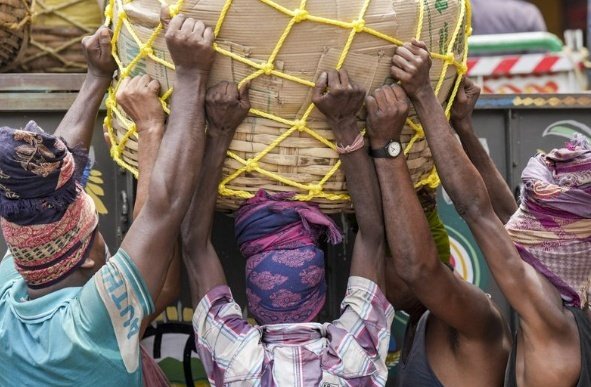
The informal sector, also known as “unorganised” or “unincorporated,” still accounts for 80% of the economy. It officially employed 128 million workers in 2025 (up 6% from 2023–24) in entities averaging just 1.7 workers. As many as 85% of these workers are “self-employed”. The remaining 15%, or 31 million workers, are employed by an employer in entities averaging 18 people. While the economic activities in this sector span all three sectors – primary, secondary, and tertiary – this diversity should not obscure their essential commonality: precariousness. No one here enjoys any guarantee of employment or social protection, let alone a retirement pension.
While precarious workers are primarily manual laborers, they are also found among white-collar workers, especially in the private sector where certain “regular workers,” even when they are salaried, receive no social protection and are therefore considered to be part of informal employment (hence the fact that while the informal sector accounts for 80% of the economy, informal workers themselves represent 90% of the labor force). We must go even further in differentiating employment statuses, as among other informal workers, we distinguish between those who are “self-employed” and those who are “casual workers,” often hired on a daily or piecework basis. The share of “regular” workers rose from 17.9% in 2012 to 21.5% in 2022, that of “self-employed” workers from 52.2% to 55.8%, and that of “casual” workers from 33.3% to 22.7%.
In addition to the poor quality of employment status, income is also a factor. According to a detailed study of Indian taxpayers, those with annual incomes between Rs 500,000 and Rs 1 crore saw their real incomes (adjusted for inflation) stagnate between 2013-14 and 2023-24: their average income fell from Rs 1,230,000 per year to Rs 169,000 rupees per year, while the average inflation rate over the same period was 5.26%. This far-reaching conclusion is supported by the trend in real wages for employees in the main sectors of the economy: in the manufacturing industry, the real daily wage for employees fell from Rs 302 to Rs 292; in non-manufacturing industrial enterprises (mining, energy, etc.), from Rs 469 to 427; and in services, from Rs 406 to Rs 403, even though real wages in these sectors had already stagnated from 2013 to 2017 . Another report, by Blume, shows that wage growth between 2019 and 2023 lagged behind inflation in the IT sector (4% versus 5.7%), the BFSI (Banking, Financial Services, and Insurance) sector, retail, logistics, and FMCG (fast-moving consumer goods).This phenomenon can be explained by persistent inflation through the mid-2020s, driven in particular by food prices, and stagnant incomes. As a result: between 2017–18 and 2022–23, the real income of urban residents grew by only 0.1% according to official figures from the Periodic Labor Force Surveys.
It is easier to understand the frustrations of India’s youth, who either cannot find jobs commensurate with their degrees or see their purchasing power stagnate. But what also explains their anger is the widening of inequality, which particularly penalizes the middle class.
This phenomenon is not new – it dates back to the first wave of deregulation in the 1980s – but the post-COVID “K-shaped” recovery has further exacerbated it. The World Inequality Lab, in a 2024 report shows that the share of national income held by the top 10% – after falling from 37% of the total in 1947 to 30% in 1982 (its lowest point) – then rose to 33.5% in 1990 and, after skyrocketing, 57.7% in 2022–23. Within this top 10%, India’s “one percent” has experienced the most rapid accumulation of wealth: while this sharpest tip of Indian society held only 6.1% of annual national income in 1982, that share rose to 22.6% in 2022–23. As for the top 0.1%, they held 10% of that income at the time. Conversely, the 40% below the top 10% saw their share of national income drop from 44.1% in 1990 to 27.3% in 2022–23. As for the “rest” – the poorest 50% – their share fell from 22.4% in 1990 to 15% in 2022-23. This trend makes India the most unequal country in the world, behind South Africa and ahead of Brazil, according to the World Inequality Lab.
If we shift our focus from flows (income) to stocks (wealth), the conclusion remains the same: the share of national wealth held by “the Indian 1%” rose from 13% of the total in 1961 to 39.5% in 2023 (within this group, “the 0.1%” held 29% of the total, “the 0.01%,” 22%, and “the 0.001%,” 16%.
The wealthiest 10%, meanwhile, saw their share of the total rise from 45% in 1961 to 63% in 2012, before falling to 61% in 2018, rising again to 63% in 2023, then drop to 62% in 2020 before rising to 65% in 2023.
Finally, the poorest 50% saw their share drop from 8.8% in 1991 to 6.9% in 2002, a level at which it has remained ever since. While this bottom 50% and “the Indian 1%” held an equal share of the national wealth in 1961, the latter now holds a share five times larger than the former.
One might argue that basing analysis on income data can be misleading given the uneven quality of the data available on this front – especially since access to data and its reliability have become problematic under the Modi government. But other indicators reach the same conclusions. This is the case with measures of consumption, which reveal inequalities that are necessarily smaller but still very large (See the Household Consumption Expenditure Survey: 2022-23, Government of India, Ministry of Statistics and Programme Implementation, National Sample Survey Office). Indeed, the poorest 50% of urban residents spend an average of less than Rs 5,000 per month, the richest 5% spend Rs 20,824 – four times as much – the next 5% spend Rs 12,399, the next 10% spend Rs 9,582and the rest – between the poorest 50% and the richest 20% – spend between Rs 5,662 and Rs 7,673 per month.
Some economists argue that India appears less unequal if the extreme deciles – the first and the last – are excluded from the analysis. Indian society then appears more homogeneous. But this uniformity reflects the pervasiveness of poverty, a fact further confirmed by the fact that since the COVID crisis, 800 million Indians have been eligible for food aid. If we remove the richest 10% from the statistics, the per capita income of the remaining 90% drops to $1,631, which is less than in most sub-Saharan African countries. These data align with World Bank figures, which show that in 2021, per capita income was $1,907 in India, compared to $3,189 in Indonesia, $2,981 in Iran, $3,732 in Iraq, $1,790 in Kenya, and $1,772 in Mauritania, to name just a few examples.
Regardless of the method used, the analysis calls into question the idea that there is a “large middle class” in India, to borrow the terms of Pawan Verma’s The Great Indian Middle: while the wealthiest 10% readily present themselves as part of the “middle class,” they in fact constitute the nation’s financial elite. Chancel and Piketty even go so far as to speak of “the absence of a middle class” in India. The follow-up question raised by these figures is simple: it is the one posed by the title.
[Christophe Jaffrelot is Senior Research Fellow at CERI-Sciences Po/CNRS, Paris, Professor of Indian Politics and Sociology at King’s College London, Non resident Scholar at the Carnegie Endowment for International Peace and Chair of the British Association for South Asian Studies. Courtesy: The Wire, an Indian nonprofit news and opinion website. It was founded in 2015 by Siddharth Varadarajan, Sidharth Bhatia and M. K. Venu.]
❈ ❈ ❈
In another article also published on The Wire, We Are Cockroaches, We Outlived Dinosaurs, Jawhar Sircar writes (extract):
We were all shocked and deeply saddened when on May 15, the honourable Chief Justice of India, Justice Surya Kant, remarked during a court hearing: “There are already some parasites who attack the system and you also want to join them. There are some youngsters who are like cockroaches, who are unemployed… some go to the media, some to social media, some become right to information (RTI) activists and then they start attacking everyone.”
Words that shocked a nation
The comment immediately triggered outrage across the country, with people calling out the harsh language that no chief justice has used in open court before. Justice Surya Kant has previously made multiple remarks perceived as unfairly supportive to the government, however, to portray dissent as a grave sin and to describe unemployed youth in derogatory terms was truly objectionable. Although many were already familiar with his impulsive observations in cases concerning the Special Intensive Revision (SIR) of electoral rolls, few could have imagined the country’s highest judicial authority making such an inappropriate statement.
A generation ignored
A look at statistics makes it clear why describing unemployed youth as “cockroaches” and “parasites” is wholly unacceptable. According to the Centre for Monitoring Indian Economy (CMIE), employment in India is stagnating, with a steadily rising unemployment rate in urban areas, as of June 2, 2026. The think tank puts the unemployment rate at 6.85%, emphasising a concerning decline in labour force participation. This is not an aberration, rather a continuing trend. A year back, in June 2025, the government’s monthly Periodic Labour Force Survey (PLFS) had put India’s unemployment rate at 5.6%, an increase from the previous month’s 5.1%.
The recently published State of Working India 2026 report by Azim Premji University states that 67% of unemployed youth today are graduates, compared to just 32% in 2004. The report paints a troubling picture of the widening gap between educational attainment and job creation. India has 367 million young people between the ages 15 and 29, nearly one-third of its working-age population. The report shows that roughly 263 million are currently outside the education system due to financial constraints and require employment opportunities immediately.
The Azim Premji University report notes that unemployment among those aged between 15 and 25 is nearly 40%, while among those aged 25-29 it is nearly 20%. More alarming is the rate of unemployment among graduates. Since 1983, this figure has broadly remained between 35-40%. However, while educational participation has increased significantly over the past four decades, reaching 73%, employment prospects for educated youth have become increasingly dire.
If we look at one band below this frustrated unemployed youth population, we encounter an even more disturbing reality that points to a major impending crisis. The recently released Sixth National Family Health Survey (NFHS-6) shows that child malnutrition in India stood at a significant 32% in 2023-24, virtually unchanged from NFHS-5 (2019-21). More concerning still, it is substantially worse than the 20-22% figure recorded in some of the poorest sub-Saharan African countries. In a country where one in every three children suffers from malnutrition, how will children, when they grow into physically weaker young adults, compete in an increasingly demanding and competitive world?
The economic disparity
On the other hand, enormous wealth continues to accumulate and circulate within a limited elite class. According to a report by the Hindustan Times Mukesh Ambani’s wealth quadrupled between 2014 and 2026, rising from Rs 1.65 lakh crore to Rs 8.10 lakh crore. Additionally, Gautam Adani’s market value increased exponentially during this period, making him one of the fastest-growing billionaires globally. His net worth rose from Rs 67,000 crore in 2014, when he flew the then prime minister designate Narendra Modi in his private jet to Delhi, to Rs 8.5 lakh crore in 2026.
India’s current model of jobless economic growth undoubtedly increases capital accumulation, yet neither the government nor the wealthy appear to bear responsibility for ensuring ordinary people’s livelihoods. Despite understanding the situation, policymakers do little to compel the creation of jobs. Instead, they seem content merely distributing free rice and wheat.
Employment generation has slowed so dramatically that the long-standing migration of workers from villages to cities has begun to reverse. Various reports suggest that millions of unskilled and semi-skilled workers have left cities and returned to villages, surviving through agriculture and casual work. Such a reversal represents a profound setback for any nation.
Regardless, there is remarkably little public discussion on this crisis. Political attention is increasingly devoted to fuelling religious divides, putting particular communities “in their place”. Courts seldom appear to take suo motu cognisance of these hardships and neither are there many examples of officials being directed to take positive corrective action. One might have hoped, when governments failed in securing the national interests, that courts would intervene and ensure the benefits of India’s economic growth are not confined to a small privileged class. Yet, over the past decade, we have seen no landmark judgments concerning the right to employment, persisting injustice towards the youth or workers’ rights. This is genuinely disappointing.
Rather, we hear hurtful and disparaging remarks from the occupant of the country’s highest judicial office, remarks that inevitably set an example for the entire judiciary. There was not one word of empathy, but an undisguised annoyance and a painful indifference towards unemployment itself, as though people were somehow responsible for their plight instead of unfortunate victims of a flawed system.
One expected courts to remind the central government of the education system’s continual failure impacting vast numbers of young people. However, those who raise concerns on behalf of the youth were subjected to ridicule by the CJI – comments arguably beyond the scope of judicial propriety. Hopefully, in the future, the CJI will recuse himself from hearing matters involving this constituency. Large sections of the Indian media expressed outrage over the insulting comments and few were satisfied by the explanation offered the next day regarding his usage of the word “cockroaches,” or what he intended to refer as “agitators.”
Cockroaches fight back
As public anger spread, political communications strategist Abhijit Dipke launched the viral satirical Cockroach Janata Party (CJP) on May 16. A postgraduate in public relations from Boston University, Dipke has previously worked on digital campaigns for the Aam Aadmi Party (AAP). He sought to encourage unemployed, frustrated and angry Indian youth to embrace the insult, transforming the term “cockroach” into a symbol of resistance against structural problems like unemployment and paper leaks.
The movement quickly attracted millions of followers and generated enormous attention on social media, while also provoking controversy. Its growth was astonishingly rapid: within four days, it reportedly grew from zero to over ten million followers. By May 23, the CJP’s Instagram following had reached nearly 23 million, while its presence on X exceeded 200,000 followers. At one point, these numbers reportedly surpassed the social media followings of established political parties such as Bharatiya Janata Party (BJP) and Indian National Congress.
[Jawhar Sircar is a former Rajya Sabha MP of the Trinamool Congress. He was earlier secretary, Government of India, and CEO of Prasar Bharati. Courtesy: The Wire, an Indian nonprofit news and opinion website. It was founded in 2015 by Siddharth Varadarajan, Sidharth Bhatia and M. K. Venu. For the full article, please see The Wire website.]