
❈ ❈ ❈
BJP’s West Bengal Sweep Was Broad, But the Numbers Reveal a More Complicated Story
Aparna Bhattacharya
The West Bengal result numbers point to a decisive Bharatiya Janata Party (BJP) victory, with the party winning 206 seats and establishing a lead across multiple social and geographic categories. But beneath the scale of the win lies a more complex story. The BJP’s dominance was structurally broad, yet not uniform.
A constituency-wise reading of the result data points to a BJP victory built on Scheduled Caste-Scheduled Tribe (SC-ST) consolidation, urban gains, district-level sweeps, and a strong performance across migration zones. However, the figures also show that voter-roll deletions may have mattered in a set of close, demographically sensitive seats.
Two terms are central to the analysis. ASDD deletion refers to the removal of names marked as Absentee, Shifted, Dead or Duplicate from the Special Intensive Revision (SIR) draft voter list. Under Adjudication Deleted (UA Deleted), or “Under Adjudication – Not Eligible,” refers to over 27 lakh voters whose citizenship or residency status was flagged during the West Bengal SIR 2026 voter-roll verification process and who were temporarily excluded from voting until their documents were cleared by the judicial tribunal.
Here are ten key takeaways from the initial numbers.
1. BJP’s 206-seat victory was decisive, but SIR may have mattered in close seats
The BJP’s tally of 206 seats reflects a commanding performance. Its average winning margin stood at around 27,939 votes, while the average margin after accounting for UA deletions was around 20,931 votes.
The most politically sensitive metric, however, is the comparison between winning margins and the number of voters deleted by placing their names in the ‘UA’ list.
In 25 constituencies in which the BJP managed to win, the number of voters found “not eligible UA” was greater than the BJP candidate’s winning margin.
While this does not establish that all such voters would have voted against the BJP, it does show that the scale of voter-roll deletion was larger than the victory margin in these areas, making the outcome highly sensitive to the SIR process. It is well established that the sharpest political concern around UA deletions is their concentration in Muslim-heavy constituencies.
Notably, several constituencies in which the BJP emerged victorious and the number of UA deletions exceeded the winning margin happened to be seats with large Muslim populations, particularly in Murshidabad, Uttar Dinajpur, Malda, Nadia, Purba Bardhaman and South 24 Parganas. In political terms, this makes the SIR process especially questionable because the most affected constituencies were often minority-heavy and closely contested.
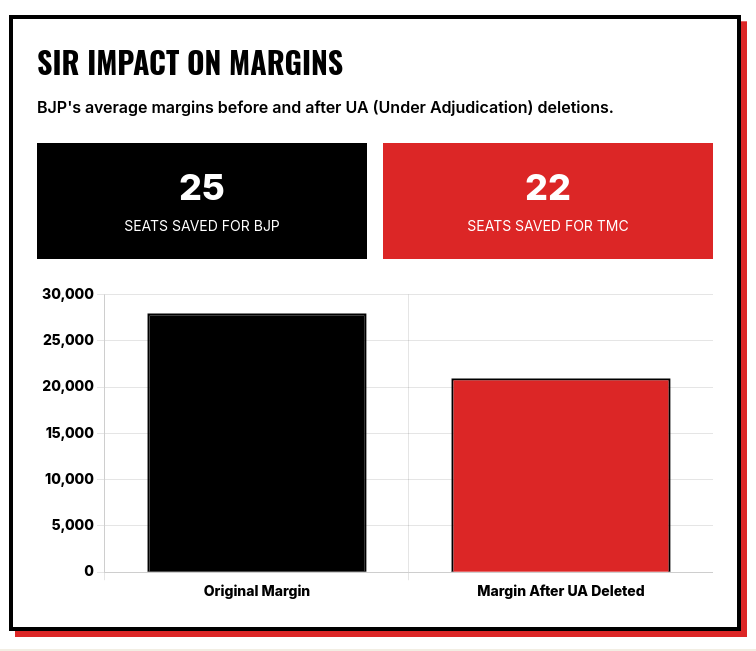
Several seats illustrate this pattern. In Jangipur, the BJP’s margin was 10,542, while 36,581 UA voters were deleted. In Karandighi, the margin was 19,869 against 31,562 UA deletions. In Bhatar, the BJP won by 6,528 votes, while 17,481 UA voters were deleted.
The broader conclusion is that the BJP won decisively overall, but the final scale of its victory may have been affected by voter-roll revision in a cluster of close seats.
2. Minority-heavy seats remained more competitive, even as BJP broke through in 18 of them
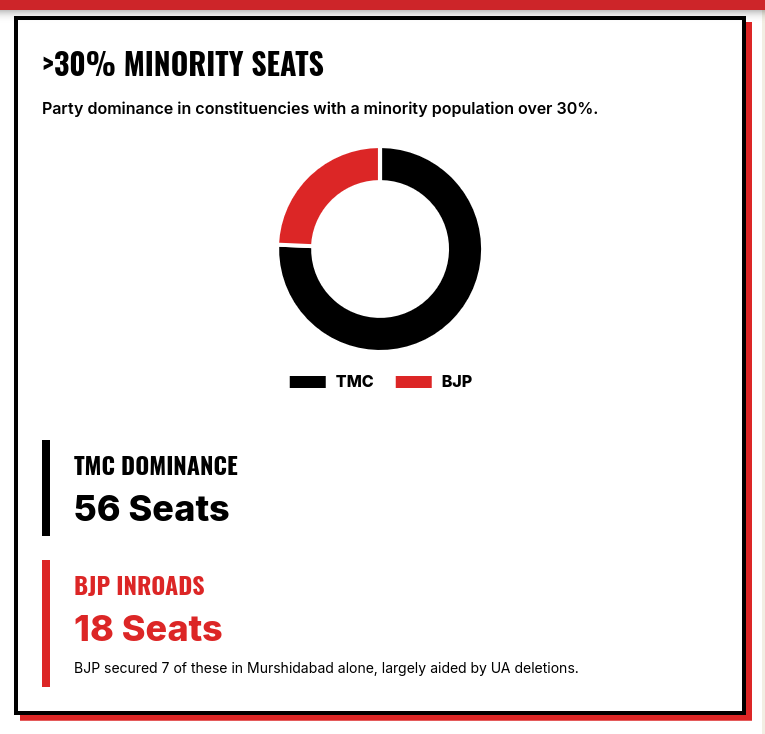
In constituencies where the minority population exceeded 30%, Trinamool Congress (TMC) remained comparatively stronger than in much of the rest of the state, winning 56 seats. The BJP, however, still managed to win 18 such constituencies, a politically significant breakthrough in seats where minority voters form a major part of the electorate.
The BJP’s wins in these constituencies were concentrated in districts such as Murshidabad, Nadia, Purba Bardhaman, Uttar Dinajpur, Malda and South 24 Parganas. In Murshidabad, the BJP won seats including Jangipur, Murshidabad, Nabagram, Khargram, Burwan, Kandi and Beldanga. In Nadia, it won Karimpur, Tehatta and Nakashipara. In Purba Bardhaman, it won Monteswar, Ketugram and Mangalkot. It also won Karandighi and Hemtabad in Uttar Dinajpur, Manikchak and Baisnabnagar in Malda, and Satgachhia in South 24 Parganas.
Several of these BJP victory margins are less than the number of voters deleted as a result of their UA status, including Jangipur, Nabagram, Nakashipara, Monteswar, Mangalkot, Karandighi, Hemtabad, Manikchak and Satgachhia. This indicates that in a number of minority-heavy seats, the number of UA voters deleted was larger than the BJP’s winning margin. It is now well established that the Muslim-concentrated seats were among the most affected by UA deletion.
But SIR alone cannot explain the shift in minority-heavy constituencies. There are at least 32 seats where Muslims make up more than 50% of the electorate. In these 32 seats, the total votes cast reportedly increased by 7.6% in 2026 compared to 2021. Yet TMC’s vote share fell by more than 16 percentage points. TMC had won all 32 seats in 2021. This time, it won 23.
That indicates a real political swing, not merely a turnout suppression story. The biggest chunk of the lost TMC vote appears to have moved toward the Left/Indian Secular Front (Left/ISF) and Congress, which together won three seats in this belt. In fact, the old Left-ISF-Congress alliance could have theoretically won five seats, reducing TMC’s tally in these Muslim-majority constituencies to 21.
The pattern becomes sharper in the top ten Muslim-majority seats, where the anti-TMC swing appears even larger. If that trend broadly reflects Muslim voting behaviour, then TMC’s vote-share decline may have been split roughly between Hindu and Muslim voters rather than being driven by one community alone.
This has two important implications. First, BJP appears to have gained more Hindu votes from Congress and Left than directly from TMC. Second, Congress and Left seem to have recovered a significant chunk of Muslim votes from TMC. In other words, minority-heavy seats did not simply move toward BJP; many saw a fragmentation of the anti-BJP vote, with Left, ISF and Congress cutting into TMC’s earlier dominance.
The concern for TMC is therefore not only that BJP broke through in some minority-heavy seats. It is that the Muslim vote, one of TMC’s strongest and most dependable vote banks, appears to have fractured. Nawsad Siddiqui’s ISF and Humayun Kabir’s Aam Janata Unnayan Party (AJUP) each won two seats, while parties beyond the four main formations together claimed 4.6% of the vote, or around 2.19 million ballots. Under a different distribution, those votes could have protected TMC in several marginal constituencies.
Contrary to the expectation of many political observers, the SIR process, which saw deletions of approximately 91 lakh voters, did not consolidate Muslim voters behind TMC. Instead, the Muslim vote appears to have split mainly between Congress and Communist Party of India (Marxist) [CPI(M)] in several constituencies, while AJUP damaged TMC’s Muslim support in parts of Murshidabad. At the same time, in Hindu-dominated seats in these districts, Hindu votes appear to have consolidated behind the BJP.
Murshidabad offers the clearest example of this double movement. In Raninagar, the Congress won with 79,423 votes, while TMC finished close behind with 76,722 and CPI(M) came third with 48,587. TMC had won the seat in 2021 with over 60% vote with a margin of 79,702 – higher that what it polled in 2026. The result points to a clear split in the anti-BJP and Muslim vote.
The same trend appeared in Khargram, where BJP’s Mitali Mal won with 77,748 votes, followed by TMC with 68,415 and CPI(M) with 41,944. In Kandi, where around 76% of the population is Hindu, BJP won with 73,355 votes, TMC received 63,020, Congress got 31,160, and All India Majlis-e-Ittehadul Muslimeen (AIMIM) polled 22,976.
The district-level shift was dramatic. The BJP won nine of Murshidabad’s 22 seats, up from two in 2021. TMC, which had won 20 seats in the district in 2021, was reduced to nine.
A similar, though less severe, shift appeared in Malda, where Muslims account for around 51.3% of the district’s population. The BJP won six of the district’s 12 seats, while TMC won six. In 2021, TMC had won eight seats and the BJP four.
The broader conclusion is therefore more nuanced. SIR and UA deletions may have been electorally consequential in several close minority-heavy seats, but the larger anti-TMC swing in Muslim-majority constituencies points to political erosion within TMC’s own minority base as well.
3. SC-concentrated constituencies became a major pillar of BJP’s victory
The SC data shows a clear pattern. In constituencies with more than 30% SC population, BJP won around 82.7% of seats, 72 constituencies, while TMC won around 17.2%, or 15 seats.
The pattern continued in seats with 20-30% SC population, where BJP won around 69% of constituencies.
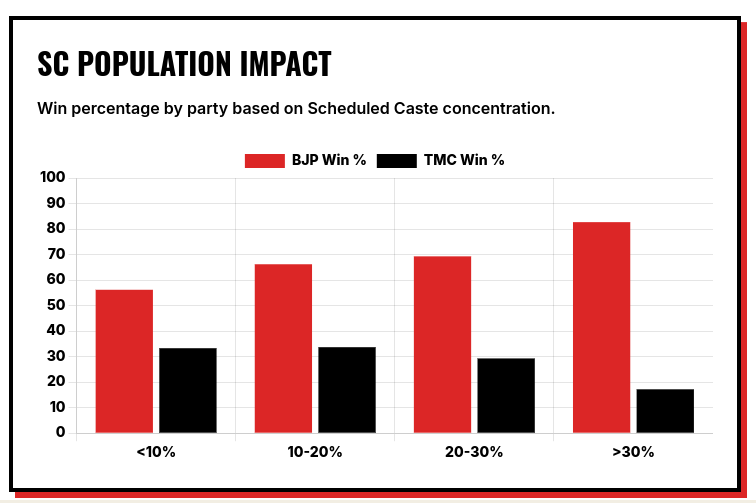
By contrast, in seats where the SC population was below 10%, BJP’s win rate fell to around 56%, while TMC’s share rose to 33%.
This suggests that higher the SC population share in a constituency, the stronger the BJP’s performance tended to be.
For Bengal politics, this is a major structural shift. It indicates that BJP’s victory was not merely a product of anti-incumbency or urban discontent. It was also built on strong performance in caste-heavy rural and semi-rural seats, especially among SC-concentrated constituencies.
For TMC, this is one of the sharpest warnings in the data. If SC-heavy constituencies move decisively away from the party, its rural electoral base becomes much more vulnerable.
4. Tribal-dominated areas produced an even stronger BJP sweep
BJP’s performance was even more pronounced in constituencies with high ST populations.
In seats with more than 20% ST population, BJP won around 96% of constituencies, 25 seats, while TMC won only one.
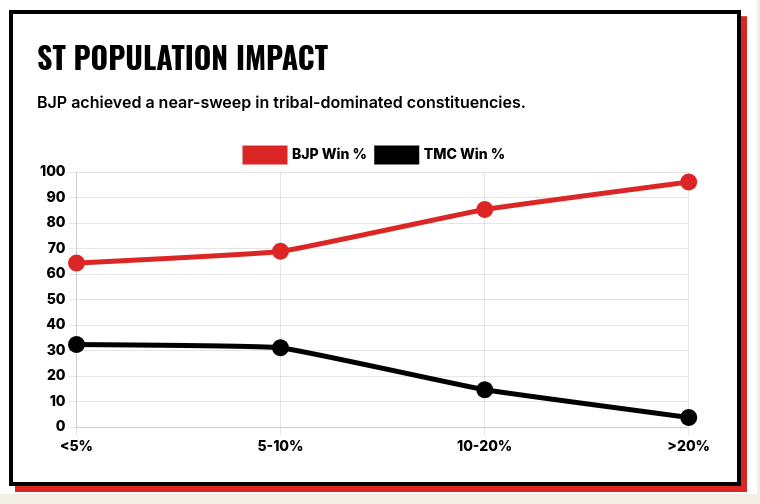
In constituencies where the ST population was between 10% and 20%, BJP won around 85% of seats. Even in seats with less than 5% ST population, the saffron party remained ahead, though the contest was closer.
The figures point to overwhelming BJP dominance in tribal belts. This likely reflects the party’s strength in regions such as Jangalmahal, parts of North Bengal and other Adivasi-concentrated pockets.
The political meaning is significant. TMC’s welfare-driven appeal appears not to have been enough to contain BJP expansion in tribal constituencies. The result in these areas looks less like a marginal swing and more like deep social consolidation.
5. BJP performed strongly across urban, rural and mixed constituencies
The BJP’s victory was not confined to one type of constituency. The party performed strongly across urban, rural and mixed geographies.
In wholly urban constituencies, BJP won 76.5% of seats, while TMC won 23.5%.
In mostly rural constituencies, BJP won 67%, compared to TMC’s 30.4%.
In mixed constituencies, BJP won 72.6%, while TMC won 25%.
This is important because Bengal’s political geography is often read through rural discontent, caste consolidation or regional anti-incumbency. But the numbers suggest that BJP also made major advances in urban and semi-urban spaces.
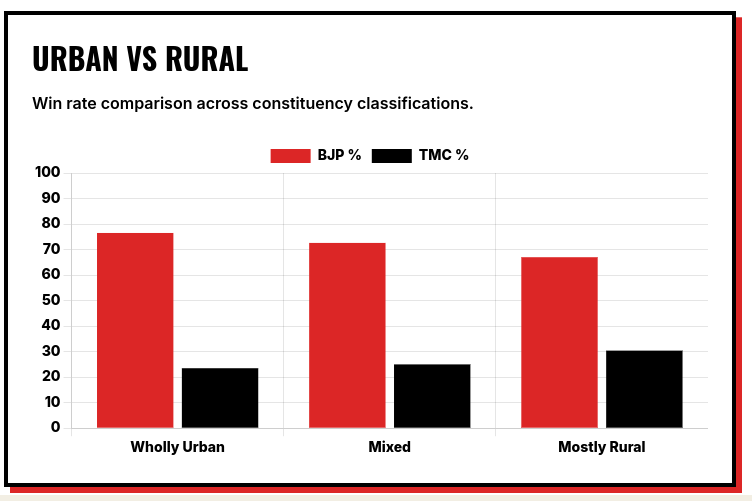
Its strongest proportional dominance, in fact, came in wholly urban and mixed constituencies. This indicates that the party’s appeal extended beyond rural protest votes and reached middle-class, aspirational and civic-issue-driven voters as well.
For TMC, the urban numbers are particularly concerning. Urban Bengal has historically included pockets of anti-BJP sentiment, minority concentration, Left influence and middle-class scepticism toward Hindutva politics. BJP’s performance suggests that those barriers weakened significantly.
9. ASDD deletions were widespread, but they do not appear to have hurt TMC disproportionately
The ASDD deletion data complicates any simple political reading of voter-roll revision.
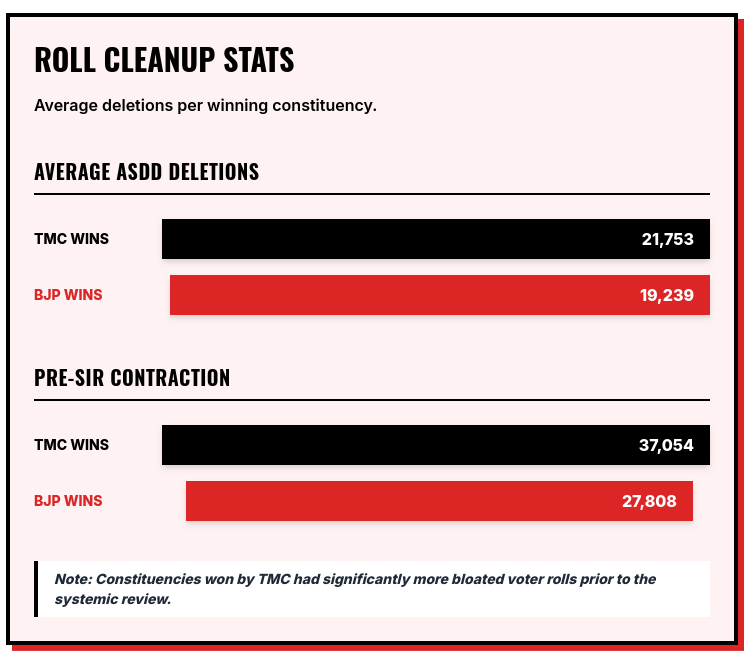
In absolute terms, ASDD deletions were higher in BJP-won seats. 3,963,271 deletions across constituencies won by the BJP, compared to 1,762,022 in TMC-won seats. But this is largely because the BJP won far more seats overall.
On a per-seat basis, the picture is different. TMC-won constituencies had an average of around 21,753 ASDD deletions per seat, compared to around 19,239 per BJP-won seat. In other words, TMC-won seats actually saw a slightly higher average level of ASDD deletion than BJP-won seats.
This suggests that ASDD deletions, by themselves, did not disproportionately damage TMC’s electoral performance. If ASDD deletion had been the main factor weakening TMC, one would expect TMC-won seats to show much lower deletion levels, or for higher-deletion constituencies to consistently move toward the BJP. The data does not show that straightforward pattern.
Instead, ASDD deletions appear to have been a statewide administrative phenomenon. TMC was able to retain many constituencies despite relatively high average ASDD deletions. This means the political impact of voter-roll cleanup cannot be assessed simply by looking at the total or average number of ASDD deletions.
The more decisive question is whether deletions exceeded victory margins in specific constituencies. That is where the Margin-UA Deleted metric becomes more politically significant than the broader ASDD total.
The numbers therefore suggest a distinction. ASDD deletion did not appear to hurt TMC much in aggregate, but UA deletions may still have mattered in selected close contests, especially where the number of deleted voters exceeded the winning margin.
10. Voter-roll contraction was higher on average in TMC-won seats
The contraction from the pre-SIR voter roll adds another important qualification.
In total, voter-roll contraction was higher in BJP-won seats because the BJP won many more constituencies. The total contraction in BJP-won seats was 5,728,437, while the total contraction in TMC-won seats was 3,001,399.
But the average contraction per seat was significantly higher in TMC-won constituencies – around 37,054, compared to around 27,807 in BJP-won seats.
This complicates the argument that voter-roll contraction mechanically benefited only BJP. On average, TMC-won seats saw greater roll contraction.
However, this does not erase the significance of the close-seat pattern. BJP’s advantage may not have come from overall contraction alone, but from the fact that in certain constituencies, particularly close and demographically sensitive ones where the number of UA deletions exceeded the victory margin.
The impact of voter-roll revision, therefore, appears to have been uneven – broad as an administrative process, but potentially decisive only in selected seats.
Final reading
The result numbers point to a BJP victory built on four major pillars: SC consolidation, ST dominance, urban and mixed-seat expansion, and district-level sweeps in key regions.
The BJP did not win through a single social bloc or one regional wave. Its performance cuts across rural, urban, caste-heavy, tribal, migration-influenced and industrial constituencies. That breadth explains the scale of the 206-seat victory.
But the data also shows the limits of the sweep. Minority-heavy constituencies, border seats, South 24 Parganas, Murshidabad and Howrah remained more competitive. These areas may form the core of TMC’s future resistance.
The most sensitive question remains the role of SIR, UA deletions, ASDD deletions and voter-roll contraction. The numbers do not support a blanket conclusion that voter deletion alone produced the BJP victory. The BJP’s social and geographic spread was too wide for that.
Yet the Muslim-majority seat data also points to a broader political shift beyond SIR. In the 32 seats where Muslims make up more than 50% of the electorate, turnout increased, TMC’s vote share fell sharply, and the Left/ISF-Congress space recovered ground. That means the anti-TMC swing in these areas was not simply the result of voter-roll deletion; it also reflected a political erosion of TMC’s minority support base.
That should be a major cause of worry for TMC. The Muslim vote, on which the party had relied on as one of its strongest electoral pillars, appears to have fractured. The split did not automatically benefit the BJP in Muslim-majority seats, but it weakened TMC’s ability to hold marginal constituencies. Congress, CPI(M), ISF and AJUP all appear to have drawn from segments of the anti-BJP and minority vote, while in Hindu-dominated seats in the same districts, Hindu consolidation behind the BJP helped the party convert fragmented contests into victories.
The final conclusion is therefore nuanced. The BJP’s victory was structurally broad, its final scale may have been amplified by UA deletions in specific close contests, but TMC’s losses in Muslim-majority constituencies also point to a genuine political swing and fragmentation of its Muslim support base. A warning sign that may matter well beyond this election.
[Extract. For full article, see The Wire website. Aparna Bhattacharya is an independent journalist whose work has appeared in The Wire. Courtesy: The Wire, an Indian nonprofit news and opinion website. It was founded in 2015 by Siddharth Varadarajan, Sidharth Bhatia and M. K. Venu.]
❈ ❈ ❈
Data Shows SIR Helped BJP Win Bengal
Aparna Bhattacharya
Electoral outcomes in fiercely contested regions are often decided by razor-thin margins, where every vote counts. In Tamil Nadu, one seat was decided by one vote this time and in Rajasthan and Madhya Pradesh, even in the parliamentary elections, MPs have been elected with the margin of just one vote. Every vote matters.
In West Bengal, the scale of the ‘special intensive revision’ or SIR was staggering. A massive 91 lakh names were struck from the voter list. This included 58 lakh routine deletions under the ASDD (absent, shifted, deleted, and displaced) categories during the draft revision, alongside another 27 lakh voters rendered ineligible following a judicial review of Under Adjudication (UA) cases. When paired with the 1.88 lakh new voter additions in the final roll published on February 28, 2026, the data points to a mathematically decisive role the revision exercise played.
This exercise becomes important as during the SIR hearings before the apex court, Supreme Court judge, Justice Joymalya Bagchi had said, “If 10% of the electorate does not vote and the winning margin is more than 10%…what will happen? Suppose margin is 2% and 15% of [the] electorate who are mapped could not vote, then maybe…we are not expressing any opinion, but we would definitely have to apply our minds.”
The constituency-level data suggests that the SIR was not just a routine roll-cleaning exercise in West Bengal. Its political significance comes from one central fact – in a large number of seats, the number of deleted voters was larger than the winning margin.
This does not prove that every such result changed because of SIR, but it shows that roll revision directly entered the zone of electoral competitiveness.
Deletions larger than winning margins in 150 seats
The strongest indicator of the SIR having been decisive in dictating the political outcome is in seats where the winning margin was lesser than the total deletions, i.e. the combined ASDD and UA removals. When I combined routine ASDD deletions and the number of UA voters, the total number of deleted voters exceeded the final victory margin in a staggering 150 constituencies. West Bengal has 294 seats in all, which puts the number of such seats over the halfway mark in the assembly.
Among these seats, the Bharatiya Janata Party can be seen to have had a clear advantage and led in 100, while the Trinamool Congress led in 48 and the Congress in two.
In 2021, TMC had won 131 of these seats, and BJP, only 19.
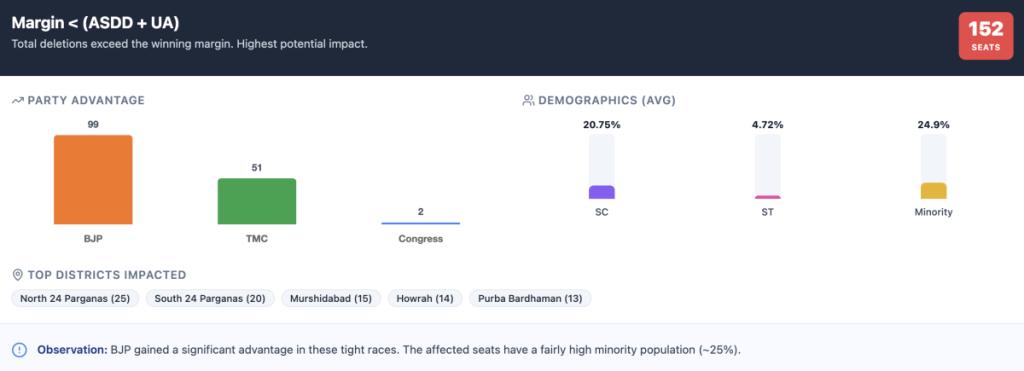
The two districts bordering Kolkata bore the absolute brunt of the roll contraction, accounting for nearly 30% of all highly affected seats. In the North 24 Parganas, the TMC dominated in 2021 by winning 23 of the 26 affected seats, but the landscape completely flipped in 2026 as BJP captured 21 of them. Similarly, in the South 24 Parganas, the TMC had previously swept all 19 of these seats, but the BJP made deep inroads post-SIR, flipping 10 of them.
Beyond these epicentres, the net roll contraction heavily impacted Muslim-rich and highly competitive districts. In Murshidabad, the TMC’s 2021 tally of 13 out of 15 affected seats fell to just 6, with the BJP picking up 7 and the Congress claiming 2. In Purba Bardhaman, the TMC lost 11 of its 13 previously held seats to the BJP. This trend continued in Howrah and Hooghly; across their 22 combined affected seats, all of which were won by the TMC in 2021, the BJP managed to capture 14 in the recent elections.
Urban centres were not immune to this sweeping pattern either.
In Paschim Bardhaman, the BJP swept all 8 highly contracted seats, 5 of which were previously held by the TMC. Even in the capital districts of Kolkata North and South, the BJP managed to wrest 6 of the 11 affected seats away from the TMC’s 2021 clean sweep including Bhabanipur, where outgoing Chief Minister Mamata Banerjee lost to Suvendu Adhikari. Ultimately, the geographical distribution clearly indicates that the roll contractions were not randomly scattered. They overwhelmingly hit the TMC’s strongest fortresses from the previous election, enabling the BJP to successfully flip 100 of these 150 highly contracted battlegrounds.
In Satgachhia, the victory margin was a mere 401 votes for the BJP candidate. However, the total deletions were massive, with 17,669 ASDD deletions and 8,785 UA voters found ineligible – totalling over 26,000 deletions. Similarly, in Rajarhat New Town, a margin of 316 votes was dwarfed by over 63,000 total deletions. In Raina, BJP led by 834 votes, while total deletions crossed 23,000.
Did the areas with the highest ASDD deletions favour BJP?
If only ASDD deletions are considered, and not UA, the impact is still enormous. In 110 constituencies, ASDD deletions alone exceeded the winning margin.
In these seats too, the BJP benefited disproportionately, winning 72 seats, exactly double the 36 seats won by the TMC. The Congress won 2 seats. The geographic concentration mirrors the overall deletions, with North 24 Parganas (19 seats) and South 24 Parganas (17 seats) topping the list.
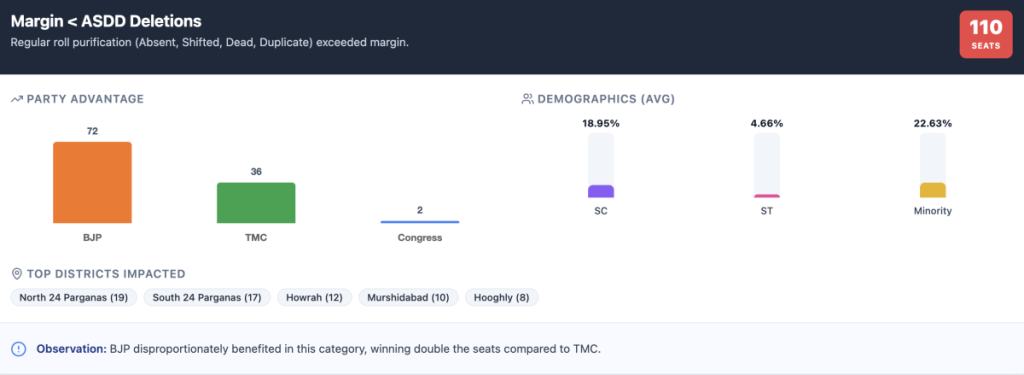
In 2021, the TMC won 102 of them compared to just 8 for the BJP. To isolate the direct change, the data shows that 66 of these 110 seats actually changed hands between the two elections. The TMC lost every single one of these 66 flipped constituencies, with the BJP capturing 64 of them and the Congress gaining the remaining two. Ultimately, the data demonstrates that routine ASDD deletions were undeniably concentrated in seats the TMC had previously won, and in areas where these roll cleanups outnumbered the winning margin, the TMC’s prior dominance was effectively shattered.
Together, the twin districts of North and South 24 Parganas accounted for nearly a third of all seats heavily impacted by ASDD deletions.
In North 24 Parganas, the TMC had nearly swept in 2021 by winning 18 out of 19 seats, but the landscape flipped drastically in 2026 as BJP captured 15 of them, reducing the TMC to just four.
Similarly, in South 24 Parganas, the TMC’s perfect 16-0 sweep from 2021 was broken when the BJP made significant inroads post-revision to capture eight of these tightly contested areas.
In Howrah and Hooghly, the TMC had won all 12 affected seats and all eight affected seats, respectively, during the previous election. By 2026, the BJP won 6 of such seats in Howrah and almost overrun Hooghly by capturing 7. In the Muslim-heavy district of Murshidabad, the TMC saw its 2021 tally of 9 out of 10 highly affected seats plummet to just 2, with the BJP capturing 6 and the Congress taking the remaining 2.
Urban clusters were also deeply impacted. In Paschim Bardhaman, the BJP swept all 6 affected seats, 5 of which were previously held by the TMC, while in Kolkata North, the BJP wrested four seats away from the TMC’s prior clean sweep.
UA deletions in Muslim-heavy seats helped BJP
The exclusion of voters marked ‘UA’ shows a more politically sensitive pattern.
In 49 constituencies, as already reported by The Wire, the number of UA deletions exceeded the winning margin. Unlike the broader ASDD category, the political impact here was much more evenly split. The BJP won 26 of these seats, while the TMC captured 21, and the Congress took 2. However, when compared to 2021 results, the impact looks severe.
These constituencies had an average Muslim population of 33.69%, much higher than in the other deletion categories. Murshidabad was the most affected district, with 8 seats where voters marked UA exceeded the winning margin. Other affected districts included North 24 Parganas, South 24 Parganas, Purba Bardhaman and Hooghly.
Historically, TMC dominated nearly 100% of these high-minority-concentration areas, having won 48 of the 49 seats in 2021, with BJP holding just one.
However, the 2026 results completely transformed this landscape.
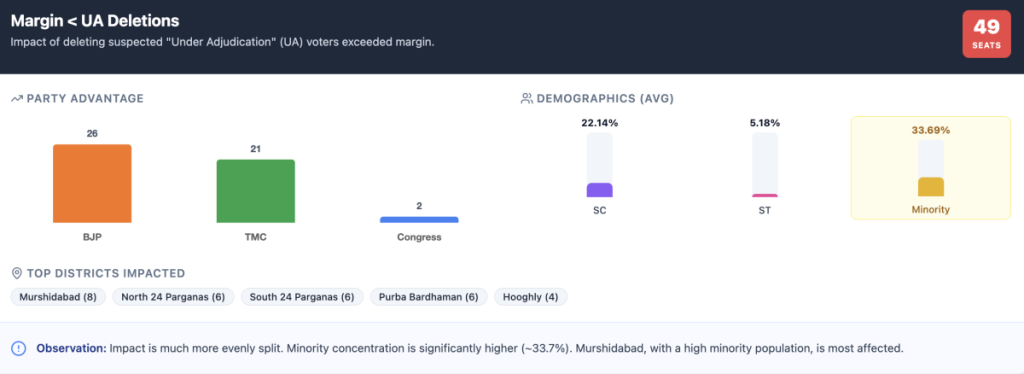
BJP emerged victorious in 26 of these seats (a net gain of 25), while TMC’s hold was reduced to just 21 seats, suffering a steep net loss of 27 seats overall. Additionally, Congress managed to pick up 2 seats. Ultimately, the data indicates that the deletion of under-adjudicated voters, intersecting with exceptionally tight winning margins, was a pivotal factor that resulted in the TMC losing more than half of these stronghold constituencies to the BJP.
The examples are striking. In Samserganj, UA deletions were 74,775, far above TMC’s margin of 7,587. In Raninagar, Congress won by 2,701 votes, while UA deletions were 17,140. In Jangipur, BJP won by 10,542, but UA deletions stood at 36,581 in a constituency with over 51% Muslim population. In Purba Bardhaman’s Raina, the BJP secured a victory margin of 834 votes, but the number of UA voters found ineligible was a whopping 11,284, showing a massive gap between the victory spread and the targeted deletions.
Had the UA deletions not taken place, five seats would have flipped – four from BJP to TMC and one, from Congress to TMC.
This is not to say that nothing has changed politically since 2021, or that all those deleted would have voted in one direction, but when there are deletions at such a large scale and winners are decided by a razor’s edge, who SIR has pushed out has to be looked at closely.
Fresh enrolments have marginally favoured BJP
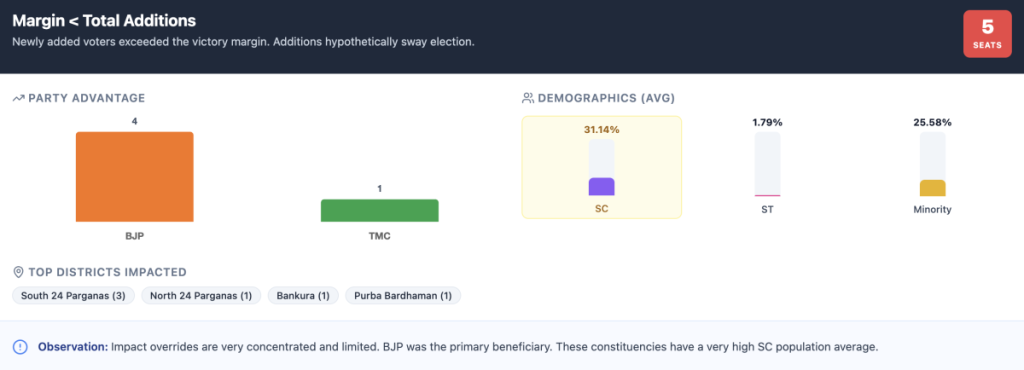
While deletions dominated the narrative of tight races, the addition of new voters also played a decisive, albeit highly concentrated, role. In just five constituencies, Satgachia, Rajarhat New Town, Indus, Raina and Mandirbazar, the number of newly added voters in the final roll exceeded the margin of victory, meaning these fresh enrolments hypothetically held the power to sway the final result. The BJP was the primary beneficiary here, winning 4 of the 5 seats, while the TMC won 1. These seats have a high average Scheduled Caste population of 31.14%, suggesting that additions mattered most in a narrow cluster of SC-heavy or semi-rural constituencies.
In South 24 Parganas’ Satgachia, the 401-vote margin was easily eclipsed by the 3,023 total additions to the electoral roll. In 2021, the TMC won the seat with a margin of 23,318 votes. Similarly, in Rajarhat New Town, the 316-vote margin was surpassed by 2,543 total additions. In 2021, the TMC’s margin in this seat was a staggering 56,432.
What if…
To understand the true weight and consequence of the SIR, we must pose a critical hypothetical question: What would the 2026 electoral landscape look like if these sweeping electoral roll revisions had never occurred? It is impossible to know exactly which candidate any specific added or deleted individual voted for.
Therefore, this simulation acts as a mathematical stress test.
It calculates the maximum net SIR impact (total additions + ASDD deletions + UA deletions) and compares it directly against the final winning margins.
First case
In the first case, the model assumes a worst-case scenario for the winning candidate, that every deleted voter would have voted for the runner-up, and every newly added voter cast their ballot for the winner.
If we isolate the 137 seats that actually changed hands between the 2021 and 2026 elections, the data reveals that 87 of those flips could hypothetically be attributed directly to the roll revisions.
If the SIR had not happened, and operating under the worst-case electoral scenario described above, these 87 seats could have theoretically remained with the party that won them five years prior.
All 87 of these highly contested, mathematically vulnerable seats were won by the TMC in 2021. But in 2026, BJP captured 84 of these vulnerable seats, while Congress captured 2.
Without the SIR, the mathematical possibility exists that the TMC could have successfully defended these 87 constituencies.
If those seats had held firm, the ultimate composition of the assembly would look drastically different, significantly shrinking the BJP’s total gains.
Simulation examples: Overwhelming SIR footprints
To grasp how deeply the roll modifications penetrated these races, we can look at specific constituencies where the TMC incumbent was unseated by the BJP. In many of these cases, the sheer volume of additions and deletions did not just edge past the victory margin, but eclipsed it by massive ratios.
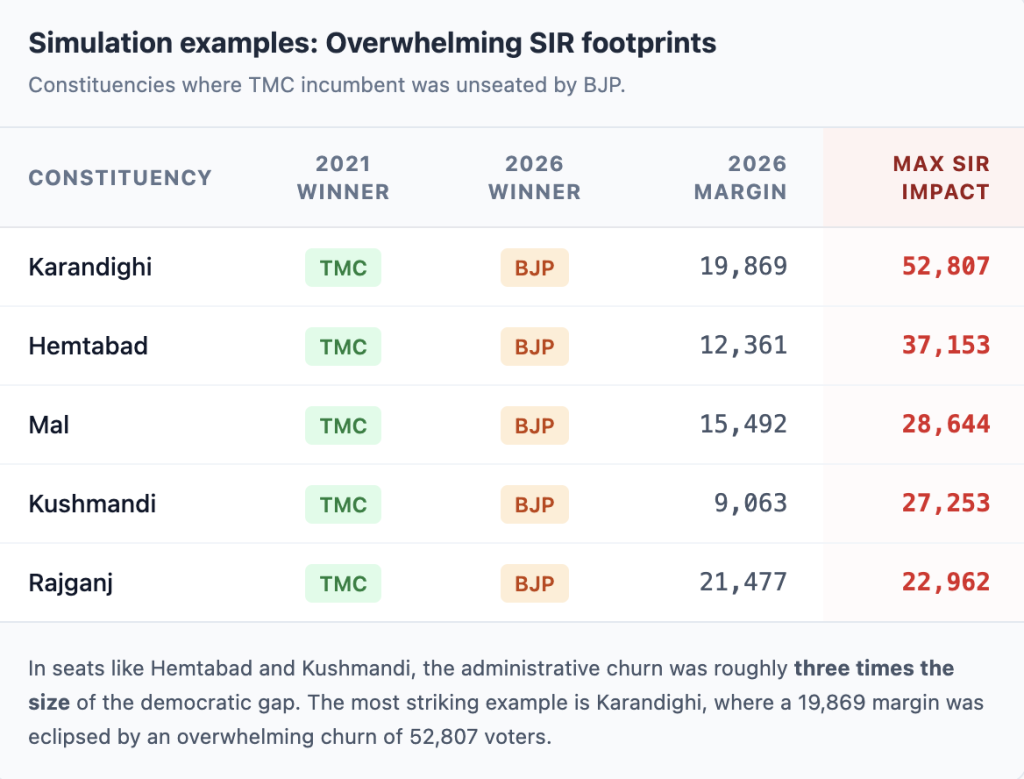
In seats like Hemtabad and Kushmandi, the deletions were roughly three times the size of the margin. The most striking example is Karandighi. While a victory margin of nearly 20,000 votes would traditionally signal a definitive mandate, the electoral roll there saw an overwhelming deletion of 52,807 voters!
While this model is an analytical tool measuring vulnerability rather than real-world voting, it points towards a reality: The electoral roll revisions were not just procedural maintenance, they were undeniably large enough to have rewritten the final outcome in the state’s tightest battlegrounds.
Second case
In the second case, a ‘no-SIR counterfactual model’ was used. The model does not assume that all deleted voters would have voted against the eventual winner. Instead, it uses each constituency’s 2021 assembly election voting pattern as the baseline.
The model follows three steps.
First, all deleted voters, UA and ASDD, are added back to the electorate.
Second, these restored voters are distributed among parties according to the constituency’s 2021 party-wise vote share, meaning, the deleted voters are assumed to follow the 2021 voting pattern.
Third, SIR-era additions are removed using the 2026 party distribution, so that the simulation isolates the effect of roll revision as far as possible.
This is not a claim of exact voter behaviour. It is a constituency-level stress test. Were the deletions large enough, and politically distributed enough, to plausibly alter outcomes?
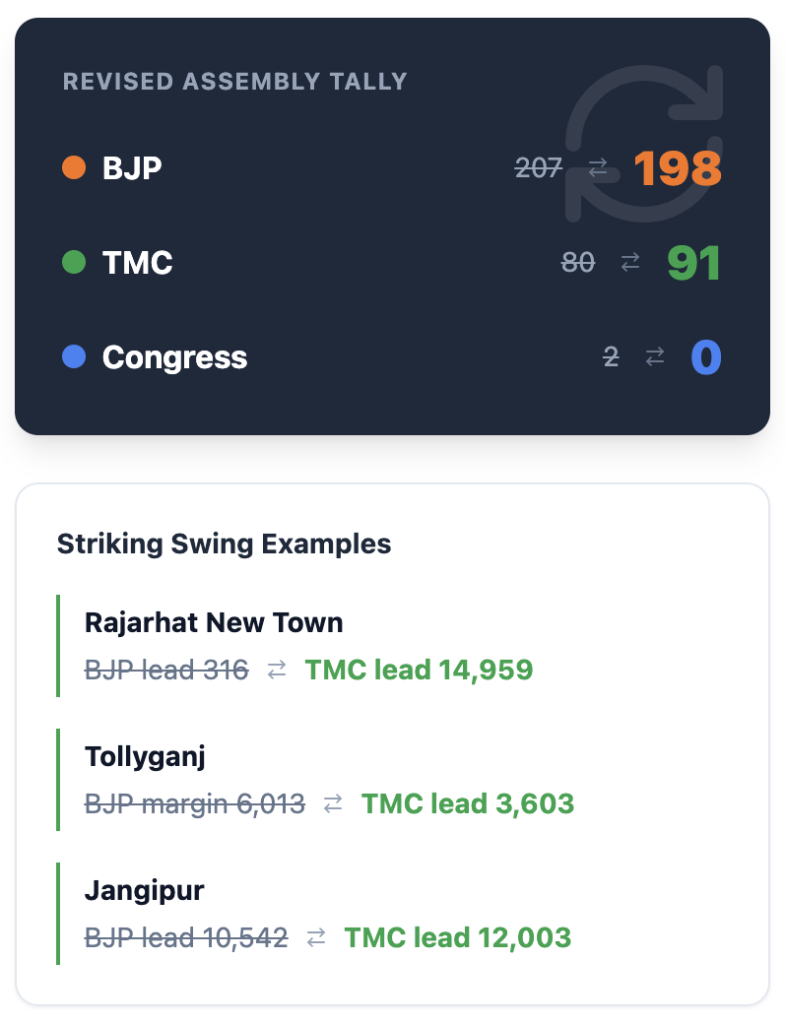
Under this hypothetical ‘no-SIR’ model, 11 seats flip, all to TMC. BJP’s tally falls from 207 to 198, TMC rises from 80 to 91, and Congress falls from 2 to 0 in the 293 valid constituencies analysed. Falta was excluded as it is yet to be counted.
Of the 11 flipped seats, 9 seats move from BJP to TMC and 2 from Congress to TMC. The flipped constituencies include Farakka, Jangipur, Raninagar, Rajarhat New Town, Satgachhia, Tollyganj, Jorasanko, Kashipur-Belgachhia, Champdani, Jangipara and Raina.
Some examples from this hypothetical exercise are striking. In Rajarhat New Town, a BJP lead of 316 becomes a TMC lead of nearly 14,959. In Tollyganj, BJP’s margin of 6,013 becomes a TMC lead of 3,603. In Jangipur, BJP’s lead of 10,542 turns into a TMC lead of 12,003.
Conclusion
The SIR did not overturn the overall result; BJP would still remain ahead in our simulation of ‘no SIR’. But it likely mattered in a decisive cluster of close contests. The data suggests that deletions, especially ASDD deletions, disproportionately helped BJP in margin-sensitive seats, while UA deletions had a sharper impact in minority-heavy constituencies.
In a state where many constituencies are decided by narrow margins, SIR, just its statistical impact, definitely became an electoral factor in itself.
[Aparna Bhattacharya is an independent journalist whose work has appeared in The Wire. Courtesy: The Wire, an Indian nonprofit news and opinion website. It was founded in 2015 by Siddharth Varadarajan, Sidharth Bhatia and M. K. Venu.]
❈ ❈ ❈
In Half the Seats BJP Won in Bengal, Total SIR Deletions Outnumber Victory Margin
Anant Gupta
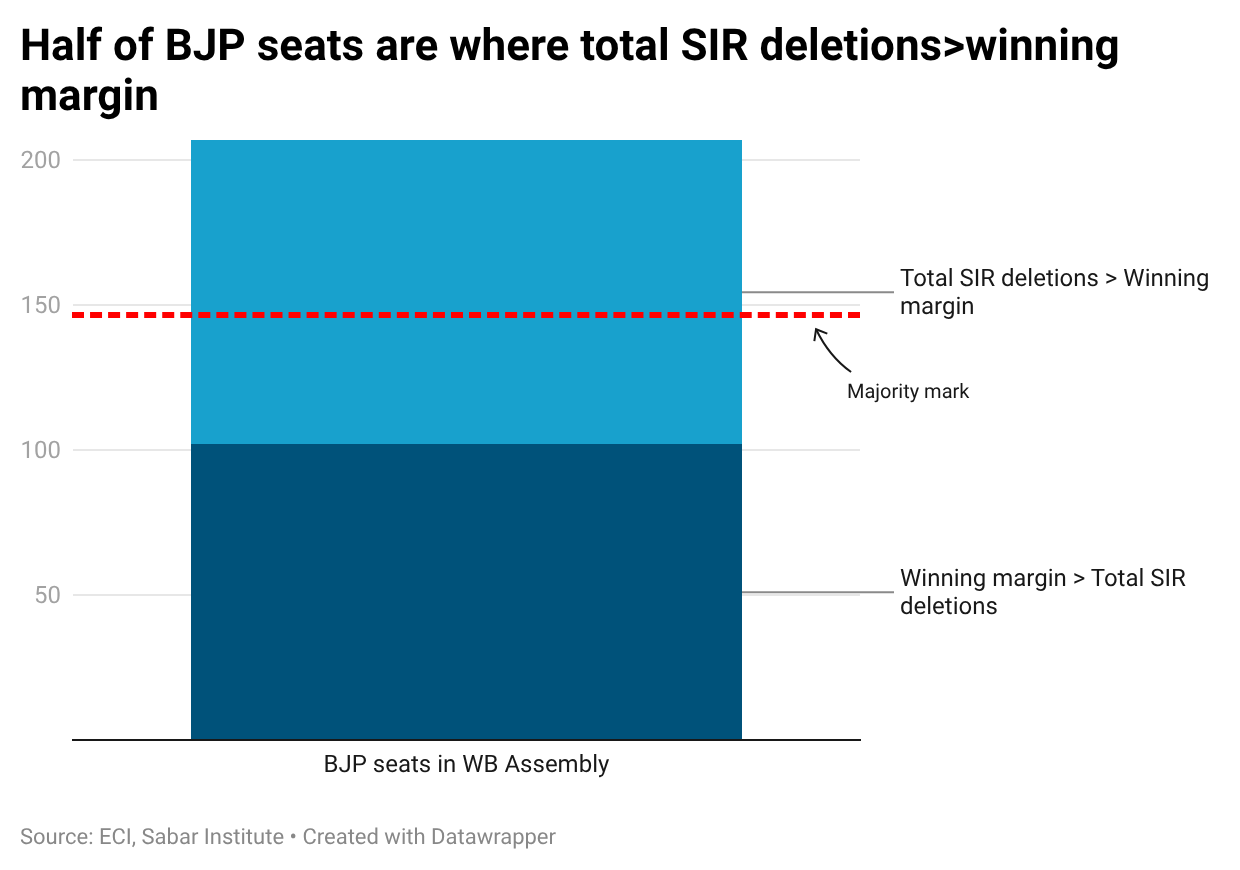
In 105 seats that the Bharatiya Janata Party won in West Bengal, the total number of voters deleted during the special intensive revision exceeds its margin of victory, according to a data analysis by Scroll.
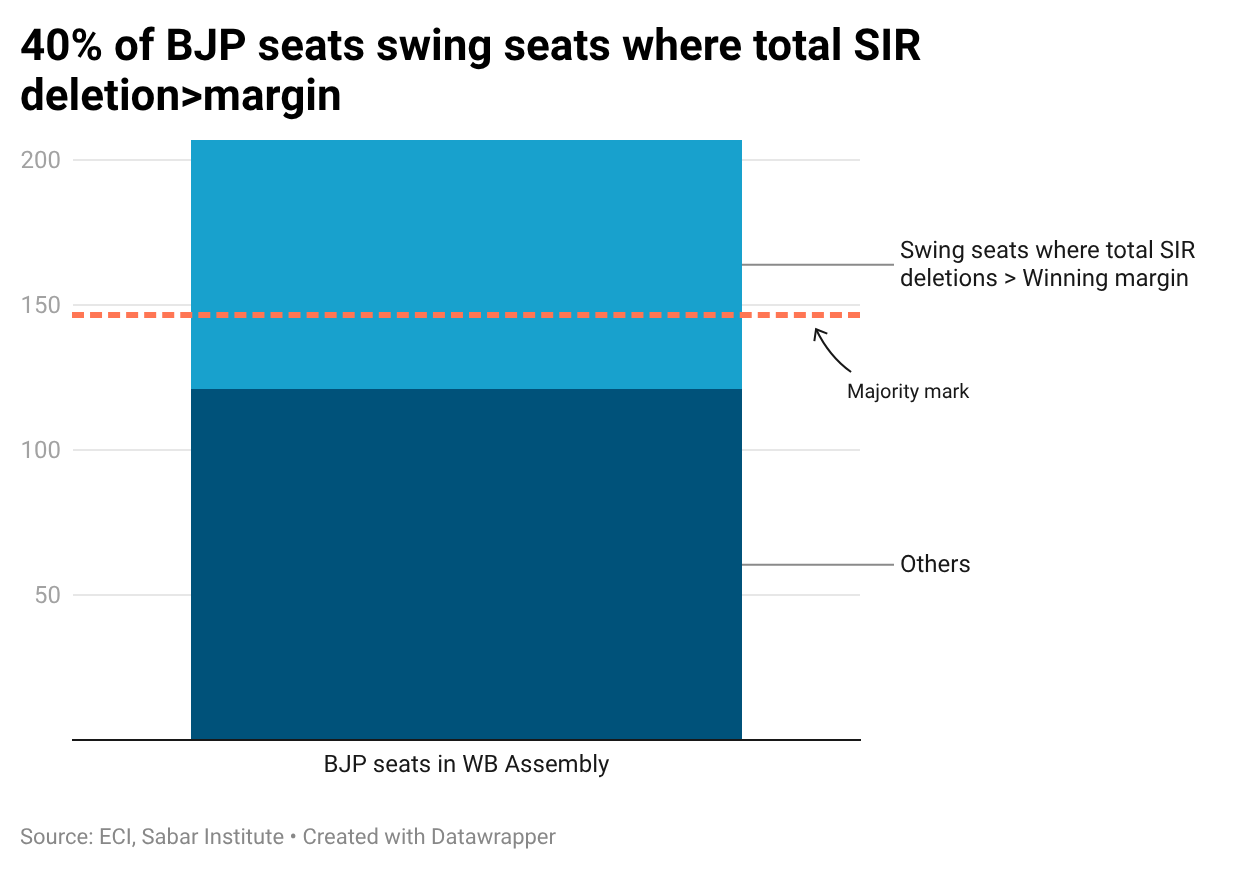
Of these, 86 are seats that the BJP has never won before.
These 105 seats made up about 50% of the BJP’s final tally of 207 on Monday. Bengal has 294 Assembly seats in all. The Hindutva party secured a historic two-thirds majority and ended Chief Minister Mamata Banerjee’s 15-year reign in the state.
In West Bengal, the SIR was a contentious process that dragged on for six months and culminated in a total of about 91 lakh names being deleted, shrinking the state’s voter rolls by 12%. Of the 91 lakh total deletions in the SIR, at least 27 lakh voters are still under adjudication, with their fate to be decided by special tribunals.
The BJP was the only major political party in Bengal that supported the exercise from start to finish.
An odd pattern
The results on Monday clearly showed that there was a significant anti-incumbency sentiment in the state against Banerjee’s government. As a result, the Trinamool Congress, which had won 215 seats last time, was reduced to just 80 in these elections. However, Scroll’s data analysis shows that the SIR might have also played a significant part in its defeat.
In as many as 105 seats, the BJP won by fewer votes than the total number of names that were purged from the electoral roll ahead of polling. This analysis is based on the results published by the Election Commission of India. The data on SIR deletions was tabulated by the Sabar Institute, a Kolkata-based public policy research organisation. It is publicly available here: https://sabar-institute.github.io/maps/overall/index.html.
One constituency where the BJP won is the Indus seat in Bankura district. The BJP had won it in 2021, too. But during the 2024 Lok Sabha elections, the Trinamool took a 9,000-vote lead over the Hindtuva party here. Then came the SIR, which removed 7,515 total voters from the rolls of this seat. On Monday, the BJP won it again by only 900 votes.
The bulk of these 105 seats have never been won before by the BJP. Banerjee’s party ended up losing 129 seats it had held to the BJP. The Hindutva party, on the other hand, won every single seat that it had won five years ago.
For the sake of this analysis, the seats that changed hands from the Trinamool to the BJP in these elections have been labelled as swing seats. Scroll found that in 86 swing seats, the BJP’s margin of victory was less than the total number of voters deleted during the SIR.
Take the Jadavpur Assembly seat located in South Kolkata, for example. The seat was, for decades, held by the communists. Buddhadeb Bhattacharjee, former chief minister of West Bengal, used to be the MLA from here between 1987 and 2011. Even after Banerjee replaced him as chief minister, this seat changed hands between her party and the Communist Party of India (Marxist).
In 2021, the Trinamool had won this seat while the CPI(M) had finished second. The BJP candidate, who received 53,139 votes, came in third. On the ground in Jadavpur last month, Scroll found that the competition seemed to be largely between the CPI(M) and the Trinamool this time too.
The SIR excluded more than 56,000 names in total from the rolls in Jadavpur. The BJP won it for the first time on Monday with a margin of less than half that number: 27,716 votes. Its vote tally in Jadavpur surged past 106,000. In contrast, the sitting MLA from the Trinamool received about 20,000 fewer votes than the last time. The CPI(M) got a little over 41,000 votes.
Crumbling bastions
On Monday, many Trinamool strongholds were breached. Some of the party’s most recognised leaders lost from what Bengal watchers consider Trinamool pocket boroughs.
Aroop Biswas, a minister in the outgoing government, lost his seat of Tollyganj for the first time in 20 years. The BJP candidate won by 6,013 votes. The total number of voters deleted during the SIR was 37,889.
At least ten other ministers including Shashi Panja, Siddiqullah Chowdhury, Moloy Ghatak and Snehasis Chakraborty met with the same fate. The total number of deletions in each of their constituencies was greater than the margin by which they lost.
Mamata Banerjee, the leader of the pack, also lost her Bhabanipur seat to BJP heavyweight Suvendu Adhikari by 15,105 votes. The seat, which had been with the Trinamool since 2011, saw over 51,000 total deletions in the SIR.
[Anant Gupta is an independent journalist and researcher who writes for Scroll.in. Courtesy: Scroll.in, an independent Indian digital news platform launched in 2014, known for explanatory journalism, investigations, culture writing, and in-depth coverage of politics, society, and human rights. Its English edition is edited by Naresh Fernandes.]
❈ ❈ ❈
BJP’s SIR Gamble Paid Off in Bengal, But It Wasn’t the Only Factor Behind Its Win
Shivasundar
The results of the legislative assembly elections in five Indian states have been declared. In Tamil Nadu, Kerala and West Bengal, incumbent non-Bharatiya Janata Party governments have suffered decisive defeats, while in Puducherry and Assam, the ruling BJP has been returned to power. In Assam, the BJP, led by Himanta Biswa Sarma, secured re-election with an approximately 4.6% increase in vote share compared to the previous election.
West Bengal, which had previously resisted BJP expansion, has now been captured through a combination of strategic political manoeuvres – co-optation, division, and coercion. Beyond the electoral outcome, the data suggests a deeper ideological and political shift, indicating the growing entrenchment of Hindutva-oriented politics in the region.
This development signifies the consolidation of BJP influence across eastern India. By 2024, the party had already extended its reach into Odisha through the mobilisation of Hindutva-based political narratives.
Southern India remains relatively resistant; however, in states like Kerala and Tamil Nadu, governance issues such as corruption, nepotism, and misuse of power have generated public dissatisfaction. The BJP appears to be gradually capitalising on these conditions, as reflected in its incremental vote share gains and its entry into the Kerala assembly with three seats.
A critical aspect of the Bengal election is the deployment of multiple institutional and procedural mechanisms to influence outcomes. These include the use of central investigative agencies (Enforcement Directorate and Central Bureau of Investigation), the Election Commission, and the controversial implementation of the Special Intensive Revision (SIR), which was characterised as constitutionally questionable and disproportionately advantageous to the BJP. The judiciary was also portrayed as having played an indirect enabling role. Additionally, security forces deployed during the final phase of the election were described as exhibiting selective enforcement patterns.
Taken together, these developments can be interpreted as indicative of systemic institutional alignment in favour of the ruling party at the national level – an occurrence framed as unprecedented in post-independence India.
From a theoretical standpoint, the election is presented as an illustration of the erosion of substantive parliamentary democracy under conditions described as “fascistic,” wherein formal democratic processes persist but lack meaningful competitiveness.
Historically, despite the spread of Hindutva politics across North India during the 1990s, Bengal remained relatively insulated. This resistance is attributed to several factors: the legacy of Congress dominance, followed by decades of Left Front governance rooted in class-based politics, the influence of Bengal’s distinct cultural-religious traditions (notably Shakta practices), and the relative incompatibility of North Indian Ram-centric political narratives with regional identity.
Furthermore, although Bengal was historically associated with early forms of Hindu nationalist thought and figures such as Shyama Prasad Mukherjee, these did not translate into sustained mass political support for Hindutva in the post-independence period.
In this context, the BJP’s electoral success in West Bengal represents a significant political shift. Consequently, any comprehensive analysis of this outcome must move beyond attributing causality solely to the SIR mechanism and instead engage with broader structural, ideological, and institutional factors.
After 1967, West Bengal was governed by the Left Front continuously for 34 years. During this period, despite various challenges, Hindutva was unable to establish or expand its base in the state. However, the structural limitations faced by state-level Left governments operating within a capitalist national framework, along with governance-related issues such as bureaucratisation, unemployment, and poverty, generated growing public dissatisfaction toward the Left parties. Additionally, the adoption of neoliberal economic policies by the Left Front government transformed this dissatisfaction into intense public resentment.
As people began searching for alternatives, Mamata Banerjee, who broke away from the Congress to form the Trinamool Congress (TMC), emerged as a viable alternative. Furthermore, various opposition parties and organisations – disenchanted by the authoritarianism of the Communist Party of India (Marxist) – extended direct and indirect support to TMC in order to dismantle Left dominance.
In a manner similar to how the BJP benefited from the anti-Indira Gandhi wave in 1977 alongside socialist groups, it began to gradually consolidate its presence by capitalising on the anti-Left sentiment in West Bengal. Grassroots political violence, which had become embedded in Bengal’s political culture, also contributed to the strengthening of TMC as an opposition force. However, TMC did not possess any fundamental ideological opposition to the BJP. In fact, it was initially part of the National Democratic Alliance (NDA).
Leveraging TMC’s rise, the BJP entered Bengal and, as in other regions, began to expand incrementally through the support of the Rashtriya Swayamsevak Sangh (RSS), alongside broader political, social, and cultural initiatives.
As the influence of the Left declined, the BJP positioned itself as an alternative, providing largely deceptive promises. Although it did not make significant gains in the 2016 elections, the political context shifted after Narendra Modi came to power at the Union government in 2014, with the state increasingly characterised as aligning with Hindutva ideology. From this point onward, Bengal became a strategic target for the BJP.
By the 2021 elections, even without mechanisms such as SIR, the BJP had already secured approximately 38% of the vote share and 77 seats, emerging as the principal opposition party. It also succeeded in attracting a substantial portion of voters from opposition parties such as the CPI(M) and the Congress.
The 2021 factor
Post-2021 analyses highlighted that the BJP, which had secured only about 10% of the vote and three seats in 2016, dramatically expanded to 38% vote share and 77 seats in 2021, becoming the sole opposition force in West Bengal. Notably, for the first time in the state’s history, neither the Left nor Congress secured representation in the assembly. This vote share was only about 2% lower than what the BJP had achieved in the 2019 parliamentary elections.
Despite lacking a widely accepted Bengali leadership face and contesting against the highly popular Mamata Banerjee, the BJP was able to consolidate a significant vote share. Another critical dimension is the demographic factor: Muslims constitute approximately 30% (around 30 million) of West Bengal’s population. In 2021, a large majority of Muslim voters consolidated behind TMC, rejecting alternatives such as Congress, Left parties, and the Indian Secular Front (ISF). Consequently, more than half of TMC’s 48% vote share came from Muslim voters.
In contrast, among the 77 seats won by the BJP, more than half were from constituencies reserved for voters in the Scheduled Castes (SC) and Scheduled Tribes (ST). This suggests that while the BJP’s overall vote share stood at 38%, its support among non-Muslim voters was significantly higher.
This shift is not without explanation. In West Bengal, ruling parties – whether CPI(M) or TMC – have historically been associated with a political culture that involves suppressing opposition through violence. In 2011, TMC came to power largely as a reaction against CPI(M)’s coercive political practices. However, once in power, TMC replicated similar patterns of authoritarianism against its opponents.
As a result, many supporters of the Congress and Left – disillusioned and seeking protection from political violence – did not view weakened parties like CPI(M) or Congress as viable options. Consequently, a significant section of these voters shifted toward the BJP.
First Ram, then Left
Popular slogans such as “Aage Ram, porey baam (First Ram, then Left)” were heard in multiple places across Bengal. Furthermore, since these results have positioned the BJP as the sole opposition force, the failures of the TMC further consolidated the BJP. This also created conditions for the BJP to expand its communal and polarising political strategies, particularly targeting Muslim communities, who constitute TMC’s primary support base since TMC lacks a coherent ideological, political, or economic framework capable of systematically countering such politics.
Meanwhile, the CPI(M), a cadre-based and ideologically driven party that governed for over three decades, had, within a span of just 10 years, declined to a position where it struggles to secure even 5% of the vote share. The party has not, over the past decade, demonstrated a credible process of internal reflection, reform, or renewal necessary for political recovery. Its current marginal status is consequence of this failure. It is similar for the Congress.
SIR is not the sole factor
Therefore, the BJP’s victory in West Bengal in 2026 cannot be attributed entirely to the SIR. Even in a hypothetical scenario where TMC might have won despite SIR, the mechanism itself warrants abolition, as it is an unconstitutional process that effectively excludes marginalised and economically disadvantaged voters by questioning their citizenship status.
Particularly in Bengal, the manner of its implementation – along with the introduction of conditions applied selectively to the state – strongly suggests that SIR was deployed as a political instrument aimed at disadvantaging TMC.
However, the question remains: was SIR the only cause of TMC’s defeat?
At a surface level, electoral data appears to demonstrate the significant impact of SIR. For instance, TMC secured approximately 26 million votes, whereas the BJP obtained around 29.2 million votes – a margin of roughly 3 million. At the same time, approximately 9.3 million voters were excluded under SIR, with about 2.7 million excluded in the final stage without tribunal review. Of these, a third were Muslims – demographically considered likely TMC voters. Thus, the number of excluded voters closely approximates the margin of victory between the BJP and TMC.
This correlation suggests that the objective of SIR was to weaken TMC electorally. Regardless of whether it directly determined the outcome, both its intent and its operational design are dangerous to polity and hence should be abolished.
However, a closer examination of the results indicates that, alongside SIR, additional structural and political factors also contributed to TMC’s defeat. For example, prior reporting by The Indian Express highlighted that in 44 constituencies in West Bengal, the number of voters removed through SIR exceeded the margin of victory observed in previous elections.
To assess the impact of SIR, in these specific constituencies, the following examples are illustrative:
- In Bally constituency, the TMC had won in 2021 by a margin of 6,231 votes. However, under SIR, 11,386 voters were deleted from the rolls. In the current election, the BJP has won this seat by a margin of 11,997 votes.
- In Howrah North, TMC had previously secured victory by 5,472 votes. Due to SIR, 11,179 voters were removed. The BJP has now won the constituency by 11,250 votes.
- In Ketugram, TMC had won by 12,467 votes in 2021. Under SIR, 26,780 voters were deleted. In the present election, the BJP has won the seat by a margin of 27,610 votes.
- In Pandaveswar, TMC had earlier won by 3,350 votes. However, 5,898 voters were removed due to SIR. The BJP has now secured victory in this constituency by 1,398 votes.
Thus, in at least 10 constituencies that were previously won by TMC, the BJP has emerged victorious following voter deletions attributed to SIR. Notably, there are no corresponding instances where TMC has gained constituencies previously held by the BJP due to similar deletions.
Therefore, there is little dispute that SIR contributed to TMC losing certain constituencies. However, it would be analytically inaccurate to attribute the overall electoral defeat of TMC solely to SIR. Supporting this, a study reported by The Indian Express indicates that among the 20 constituencies with the highest levels of voter deletion, TMC still managed to win 13 seats.
Thus, while SIR contributed to the defeat of the All India Trinamool Congress (TMC), it was not the sole determining factor. Several deeper structural causes can be identified, among which the most significant include:
- On one hand, the sustained, organised, and ideologically driven Hindutva mobilisation by the BJP and the RSS consolidated Hindu votes in favor of the BJP. On the other hand, unlike in 2021, Muslim votes did not consolidate exclusively behind TMC but were instead distributed across the broader anti-BJP spectrum.
- Efforts by various opposition parties to challenge what they perceived as TMC’s authoritarian governance indirectly benefited the BJP.
- Opposition parties, including TMC, lacked a coherent alternative framework or a strong oppositional strategy to counter the social, economic, and cultural challenges posed by BJP and its ideological ecosystem.
- There was an absence of a clear democratic national vision or program capable of countering the narrative of a “Hindu Rashtra”. Instead, what prevailed was a form of “soft Hindutva” within mainstream political discourse.
- After assuming power, opposition parties failed to implement long-term policies or programs that could be seen as distinctly pro-people or fundamentally different from those of the BJP. Structurally, they are portrayed as operating within similar frameworks of elite dominance and capitalist orientation.
- When in power, opposition parties have also been associated with corruption, misuse of authority, nepotism, and coercive practices. While the BJP is also described as engaging in similar patterns wherever it governs, it is argued that these are often obscured through ideological mobilisation and the construction of external adversaries.
- Most significantly, it is argued that under BJP rule, electoral democracy itself has undergone erosion, leading to a contraction of meaningful democratic possibilities.
In this context, the only viable alternative democratic pathway lies in building a broad-based, anti-fascist mass movement that includes marginalised and oppressed communities. Even if such an effort does not yield immediate electoral outcomes, it may produce substantive results in the long term – potentially over a couple of decades.
[Shivasundar is a columnist and activist in Karnataka. Courtesy: The Wire, an Indian nonprofit news and opinion website. It was founded in 2015 by Siddharth Varadarajan, Sidharth Bhatia and M. K. Venu.]
❈ ❈ ❈
An RSS Whisper and Beauty Parlour Didis: How BJP Swept Bengal with Micro Campaigns
Yudhajit Shankar Das
A sentence on cut-money dropped by an auto driver during a ride, a subtle message on women’s safety by the didi at a rural beauty parlour, and evening tea and chanachur at a voter’s home. The BJP’s mega “poriborton” in West Bengal came through micro drives and a near-silent campaign carried out for over a year. There was no hint that an election campaign was on.
Most wave elections present some signs. You know that the tsunami is coming. But Bengal presented no such signal. An undercurrent had developed due to anxiety, oppression, extortion, and hopelessness among the people. And for the big change, all that the BJP needed to do was go micro. Its ideological fountainhead, the Rashtriya Swayamsevak Sangh (RSS), and its affiliates “whispered”. And the winds carried the word.
On May 4, the results of the 2026 West Bengal Assembly election revealed the impact of the campaign as the BJP registered a landslide victory, winning 207 of the 294 seats. The ruling Trinamool Congress was reduced to 80 seats from 215 in 2021.
The BJP’s gain was stupendous. It moved from 77 seats in 2021 to 207 in 2026, forming the government for the first time in West Bengal.
While the big rallies addressed by BJP leaders, including Prime Minister Narendra Modi and Home Minister Amit Shah, acted as booster shots, the BJP and the Sangh affiliates have been holding micro-meetings, using local businesses to relay messages, and holding “whisper campaigns”. Meanwhile, the BJP’s central leadership rejuvenated the party’s Bengal organisational machinery and helped it in micro-targeting its messaging of welfare and developmental promises, while highlighting the TMC government’s failures.
An RSS senior functionary in West Bengal, who didn’t want to be identified, told India Today Digital that Sangh affiliates and the BJP got their messages to the voters through tea stalls, beauty parlours, grocery stores and auto drivers.
“For over a year, 50,000 autorickshaw drivers in Kolkata have been silently campaigning for the BJP. They would drop a line or two of political significance during conversations with customers,” he said.
People always think of celebrities as influencers, but the RSS and the BJP used locals with grassroots connections to influence voters in West Bengal. The RSS member said that the “local influencers” had been identified and reached out to a long time ago.
“We reached out to people running grocery stores, beauty parlours and tea stalls in both urban and rural areas. When I talk about beauty parlours, these aren’t the glitzy ones, but those in colonies and very small towns,” he explained.
Though the Sangh outfits do not canvass for any political party, they organise extensive pre-election voter contact programmes.
Hindutva Politics in Bengal and a Whispering Campaign
Politics around Hindu identity and Hindutva has also gained traction in the state that had been governed by Left parties for 34 years and then by the TMC for another 15. Illegal immigration from Bangladesh and demographic change in Bengal were big issues in the election.
Sarnath Ghosh, the Sanjojok of the Hindu Jagaran Manch, an RSS affiliate, of Chandannagar in Hooghly district, said social media had been “a gamechanger in spreading awareness”.
“People in Bengal were seeing what was happening all around them,” said Ghosh, a lawyer.
“We highlighted the atrocities against Hindus to voters. We asked them who in power will help you stay safe and practise your faith without fear,” said Ghosh, adding, “We don’t ask anyone to vote for the BJP. We have created awareness around Hindutva and politicians who are of the same ideology are benefiting.”
Small and near-silence have been the key to the Sangh’s mobilisation for the Bengal polls.
“We have held ‘whispering campaigns’ with about 10 people, who then go and spread it to 100 more people,” explained Ghosh.
Bjp Focused More on Door-to-Door Campaigns in Bengal
West Bengal BJP spokesperson Bimal Sankar Nanda told India Today Digital that the party conducted approximately 2.5 lakh big and small meetings in the run-up to the election.
Most of the small meetings and the contact programmes were held by the BJP’s Mandal committees, the party’s grassroots units, said Nanda. “There was booth-level focus,” he added.
Nanda pointed out the difference in strategy in 2026 vis a vis 2021, when he himself was a BJP candidate. “There were more formal meetings in 2021, but this time, the emphasis was on informal campaigning. More door-to-door campaigns were held, as BJP workers reached out to families,” he said.
People were visited by small teams for tea and chanachur (snack mix) in the evening. Mostly, there was no political discussion or pressing for votes. Just an outreach for familiarity and social discussions.
The ground workers knew that there was an undercurrent, and just a nudge was enough. The RG Kar rape-murder, the Sandeshkhali oppression, the syndicate and cut-money extortion and the harassment at the hands of Trinamool-backed goons had created a fertile ground for “poriborton” (change) in Bengal.
West Bengal Was Primed for Change, BJP, RSS Just Gave a Push
“Bangalir astitva shankate (the existence of Bengalis is under threat) was the feeling among Bengal’s voters this time,” Jisnu Basu, the Purba Kshetra Prachar Pramukh of the RSS, told India Today Digital on the evening of May 3, some 12 hours before the results were announced.
Basu, the RSS in-charge for Bengal, Odisha and the adjoining areas, said the high voter turnout was an “organic reaction of the people to the existential threat”. West Bengal recorded an all-time high voter turnout of 93%, with the SIR exercise too playing a role in that.
Basu tried to play down the role of the Sangh outfits, saying it was more of a public reaction to the “mis-rule and terror of the Trinamool Congress under Mamata Banerjee”.
“The Sangh has played a meagre role in the social transformation that was seen in West Bengal this time. The entire society fought back against Trinamool. This was people’s organic reaction to the oppression and misrule through goondas,” said Basu.
“There has been widespread criminalisation of Bengal’s society. The criminals are backed by jihadis and oppress the common people. The criminals receive political patronage and fund the Trinamool Congress. People are fed up with this nexus,” added Basu.
A Silent Campaign With a Rejuvenated BJP Organisational Structure
An RSS worker from Tollygunge in South Kolkata, who runs a tea stall, said people were well aware of the TMC’s misgovernance.
“While North Bengal and Kolkata were fighting a devastating flood in 2025, Mamata Banerjee was holding a carnival with celebrities,” he told India Today Digital. These were the incidents that were reminded to the voters before the polls.
While the Sangh outfits were slowly growing in West Bengal, the BJP too saw a boost in membership, especially after the 2019 Lok Sabha election performance. It won 18 seats and lost three by narrow margins.
What helped the BJP’s door-to-door campaign was that the party’s organisational strength in Bengal had improved a lot since 2021.
“People had started flocking to the BJP since the 2019 Lok Sabha election, but it was unorganised. The central leadership of the BJP, ahead of the 2026 Assembly election, made it more organised and instilled confidence in the local leadership and workers,” said Nanda.
BJP National General Secretary Sunil Bansal, who started off as an RSS Pracharak, played a key role in building the party’s organisational structure in West Bengal. Union minister Bhupender Yadav and Tripura MP Biplob Deb camped in the state to help with that and strategise.
The party identified around 44,000 booths and categorised them in terms of its strength. Panna pramukhs were assigned for 30 to 60 voters, who kept in constant touch with them until polling day.
Bimal Sankar Nanda, the Bengal BJP spokesperson who is also a political science professor, said that the TMC exploited the holes in the voter list in the 2021 Assembly election to get fake votes cast for it.
“The SIR exercise weeded out fake entries, while the deployment of central forces helped people vote fearlessly,” said Nanda.
Nanda, who went for some of the voter-contact drives, spoke about how people in Bengal were seething over crimes, corruption and unemployment.
“The anger was no longer latent, but being manifested. The RG Kar incident and South Calcutta Law College rape case exposed the TMC and created terror in the minds of the people over the safety of women. I have myself witnessed the anger among people,” he said.
The BJP and the Sangh affiliates tapped that resentment silently for about a year, which resulted in a rejection of the Mamata Banerjee government and a landslide victory for the saffron party on May 4. Boosting the rallies were the whispers, and the micro-targeting, which resulted in a BJP wave in Bengal.
[Yudhajit Shankar Das is a journalist with nearly two decades of experience and is Executive Editor at India Today, where he writes analytical pieces on politics, governance, and current affairs. Courtesy: India Today Digital, the online news platform of the India Today Group, one of India’s leading multimedia news organizations based in New Delhi.]
❈ ❈ ❈
In another article, Bengal’s Silent Shift: How RSS Engineered Hindu Consolidation Beyond Caste and Changed the Game, published on News18.com., Pathikrit Sen Gupta and Madhuparna Das write (extract):
What unfolded in Bengal is not just an electoral contest. It is the outcome of a deeply embedded social project that has steadily worked to dissolve internal Hindu fault lines, caste, sub-regional identities, and class divisions while replacing them with a singular, cohesive political consciousness.
The scale itself is staggering. Nearly 2 lakh voter awareness meetings across roughly 250 constituencies, with 14 affiliate organisations fanning out into every imaginable social layer, from students and labourers to women and tribal communities.
This is not mobilisation as spectacle. There are no grandstanding speeches or headline-chasing rallies. Instead, the RSS has deployed a calibrated, almost clinical model, Lokmat Parishkar meetings, roughly 700 per constituency, designed to ‘clarify public opinion.’ But the phrase is deceptively mild. What these meetings have effectively done is reframe the electoral choice itself: from a routine democratic exercise to a perceived ‘fight for existence’ for Bengali Hindus.
Most importantly, the quiet campaign by several Sangh Parivar organisations highlighting the condition of Hindus in Bangladesh after the regime change, along with fears surrounding Jamaat, also played a crucial role in consolidating Hindu support.
The most striking success of this effort lies in what Bengal historically resisted, and that was Hindu consolidation beyond caste lines. Unlike states where caste arithmetic dictates political outcomes, Bengal’s Hindu society was never electorally unified.
Years ago, the RSS recognised this gap and worked to bridge it, not through overt political messaging, but through sustained social conditioning.
Festivals like Ram Navami became not just religious events but instruments of collective identity-building. Grassroots outreach ensured that the message penetrated beyond urban centres into rural and semi-urban Bengal.
Now, with a targeted push complementing earlier efforts, the mobilisation has acquired rhythm, almost like an orchestral manoeuvre where each affiliate body plays its part in harmony.
What makes this strategy particularly potent is its subtlety. RSS work has always been low decibel. By avoiding overtly aggressive posturing, it has normalised the idea of Hindu consolidation rather than presenting it as a rupture. The narrative has been internalised, not imposed. And that is where its real strength lies.