As Turkish President Recep Tayyip Erdogan deepens military and security ties with US President Donald Trump’s administration and the EU, and pours diplomatic capital into the NATO summit scheduled for July, his government is also carrying out an unprecedented redesign of Turkiye’s domestic politics.
On 21 May, a court in Ankara annulled the 4–5 November 2023 congress of the main opposition Republican People’s Party (CHP), which had brought Ozgur Ozel to the party leadership, and effectively handed the party back to former chairman Kemal Kilicdaroglu.
The ruling struck at the internal authority of the country’s main opposition party, removed an elected leadership, and pushed Turkiye deeper into what can only be described as an “electionlessness” process: a system in which elections formally survive, but their political consequences are neutralized in advance.
Why was this decision issued now? Was it a legal judgment or a political intervention? What does it mean for Turkiye’s opposition? And how does this court ruling fit into the wider picture of Erdogan’s domestic crackdown, his renewed alignment with Washington, and Ankara’s investment in the NATO track?
To answer those questions, the story must return to 19 March 2025.
The removal of Erdogan’s strongest rival
On that day, Istanbul Mayor Ekrem Imamoglu – the CHP presidential candidate and Erdogan’s most serious rival – was detained and then arrested. One day earlier, the university diploma he had received 30 years earlier was annulled on claims that it was fraudulent, stripping him of one of the formal requirements to run for president.
The cancellation of Imamoglu’s diploma and his arrest were not isolated events. They formed part of the “electionlessness” process now reshaping Turkiye’s political system. The ruling Justice and Development Party (AKP) has not formally abolished free elections. It has instead sought to render them functionally meaningless, shaping the field in advance so that the ballot box produces the result the palace requires.
The first step was the removal of Erdogan’s strongest electoral challenger through a politicized judiciary. But the operation was never limited to Imamoglu. The second target was the party that could carry him to power: the CHP, which has rivaled the AKP in national polling and proved in the 2024 local elections that it could beat the ruling party at the ballot box.
After Erdogan defeated Kilicdaroglu in the May 2023 elections, pressure grew inside the CHP against a chairman who refused to resign despite the loss. That pressure forced the party into its 4–5 November 2023 congress.
In Turkiye, party delegates elect party leaders, but party leaders largely determine who becomes a delegate. For that reason, the expectation was that Kilicdaroglu would secure another victory. Few believed a serious challenger could overcome the internal machinery he had built.
Yet Ozel, until recently one of Kilicdaroglu’s closest political allies, entered the race with Imamoglu’s backing. Under pressure from the party base, he defeated Kilicdaroglu and became CHP chairman.
The new leadership faced its first test only five months later. On 31 March 2024, the CHP won the local elections by a wide margin. For political observers in Turkiye, the result was a major shock. Less than a year after the general elections, the balance had been reversed. It was the AKP’s first nationwide electoral defeat since it came to power in 2002, and the CHP’s first such victory since 1977.
The economy breaks the AKP’s ballot advantage
The decisive factor behind that reversal was the neoliberal “Simsek program,” named after Economy Minister Mehmet Simsek and introduced in June 2023, immediately after the general elections. Presented as a program to reduce inflation, it produced the opposite effect in everyday life.
Inflation, which stood at around 39 percent in June 2023, rose to 68 percent by March 2024, when the local elections were held. Exchange rates jumped as well, with the dollar rising from roughly 20 Turkish lira to 32. The most dramatic increase came in credit interest rates, which surged from 3.85 percent to 50 percent in less than a year.
For ordinary citizens, these numbers meant a rapid collapse in purchasing power and an equally rapid descent into poverty. The electorate responded by punishing the AKP government that had won the general elections only months earlier. For the first time since 2002, Erdogan’s party lost an election.
The meaning of 31 March was unmistakable. The ruling party saw that it was beginning to lose the ballot box, its most important political weapon. It also understood that in Turkiye, where free elections continued to function, its hold on power could no longer be taken for granted.
That is when the “electionlessness” process was fully activated. First came a judicial campaign built around corruption allegations against CHP municipalities. Several mayors were targeted. Imamoglu, the presidential candidate and mayor of Istanbul, was arrested. While this was underway, the 4–5 November 2023 CHP congress that had brought Ozel to the leadership was also taken to court.
With that lawsuit, one legal phrase moved to the center of Turkiye’s political crisis: “absolute nullity.” According to the government-aligned prosecution, the CHP congress had been tainted by fraud and irregularities. Delegate votes, it alleged, had been bought. On that basis, the congress results had to be deemed void from the beginning, as if the vote had never happened.
After roughly a year and a half of proceedings, the Ankara court ruled on 21 May that the congress was invalid and that the party leadership should be handed back to Kilicdaroglu.
‘Absolute nullity’ and the return of Kilicdaroglu
Kilicdaroglu’s conduct after losing the congress made the political nature of the process difficult to ignore. The former chairman largely maintained his silence. He did not mount a serious objection to the attacks on his party; he did not challenge the broader campaign to strip elections of their meaning.
Instead, once the “absolute nullity” ruling was issued, he accepted the court’s decision, urged party members to remain calm, and treated his return as a fait accompli.
In an interview with TV100, he said, “All party members should respond calmly. Our party is a very large party, and it will solve its own problems internally.”
One day before the court announced its decision, Kilicdaroglu posted a video message on social media that closely mirrored the government’s corruption narrative against the CHP. “Politics that becomes polluted first rots the conscience,” he said, before insisting that the party “knows how to cleanse itself” and carry out an internal reckoning when necessary.
The timing made the message impossible to read as neutral, given that less than 24 hours later, the court handed him back the party leadership.
With that, another stage of the electionless process was complete. After the strongest presidential candidate had been removed, the leadership of the most powerful party seeking power was subjected to a liquidation operation.
There was already a strong public expectation that the court would rule in line with the government’s wishes, so the decision itself did not come as a surprise. The timing did.
Both government and opposition circles had expected elections in 2027. Many assumed that a ruling of this magnitude would be saved for the election period, when it could be used to plunge the opposition into chaos and internal conflict. Others believed Erdogan would avoid such a decision before the NATO summit scheduled to be held in Turkiye in July, in order to blunt potential criticism from western capitals.
But the ruling came before 2027 and before the NATO summit.
Opposition circles immediately pointed to two “coincidences.” Prior to the operation against Imamoglu, Erdogan had spoken with Trump shortly before the court’s decision. Erdogan and Trump held phone calls before both the 19 March operation and the 21 May ruling, and it is highly likely that the undisclosed portions of those conversations touched on Turkiye’s domestic political crisis.
At minimum, the sequence fed a widespread conclusion among the opposition that Washington knew what was happening and did not object.
A related claim is that Erdogan’s government, seeing Trump weaken, may be preparing a snap election in Turkiye parallel to the November midterms in the US, with the goal of securing at least one more term before external conditions shift.
In that context, US Ambassador to Turkiye Tom Barrack’s remark last year – “let’s give them what they need … legitimacy.” – carries obvious political weight. If Trump’s weakening means Erdogan’s legitimacy will also weaken, the palace may be rushing the electoral timetable.
Another debate over the timing focused on the extended Eid al-Adha break that followed days later. The holiday was stretched into a nine-day period for public employees, beginning with the weekend after the ruling and running through the end of May. Opposition circles argue that the calendar helped absorb the shock by pushing it into a holiday period, when student mobilization and street pressure were harder to sustain.
The calculation largely worked. Participation in demonstrations outside CHP headquarters was far lower than during the 19 March protests, and no nationwide wave of outrage emerged among opposition constituencies.
This was the result of two forces acting together: the government’s repressive policies and the opposition’s own retreat from street politics after the 19 March demonstrations. Large protests with mass participation did not materialize.
A court ruling backed by the police force
Whatever comes next, 21 May 2026 must be treated as a milestone in Turkiye’s political history. For the first time, a court invalidated the congress of a political party and effectively chose the leadership of a major opposition force. The decision was political, not legal. The decision also struck directly at the constitutional principle that parties govern their own affairs through their members and institutions.
With this ruling, the AKP pushed Turkiye closer to elections without choice. The ballot box stays. The contest is gutted before voters arrive. Candidates are removed, parties are remade, and rivals are criminalized. The managed result is then sold as democracy.
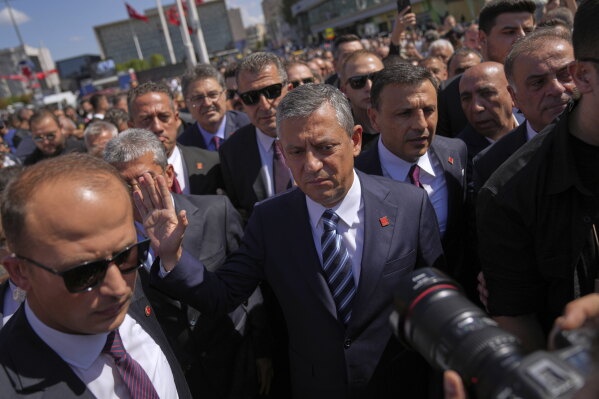
Three days after the ruling, the state made the message visible. Police stormed CHP headquarters, firing tear gas and rubber bullets to end a three-day standoff with Ozel supporters who had barricaded themselves inside. As evening approached, Kilicdaroglu supporters, including several MPs, marched to the building.
There is now open talk that the parliamentary immunities of Ozel and his team could be lifted, and that they, too, could be jailed. The question is whether the Ozel–Imamoglu camp, and the opposition as a whole, can resist the process being imposed on them.
The opposition sees the outline of a de facto monarchy taking shape. Barrack’s claim that “what has worked best” in the region is “a benevolent monarchy” only sharpened that reading. After years of weakening parliament and hollowing out the separation of powers, the state is now moving against the last instrument that could still change power: elections.
Ozel and his team have one immediate option. They can stay inside the CHP, demand a new congress, and build enough social pressure to win the party back through its members. But Kilicdaroglu, now in line with the government’s roadmap, has no reason to prioritize another congress. His return depends on stopping the party base from deciding again.
If that path is blocked, a second option is already being discussed. A new party could be formed with the support of a large majority of CHP deputies, mayors, local organizations, and members. That would preserve the political energy around Ozel and Imamoglu. It would also force the opposition to rebuild under repression, legal threats, and the constant risk of another state intervention.
Whether this can stop Turkiye’s drift toward an electionless order remains to be seen. What is already clear is that the struggle has moved beyond the CHP chairmanship, Imamoglu’s candidacy, or Ozel’s return.
It is now a fight over whether elections can still change power in Turkiye, or whether they will become the ritual by which power renews itself.
[Fatih Yasli is a Turkish academic and writer. He studied finance at Gazi University before completing his master’s and doctorate in political science, and now serves as an associate professor at İzzet Baysal University. He has published numerous articles in leading journals and newspapers and is the author of several books on fascism, Turkish politics, and political thought. Courtesy: The Cradle, an online news magazine covering the geopolitics of West Asia from within the region.]