❈ ❈ ❈
Bolivia: From the Promise of Change to the Struggle for Sovereignty and Dignity
Oscar Rotundo
What is happening in Bolivia today is not an isolated event or a passing conflict. It is the culmination of a historical process that began almost two decades ago, when a political and social transformation broke with centuries of inequality, and which today faces an attempt to reverse it, jeopardizing the very future of the country. To understand why the Bolivian people are demanding the resignation of President Rodrigo Paz Pereira, we must first look at what was built, what was lost, and what is at risk when a government serving the elites and foreign interests makes workers the primary victims of an austerity program that solves nothing but only deepens poverty.
The process that broke down: From transformative change to political fragmentation
Between 2006 and 2019, Bolivia was recognized throughout Latin America as the most ambitious experiment in social transformation. The gas industry was nationalized, revenues flowing to the state tripled, extreme poverty fell from 38 to 15 percent, and a Plurinational Constitution was approved that recognized collective rights, territorial autonomy, and the dignity of the Indigenous nations that had been excluded for centuries. This project was not the work of a single individual: it was the result of decades of struggle, marches, road blockades, grassroots assemblies, and social organizations that transformed discontent into real power. Miners, farmers, Indigenous communities, and workers from all sectors were the protagonists: they were subjects of rights, the decision-makers, the builders, and the recipients of their labor.
But that process began to deteriorate over time. Serious mistakes were made when the interests of extractivism clashed with territorial rights, the state apparatus sided with large corporations; laws were modified to allow indefinite re-elections, breaking the agreements that had built consensus; and, most seriously of all, the social organizations that had been the driving force behind change ceased to be spaces for deliberation and became tools for ratifying state power. When the state entered into crisis, the movements no longer had the autonomy to separate themselves from it.
Then came the 2019 coup, which left dozens dead and showed that the old order still held sway, followed by internal strife within the popular movement itself. The MAS, which had been the embodiment of hopes for change, splintered into factions that fought for power, resources, and candidacies, disregarding the interests of the people. Demonstrations ceased to be about demands and became instruments of pressure between opposing sides, while the social base grew disoriented, divided, and weary.
A government without a plan: The neoliberal adjustment that is imposed on everything that has been built
In August 2025, the defeat of the MAS was not the triumph of a stronger political force: it was the result of the popular movement being fractured, of people tired of broken promises, and of the alternative presented being a man who represented exactly what the process of change had fought against. Rodrigo Paz Pereira, a businessman from the private sector, owner of large businesses that had operated under both progressive and old-style governments, came to power with an empty promise: he spoke of “capitalism for all,” but what he delivered was a package of measures that exactly replicated the prescriptions of the International Monetary Fund and were identical to those applied in other countries in the region, such as the laws being promoted in Argentina.
The turning point came with the approval of Supreme Decree 5503, an instrument that modifies the role of the Central Bank, paves the way for unconditional foreign investment, grants tax breaks to large corporations, and dismantles the gains built up over years: it cuts subsidies, reduces the State’s presence in the economy, eliminates worker protections, and opens the door to the privatization of public companies. The government’s argument is that this serves to “stabilize the economy,” but the reality is very different: the prices of diesel, electricity, and food have skyrocketed, the minimum wage of 3,300 bolivianos is not even enough to cover half of the basic food basket, and workers, farmers, transporters, and all those who produce and sustain the country are the ones who pay the price for the adjustment.
What is even more serious is that this government is not only attacking the economy: it is also attacking institutions and democracy. To govern without checks and balances and without accountability, Decree 5515 was passed, creating the unconstitutional figure of the “Remote Presidency,” allowing the president to exercise his duties from abroad, as he did when he traveled to the World Economic Forum in Davos. At the same time, the vice president’s powers are being reduced, and his decision-making capacity is being diminished, while opposition is growing even within his own circle: Vice President Edmand Lara has joined the opposition, denouncing that Paz “was born with a silver spoon in his mouth” and that his government serves only the interests of the rich, while the poor subsidize the economic elites with their labor and their future.
The people rise up: From disillusionment to demands for resignation
When people realize that the promises were a lie, when they see their living conditions worsening every day and the government acting as if it doesn’t exist, the response is swift. What we see today in the streets of Bolivia is the return of historical memory: the people remember what was built, they remember that rights were respected before and that the State existed to protect them, and they are not willing to accept a return to the past.
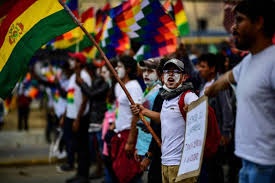
The Bolivian Workers’ Central Union, along with mining, peasant, teachers’, healthcare workers’, and Indigenous community organizations, have taken to the streets with a clear demand: the complete repeal of Decree 5503, decent wage increases, a halt to the privatization of state-owned companies, and, above all, the resignation of a president who no longer represents anyone but his friends and the powers that put him in office. The road blockades, demonstrations, and strikes are not acts of disorder, as the government tries to portray them: they are how people defend their rights when they have no other avenue to be heard.
Faced with resistance, Paz’s response has been repression: thousands of police and military personnel have been deployed, tear gas has been used against protesters, dozens of people have been arrested, and workers are being accused of being criminals or linked to drug trafficking. Measures such as the construction of “model” prisons have also been announced—a response presented as a solution to insecurity, but which is actually a way to militarize the state, divert attention from real problems, and apply the same authoritarian logic that has already proven to solve nothing, but only generates more violence. What the government seeks is to impose a vision that considers problems solved with higher walls and narrower cells, without addressing the root causes of inequality and poverty.
The meaning of the struggle: For a democracy at the service of the workers
What is at stake in Bolivia today is much more than the continuation of a president’s term. It is a question of what kind of democracy we want: one that serves those who work, produce, and build the country, or one that serves only the interests of powerful minorities and external powers.
The Bolivian people have learned from their history: they know that for years the State was a tool to protect them, to redistribute wealth, and to give a voice to those who were previously excluded. Now they see how that model is being destroyed and how the country is reverting to the logic of its resources going abroad or becoming concentrated in the hands of a few, while the majority continues to suffer. The struggle for Paz’s resignation is, at its core, a struggle to recover sovereignty, to defend what has been built, and to prevent the return of a model that has already proven to be unjust.
It is true that social movements went through difficult times, that there was division, and that the grassroots lost their way for a while. But that division is not permanent: the organizations still exist, the memory of what was achieved remains alive, and historical experience teaches that when workers unite and defend their rights, they are capable of changing the course of history. The interregnum that Bolivia is experiencing today—a moment in which the old order is not yet dead, and the new order has not yet been born—is both a danger and an opportunity: a danger because the damage could be irreversible if the austerity measures are allowed to proceed, but an opportunity because it is the moment in which stronger, more autonomous, and more conscious foundations can be rebuilt, foundations that are better equipped to construct a just country.
Bolivia has an advantage few countries possess: its people have a long memory. They know what was built, how it was built, and what mistakes were made. This memory doesn’t guarantee success, but it is the most valuable resource there is. Because democracy isn’t just about voting every so often: it’s about decisions being made with the people in mind, resources being distributed fairly, and no one being left behind. This is the democracy Bolivia is fighting for today, and it is for this democracy that the fight is worth continuing.
The Bolivian people are demanding Paz’s resignation because they understand that his government represents a step backward, because they know that the imposed austerity measures bring not progress, but only misery, and because they are determined to reclaim the leading role that is rightfully theirs. This is not a fight against a person, but a fight for the future of the country, for the dignity of the workers, and for building a society where everyone has a place.
[Oscar Rotundo is an international political analyst and editor of PIA Global, writing mainly on Latin American politics, imperialism, sovereignty and global geopolitical shifts. Source: United World International, an independent analytical center based in Turkey that seeks to understand and describe the multipolar world as it unfolds with cutting edge analyses of the most critical geopolitical developments of the day.]
❈ ❈ ❈
Bolivia Strike Grows as Government Hits Labor Leader with Terrorism Charge
Gary Wilson
On May 19, Bolivia’s government charged the head of the country’s main labor federation with terrorism. The charge is aimed not only at one leader. It is aimed at workers, Indigenous Peoples and poor communities–including miners, teachers, transport workers and health workers–who have entered an indefinite general strike against President Rodrigo Paz.
Attorney General Roger Mariaca confirmed that Mario Argollo, executive secretary of the Bolivian Workers Central (COB), is being prosecuted for alleged public incitement to commit crimes and terrorism. A separate arrest order was issued against Justino Apaza Callisaya, leader of the Federation of Neighborhood Councils of La Paz (FEJUVE).
“They will not break us in the struggle we have begun,” Argollo said, accusing the government of trying to silence the movement’s leadership with legal actions and criminal complaints.
That is what the terrorism charge means. It turns a labor struggle into a criminal conspiracy. When workers block highways to defend wages, land and fuel, the government calls it terrorism. When the government sends soldiers, police, armored vehicles and tear gas against them, it calls that “restoring order.”
TeleSUR reported that at least four protesters have been killed since May 16. AP reported that prosecutors announced 90 arrests on May 18; by May 19, TeleSUR reported that the number had risen to more than 127. The strike has not collapsed. At least 67 highways remain blockaded. The government-owned oil company YPFB has suspended gas supply to municipalities because fuel tankers cannot move.
Washington wants the spoils
Paz was elected president in October 2025 after the Movement Toward Socialism–Movimiento al Socialismo, or MAS–split and Morales was kept off the ballot. MAS, rooted in Bolivia’s Indigenous, labor and coca-grower movements, brought Evo Morales to power in 2005 and governed for nearly two decades. Paz took office after years of U.S. sanctions, aid cuts and drug-war pressure battered Bolivia’s economy, fuel supply and ability to defend its resources. Washington used the U.S. Drug Enforcement Administration, or DEA, as a weapon against Morales and Bolivia’s coca-growing regions. In 2019, Morales was forced from office after the military demanded his resignation, and Trump praised the coup.
Washington destabilized Bolivia and now wants the spoils. Paz quickly aligned with the Trump administration. The U.S. State Department backed him as his government moved to hand Bolivia’s land and natural wealth over for exploitation by foreign capital.
Bolivia is one of South America’s richest countries in strategic resources: lithium, tin, silver, zinc, lead, copper, antimony, tungsten, natural gas, forests and water. The oligarchy wants to turn these resources–and the Indigenous territories that stand in the way of the grab–over to banks, agribusiness, mining companies and imperialist capital. Law 1720 is part of that larger plan.
The current wave of struggle began with Law 1720, the land measure passed in April. Indigenous communities saw it as an opening for land theft. The movement spread because years of U.S. economic warfare and the Paz government’s austerity program had already hit workers and poor communities through fuel shortages, rising prices, low wages and privatization threats.
In December 2025, Paz issued Decree 5503, eliminating decades-old fuel subsidies overnight and sharply raising fuel prices. Bolivia once earned dollars by exporting natural gas. But U.S. sanctions, trade punishment, drug-war pressure and support for the 2019 coup weakened the country’s ability to defend its resources, invest in production and control its fuel supply. Falling gas production and the dollar squeeze left Bolivia dependent on imported diesel and gasoline. Then the U.S. war against Iran and the blockade of the Strait of Hormuz made every fuel shipment more expensive, deepening the squeeze Paz was already shifting onto workers and Indigenous communities.
Paz and Bolivia’s rich shifted the crisis onto workers and Indigenous communities. His first legislative act eliminated taxation on large fortunes. Fuel prices doubled, wages lagged, and the wealthy got relief.
That is the class issue behind the strike: who will pay for Bolivia’s fuel shortages, rising prices, debt and land crisis–workers, Indigenous Peoples and poor communities, or the rich, the banks, the landlords and the importers.
Facing a massive May Day assembly in El Alto, the COB moved to declare an indefinite general strike on May 2. The first demand was Paz’s resignation. The movement also demanded repeal of Law 1720, higher wages and pensions, an end to privatization plans and lower taxes for small businesses. More than 70 unions have joined the mobilization.
Land theft dressed up as credit
Law 1720 exposed the land question behind the crisis. The issue was not simply high-cost, extortionate credit for “small farmers.” The law went much further. In Bolivia, small agricultural property is a protected legal category rooted in the struggles that broke up the old landlord system. It is protected family land: it cannot be seized, divided up or taxed as ordinary agrarian property.
Law 1720 allowed titled small agricultural properties to be reclassified as medium-sized holdings through a fast administrative process at INRA, Bolivia’s agrarian reform agency. Once reclassified, the land could be used as collateral for bank loans. That meant land protected from seizure could be mortgaged and lost for debt.
For Indigenous and rural communities, the danger went beyond individual plots. Many small titled parcels exist inside larger community territories. Pulling those parcels into the land market without community consent threatened to fracture collective territory from within. Indigenous land is not simply a commodity. It is held and defended as the basis of community life, production, culture and self-government.
The government called Law 1720 rural credit. Indigenous communities saw it as land theft dressed up as credit.
The Amazon march
The march began April 8 in Cobija, Pando, in Bolivia’s northern Amazon lowlands, and was joined by people from Beni and other regions along the route. Bolivian reports put the route at roughly 1,000 kilometers–more than 600 miles–over nearly a month, from the tropics into the near-freezing Andes, before the marchers reached La Paz on May 4.
“Our life is collective, not individual,” rural union leader Oscar Cardozo said in La Paz. “The land must be respected; it’s not for sale.”
That sentence cuts through the official language. The issue is collective life against private profit. It is Indigenous territorial rights against banks, landlords and corporations.
Paz retreats, then cracks down
On May 13, Rodrigo Paz formally repealed Law 1720. But the Chamber of Deputies said it would draft a new law with the same intent. Protesters rejected the repeal as a maneuver and kept their demand for Paz’s resignation.
The government’s next answer was repression. On May 17, about 3,500 soldiers and police carried out a pre-dawn sweep of roadblocks around El Alto and along the La Paz—Oruro highway. When negotiation failed to stop the strike, the Paz government turned to force. It sent police and soldiers against workers and Indigenous communities defending the blockades.
The Paz government has tried to blame former President Evo Morales for the uprising. Morales rejected that charge, saying there are no “sinister plans,” only “a country tired of being lied to” while the government protects business owners, bankers and agribusiness.
The previous week, authorities issued a warrant against Morales on contempt charges in a politically driven case that Morales and his supporters denounce as part of the effort to sideline him.
The meaning is clear. The Paz government is trying to smear labor and Indigenous resistance as terrorism. Roadblocks, strikes and union organization are tools of mass struggle, not terrorist acts. Prosecutors are trying to rename them as crimes: a roadblock becomes an “attack on transportation security,” a strike becomes an “attack on public services,” and a labor federation becomes a “terrorist network.” It is a political fraud meant to break the strike.
Washington, the IMF and the crackdown
Washington and Trump-aligned governments in the region quickly closed ranks behind Paz. Eight Latin American governments–Argentina, Chile, Costa Rica, Ecuador, Guatemala, Panama, Paraguay and Peru–issued a joint statement May 15 backing him and condemning the mobilizations. Most are tied to Trump’s Shield of the Americas network, a U.S.-led bloc of right-wing governments built to police Latin America for imperialism.
Blackwater founder Erik Prince called publicly for U.S. military intervention. Bolivian lawmaker Rolando Pacheco of the Popular Alliance has alleged that Argentina’s far-right President Javier Milei sent two planeloads of tear gas and crowd-control equipment to Paz’s forces.
An IMF mission was in La Paz as of May 19, negotiating terms for Bolivia’s first loan from the Fund in five years. That is the other side of the terrorism charges. While labor leaders are threatened with prison, the IMF is negotiating the next round of austerity.
Paz had already weakened environmental and water oversight by dissolving the Ministry of Environment and Water as one of his first acts in office. Then, after the government was forced to repeal Law 1720–the measure that would let protected small agricultural property be reclassified, mortgaged and lost for debt–the Chamber of Deputies said it would draft a new land law “with the same spirit.” The message was clear: the government had not abandoned the land grab. It had only retreated and repackaged it.
The target is not only land in the narrow sense. It is Bolivia’s whole material base: land, forests, water, lithium, gas and minerals. These lands and resources were first stolen from Indigenous Peoples through conquest and landlord rule, then partly won back and defended through decades of Indigenous, worker and popular struggle. The same forces demanding “credit,” “investment” and “legal certainty” want to turn those gains back into property claims for banks, agribusiness, mining companies and imperialist capital.
One mining leader put the movement’s position plainly: “The sole demand of the mobilized people is the removal of the president due to his inability to solve this country’s structural problems. He is leading us adrift, giving away our natural resources, mortgaging the country for our children and grandchildren.”
That is why the Paz government reaches for terrorism charges. The terrorism charge is a weapon to break the strike. It puts prosecutors, police, soldiers and prisons at the service of the rich, the banks, the landlords and Washington. The aim is to clear the roads, break the blockades, bust the unions and push through fuel hikes, privatization and land theft. Bolivia’s workers and Indigenous Peoples are refusing to pay for a crisis made by capitalism and imperialism.
[Gary Wilson is a retired computer network engineer and long-time socialist agitator currently working as co-editor of Struggle-La Lucha. Courtesy: Struggle La Lucha, a US based socialist publication.]
❈ ❈ ❈
Evo Morales: The Popular Uprising in Bolivia “is Unstoppable”
Hector Bernardo
Hector Bernardo: Is this rebellion similar to the Gas War, the Water War, or the 2005 uprising?
Evo Morales: The same thing. In the Gas War, Goni (Gonzalo Sánchez de Lozada) and the entire MNR and ADN (Nationalist Revolutionary Movement and Nationalist Democratic Action) mega-coalition wanted to sell gas to California through an LNG (Liquefied Natural Gas) plant in Chile, all privately owned, and the price was extremely low. But the people rose up.
During the Water War, under the governments of Hugo Banzer and Tuto Quiroga, we participated in the protests with Óscar Olivera and Omar Fernández—who was a senator and has sadly passed away. Together, we led that mobilization and won the battle against the state in Cochabamba: we prevented the privatization of water. They even wanted to privatize rainwater.
Now it’s about lithium, about rare earth elements. By decree, Elon Musk’s Tesla is already in Bolivia, for the lithium. Elon Musk financed the 2019 coup. He says so publicly. They’ve already signed memoranda with the United States and Canada for rare earth elements and lithium.
It’s an uprising to defend natural resources. It’s no longer a mobilization for higher wages, for a school, for a road. That’s over. Two things are converging here: a mobilization for social demands and another for a structural change to the neoliberal model. I call that a popular rebellion, a rebellion against the neoliberal model and against this neocolonial government.
Something analysts often overlook is the Coca War, the war over the coca leaf. For me, the defense of the coca leaf is far more profound than the defense of gas, water, or other natural resources, because under the pretext of fighting drug trafficking, they exploit the issue for purely geopolitical interests. The Cold War brought Operation Condor; the war on terror and the persecution of drug traffickers are instruments of imperialism to dominate nations.
Returning to the current situation, who is calling for this mobilization? Hunger, unemployment, the loss of purchasing power, inflation, the lack of dollars, the return to poverty and extreme poverty. They are all self-organizing. If a leader engages in dialogue, they are rejected as a traitor.
That town—as I said before—had no right to education, no right to be elected. Our parents couldn’t enter the town squares. Because we were forbidden to read and write, today they are professionals.
After the coup, total theft. This crisis is back because of the coup. We made a mistake in electing Lucho Arce. Rodrigo Paz, openly, with great arrogance and overbearingness, handed over the lithium. Hence this uprising, so natural, so profound.
HB: You have said that the 2019 coup was about lithium and against the indigenous population, and that the United States embassy and the State Department played a fundamental role. What role are the State Department and its local allies playing today? Because we have seen that President Milei sent a plane to Bolivia, and there are allegations about what that plane is being used for.
EM: Some groups in Bolivia, and especially the Empire, refused to accept that Indigenous people could lead the liberation of our people: political and economic sovereignty. Therefore, I say: it is a coup by the gringo against the Indigenous people.
Our sin was nationalizing (the companies that were in foreign hands) and closing the (US) military base. Before, basic services were provided by foreigners.
The blow was also against our economic model, which was better than the neoliberal model imposed by capitalism.
They didn’t forgive us for the fact that we, along with Álvaro (García Linera) and the cabinet, had developed a plan in 2013-2014 to have 41 lithium plants by 2030. We began in 2018 by inaugurating the first potassium chloride plant, to process 350,000 tons per year—still small, a pilot plant—and 1,000 tons of lithium carbonate. A plant to produce 15,000 tons of lithium carbonate was under construction. That’s when the blow came.
I see this as a fight for lithium. What did the Southern Command say in 2023? “The United States complains about the activity of its adversaries in the lithium triangle, comprised of Bolivia, Chile, and Argentina.” Argentina is already in the hands of transnational corporations. Chile too. Only Bolivia remains. They want to complete their control of the lithium.
Marco Rubio, the United States Secretary of State, said three days ago: “Let there be no mistake: The United States firmly supports the legitimate constitutional government of Bolivia. We will not allow criminals and drug traffickers to overthrow democratically elected leaders in our hemisphere.”
This is not an internal matter, but an international one. And in the new global geopolitical context, the people’s parties, the left, progressive and humanist parties, are in the crosshairs of the Empire. They want to implement the Monroe Doctrine.
HB: Among all these figures appearing internationally, Israel is also supporting Paz Pereira. What role does Israel play and what interests does it have in this context?
EM: By decree (Paz Pereira) authorized the presence of an Israeli intelligence and espionage company in Bolivia, according to experts in the field.
I see that there is a triumvirate trying to destabilize popular and left-wing parties: Donald Trump (United States), the Prime Minister of Israel (Benjamin Netanyahu) and Milei (President of Argentina), with allies such as Rodrigo Paz, and the presidents of Chile and Ecuador.
The Argentine plane (sent by Javier Milei’s government to deliver “humanitarian aid”) transported police officers from Santa Cruz to Oruro; it also transported officers from four departments: Santa Cruz, Potosí, Chuquisaca and Tarija, for the repression in La Paz.
HB: How do you think this situation will be resolved?
EM: I was saying that if the president (Paz Pereira) had publicly promised that he was not going to privatize basic services —which by Constitution are a human right and cannot be a private business—, that he was not going to privatize natural resources, health or education, I think the tension would stop, it would go down.
I don’t know what the solution is, but the security forces have been overwhelmed. And don’t blame me: we aren’t blocking roads yet, although, in a disciplined manner, we are also affiliated with the Bolivian Workers’ Central Union and are joining the march.
Everyone is angry with the president. La Paz has been under siege for almost two weeks, and Cochabamba, Oruro, and Potosí are also under siege.
This mobilization is now unstoppable. I cannot predict what the outcome will be.
[Héctor Bernardo is a journalist, writer and professor of Introduction to Contemporary Social and Political Thought – Faculty of Journalism and Social Communication – UNLP. Interview in Spanish courtesy PIA-GLOBAL. Translated into English and published by Internationalist 360°, an online platform that publishes articles and analyses on global geopolitical issues, social justice movements, and international relations.]