❈ ❈ ❈
Not for Failure to Push Bills Through Parliament, Modi Should Have Apologised to Women Over Bigger Failures
Vrinda Gopinath
Let’s get this straight first – it was not the Women’s Reservation Bill 2026 which was rejected by the opposition parties in parliament last week, but the Constitution (131st Amendment) Bill, 2026, which aimed at implementing 33% women’s reservation in the Lok Sabha and state assemblies, via delimitation. The Bill failed the test as the Modi government did not secure the required two-thirds majority. It proposed to raise the Lok Sabha seats to 850 to the disadvantage of southern and eastern states. Not surprisingly, the Bharatiya Janata Party government went on an overdrive to spuriously claim it had done its best to push the women’s bill but failed to say that the actual reservation bill of 2023 was passed the same year and that opposition parties had supported the bill in its entirety.
It was the Modi government’s surreptitious act of entwining the women’s bill with delimitation that opposition parties objected to.
Nonetheless, Prime Minister Narendra Modi too went on national television to broadcast a political harangue against the opposition, in blatant violation of norms of not using state television for party politics, that too in the midst of state elections. In his address to the nation, Modi accused the opposition of “female foeticide,” singling out the TMC and DMK who will both go to polls in a weeks.
Notably, Modi “sought forgiveness” from “India’s mothers and daughters” and added that “a woman may forget everything but never an insult to herself.”
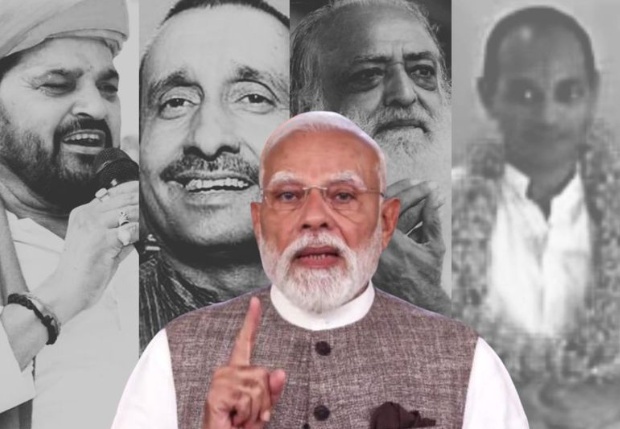
Perhaps it would do the country and its women good if Modi would follow his pious and virtuous utterances and seek forgiveness for the utter horror that has befallen women — here are five times Modi should have apologised to India’s women but never did.
Brij Bhushan Sharan Singh
Remember how two-time world champion medallist Vinesh Phogat and Olympic medallists Sakshi Malik and Bajrang Punia were dragged off the streets and flung into police vans for protesting against the Modi government’s refusal to act on serious charges of sexual harassment, assault and intimidation and stalking against six-time BJP MP Brij Bhushan Sharan Singh?
The cases had been filed by seven female wrestlers, and initially included a minor. Singh, an Uttar Pradesh bahubali, was then the president of the Wrestling Federation of India.
According to police records, between 1974 and 2007, as many as 38 cases were registered against Singh, accusing him of theft, dacoity, murder, attempt to murder, and criminal intimidation. He was acquitted in most cases according to his election affidavit. He was also arrested for the demolition of the Babri Masjid and booked under the anti-terrorism law TADA for harbouring shooters of a Dawood Ibrahim gang, but was later acquitted in both cases.
Not surprisingly, it was almost a year later that charges were framed by a Delhi court against him, in 2024, for sexual assault and harassment of the female wrestler complainants. A separate case under the POSCO Act was later retracted, leading many to consider a cloud of intimidation. And despite the public outrage against both Modi and Union home minister Shah for their noted inaction against a member of their party, it was an unmoved Modi and Shah who gave his son Karan Bhushan Singh a party ticket to fight from the Kaiserganj seat in the 2024 general election. Worse, Singh’s close side Sanjay Kumar Singh was elected the new president of WFI in 2023. Phogat announced her retirement after the appointment of the new president.
And so the political backing continues with Modi-Shah passing on the baton to the son who now wields political influence in the region. In fact, despite the international wrestling association asking for an investigation, Brij Bhushan even appeared as a guest of honour at last year’s Pro Wrestling League launch despite court cases, blatantly exhibiting his political patronage from Delhi.
Bail and parole for godmen
The list of predatory self-styled swamis and gurus is legion, from Asaram in Gujarat convicted in 2018 for raping a minor in 2013, and a life sentence in 2023 for another rape case from 2001 to 2006. It was only in January 2023 that a court in Gandhinagar sentenced Asaram to life, but magically he has has got several temporary bails on health grounds. In fact, all through 2025, the Supreme Court too upheld the Gujarat high court’s bails several times, and in November 2025, Asaram was released yet again for six months on medical grounds.
To everyone’s shock he made a high profile visit to Ayodhya in March 2026 followed by a darshan at the Kashi Vishwanath temple in Varanasi. Asaram claimed that he undertook the visit because it prevented one from going to hell even as social media exploded with horror of a convicted sexual predator walking around freely without inhibition.
Gurmeet Ram Rahim Singh, the head of Dera Sacha Sauda, was sentenced to 20 years in prison in 2017 for raping two female followers and is also serving a life sentence for the murder of a journalist who exposed the goings-on in the ashram. However, he was granted a 40-day parole in January this year, making it his 15th temporary release from Sunaria jail, in Rohtak, Haryana. He has spent 406 days out of jail from 2017 to 2025. The fact that his repeated paroles have often coincided with local or state elections in Haryana and Punjab has raised questions among the opposition.
Virender Dev Dixit, the 82-year-old self-styled godman, was accused of rape by two minor girls and for illegally confining several minor girls and women at his “spiritual university” in Rohini, Delhi. He was finally arrested in 2018 but escaped the net and was absconding despite a CBI lookout notice. It was in 2023, the CBI finally told the special court Dixit had died that year; and that it will now seek abetment of trial.
Garlands for Gujarat rapists
Where was the outrage over the reception received by 11 convicts who were all serving a life sentence for the gang rape of a five-month pregnant Bilkis Bano and the murder of seven members of her family, including her three-year-old daughter during the murderous Godhra riots in Gujarat, in 2002. The savage attack on her did not end here – Gujarat police summarily dismissed the case against the criminals; the case was finally moved to Maharashtra in 2004 for a fair trial, and charges were finally framed in January 2008, and upheld by the Bombay high court only in 2017.
In March 2022, two BJP legislators, a former BJP councillor and a BJP member from the women’s wing sought remission of the convicts, and on Independence Day, the same year, the 11 convicts were released on grounds of good behaviour. The convicts were greeted with fanfare of garlands and sweets, and the Gujarat government told the Supreme Court that it had sought the approval of the Centre, and was granted so by the home ministry, under Amit Shah. But the global outrage that followed got the Supreme Court to quash the remission saying it was based on “misguided facts” and overturned the remission order, but it took two years for the 11 convicts to be back in prison, in January, 2024.
The reaction in Kathua
Political patronage of convicts can only be dreamed of but convicted criminals of sexual violence have been supported often, as was seen yet again during the vociferous protests by BJP legislators in the conviction of the rapists and murders of the eight-year-old belonging to a Muslim nomadic tribe. She was kidnapped, drugged and raped over several days, and brutally murdered in a temple in Kathua, Jammu and Kashmir.
BJP supporters and leaders took out a rally holding the Indian flag in defence of the rapists – there were seven, one was a minor, the son of the temple priest – while the BJP women’s wing took out protests raising slogans against the prosecution lawyer. Two BJP state ministers, who had addressed a Hindu unity rally protesting the arrest of the rapists, were forced to resign following the public outrage. Finally, three years later, the special court convicted three men to life for rape and murder of the eight-year-old. Three police officers were found guilty of destroying evidence and were sentenced to five years in prison. The minor was let off by the court.
The Unnao rapist
It has always been the indomitable spirit of victims that have brought sexual criminals to book, as was in the case of former BJP MLA Kuldeep Singh Sengar who was still an MLA when he was accused for the kidnap, rape, illegal confinement of a minor girl. Sengar continued to torment and kill despite being named by the victim.
First, the girl tried to lodge a complaint with the local police for months; then, exhausted by threats and coercion by Sengar’s goons and police, the girl attempted self-immolation in front of the BJP chief minister’s house saying the police were refusing to register her case. It stirred local authorities and woke up the national media. Meanwhile, her father was picked up by the police and thrown into prison as the perpetrator of the crime. The day after she tried to kill herself, the father was brought dead to the hospital after succumbing to injuries in police custody. The police finally registered a case against Sengar and said it was not filed earlier because of discrepancies in the girl’s statement.
But even as the girl doggedly pursued the case, she was hit by another catastrophe – while on her way to depose before a local court, the car in which she was travelling along with her two aunts and lawyer was suspiciously hit by a truck. The aunts died and she and her lawyer was grievously injured. The case had now dragged for over two years. The Supreme Court finally transferred the case to Delhi for a fair trial; the CBI filed a chargesheet against Sengar for rape, and another chargesheet against him, his brother and accomplices for framing the father and his custodial death. Three years after the crime, Sengar was convicted with a life sentence for rape; a year later he along with other accused were convicted for 10 years for the murder of the girl’s father.
As of today, Sengar is incarcerated even as the Supreme Court reviews the appeal of the suspension of his conviction.
[Vrinda Gopinath is an independent journalist and political commentator who writes on Indian politics, gender, governance and democratic rights. Courtesy: The Wire, an Indian nonprofit news and opinion website. It was founded in 2015 by Siddharth Varadarajan, Sidharth Bhatia and M. K. Venu.]
❈ ❈ ❈
Please, Modi ji, Don’t Shed Tears for India’s Women
Brinda Karat
[An open letter to the prime minister who has betrayed the nation’s women many a time.]
Prime Minister Shri Narendra Modi ji,
You had stated in your address to the nation on the women’s reservation issue that “the fight to give women power participation has been going on for decades…so many women have raised this subject before me. So many sisters have written letters to me explaining everything.”
Modi ji, Here is another letter to you, from one who has been an active participant in the “decades long fight” you mention. That historic fight was led by women’s organisations, it was led by lakhs of women in the panchayats who fought patriarchal cultures to establish that they were not “proxies”, it was through thousands and thousands of demonstrations, rallies, protests, dharnas, petitions. You also said, “I too have been among those making efforts for it”. No Modi ji, in all these years of struggle we have never ever received any support from you. Your claim is as distant from the truth as Godse’s ideology was from Gandhi’s.
Let’s sift facts from propaganda Modi ji. But before that – in reference to your statement of “sharing the sorrow” of women and your pledge, “I assure every woman of the country: we will remove every obstacle in the path of women’s reservation,” here is a concrete suggestion which will remove your sorrow and every obstacle. Delete the major obstacle which was erected in the 106th constitutional amendment moved by your government in 2023. This links women’s reservation to the census and delimitation. Delete this sentence, Modi ji, and women’s reservations can be implemented from tomorrow. But you won’t do this, Modi ji. Your commitment was never to women’s reservation.
You were elected as prime minister in 2014. Your party had promised one third reservations for women in its election manifesto. The alliance you led won 336 seats, of which your own party won 282 seats. What were the “efforts” you made? Tell the women of India why you did not pass the women’s Bill in your first term. Not just that Modi ji, you refused to even list the Bill in the government agenda. In the Monsoon Session of 2017, the then Communist Party of India (Marxist) general secretary Sitaram Yechury as a member of the Rajya Sabha had demanded the listing of the Women’s Reservation Bill as part of the business agenda. Why did you refuse? In July 2018, P.K. Sreemathy, the CPI(M) MP in the Lok Sabha who is now the president of the All India Democratic Women’s Association had raised the issue. There was an urgency as only one year was left before the elections scheduled for 2019. She was supported by several parties but your government ignored her plea. Women MPs of several opposition parties staged a dharna inside parliament demanding the passage of the Women’s Reservation Bill. Outside parliament, women were out on the streets in demonstrations, demanding the Bill be listed and passed. You did nothing. Why Modi ji? As a result, women were deprived of one-third reservations in the 2019 Lok Sabha elections. This was your first betrayal on this issue.
In 2019 you won with an even bigger majority, with your party getting 303 of the 353 seats won by your alliance. This was a massive majority. How did you use it? Your priority was to help business. You brought the four anti-worker labour codes, you used your majority to push through three anti-farmer bills. Why did you not use your majority to bring the Women’s Reservation Bill? Why did you wait till almost the last session of your term to bring a flawed version of the Women’s Reservation Bill, leaving no time to refer it to a parliamentary committee?
It was only in September 2023, that you presented a Bill named Nari Shakti Vandan Adhiniyam (NSVA). I will later in this letter come back to your choice of the title. Many said that your government brought this Bill to escape criticism during the forthcoming 2024 elections that you had reneged from your promise the second time. But the agenda was far worse. The NVSA introduced Section 334a as a constitutional amendment which stated that women’s reservations would be implemented only after the census and delimitation were completed. Women’s organisations strongly protested against this linkage. We argued that women’s reservations were not at all linked to the census or delimitation, that women would be denied the right to reservations in the 2024 elections, and thirdly, that there was no guarantee when the process would be completed. Opposition parties in parliament raised many of these issues. You and the Union home minister gave a “guarantee” that the census and the delimitation would be completed by the 2029 elections. The Bill was adopted. But none of your assurances have been implemented.
Modi ji, women paid the price.
If you had not insisted on the linkage and presented the 2010 Bill which your own party had voted for at the time, there would have been 180 women in the Lok Sabha today. Instead their number has gone down to just 74, less than in 2019. Ten assembly elections have been held in this period. Instead of one-third, their number is less than 10%. In your home state of Gujarat of the 182 assembly seats, in the elections held in 2022, only 15 are women, just around 8%. Even though you had a two-third majority in parliament, you refused to adopt a legislation which would be implemented with immediate effect. That was the second betrayal, Modi ji.
In the midst of important state elections, on April 16, you extended the parliament session to push through a new set of constitutional amendments on the women’s reservation issue. There was no prior discussion with opposition parties nor any consultation with women’s organisations. The constitutional amendments were defeated on the floor of the House. Your game to use the women’s reservation issue to push your agenda of delimitation on the basis of an outdated 2011 census was foiled. It is clear now that your government deliberately did not start the census process because you had planned this move all along. This was your third betrayal, Modi ji.
You wanted to increase the seats in Parliament to 850. In your address you said, “The Nari Shakti Vandan amendment was not about taking anything away from anyone. The Nari Shakti Vandan amendment was about giving something to everyone, it was an amendment to give.” In other words, patriarchy in politics is not to be disturbed, let the men keep the power, let their numbers increase – women can be the add ons. You compromised with the opposition in your own party from the feudal casteist lords, who run their fiefdoms and who have been the greatest opponents of women’s reservations. An increase in seats would leave them undisturbed.
Additionally the manuvadi approach is clear. Is it not a fact that by using the 2011 census you would have deprived Dalit and Adivasi women of their rightful share in the number of seats reserved for them? The Scheduled Caste and Scheduled Tribe population has increased between 2001 and 2026, and so the proportion of their seats should also increase. But your proposal denied them this right.
And finally, let us come to the issue of delimitation and the increase of seats. Discuss this separately. Population of states cannot be the basis for proportionate shares as this punishes states for their development. So what can be the basis? Let there be discussion and consultation. In any case, this has nothing to do with women’s reservation.
Women are happy that you failed in your manipulation of the women’s reservation issue. You are accusing the opposition of “committing a sin” of “committing female foeticide” for which they “will be punished.” Use your words with more care, Modi ji. If you must use such inappropriate analogies, you should know that there was no foetus. There was a fully formed “being” in the shape of the 2010 Reservation Bill which your party had voted for. You buried that being. If there is a sin, it is that.
Women are fed up with the series of betrayals from your government. Do not call it “vandan”. We are not looking for reverence but for rights. Our demand is rooted in our strong belief that a constitutionally mandated increase in women’s participation in parliament and state assemblies will strengthen democracy in India. We support the demand for a caste census, which is what you want to avoid as you do not want the truth of India’s caste inequalities to be documented and addressed through irrefutable data.
And please, Modi ji, don’t shed tears for us – just act as you should have done in 2014: bring the Women’s Reservation Bill without linkages, without conditions, in the next session of parliament so that it can be implemented in the next round of elections. We want action not theatrics.
Yours sincerely,
Brinda Karat
[Brinda Karat is a senior CPI(M) leader. Courtesy: The Wire, an Indian nonprofit news and opinion website. It was founded in 2015 by Siddharth Varadarajan, Sidharth Bhatia and M. K. Venu.]
❈ ❈ ❈
BJP’s ‘Men’s Reservation Bill’ Defeated, But When Will Women’s Reservation Win?
Shivasundar
Opposition parties were successful in defeating the “Mens’s Reservation Bill” clad as Women’s reservation Bill and the fraudulent “Delimitation Bill”. But once again women’s reservation has been postponed because of the political chicanery of the Modi government’s ulterior motives.
Both in 2023 and 2026, the Bharatiya Janata Party (BJP) government used the women reservation bill for their partisan political campaign and not for its genuine implementation.
In 2023, Parliament unanimously passed a law promising 33% seats for women in the Lok Sabha and state assemblies. On paper, it looked historic. In practice, it came with a catch: implementation was tied to a future census and delimitation exercise after 2026. That effectively pushed real change well into the next decade.
At the time, opposition parties objected, arguing that if the intent was genuine, reservation could be implemented as early as the 2024 elections. The government refused.
Fast forward to 2026, and the script has flipped. The same government proposed implementing reservation for the 2029 elections, but tying it to delimitation using the 2011 census through the 131st Constitutional Amendment. It proposed increasing the total number of parliamentary seats to 816 without solid constitutional justification, reserving 33% (273 seats) for women. When southern states strongly opposed this, the government tried to placate them with claims that all states’ seats would be increased equally by 50% by verbal assurance not backed by any constitutional rationale.
However:
- The bill did not actually contain any provision for a uniform 50% increase in seats across all states.
- Increasing seats equally by 50% across states, regardless of population growth, lacks constitutional basis and is impractical.
- Raising the total seats from 543 to 816 and then allocating 33% to women was to protect male dominance – something the BJP has indirectly acknowledged.
Even though women constitute about 50% of the population, around 90% of the existing 543 seats are held by men. If 33% reservation were implemented within the current seats, men would have to give up about 180 seats. To avoid affecting entrenched male interests, the BJP proposed increasing total seats so that the original 543 seats effectively remain with men while the additional 273 go to women.
Thus, what is being proposed is essentially a “men’s reservation” bill rather than a genuine women’s reservation bill.
In other words, rather than redistributing power, the system expands to accommodate change without disruption.
Why, then, did the government push this amendment despite clearly lacking the required two-thirds majority?
The reasons are petty and nefarious. The BJP has no real commitment to women’s reservation. Even in 2023, the bill seemed more like an attempt to attract women voters in the 2024 elections rather than to genuinely implement reservation. The conditions in the 2023 bill meant that even if passed, it would only come into effect around the 2034 elections.
The bill had already passed both houses and received presidential assent, yet its implementation date was only announced three years later – on April 16, 2026 – after signs emerged that the new amendment proposal might fail.
Therefore, the rushed introduction in 2023 appears aimed at gaining women’s votes in 2024, while the 2026 move – despite lacking majority support – seems designed to portray the BJP as pro-women and opposition parties as anti-women during ongoing state elections, especially in regions like West Bengal and Tamil Nadu.
In essence, by proposing what amounts to a “men’s reservation” and undermining the concept and process of women’s reservation, the BJP has once again demonstrated an anti-women stance.
But what about opposition parties? Are they truly committed to women’s reservation?
Looking at their track record – in party structure, ticket distribution, and power-sharing – there is little evidence of such commitment. Since 1951, there has been no legal barrier preventing parties from giving 33% tickets to women. Yet, except for the Trinamool Congress (TMC) at the state level, no major party has done so.
A closer look at election data reveals a deeper, bipartisan gap between rhetoric and reality. In the 2024 Lok Sabha elections, major parties gave women far fewer tickets than the proposed 33% quota:
- BJP: 15%
- Congress: 12.5%
- CPI(M): 13%
- BSP: 8%
- TMC: 25%
2019 Lok Sabha elections:
- BJP: 12.6%
- Congress: 12.8%
- CPI(M): 12%
- BSP: 12.6%
- TMC: 40.5%
The pattern is consistent in earlier elections as well. Despite rhetoric about women’s empowerment, even half of the promised 33% has not been met. Except for TMC, most opposition parties compete with the BJP in neglecting women’s representation.
The takeaway is hard to ignore: for decades, political parties have had the freedom to nominate more women. They simply haven’t. Moreover, many women candidates are given tickets due to male connections (husband, father, etc.), and most belong to upper castes and classes.
Social justice is a responsibility of all parties that accept the Constitution. Why wait for a law to implement it?
Parties can ensure representation for women and marginalised communities without legal compulsion and should use all their resources to help them win. Instead, prioritising “winnable” candidates – mostly men from privileged groups –undermines social justice.
While the BJP is ideologically opposed to social justice, if opposition parties truly want to distinguish themselves, they should:
- Demand removal of the census and delimitation conditions attached to the 2023 law.
- Push for implementing 33% reservation (180 seats) within the existing 543 seats, ensuring representation for marginalised groups in the very next Monsoon session
- Voluntarily allocate 33% tickets to women (with due representation for the more oppressed castes and Minorites ) within their parties and actively support their victory.
Otherwise, a tradition where “male India” continues to defeat “female India”—across parties and ideologies—will persist.
Finally, why is no one questioning why women, who make up 50% of society, are being offered only 33% reservation?
Just asking.
[Shivasundar is a columnist and activist in Karnataka. Courtesy: The Wire, an Indian nonprofit news and opinion website. It was founded in 2015 by Siddharth Varadarajan, Sidharth Bhatia and M. K. Venu.]