❈ ❈ ❈
Explained: Why Uproar Over Delimitation, More LS Seats Using Women’s Quota as ‘Cover’
Tanishka Shah
Parliament is set to convene for a three-day special session beginning April 16 to consider proposals to expand the strength of the Lok Sabha to 850 members and to remove the requirement that delimitation be based on post-2026 census data, thereby permitting the use of existing figures.
Three Bills have been circulated among the MPs: The Constitution (One Hundred and Thirty-first Amendment) Bill, 2026, The Delimitation Bill, 2026, and The Union Territories Laws (Amendment) Bill, 2026. The latter two are ordinary legislations requiring only a simple majority, whereas the constitutional amendment demands a higher threshold for passage.
The Bharatiya Janata Party has issued a three-line whip to its MPs in both the Lok Sabha and Rajya Sabha, mandating their presence from April 16 to 18 and making attendance compulsory, with no leave permitted during this period. Prime Minister Modi has written op-eds and made appeals to political parties to support the Nari Shakti Vandan Adhiniyam and changes to be adopted in the special session and warning that further delay would amount to an injustice to women. While women’s reservation remains the public-facing centrepiece, critics argue that the substantive changes introduced by the Bill lie in the restructuring of delimitation and the redistribution of seats.
What are the proposed changes?
These three interconnected bills propose a major overhaul of India’s electoral and constitutional framework to expand the House of the People (Lok Sabha) and end decades-long freezes on constituency readjustment.
Expansion of parliamentary representation
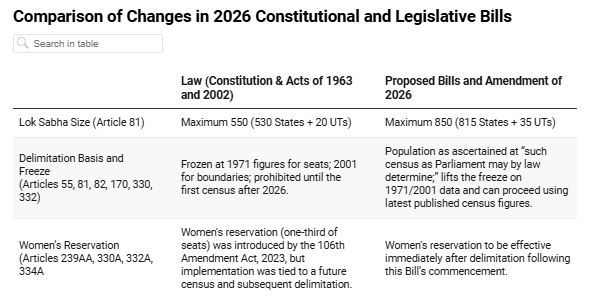
A key feature of the constitutional amendment is the expansion of the Lok Sabha from its current strength to a maximum of 850 members, with 815 seats allocated to states and 35 to Union Territories. This increase is justified on the grounds of demographic change, including population growth and rapid urbanisation, as well as the need to accommodate one-third reservation for women without reducing existing constituencies.
In parallel, the Union Territories framework is also restructured with Legislative assemblies in Union Territories being assigned minimum seat thresholds, including 114 seats for Jammu and Kashmir, where 24 seats remain vacant due to territories under Pakistan’s administration.
Reconfiguration of delimitation
The proposed Delimitation Bill, 2026 establishes a new Delimitation Commission comprising a current or former Supreme Court judge, the Chief Election Commissioner, and State Election Commissioners. The Commission is tasked with readjusting seat allocations in both Parliament and State Assemblies based on the latest available census data and redrawing constituency boundaries accordingly.
The Commission is vested with powers equivalent to that of a civil court, including the ability to summon data and witnesses. Importantly, its decisions are final and not subject to judicial review, marking a significant consolidation of authority in determining electoral boundaries.
The proposed change to Article 82 removes the long-standing freeze and hands Parliament the power to decide, by simple majority, which census data serves as the baseline for delimitation.
Shift in basis of population data
The freeze on using the 1971 Census for determining Lok Sabha and State Assembly seat allocations was initiated by the 42nd Amendment in 1976 and extended until 2026 by the 84th Amendment in 2001. This measure was designed to encourage population control and prevent states with effective policies from losing political representation. The proposed change to Article 82 (and related provisions such as Article 170) removes the long-standing freeze and introduces a new formulation where seat allocation will be based on “such census as Parliament may by law determine.” This effectively moves the determination of the relevant census year from the Constitution into the domain of ordinary legislation. As a result, Parliament can, by a simple majority, decide which census data will serve as the baseline for delimitation.
Enabling women’s reservation
The proposal provides for one-third reservation for women based on existing census data, with the justification that waiting for the next census cycle, expected around 2027, would delay implementation.
The key changes are summarised in the table below for ease of comparison.
Why are the Bills being criticised
The strategic bundling of women’s reservation with seat expansion
The proposed near-fifty per cent expansion of Parliament has been framed as a necessary logistical precondition for implementing women’s reservation. The Statement of Objects and Reasons accompanying the constitutional amendment argues that waiting for the next census and the subsequent delimitation exercise would significantly delay women’s effective participation in democratic institutions and therefore proposes to operationalise one-third reservation for women through a delimitation exercise based on the latest available census data.
However, this justification raises an immediate and unresolved question, why wasn’t one-third reservation not introduced within the existing strength of the Lok Sabha itself? The decision to link reservation with a substantial expansion of seats suggests that the two may have been artificially tethered, rather than inherently dependent on each other.
On April 13th, the Chairperson of Congress Parliamentary Party, Sonia Gandhi wrote an editorial in The Hindu titled ‘delimitation, and not the women’s reservation is the issue,’ where she pointed out that the Nari Shakti Vandan Adhiniyam, was passed unanimously in 2023, but its implementation was made contingent on a future census and delimitation exercise. “In fact, the Leader of the Opposition in the Rajya Sabha, Shri Mallikarjun Kharge, had forcefully demanded that the reservation provision be implemented from the 2024 Lok Sabha elections itself. For reasons best known to itself, the government did not agree. Now, we are given to understand that Article 334-A will be amended to make women’s reservation applicable from 2029 itself. Why did it take the Prime Minister 30 months to make his U-turn? And why can he not wait a few weeks to convene the special session?,” she wrote.
By coupling seat expansion with reservation, the government has arguably placed the Opposition in a position where opposing the Bill risks being framed as opposing women’s representation.
By creating 273 additional seats the framework allows existing legislators, who are overwhelmingly male (approximately 85% of MPs and 91% of MLAs), to retain their constituencies. Instead of redistributing existing seats to accommodate reservation, new seats are created for women. Academic and author Radha Kumar, in an article published in The Wire, raised critical questions: Why should women’s seats be additional seats? Did the male MPs who voted for the bill do so only because they were assured that their seats would not be allocated to women? What made the male MPs so sure that they would be reelected?
Concerns on transparency and pre-legislative process
The manner in which the proposed Bills have been introduced have raised serious concerns about transparency and adherence to established consultative norms. The draft Bills have reportedly been circulated to Members of Parliament only two days before the commencement of the special session scheduled from April 16 to 18, 2026, leaving little to no room for meaningful analysis, consultation, or legislative scrutiny, particularly given the scale and structural implications of the proposed changes.
The Union Government’s Pre-Legislative Consultation Policy, adopted in 2014, requires that draft legislation be placed in the public domain for at least 30 days, with wide publicity, stakeholder engagement, and the publication of a summary of feedback prior to Cabinet approval. The approach in the present case raises broader concerns about the erosion of deliberative legislative processes.
Gandhi in her piece wrote, “Opposition leaders have written to the government not once but thrice requesting that an all-party meeting be convened after the last phase of elections is over in West Bengal on April 29, to discuss what the new proposals of the government are. But that perfectly reasonable request has been turned down. Instead, the Prime Minister has resorted to writing op-eds, making appeals to political parties, and organising sammelans. It is an underhand tactic that reflects the Prime Minister’s one-upmanship and his ‘my way or the highway” approach to decision-making.”
Lack of judicial review in delimitation
According to The Delimitation Bill, 2026 Section 10, Clause (2), states:
“Upon publication in the Gazette of India, every such order shall have the force of law and shall not be called in question in any court.”
The direct consequences of drawing of electoral boundaries on political representation- often determining which communities are consolidated, fragmented, or rendered electorally insignificant – cannot be overstated. In the absence of judicial oversight, there is little recourse if the process results in the dilution of representation for marginalised groups.
Past exercises, including the delimitation process in Jammu and Kashmir (‘J&K’) have been heavily criticized for tilting political representation toward the Jammu region with a significant Hindu population. Thus, complete judicial impunity becomes particularly troubling in such contexts.
Nothing in the text of the 131st Amendment Bill guarantees that present proportions will be maintained which has led to apprehension among southern states, including Tamil Nadu Chief Minister M.K. Stalin, who argued that this shift in numbers would diminish the influence of southern states in national policy-making.
Opposition members have suggested that the government’s push to use latest published census figures for immediate delimitation is a strategic move to avoid the 2027 Census, which is expected to include caste data.
At the end, it is also important to ask, as we approach a legislative body of over 850 members, at what point does a room become physically and procedurally too large to debate laws? Would scaling up representation, scale down the quality of debates? Managing debates, ensuring meaningful participation and quality speaker time has already been difficult. Could this amendment risk producing more passive or disengaged legislators?
[Tanishka Shah is a writer for The Leaflet, where she has recently written explanatory pieces on Indian governance, constitutional law and electoral reform. Courtesy: The Leaflet, an independent platform for cutting-edge, progressive, legal & political opinion, founded by Indira Jaising and Anand Grover.]
❈ ❈ ❈
Christophe Jaffrelot on Delimitation and Modi Govt’s Plans for Centralised ‘Akhand Bharat’
Seema Chishti
[Professor Christophe Jaffrelot, author, political scientist, scholar of South Asia with a keen understanding of India’s political landscape, is interviewed by The Wire’s editor, Seema Chishti.]
● ●
Seema Chishti: Hello, Professor Christophe Jaffrelot and a very warm welcome to The Wire on a very dramatic day.
We’ve had extensive deliberations and debates in the House of Parliament and the Lok Sabha, which is suddenly debating three bills that have just been hurled, almost kind of spirited out of nowhere, that say that the women’s reservation – that is already a constitutional amendment, agreed unanimously in 2023 – needs to be expedited and put on a speed bill, really. And for that, India needs to undergo immediate delimitation based on the 2011 census while the new census is on.
So suddenly the Indian polity is looking at the prospect of 850 Lok Sabha seats drawn on the basis of an old census, while the new census is happening, only because we’re told women’s reservation needs to get off the ground. So there’s plenty to pick from all of that. A very warm welcome to you again, Professor Jaffrelot. He is, we’re very proud to say, a columnist at The Wire. He’s the Avantha Chair and Professor of Indian Politics and Sociology at King’s India Institute, London. And he’s also the research head at King’s College, London. And he teaches South Asian politics at Sciences Po, Paris, from where he’s joining us today. So, welcome.
Professor Christophe Jaffrelot: Thank you, Seema, for this kind invitation and introduction.
SC: So, Christophe, we see that some very obvious things that are coming out about why the BJP may have chosen this very sudden route to do something so dramatic, which will leave its footprint on generations of years, on several years and decades of Indian politics and society. One we can see is that there is a Hindi heartland skew, which would result from a 2011 pure population count or a delimitation of seats, which will suit the BJP. So as Yogendra Yadav says, it’s more about political reservation for the BJP than women’s reservation. And number two, 850 seats probably allow for more gerrymandering, if you like, or more seats to be fiddled about with, and you can fix things. Those are the two things. So I wanted to get first thoughts from you on what you think are the reasons why this has suddenly been kind of bounced upon India.
CJ: Well, I think what is happening in India is also a reflection of what we see in the rest of the world. When we see on the one hand, Viktor Orban losing after 16 years, when we see Erdogan, his back to the wall, forced to put opponents behind bars, when we see so many authoritarian figures realising that elections are dangerous and you have tried hard in the past to transform the field into a really uneven playing field by saturating the public space, by the media, by getting much more money than any other party. But well, in 2024, it was not enough. It could not save the skin of the BJP fully. So things are getting even worse on the economic scene. The crisis that is coming because of the war against Iran is definitely there for staying and it will have a major impact on the state election already, probably, and even more because it’s going to be for months and years – a pain in the neck.
So for all these reasons, well, you protect your political interests when you still have full control, when you still have the majority and so much support from so many quarters, including the institutions which are not playing their role any more. We’ve seen the Election Commission, we’ve seen the Supreme Court. There is no one to object, to oppose this kind of move. So it’s now, before it’s too late.
SC: Okay, so I wanted to dig deeper. You’re absolutely right on the control of elections and all, but as you’ve done so much seminal work at a time when nobody was looking at these things from the ’80s onwards on the nature of politics or the ideological roots of the BJP, is there something that was waiting to be done? Is the fact of the many seats envisaged – it sounds counter-intuitive, but is that a better way of controlling India, of centralising elements here? And is there something here because it attacks essentially federal autonomy and all states, not just Southern states. Is there something very basic to the ideology of the BJP which makes this an attractive proposition? Because after all, they built such a big parliament. Clearly they were thinking of something when this can accommodate about a thousand MPs. So what’s going on there?
CJ: Yeah, there is in this parliament something that we need to refer to again: a map, a map of Akhand Bharat. And this is their vision of the country. Well, not only the country, by the way, the region. Well, this is deep. And I’m glad you asked the question, Seema, because most of the time we don’t go back in history, not realising that this was the main reason why someone like Narendra Modi inheriting the legacy of decades of Hindu politics is finally achieving something they are longing for, for decades. You know, I was reading today the election manifesto of the Jan Sangh of 1957. And I will just quote two sentences: “Jan Sangh will amend the constitution and declare Bharat to be a unitary state.” This is the election manifesto of 1957.
But the establishment of a unitary state would not mean centralisation of power. Jan Sangh has faith in democracy. To make all people partners in the governments of the country, Jan Sangh will decentralise power to the lowest levels. What do you do there? You circumvent the states and you reach out to the local municipal boards, panchayats. They wanted to invent something else. They wanted to invent Janpads. Janpads, which would be kind of intermediary level. But the idea is the same. Linguistic states were something they could not swallow in the ’50s. RSS was saying in the Organiser, we are creating many nations. We can’t divide India that way. So this is indeed a very deep vision of the nation as a unitary nation state. If you have something to revere in this territory, it’s not language. It is the rivers, sacred rivers, the mountains, sacred mountains. Now the territory of Akhanda Bharat when you look at the map in the Lok Sabha, has nothing else except rivers and mountains. Because this is the sacred land. This is the Bharat that was there in the epics. That is their vision.
And of course, to make the state governments redundant is easier when you shift the balance of power and make the Hindi belt that dominant, making it impossible for the other states to resist, the South and the East. Incidentally, ironically, this is exactly the vision of Pakistan. The Pakistani army is cultivating for decades. They were against the 18th amendment. They were against everything that would give power to the state governments. Sindh, Punjab, Baluchistan, KP, same idea. You have to reach out directly to the local bodies to circumvent, to short circuit these intermediaries which are made of politicians, which are made of people who divide the nation. And when Musharraf was president, he made the Nazims, the local Nazims, very strong for this very reason. So unitary state supporters are doing the same thing everywhere.
SC: Okay, other than even the manifesto, I think in Bunch of Thoughts, Golwalkar also spoke of one country, one state, one legislature, one executive. So I think even beyond election manifestos, as you yourself in your work have pointed out, this is very much there. I wanted to also briefly discuss what happened in Kashmir with Article 370 being knocked down or being read down in 2019 and the state being just snipped into two and turned into a union territory. So would you see, is this too much hindsight that one is doing? Or would you see a pattern in what happened to Kashmir? The first time a state ever in the history of India was turned into a union territory – and what’s happening now?
CJ: Yes, of course. This is the same centralisation trend in the case of Jammu and Kashmir, of course, and Ladakh. By transforming these territories into UT, you can certainly make the police report to the Centre directly, number one. And number two, you can encroach on their autonomy. So you have a de-Kashmirisation of the bureaucracy. You have control of the territory by the army and it’s even the case in Ladakh. So yes, this is always the same pattern.
Well, we don’t see this for the first time. In fact, Indira in the ’70s and ’80s made also big mistakes of the same kind when she tried to delegitimise the Punjab government, the Jammu and Kashmir government, the Assam government, and control these peripheral states from Delhi. And it bounced back in a bad way. Because, Jawaharlal Nehru knew, he was the first one to realise, that there was no point to resist regional identities. He was against the redrawing of the Indian map along the linguistic criteria. He said, we are Indian first, we will not think as Tamils or so on. But he realised that to diffuse these tensions, there was no alternative but to give them autonomy. And that may happen again. Except that, of course, when you weaponise religion, you can also try to erase other identity markers. And we may see this in many states where there is a balance of power that is rather even. Is Karnataka joining hands with the southern states fighting for their rights? Or is it still more on the Hindutva side to such an extent that it makes a difference? Telangana, Andhra will be in the same league, maybe. But we used to have two repertoires, caste versus Hindutva. We have now three repertoires. We have caste, Hindutva, and linguistic identities. Original identities.
SC: There’s one more short point before I urge you to help us project what’s going to happen in the years ahead. The degrading of the Rajya Sabha is also there if you increase the numbers of the Lok Sabha to something which is, if it goes up to 850 seats, it would be 3.3 times the size of the Rajya Sabha. This has been brought out very eloquently by N.R. Madhavan in an op-ed today. And that’s also the Council of States, coincidentally. So is that also part of the same process? And do you think that degradation will also continue? That you have no check and balance to the Lok Sabha and you also downgrade the Council of States?
CJ: Yes, definitely. Plus, you also see there the populist impulse. Because the populist says, I am the people. People have voted for me. I embody the nation. So that’s what the Lok Sabha is supposed to do. The Lok Sabha is the voice of the people. And the populist impulse is very much what Modi is cultivating constantly. So what would the Rajya Sabha’s voice represent against a larger house that is expressing the voice of the people? And we have definitely a big challenge. It’s a regime change. It’s a regime change kind of strategy.
SC: And knowing as you do so much about the past – and you do a lovely column, Notes From the Past and Present – I invite you to look in the future. What does it look like 10, 20 years, five years, 2029? What’s the kind of India you think will unfold if this goes through?
CJ: You know what we are discovering in Europe these days is that what a government has done and the government can undo. What Magyar is doing in Hungary is just fascinating. 16 years of Orbán will be undone one by one, step by step. So the future is not unilinear. There’ll be a political battle that will be probably more fierce than in 2024. In a few years before that, there’ll be state elections, important ones, including the UP elections. But I repeat the three repertoires that will be fighting the next elections may make a difference. Caste politics will definitely be there, because this caste census will definitely take place. And that will be one of the arguments some people may articulate. And then you’ll have all the regional identities that can also coalesce. And yeah, the worst case scenario is all this is submerged by one more Hindutva wave. But another alternative scenario is these two repertoires are joining hands. And in the context of a socioeconomic crisis that is bound to deepen, there might be some space for an alternative. And even when you think elections are not doing any difference, well, when they take place, till they take place, they can make a difference.
SC: Till they take place, they can make a difference. I’m also reminded of that song, Que Sera Sera, what will be, will be. But yeah, maybe there are people jumping in and capitalizing on the three axes. That’s a very important point that you mentioned and also opened up the sort of a Hungarian blueprint of how societies respond, governments respond and politics responds. Thank you so much for joining us this evening, Professor Jaffrelot. Thank you very much.
[Seema Chishti is a senior Indian journalist and editor at The Wire, where she has been in charge of its English, Hindi and Urdu editions since joining as Editor in January 2023. She has earlier worked with the BBC and The Indian Express, and is the author of Sumitra and Anees: Tales and Recipes From a Khichdi Family and co-author of Note by Note: The India Story (1947–2017). Courtesy: The Wire, an Indian nonprofit news and opinion website. It was founded in 2015 by Siddharth Varadarajan, Sidharth Bhatia and M. K. Venu.]
❈ ❈ ❈
Delimitation Could Create Permanent Winners and Losers in Representation
Banojyotsna Lahiri, Imran Ansar, Nadeem Khan and Rizak Mohammad
The original law on women’s reservation, the Nari Shakti Vandan Adhiniyam, was passed unanimously by Parliament as a constitutional amendment back in 2023. It mandates 33% reservation for women in the Lok Sabha and state assemblies. However, its implementation was deferred pending a fresh census and a delimitation exercise.
This year, in a controversial move, the government led by Narendra Modi sought to advance the delimitation process without conducting a new census, citing the need to expedite the implementation of the women’s reservation law.
Although the process was ultimately halted by parliament, it is important to understand delimitation and how it can be brought up abruptly again by the regime and used in ways that subvert democracy. Delimitation risks distorting representation and undermining the political voice of marginalised communities. If not implemented with caution, and accompanied with a progressive consciousness, delimitation can sabotage democracy.
Understanding delimitation
Delimitation is the process of redrawing constituency boundaries and reallocating seats based on updated Census data. Articles 82 and 170 of the Constitution of India mandate that the allocation of seats in the Lok Sabha and state legislative assemblies, and their division into territorial constituencies, be readjusted after each census. This exercise is carried out by the Delimitation Commission, established by an Act of Parliament.
Delimitation exercises were conducted after the 1951, 1961 and 1971 censuses. However, following 1971, the process was suspended to incentivise population control measures. The 42nd Amendment Act froze constituency allocation based on the 1971 census until 2000, a deadline later extended to 2026 by the 84th Amendment Act. As a result, the next readjustment is to be based on the first census conducted after 2026.
The 2021 census was postponed due to the COVID-19 pandemic and subsequent delays by the Union government. Meanwhile, population growth has varied significantly across states: northern states such as Uttar Pradesh, Bihar, Madhya Pradesh and Rajasthan have grown faster than southern states like Kerala, Tamil Nadu, Karnataka and Andhra Pradesh. This uneven growth underlies the current push to realign constituencies based on projected population figures for 2026.
In the meantime, two pilot projects have taken place: in Jammu and Kashmir in 2022, after its special status under the constitution was abrogated, and in 2023 in Assam, which was kept out of the purview of delimitation in 2009.
Delimitation also determines which constituencies are reserved for Scheduled Castes (SCs) and the Scheduled Tribes (STs). These previous exercises show that delimitation has often resulted in discrimination against minority communities. It has also failed to advance the cause of SC and ST communities. It has, in many cases, resulted in two marginalised communities being pitted against each other.
How Muslim representation gets affected
One of the most cited concerns in delimitation debates is gerrymandering or the drawing of electoral boundaries in ways that fragment concentrated communities and dilute their voting strength. This can reduce the likelihood of such groups influencing outcomes in any single constituency, making it harder for their representatives to get elected.
In Jammu and Kashmir, the Jammu and Kashmir Reorganisation Act mandated fresh delimitation following the abrogation of the region’s special status. The total number of Assembly seats increased from 83 to 90. Notably, the Jammu region’s seat share rose from 37 to 43, strengthening its representation in the assembly. In contrast, the Muslim-majority Kashmir Valley saw its seat count increase by just one, to 47. But of the nine seats reserved for STs, six were allocated to the Valley and three to Jammu.
Concerns have also been raised in Assam following the 2023 delimitation exercise. Constituencies such as Dhubri and Barpeta, both previously Muslim-majority with their share in the population exceeding 60%, had consistently elected Muslim MPs. Post-delimitation, three assembly segments of Barpeta – Chenga, Baghbar and Jania – were transferred to Dhubri, increasing its electorate by roughly one million (ten lakh).
As a result, Dhubri remains heavily Muslim-majority, while Barpeta’s Muslim population share has fallen to around 35%. Naoboicha assembly seat, which earlier had a Muslim population of 41%, had always elected a Muslim representative. After the last delimitation, the Muslim areas were cut from the seat and redistributed among three other neighboring constituencies. Now, Muslim voters do not play a strong or decisive role on any of these seats. As a result, representatives of their choice cannot win these seats either, which has implications for whether Muslim leaders can reach the assembly as well.
Gerrymandering is in the redrawing of constituency boundaries
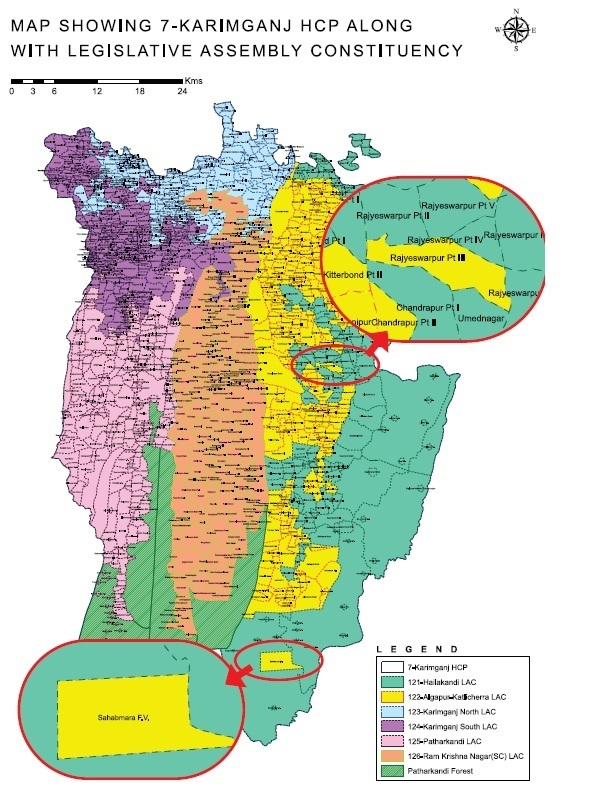
In Assam and J&K, where delimitation has been completed, the redrawing of constituencies has been done to arrive at geographically bizarre results. But this was done in a way that has separated Hindu and Muslim electorates from each other. Take a look at the map below of two constituencies from Assam, the one in green is Hailakandi, while the one in yellow is Algapur-Katlicherra. Both are in the Karimganj Lok Sabha seat.
Before the delimitation of 2023, three of the region’s seats – Algapur, Hailakandi and Katlicherra – were represented mostly by Muslim candidates from the Congress party or the AIUDF.
Now, pockets where Hindus live have been carved out from Algapur and Katlicherra and merged with Hailakandi, making it a seat where Hindu voters will hold sway. Meanwhile, areas where mostly Muslims live, like Sahabmara and Rajyeswarpur, have been carved out of Hailakandi and added to the Algapur-Katlicherra assembly.
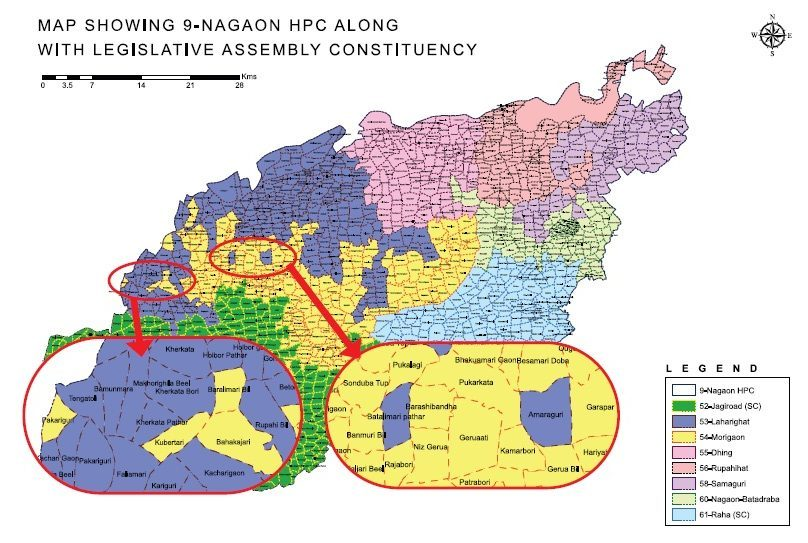
Secondly, within Naugaon Lok Sabha are two assembly constituencies, Morigaon and Lahariyaghat. Traditionally, Muslim candidates fielded by the Congress party have won from Lahariyaghat. Morigaon was a Hindu-majority constituency. Now, two Muslim-majority areas, Amraguri and Batalimari Pathar, have been added to Lahariyaghat, while other areas have been cut out and added to Morigaon, creating separate electorates out of Hindu and Muslim voters (See map below).
Pitting Muslims against SC/STs
In some instances, the Delimitation Commission has designated constituencies as reserved for SCs or STs even where these groups form a smaller share of the population than Muslims. Such decisions can have the effect of reducing Muslim representation in legislatures. For example, in Jharkhand, Ranchi has 15% Muslim and 30% tribal population, while Rajmahal has 45% Muslim and 20% tribal population. Between these two constituencies, Rajmahal and not Ranchi has been reserved as a tribal seat.
Discrimination against SC/STs
While some constituencies are reserved to enhance representation for SCs and STs, several Lok Sabha and state assembly seats with substantial SC and ST populations remain unreserved. This uneven allocation can limit the political representation of these communities.
In areas where SC and ST populations are significant, the absence of reserved constituencies can hinder leadership and weaken the articulation of their demands. Conversely, in constituencies reserved despite smaller SC populations, candidates often depend on support from other communities to secure victories. This dynamic can enable dominant caste groups to shape electoral narratives, limiting the space for elections to be fought on a strong Dalit agenda. Lok Sabha constituencies like Habibpur (West Bengal) that has a 489.% SC population, Aurangabad in Bihar with a 29% SC population or Hasan in Karnataka with 20% SC populations are among many such seats that, despite more than 15% SC share in their population, remain unreserved.
Endangering Southern states and federalism
Since constituency sizes were frozen in 1976 using 1971 census data, India’s population has grown alongside significant internal demographic shifts. This has led to stark disparities in representation. For instance, each Member of Parliament in Bihar represents roughly 3.1 million (31 lakh) people, while in Kerala the figure is about 1.75 million (17.5 lakh).
If delimitation is carried out after the next census based on a linear population criteria, southern states, which have been more effective in implementing family planning, could see their share of parliamentary seats decline relative to faster-growing northern states.
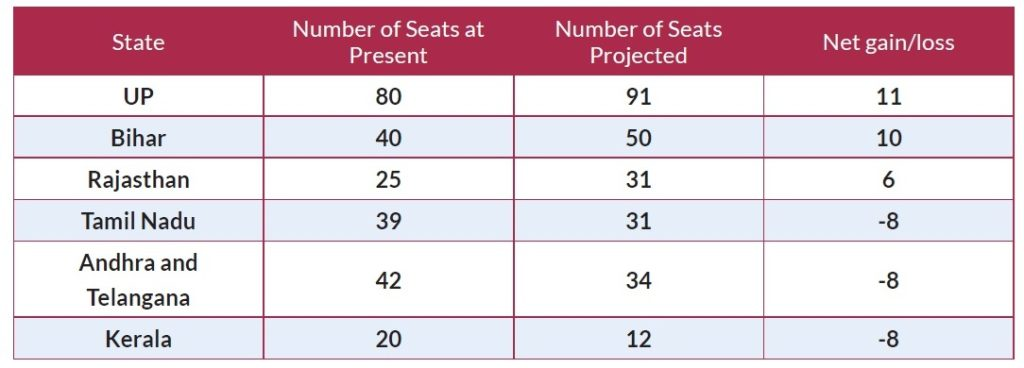
If the number of seats in Lok Sabha is retained at 543 and reapportioned among states based on the projected population in 2026, the differences between some North Indian and southern states will be significant, as the table below shows.
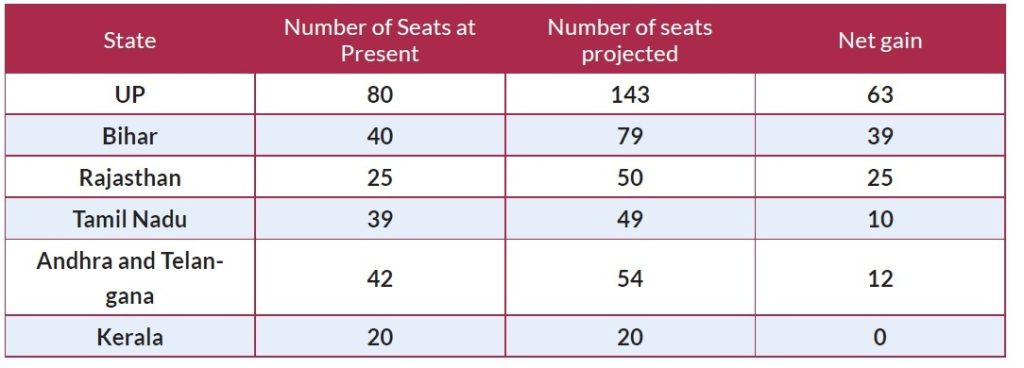
Further, if the strength of the Lok Sabha is expanded to 848, based on projected population figures for 2026 while maintaining proportional representation across states, the disparity between several northern and southern states would be as in the table below:
Alternatives ahead
One of the most progressive models of delimitation in the world is that of the European Parliament, which also has a mix of countries with very high populations like Germany (84 million) and small ones like Malta (0.54 million). Germany has over 150 times the population and has 96 seats (maximum cap), Malta, with significantly less population, has 6 seats (minimum guarantee).
In the European Parliament, currently, the FPS formula is used.
In it, F is a section of the seats (say 10%) that is distributed equally. So, the size of the European Parliament is 720, and 10% of that is 72, which is distributed among its 27 members. (0.10 × 720 divided by 27 = 2.67)
Next, P is proportionally, held according to population. So 50% of the seats, which is 360, is distributed according to population. So, total population of the European Union is 447,533,143 inhabitants, Ireland with 5,060,004, will receive seats of 0.50 × 720 × 5,060,004 divided by 447,533,143, which comes to 4.07.
Lastly, S is for the remaining 40% seats, which are determined by square root of the population of a country. The denominator here will be the sum of the square root of the population, which is 91,209. So for Ireland this will come to be 0.40 × 720 × √5,060,004 divided by 91,209 = 7.10.
So, in total, Ireland gets 14 seats, which is more than what Ireland received in the simple proportional distribution. In India, such a formula can be mandated to maintain an even proportion of states, converging their population, along with other axis.
Delimitation can create serious political and federal tensions in India
If based purely on population, delimitation will disproportionately increase representation for northern states while reducing the relative voice of southern states that have successfully controlled population growth. This risks undermining the federal balance and penalising better-performing regions. It can also intensify regional inequalities, fuel political resentment and shift policy priorities unevenly.
Gerrymandering of constituencies will harm the interests of SC, ST and Muslim populations. Eventually, it will create resentment over resource allocation between states and that will invariably affect inter-state relations and processes like inter-state migration for livelihood.
[This is a research report published by SPECT Research Association. The researchers include Banojyotsna Lahiri, Imran Ansar, Nadeem Khan and Rizak Mohammad. Courtesy: The Wire, an Indian nonprofit news and opinion website. It was founded in 2015 by Siddharth Varadarajan, Sidharth Bhatia and M. K. Venu.]
❈ ❈ ❈
Ambedkar, Rajaji’s Fears of North-South Divide Resonate in Modi Govt’s Delimitation Agenda
S.N. Sahu
The delimitation Bill being pushed through by the Modi regime in the ongoing special session of parliament by using the cover of the Bill for reservation of seats for women in the Lok Sabha and state assemblies hoodwinks the nation and egregiously violates the vision of two stalwarts of modern India, C. Rajagopalachari and B.R. Ambedkar.
Ambedkar warned in 1955, at the time of the reorganisation of States, that the way boundaries were being reset by creating huge states in the Hindi belt and the western part of India, and smaller states in the south, would lead to the perpetual domination of north over south.
In his book Thoughts on Linguistic States Ambedkar brought out the vast differences between north and south and asserted: “The North is conservative. The South is progressive. The North is superstitious, the South is rational. The South is educationally forward, the North is educationally backward. The culture of the South is modern. The culture of the North is ancient.”
Having outlined the positive attributes of the south in contrast to the regressive state of affairs of the north, he sharply asked: “How can the rule of the North be tolerated by the South? Already there [are] signs of the South wanting to break away from the North.”
Those utterances of Ambedkar’s are being echoed in the resentment of the chief ministers of Tamil Nadu, Kerala, Karnataka and Telangana against the delimitation Bill. They charge that the southern states have registered impressive progress in achieving much better human development indices and drastically controlling population growth in sharp contrast to the northern states, and yet are being penalised by reducing their share of Lok Sabha constituencies based on their lower population figures.
They persuasively argue that the delimitation Bill proposing to increase the number of Lok Sabha seats from 543 to more than 815 delimiting constituencies based on 2011 census figures would politically put southern states at a hugely disadvantageous position vis-a-vis the northern states.
According to The Hindu’s editorial of April 15,
“the Hindi heartland states (Uttar Pradesh, Bihar, Madhya Pradesh, Rajasthan, Haryana, Chhattisgarh, Uttarakhand and Delhi), which currently hold 207 of 543 seats, would secure 366 – a 77% increase, with their share rising from 38.1% to 43.1%. The southern states (Tamil Nadu, Karnataka, Andhra Pradesh, Telangana, Kerala and Puducherry), with 132 seats now, would receive only 176, a 33% increase, while their share would drop from 24.3% to 20.7%. The eastern states would slip from 14.4% to 13.7%; the Northeast from 4.4% to 3.8%.”
All these clearly prove that the political domination of northern states, where the BJP is in power, would be further perpetuated over the southern states, with no incentives in sight for them for their noteworthy progress in the diverse fields of health, education, empowerment of women and population control.
Stalin’s warning
Therefore, Tamil Nadu chief minister Stalin in a video message issued a “final warning” to the Modi regime and sternly stated that if Tamil Nadu would be subjected to an extreme level of unfair treatment on account of the delimitation Bill, “you will witness a Tamil Nadu that you have not seen before” and that “India will once again witness the spirit of the Dravida Munnetra Kazhagam (DMK) of the 1950s and 1960s”.
In his angry outburst, Stalin resonates Ambedkar’s aforementioned anguished remarks: “How can the rule of the North be tolerated by the South? Already there [are] signs of the South wanting to break away from the North.”
Ambedkar and Rajagopalachari’s warnings
It is salutary to note that Ambedkar validated his remarks in the book Thoughts on Linguistic States by quoting Rajagopalachari, who while referring to the reorganisation of states had said on November 27, 1955: “It would be utterly wrong to fritter away national energy in [the] dispute over boundaries and divisions conceived in the drawing room and not on the background of conditions that have resulted historically.”
Those remarks of Rajaji’s assume greater significance when the boundaries of Lok Sabha constituencies are altered or their numbers increased on a proportionate basis without considering absolute numbers and that too without consulting chief ministers and other stakeholders. So, the imposition of the Modi regime’s decision on delimitation taken in a drawing room and imposed on the southern states is like playing with fire.
Ambedkar recalled Rajagopalachari’s warnings regarding the federal framework being proposed in the draft Constitution in the Constituent Assembly. He told Ambedkar:
“In such a federation the Prime Minister and President of India will always be from the Hindi-speaking area. You should have two Federations, one Federation of the North and one Federation of the South and a Confederation of the North and the South with three subjects for the Confederation to legislate upon and equal representation for both the federations.”
Ambedkar thought that Rajagopalachari’s ideas would lead to India breaking up along a north-south divide and so remarked: “We must do everything to falsify Mr. Rajagopalachari’s prophecy.”
That prophecy did not become a reality because successive prime ministers including Atal Bihari Vajpayee, in the words of Stalin, “froze delimitation – to preserve balance until the country evolved more evenly”.
The Modi regime is attempting to make that dire prophecy, which Ambedkar wanted to falsify in 1955, a reality. While doing so, Ambedkar expressed serious apprehensions that there could be a civil war in India on the basis of sharp cleavages between the north and south. He wrote:
“It must not be forgotten that there was a civil war in the USA between the North and the South. There may also be a civil war between the North and the South in India. Time will supply many grounds for such a conflict. It must not be forgotten that there is a vast cultural difference between the North and the South and cultural differences are very combustible. In creating this consolidation of the North and balkanisation of the South the Commission [States Reorganisation Commission] did not realise that they were dealing with a political and not a merely linguistic problem.”
Ambedkar’s words “time will supply many grounds for such a conflict” can be juxtaposed with the timing of the Modi regime’s delimitation Bill being pushed under the cover of the women’s reservation Bill. It has provided the ground for conflict, and the angry and justifiable outbursts from southern states clearly flag an irreconcilable north-south conflict of the kind Ambedkar and Rajagopalachari apprehended.
Delimitation is a political problem and should be handled with great deal of care and sensitivity.
Ambedkar expressed the view that the reorganisation of states based on language was not just a linguistic problem but a political problem. That view was reflected in Stalin’s remarks that “what we are witnessing today goes beyond delimitation; it is about how power itself is being restructured in one party’s advantage. Is this to strengthen democracy, empower women or recalibrate it for political convenience?”
Ambedkar prescribed in his book Thoughts on Linguistic States that to prevent a north-south civil war, huge states in the Hindi-speaking belt should be split into small states to prevent their domination of the south.
The sensitivity and understanding of the need to uphold the unity of India that those wise words represent are the need of the hour to defeat a delimitation process curated without following a deliberative and consultative process of lawmaking.
[S.N. Sahu served as officer on special duty to former President K.R. Narayanan. Courtesy: The India Cable – a premium newsletter from The Wire. The Wire is an Indian nonprofit news and opinion website. It was founded in 2015 by Siddharth Varadarajan, Sidharth Bhatia and M. K. Venu]