❈ ❈ ❈
Notes from Noida
C.P. Chandrasekhar
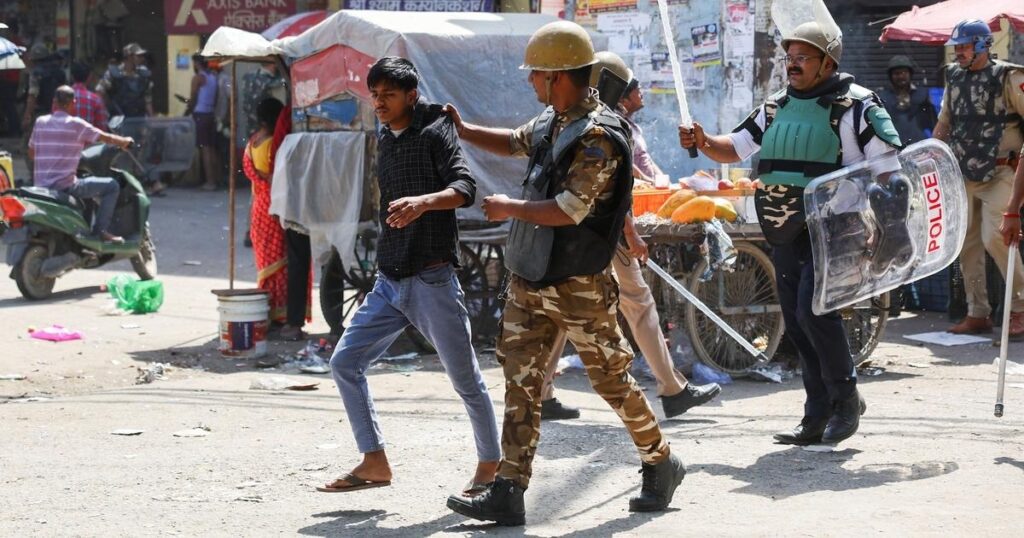
On April 13, 2026, a large number of factory workers in Noida, Uttar Pradesh—one of New Delhi’s suburban industrial centres—took to the streets. They were protesting against low wages and poor working conditions. Details on what followed remain hazy, with the protesters charging that the police attacked them without provocation and the police claiming that the protesters turned violent, necessitating action.
What is noteworthy is that protests by workers in Haryana against a measly increase in wages recommended by the State government had preceded the stir at Noida. In Noida, the initial protest involved workers from multiple factories who had been coordinating and mobilising through social media. It soon spread across a cluster of factories in unrelated industries and brought domestic workers, many of whom are poorly paid and treated badly by their employers, into the fray. The protests signalled resentment that runs deep and is quite widespread.
The workers have a strong case. Many are paid as low as Rs.10,000 to Rs.11,000 a month for 12-hour shifts on working days. Being contract workers hired through agents, many of them lack security of tenure and any social security benefits. Even the benefits due to them are not provided by employers. And norms on payments for overtime work are ignored. In addition to being treated badly in the workplace, workers find it difficult to meet basic needs. When any new shock is felt, such as the rise in fuel prices following the US-Israeli war against Iran, life proves unbearable, and the situation turns volatile. The implicit violence at work spills over as violence on the streets.
What fuels anger further is evidence of the huge differential between the benefits derived and lifestyles led by employers and privileged managers and the earnings and standards of life of workers in these relatively newer business enclaves, which reflect the new modes of doing business in neoliberal India. These enclaves are populated with units relying on unskilled workers or those with “lower-valued” skills, which, when successful, deliver large profits by riding on low wages and poor working conditions in a country plagued by precarity because of high under-employment, inadequate education, and laws that do not preclude or even permit the recognition of violations by employers and managers.
Moreover, the state that is expected to mediate to improve workers’ wages over time by raising the minimum wage floor it sets has failed to do so. By definition, the minimum wage consists of a basic component and a component linked to the consumer price index to be adjusted for inflation. The basic component, which is expected to be adjusted upwards at least once in five years, was last revised in Haryana and Uttar Pradesh more than a decade ago. The perception of collusion between state actors and private employers is, therefore, strong.
It does not help that an authoritarian government apparatus that favours factory owners keeps worker dissent suppressed and discourages trade union activity. With little space for a negotiated and reasonable settlement of grievances on a routine basis, spontaneous “revolt” is the vent for accumulated worker anger.
As far back as 2012, in Manesar, another NCR suburb, in the factory of the auto major Maruti Suzuki, worker anger led to violent protests that resulted in the death of a human resources manager. Then, too, the workers had a case. State reprisal was brutal, and the management opted for a lockout and sought to set an example of what could happen to workers following such protests: more than 500 permanent workers and close to 2,000 contractual workers, many of whom were not even identified by the police as protesters, lost their jobs. Even today, some of them return to protest and demand reinstatement and compensation, with no success.
Shifting the blame
The Uttar Pradesh government’s response to the recent Noida protests is revealing. On the one hand, it implicitly admitted that workers were being exploited—by notifying a 21 per cent increase in minimum wages for workers in the State (much lower than what the workers are demanding) and promising a scrutiny of working conditions—and, on the other, it attributed the protests to conspiracies hatched by “outsiders” who were aiming to sully the good name of the State government, no less.
The government of Uttar Pradesh has, according to an official statement, “constituted a high-level committee with the objective of establishing effective dialogue with the concerned stakeholders and maintaining industrial harmony and law and order”. The district administration is threatening to cancel the licences of 203 contractors, blacklist them, and require them to pay workers dues in excess of Rs.1 crore. The attempt is to blame the contractors rather than the system.
Meanwhile, Uttar Pradesh Chief Minister Yogi Adityanath declared that when “the double engine government under the leadership of Prime Minister [Narendra] Modi” was striving to create an environment of “development and peace, some people are trying to create unrest through conspiracies”. The DGP claimed that “provocation” by “external elements” led to the protests. Claiming that his “government stands with workers”, the Chief Minister promised “protection to every worker” and “proper remuneration for them”. Given their experience, workers are not convinced.
It is more than likely that the workers arrested will be held for a long time and be deprived of their jobs, as happened in Manesar many years ago. Meanwhile, employers and contractors are likely to escape being penalised.
The evidence is telling. Under neoliberalism, collusion between the state and private capital facilitated profit inflation at the expense of the living standards and working conditions of undervalued workers during the years when inflows of foreign financial capital and debt drove an artificial boom. There are multiple signs that the boom is giving way to a downturn.
This is likely to justify use of the exploitative apparatus constructed during the boom to sustain profitability. New rounds of violence at work and on the streets seem inevitable.
[C.P. Chandrasekhar taught for more than three decades at the Centre for Economic Studies and Planning, Jawaharlal Nehru University, New Delhi. He is currently a senior research fellow at the Political Economy Research Institute, University of Massachusetts Amherst, US. Courtesy: Frontline magazine.]
❈ ❈ ❈
The Workers Who Keep India’s Cities Running Have a Simple Message – Pay Us Living Wages
Rajiv Khandelwal
The protests by workers across Indian cities through early April are an urgent signal that survival is impossible on wages that hover around the bare legal minimum.
Domestic, gig and delivery workers to industrial labourers in the Delhi-National Capital Region protested demanding an increase in wages and overtime pay. Most of them are often migrant workers to India’s urban centres.
The spark was the increase in basic expenses following the shortage of cooking gas and economic uncertainty after the US-Israel launched military strikes on Iran in February, setting off a conflict which is now closing in on two months.
In Noida, protesting workers told the Indian Express that their monthly salaries ranged from Rs 13,000 to Rs 20,000 but expenses had increased, with rent costing Rs 5,000 and food Rs 4,000, and nothing to save. One factory worker in Noida told a news publication that his employer hiked his monthly pay by Rs 39. Worse still, workers report deductions as punishment for protesting and their wage demands were met with batons.
Across urban India, the numbers tell the same story.
Domestic workers manage to earn anywhere between Rs 7,000 – Rs 12,000 a month by working in multiple homes, with no leave or social security in the National Capital Region, says a report in the Hindustan Times. Security guards working at Delhi’s leading hospitals earned between Rs 10,000- Rs 13,000 a month for 12-hour shifts, according to a report in Hans India.
In upscale malls and fast-fashion outlets, retail workers start out by earning Rs 9,000- Rs 13,000, with sales targets that stretch their workday without pay. Delivery and warehouse workers, who form the backbone of “quick commerce”, report earning between Rs 14,000-Rs 18,000 after 10-12 hours of work. Anecdotal evidence suggests that private drivers in NCR average around Rs 15,000-Rs 22,000.
These earnings fall short of the living-wage estimate of Rs 23,086 per month in Delhi-NCR in 2025 by the Anker Research Institute, a nonprofit that researches benchmarks for wages across countries.
At the same time, India’s national floor level minimum wage was last revised in 2017 to Rs 178 a day, which amounts to less than Rs 5,500 per month. The Centre sets the national floor wage as a benchmark to guide states in setting their own minimum wages. Without revisions to reflect increasing costs and inflation, the low minimum wage has practically legalised poor pay and enabled a race to the bottom.
Aajeevika’s study, carried out between July 2024 and February 2026 in Ahmedabad, shows how low wages are inadequate to sustain a dignified life. The current wage frameworks assume that workers and their dependents form a single household in one location. However, migrants’ realities are “bilocal”: their wages must sustain their life in the city while remittances are essential to support their native villages and homes.
Strained incomes have unsurprising consequences: debt, unhygienic and cramped living conditions and compromising on healthcare and education, which results in children being pulled into work.
The workers’ protests also erupted months after the Centre’s four labour codes came into effect in November 2025. The government has said the four new codes modernise and consolidate India’s labour and worker-related laws. But workers’ rights organisations have warned of a dilution in labour protection and rights.
The same month, amendments to the Uttar Pradesh Factories Act were enforced which allowed the government to extend the workday to 12 hours and raise quarterly overtime limits from 75 to 144 hours. The NCR’s Noida industrial hub comes under the jurisdiction of Uttar Pradesh.
In response to the protests, state governments have marginally revised wages. Uttar Pradesh raised wages for unskilled workers to Rs 13,690, Haryana to Rs 15,221. Both are far below conservative living-wage benchmarks and well short of the Rs 26,000 long demanded by unions. These wage revisions also come after years of inflation, and it is unlikely that they are enough to meet current expenses.
Why businesses must pay more
It might seem profitable to keep wages low, but it is a liability. It sparks frustration and unhappiness among workers, leads to their exit and drives up costs through recruitment and training expenses while lowering service quality.
Stable wages guarantee dignity and lower attrition, while fixed hours reduce errors and fatigue. Predictable hours will reduce defects and returns. Workers who can afford transport show up on time. Those who can eat and sleep well sell better, drive safer, and stay. Paying fair wages is far from a charitable act. Corporations must weigh the costs of increasing wages or grappling with the costs of lost output and other losses.
Setting minimum wages
Faced with labour unrest and the increasing cost of living in expenses in the midst of global economic turmoil, the government must reframe minimum wages to living wages. It must notify a time-bound roadmap to reach city-wise, Anker living-wage benchmarks with annual increases based on inflation. The national floor level minimum wage must also be revised urgently.
Enforcement often becomes the main failure. Here, governments must cap the workday at eight hours, ensure overtime is voluntary and paid at double rates, bring about digital muster rolls and wage slips. Non-payment of wages must become a cognisable offence, which means police can begin investigations and make arrests as the relevant laws.
Wages must also be accompanied by social security nets. Welfare benefits like insurance and provident fund should be portable across states and employers.
Grievance systems should work on the ground: district wage-facilitation cells with a 30-day disposal rule, protection against retaliation, dialogue before detention, and quarterly compliance disclosure. The state must also stop underwriting low wages through its own contracts, by demanding, for instance, Rs 20,000 but paying Rs 13,000 in its tenders.
The workers’ anger is grounded in the desperation of surviving from day to day. Their demands for a minimum of Rs 20,000 per month and overtime are modest given the cost of living in the capital of India.
From factory and industry workers to the labourers who deliver food and groceries and clean homes, it is their sweat and effort that is central to making Indian cities what they are today.
[Rajiv Khandelwal is the co-founder and Director of Aajeevika Bureau, a workers’ rights and services organisation supporting migrant and informal workers everywhere. Courtesy: Scroll.in, an independent Indian digital news platform launched in 2014, known for explanatory journalism, investigations, culture writing, and in-depth coverage of politics, society, and human rights. Its English edition is edited by Naresh Fernandes.]
❈ ❈ ❈
Noida: High Profits, Stagnant Wages, and a City on Edge
Narender Thakur, Abhinav Singh
The twin engines of high growth and rising corporate profits in India’s industrial heartland have long been celebrated. But beneath the glossy facade of Uttar Pradesh’s manufacturing hubs in Noida, a starkly different story is unfolding—one of stagnant wages, exploited contract labour, and simmering anger that erupted into violence on April 13, 2026.
We have undertaken a new ground-level study by interviews of workers in NOIDA Sector 15, which paints a troubling picture of both macro and micro conditions for workers in the National Capital Region (NCR). The central finding is urgent and clear: real wages have barely budged for decades, while the cost of survival has skyrocketed. The study argues that for Noida—part of the national capital territory or NCT—the only just solution is to immediately adopt the minimum wage standards of neighbouring Delhi.
Macro Picture: Profits Soar, Workers Stagnate
At the aggregate level, the Indian organised industrial sector presents a paradox of prosperity for capital and penury for labour. Using data from the Annual Survey of Industries (2026), the authors of the study show that capital per factory skyrocketed from Rs. 494 lakh in 2006-07 to Rs. 1,778 lakh in 2023-24. Profits per factory followed suit, rising from Rs. 167 lakh to Rs. 413 lakh over the same period. Yet, wages per factory crept up at a snail’s pace—from Rs. 61 lakh to just Rs. 276 lakh.
Even more damning is the employment figure: the average number of workers per factory remained virtually frozen, moving from 71 to 75 over nearly two decades. This is not a story of job creation; it is a story of capital deepening without labour benefit.
The human consequence of this is casualisation of the workforce. The share of contractual workers in the organised sector has exploded from 13% in 2000 to 42% in 2023-24. Contractors, as the study later found on the ground, act as a buffer to suppress wages, evade responsibility, and deny benefits—leaving workers with no job security, no paid leave, and no bargaining power.
Furthermore, the wage growth for all workers has been grim. Using data from the State of Working (2026), the study notes that the lowest growth in salaries and wages for both young (20-29) and older (30-64) workers occurred during 2017-2023. Women, already paid less than men, have fared even worse.
Micro Reality: Voices From Factory Floor
To understand the human face of these numbers, we conducted field work in Noida’s Sector 15 industrial area during the April protests. The interviews reveal a systemic architecture of exploitation.
A 22-year-old worker, a 6th standard pass-out, earns Rs. 18,000 per month working 10-hour a day at a snack outlet in the Metro station of Noida Sector 15. He supports the demand for doubling overtime wages. Another factory worker, fearful of a security guard, whispered that he earns just Rs.10,000/month for eight hours of daily labour.
The most harrowing account comes from a young woman, a 12th pass from Pauri Garhwal, who recently resigned from Motherson, a major auto parts manufacturer. Despite working 10 hours daily for six months, she earned only Rs. 9,000 per month. Her monthly travel cost from Dwarka (30 km away) was Rs. 5,000, and a single LPG cylinder for cooking cost another Rs. 5,000. “My expenses exceeded my entire salary,” she told the researchers, explaining why she walked away.
A driver-porter for Motherson, working 24-hour shifts with his nephew, earns Rs. 20,000 per month after fuel costs. He was unequivocal in his diagnosis: “Workers are being exploited by contractors… paying very lower wages of Rs. 10-12,000. The factory forces long 10-12 hours of work and does not pay for overtime. Removal of contractors can lead to better wages.”
Tinderbox: Violence, Arrests, Demand for Delhi’s Wage
The protest on April 13, 2026, was not spontaneous. Outside Motherson, researchers documented broken CCTV cameras, shattered window glass, and stone-pelting. An ice cream vendor recounted how 500 workers had gathered, demanding Rs. 20,000 per month—a 35% hike recently announced by the Haryana government for its workers.
The state’s response was swift and heavy. Police invoked prohibitory orders under Section 144 of the CrPC (now Section 163 of the Bharatiya Nagarik Suraksha Sanhita – BNSS) for maintaining law and order in Noida and Greater Noida. The study’s authors met family members of arrested workers outside the Deputy Commissioner of Police’s office. One worker’s younger brother described how his sibling was arrested without evidence. Families from as far as Hathras, Uttar Pradesh, were paying advocates Rs. 8,000-10,000 per bail. In one case, a single lawyer had collected Rs. 3 lakh from 100 workers—each paying Rs. 3,000.
What do the workers want? The notice pasted on Motherson’s gate after the protests shows revised wages: Rs. 13,690 for unskilled, Rs. 15,059 for semi-skilled, and Rs. 16,868 for skilled workers. But this is far below the prevailing minimum wage of Delhi: Rs. 18,456, Rs. 20,371, and Rs. 22,411, respectively. Even Haryana’s new rates (Rs.15,221 for unskilled) are higher than Motherson’s offer.
The Way Forward: A Policy Imperative
We can conclude that the current trajectory is unsustainable. With global recessionary pressures, war-induced inflation, and a spiralling LPG cost (a 12kg cylinder was reportedly priced between Rs. 3,600 to Rs. 4,800 in the grey market), workers simply cannot survive on current wages.
The solution, the study argues, based on macro and micro labour markets, is neither radical nor new. The Central and Uttar Pradesh governments must immediately intervene to set a minimum wage for Noida-based on the Delhi benchmark. Delhi and Haryana minimum wages can be the benchmarks for revising the minimum wages in Noida and other areas of NCR in Uttar Pradesh, like Ghaziabad and Faridabad, for ensuring peace and harmony.
If policymakers ignore this warning, the violence of April 13 may be only a prelude. When profits triple but wages flatline and stagnant employment with increasing contractual workers, when a day’s work cannot buy a week’s meal, the factory floor will inevitably become a battlefield. The choice is simple: a just wage today, or a larger crisis tomorrow.
[Narender Thakur is a Professor and Abhinav Singh, is a student of BA (Hons.) Economics 8th Semester, Department of Economics, Dr. Bhim Rao Ambedkar College, University of Delhi. Courtesy: Newsclick, an Indian news website founded by Prabir Purkayastha in 2009, who also serves as the Editor-in-Chief.]
❈ ❈ ❈
In India, Minimum Wages Exist Only on Paper
Utkarsh Mishra
India has a minimum wage. Delhi has one of the highest legal minimum wage rates in the country, Rs 763 per day for unskilled workers, which was revised upward in October 2025. The national floor wage, set under the Code on Wages, 2019, is Rs 375 per day for urban workers. These are legal minimums, not goals. Paying below the minimum wage is a crime under the Minimum Wages Act, 1948.
On many construction sites in Delhi, women earn about Rs 412 per day. In garment clusters and home-based work, daily wages often range from Rs 250 to Rs 300. The law is in place, but the wages are not.
This issue is not new. In construction, garments, and agricultural labour, the gap between what workers should be paid and what they receive has been wide for decades. Notifications get updated. Committees provide reports. Workers remain underpaid.
The Promise on Paper
The Code on Wages, 2019, is one attempt to streamline wage law. It combines four older laws, expands coverage to all workers regardless of industry, and requires a national floor wage that no state can go below. The Anoop Satpathy Committee, created to recommend the floor wage, completed its task. Notifications have been issued.
The government’s e-Shram portal has registered over 30 crore unorganised workers, suggesting that the system is finally reaching the people it was meant to help. However, registering on a government portal and receiving a legally required wage are two very different things.
What Workers Are Actually Paid
Finding data on actual wages is easy. It mainly comes from government surveys. According to the PLFS 2023-24, 61 per cent of women workers in non-agricultural sectors work in informal businesses. The ILO’s April 2025 report on women in India’s construction sector found that women earn an average of Rs 412 per day, compared with Delhi’s minimum of Rs 763 for unskilled work. That’s a gap of almost 46 per cent.
For men in general, unskilled construction work, actual wages are higher than what women earn, but they still fall below the legal minimum. In garments and home-based work, where women make up most of the workforce, earnings of Rs 250 to Rs 300 daily against a national floor of Rs 375 are common.
Workers from Jharkhand, Bihar, and Odisha make up a large part of Delhi’s construction labour. They are far from home, often unknown to local labour offices, and depend on contractors who usually take a cut of their wages before passing anything on. The person who received Rs 412 started out as someone who owed Rs 763.
Why Enforcement Has Not Worked
The Minimum Wages Act allows inspectors to check compliance and penalise violations. The penalty can be a fine of up to Rs 5,000 and imprisonment of up to six months for each violation. It’s evident that this system has failed. The important question is why.
The structural issue lies in where inspectors actually go. India’s labour inspection system focuses on registered businesses such as factories, shops, and offices. The informal sector, which makes up over 90 per cent of the workforce and about 45 per cent of GDP (MoSPI, 2025), lacks similar oversight. Construction sites, home-based garment work, and agricultural labour are where wage theft happens most often and where labour inspectors are least available.
The e-Shram portal does not cover this gap. It tracks registration, not wages. Over 30 crore workers are enrolled, but none have had their wages verified through it. The Equal Remuneration Act, 1976, requires equal pay for equal work, but is commonly violated at informal work sites. Prosecutions are rare to the point of being practically nonexistent.
CEDA, Ashoka University, in its October 2024 analysis of PLFS data, found that the recent increase in female labour force participation is mostly due to unpaid helpers and distress-driven self-employment.
Where Some States Do Better
Kerala and Tamil Nadu provide a clear contrast to what happens in Delhi and Uttar Pradesh. Both states have more active labour welfare boards, a stronger union presence in key sectors, and a longer history of labour inspections that extend into informal work. Minimum wage compliance in both their formal and semi-formal sectors is not perfect, but it’s significantly better.
Delhi’s minimum wage rates are among the most progressive in the country. However, the enforcement does not match that ambition. Budget allocations for labour inspection have not kept up with the growing informal workforce. The Labour Department updates wage orders biannually. The ability to check whether contractors on Delhi’s public infrastructure projects pay those wages is effectively absent.
What Would Actually Change Things
Linking wage payments to UPI or creating direct benefit transfers to registered workers would provide a transaction record that inspectors could review. This is technically feasible and would cost relatively little compared to the scale of underpayment happening now. Contractor blacklisting, which prohibits contractors found in violation from participating in public projects, is already part of the law but is rarely used.
The Building and Other Construction Workers Act welfare boards have, over three decades, accumulated over Rs 1.17 lakh crore in cess collections nationally. A small portion of that, used for wage monitoring and grievance mechanisms for construction workers, would be more effective than another round of notification updates.
Reviving the labour inspector working and that does not require new laws. The authority is already in place; it just needs a redefinition of where inspectors go. Currently, they focus on where employers are registered. They need to go where the workers are.
A minimum wage unobserved by employers is a hollow promise. It is merely a figure on a government notice, circulated for press releases or compliance checks, while on the ground, workers remain deprived and the law is disregarded.
Until enforcement reaches the workplaces where violations persist, the reality will continue to contradict what was promised to the workers in the first place. Minimum wage must become more than policy- it must be delivered where it matters most.
[Utkarsh Mishra is a journalist who writes on law, labour, gender, and migration. His work has appeared in The India Forum, Feminism in India, and Zee Media. Courtesy: Countercurrents.org, an India-based independent online journal founded in 2002, publishing articles on peace, democracy, social justice, ecology, secularism, and people’s movements. Edited by Binu Mathew, it is known for giving space to progressive, grassroots, and alternative voices often ignored by mainstream media.]