❈ ❈ ❈
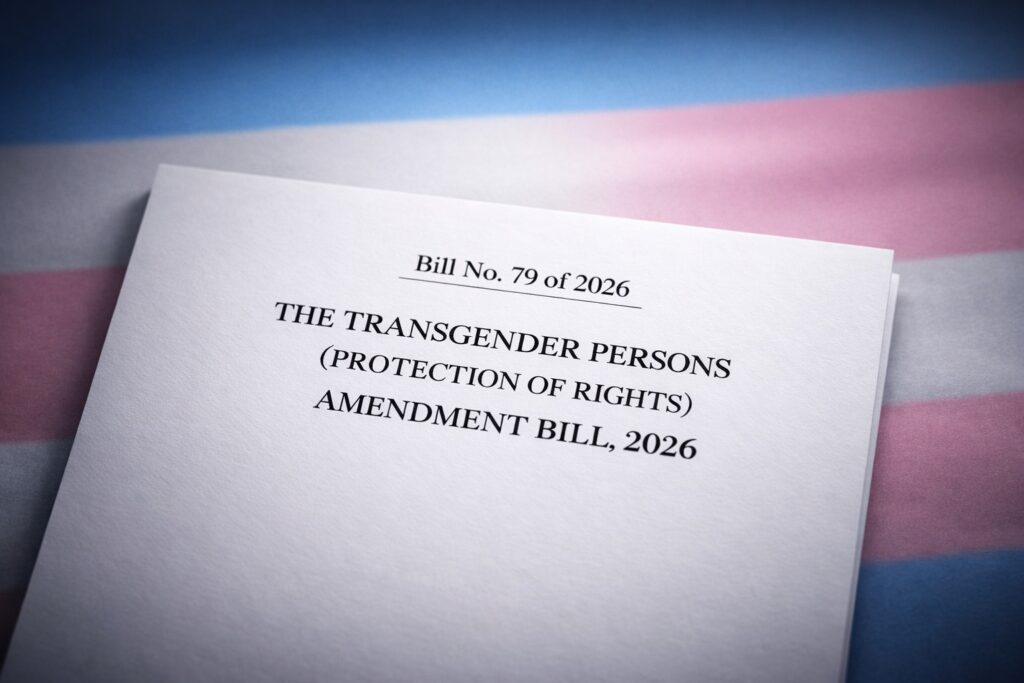
‘Withdraw Transgender Persons (Protection of Rights) Amendment Bill, 2026 Now’
Sabrang India
The Transgender Persons (Protection of Rights) Amendment Bill, 2026 represents a shocking attempt to take back the hard won rights of the transgender community. The aim of the amendment is to destroy the framework set by the Supreme Court in its historic decision in National Legal Services Authority – NALSA v Union of India which recognised the self-definition of gender and set in place the legal recognition of the rights of the transgender community. The Karnataka State Gender and Sexuality Minorities Coalition for Convergence (the Coalition) has issued a strong press statement against the Modi 3.0 governments tabling of the Transgender Persons (Protection of Rights) Amendment Bill, 2026.
In a detailed critique of the amendments, the Coalition states that the dilution and destruction of the framework outlined in the historic 2014 judgement of the Supreme Court in its National Legal Services Authority-NALSA v Union of India verdict has been achieved in the amendment bill
“through its proposal to narrow the definition of transgender in Section 2 (k). As per the proposed definition, transgender person is limited to ‘socio-cultural identities such as kinner, hijra, aravani, jogta or eunuch’ or those with ‘intersex variations at birth’. It also includes persons who have by ‘force’ been made to ‘present a transgender identity’. It specifically excludes, ‘persons with different sexual orientations and self perceived sexual identities’.”
The amendment seeks to take away the right of a transgender person to self-identification. This is made clear by the omission of Section 4 (2) of the 2019 Act which read, ‘A person recognised as transgender under sub-section (1) shall have a right to self- perceived gender identity’.
The statement of objects and reasons makes clear that the aim of the amendment is to exclude. As it notes, ‘The purpose [of the amendment] was and is not to protect each and every class of persons with various gender identities, self-perceived sex/gender identities or gender fluidities.’ The 2026 amendment will ensure that protection of the law is only extended to ‘those who face severe social exclusion due to biological reasons for no fault of their own and no choice of their own.’
This amendment instead of expanding the rights of the transgender community contracts it. Under this amendment, all the rights which transmen enjoyed will be taken away as transmen are no more considered transgender as far as the law is concerned. Moreover, under the amendment, no person can identity as a transwoman either. The only option for a transgender person under the law is a traditional identity. Those who see their identity on a spectrum fall outside this conservative new definition proposed by the amendment. These are the strong critical arguments advanced by the Karnataka State Gender and Sexuality Minorities Coalition for Convergence (the Coalition).
Even for those who fall within the narrow definition of transgender, the ability to change one’s gender is made far more difficult. The amendment makes it mandatory for a person to get a certificate from a medical board to be appointed by the government, essential for getting identity as a transgender. However, even after getting such a certificate, the District Magistrate has the discretion to grant recognition.
The Coalition has made a strong plea and pitch that this amendment should be opposed as it strikes at the root of self-identification and is therefore completely at odds with the rights recognised under NALSA v Union of India. Finally, the press statement says that, the transgender community strongly asserts that it will not allow the rights recognised by NALSA and the Trasngender Act, 2019 to be taken away by an amendment. Passing this amendment will put in jeopardy the rights of thousands and lakhs of persons who are currently recognised as transgender. It will limit the right to self-identification for newer generations and represents a set-back in the struggle for transgender rights.
Strong protests are likely against the union governments move. The statement has been issued by the Members, Karnataka State Gender and Sexuality Minorities Coalition for Convergence and Akkai Padmashali Prakashi Abeda Begum Pruthvi Rakshitha Monika.
Meanwhile, the People’s Union for Civil Liberties (PUCL) has also issued a statement condemning the Transgender Persons (Protection of Rights) Amendment Bill, 2026 as unconstitutional and demanding its immediate withdrawal. The PUCL statement says that the amendments proposed in the Transgender Persons (Protection of Rights) Amendment Bill, 2026 constitute a gross dilution of valuable rights provided under the Transgender Persons (Protection of Rights) Act, 2019 and shall result in exclusion of a large number of Transgender Persons from its ambit, denial of their constitutional and statutory rights and targeting their support system.
The Union Social Justice and Empowerment Minister, Dr. Virendra Kumar introduced the Transgender Persons (Protection of Rights) Amendment Bill, 2026 (“the Bill”) in Parliament on March 13, 2026. The Bill was not released in the public domain for scrutiny and consultation. The Bill is regressive and nothing but a shocking attempt to take back the hard won rights of the transgender community. The aim of the proposed amendments, says the PUCL, also, is to destroy the framework set by the Supreme Court of India in its historic decision in NALSA v Union of India (2014) which recognised the right to self-identification of gender by transgender persons and set in place the legal recognition of the rights of the transgender community.
Narrowing of the definition of transgender persons who are entitled to protection by the law
The Bill fundamentally alters the scope of the Transgender Persons (Protection of Rights) Act, 2019 (“the Act”) by diluting the existing definition of a transgender person under Section 2 (k) of the Act and replacing it with a reductive definition of a transgender person. This tantamount to changing the law altogether and excluding a large number of transgender citizens from the ambit of the law, which is a shocking development.
The amendment at its heart seeks to take away the right of a transgender person to self-identification, which was recognised under the 2019 Act. This is made clear by the deletion of Section 4 (2) of the 2019 Act which read, ‘A person recognised as transgender under sub-section (1) shall have a right to self- perceived gender identity’.
According to the new definition, only three groups are entitled to the protection of the law, namely
- Someone from the traditional socio-cultural Trans groups like Kinnars, Jogtis, Hijras, etc.
- Intersex people
- Or a person who has been “by force, allurement, inducement, deceit, or undue influence” been subject to “mutilation, castration, amputation or emasculation” and forcibly made to present “a transgender identity” can be considered a transgender person under this new bill.
A proviso has also been added to specifically exclude persons with different sexual orientations and self-perceived sexual identities.
This amendment instead of expanding the rights of the transgender community dilutes it significantly. By way of this amendment, all the rights which transmen enjoyed will be taken away as transmen are no more considered transgender as far as the law is concerned. Moreover, under the amendment, no person can exercise their right to identify as a transwoman either. The only option for a transgender person under the law is a traditional identity. Those who see their identity on a spectrum fall outside this conservative new definition proposed by the amendment. Thus the law expressly discriminates against Trans men, trans women, genderqueer and non-binary persons, because of the narrow definition of transgender persons which the proposed law adopts.
Discriminatory intent of the 2026 amendment
The Objects and Reasons of the Bill goes on to underline that the legislative policy has been formulated to only protect those who “face severe social exclusion due to biological reasons for no fault of their own and no choice of their own.” It then goes on to state that the purpose of the Act was not to “protect each and every class of persons with various gender identities, self-perceived sex/gender identities or gender fluidities.”
This goes against the historic NALSA judgement which recognised the right of transgender persons to determine one’s own gender identity as integral to lead a life with dignity as recognised under Article 21 of the Constitution. It also emphasised that while discrimination on the ground of “sex” is prohibited under Articles 15 and 16 of the Constitution, sex here does not only refer to biological attributes but also one’s self-perceived gender.
Further, states the PUCL, the Bill is premised on an entirely false assertion that the intent of the 2019 Act was not to protect all categories of transgender persons, self perceived sex/gender identities and gender fluidities, in as much as the 2019 Act categorically included all transgender persons, including self-perceived gender identities and did not make any distinction or exclusion on the basis of self-perceived gender or sexuality. This is also clear from the Statement of Object and Reasons of the Transgender Persons (Protection of Rights) Bill, 2019, which clearly acknowledged that it was being introduced in compliance of the directions of the Supreme Court of India in the NALSA judgment and further stated under clause 4 (c) that the 2019 Bill sought to “confer right upon transgender persons to be recognised as such, and a right to self-perceived gender identity”.
Accordingly, the `Statement of Objects and Reasons’ of the 2026 amendment Bill by itself reveals the falsely-premised regressive and unconstitutional intent of the proposed law. The Bill discriminates upon a large category of transgender persons by denying them the right to be legally recognised by their gender identity.
Till date only around 37000 people have been registered on their portal in the six years since the Act came into operation. There has been little intent displayed by the government to implement the Act. Instead of ensuring that the transgender persons are legally recognised and benefit from the provisions of the Act, the law is being diluted on the excuse of this very non-implementation and claiming that the object of the Bill is that the enactment “works towards only those who are in actual need of such protection”.
The 2026 amendment also introduced a fresh set of hurdles introduced for legal recognition of transgender identity.
Even for those who fall within the narrow definition of transgender, the ability to change one’s gender is made far more difficult, by bringing in amendments to Section 6 and 7 of the Act. The amendment makes it mandatory for a person to get medical certification, for getting a certificate of (transgender) identity. However even after getting such a certificate, the District Magistrate has the discretion to grant recognition or reject it.
The point to be noted is that even if the law is meant for the restrictive category of so called traditional identities of ‘kinnar, hijra, jogta and aravani’, those who come within this category still have to go through the hoop of getting a medical certificate. The question of mandating even hijras to get a medical certificate does grave violence to the notion of a traditional identity itself. This provision in effect puts forward a medical test to identity if a person belongs to a socio-cultural identity which has existed even prior to the advent of modern medicine!
This will make it highly difficult for transgender persons to obtain a certificate of identity and get legal recognition of their rights. Instead of making the process easier for transgender persons, so they can avail of and assert their rights under the Act, the government has increased the obstacles for transgender persons to gain legal recognition. This is highly discouraging and will only impede the implementation of the Act, which has in any case been poor.
By removing self-identification and introducing the requirement for medical certification, the state is taking over the role of deciding the gender identity of a transgender person. This not only stands in complete violation of the NALSA judgment and upturns the fundamental basis of the 2019 Act, but infringes upon the constitutional rights guaranteed to citizens under Articles 14, 15 and 21 of the Constitution.
Criminalisation of support groups and chosen family of transgender persons
Under the Offences and Penalties chapter, the Bill proceeds to amend Section 18 of the Act. Under the proposed Section 18 (e) and (f), an offence of kidnapping and abduction has been added under the pretence of protecting adults and children. However this provision can be weaponised to target support structures and individuals that provide help to transgender individuals facing abuse and rejection by their natal families. Thus, even with respect to traditional communities, the approach of the amendment is tinged with suspicion and capable of misuse to target chosen families. The offence of kidnapping and abduction introduced by way of the amendment should be with the intention to compel the adult / child to assume, adopt or outwardly present transgender identity through ‘force, allurement, deceit, undue influence or otherwise’ by ‘emasculation, mutilation, castration, amputation or any surgical, chemical or hormonal procedure’. The broad wordings of the section enable its misuse against any person supporting a transgender person in their attempt to undergo sex change / reassignment procedures or to outwardly present themselves as transgender. Moreover, it infringes upon the right to privacy, choice and autonomy of transgender persons, foregrounding a stereotypical understanding of transgender identity as based on coercion, inducement, fraud and violence, and not on personal choice.
Similarly under the proposed Section 18 (g) and (h) new offences have been introduced for compelling an adult/child by ‘force, threat, coercion, allurement, deception, inducement, or undue influence’ to dress, present or conduct themselves outwardly as a transgender person. The irony of this offence sought to be introduced is that, it is in fact transgender persons who are often subjected to violence, discrimination and abuse, and are compelled to hide their transgender identity rather than to assume it. The provisions are reminiscent of the colonial Criminal Tribes Act, 1871 that criminalised transgender persons for appearing dressed or ornamented as women. The provisions are capable of misuse against the support systems of the transgender person, outside of their natal families, and can put the transgender person to further risk.
The approach of the amendment is thus tinged with suspicion even towards those it unequivocally claims to protect, namely the traditional communities. The amendment in fact defines transgender to include those who are ‘forced’ or ‘induced’ to ‘present a transgender identity’ by ‘emasculation, mutilation or castration’. It seeks to punish such persons who cause ‘mutilation, emasculation, amputation or castration’. This amendment by foregrounding ‘coercion’ as an essential dimension of the transgender identity, does violence to the element of choice and foreground a stereotypical understanding of transgender identity as based on coercion, fraud and violence not on choice.
These newly added offences which can be misused against supportive individuals and chosen families of transgender persons are punishable with rigorous imprisonment from 5 to 10 years going up to life imprisonment, the offences of physical, sexual, emotional and economic abuse of transgender persons attracts a sentence of only six months to 2 years. Meanwhile with there being no provision in the Bharatiya Nyaya Sanhita, 2024 for rape of transwomen, boys and men (offence of sodomy), leaving no other recourse under criminal law for sexual assault of a transgender person. It is unfortunate that the government has lost a valuable opportunity to introduce changes in the law that were being demanded by the transgender community with a view to protect their rights, and have instead introduced this Bill curtailing their rights further and increasing the risk of criminalisation.
Passing this amendment will put in jeopardy the rights of thousands of persons who are currently recognised as transgender. It will limit the right to self-identification for newer generations and represents a setback in the struggle for transgender rights.
This amendment is a part of a wider framework of attack on rights.
[Courtesy: Sabrang India, an online portal dedicated to fighting the cancer of divisive politics. It is edited by Teesta Setalvad and Javed Anand.]
❈ ❈ ❈
The Curious Logic of the Transgender Persons Amendment Bill
Swarupa Deb
The passage of the Transgender Persons (Protection of Rights) Amendment Bill, 2026, in the Rajya Sabha on Wednesday has been accompanied by a familiar, almost predictable. justification: protection.
The bill will offer protection for “genuine” beneficiaries of state welfare programmes for transgender persons, supporters say, and protection against these schemes being misused by those falsely claiming transgender identity.
Articulating this logic, Bharatiya Janata Party MP Medha Kulkarni said in the Rajya Sabha that the amendments would ensure that benefits reach the deserving people in a proper manner. “She said there is a need for a law that brings justice to real transgender individuals and punishes fake ones,” All India Radio reported.
To ensure that benefits reach the “right people”, supporters say, the bill removes the right to self-perceived gender identity. It makes verification by medical and bureaucratic boards mandatory for obtaining a transgender certificate.
The spectre of “fraudulent claimants” is being used to legitimise additional layers of procedural control.
But it isn’t clear whom the government believes it is preventing misuse by.
For a community that faces exclusion from housing, employment, healthcare, and even the most elementary forms of social recognition, the suggestion that transgender identity has suddenly emerged as a lucrative site of opportunistic fraud is bizarre.
Are there really self-serving individuals who might decide to declare themselves transgender and voluntarily assume stigma and social ostracism to access often inconsistently provided welfare provisions?
The claim of misuse recasts transgender persons as objects of suspicion instead of citizens with rights. The burden is no longer on the state to ensure inclusion, but on individuals to prove authenticity.
Identity, recognised by the Supreme Court in NALSA v Union of India in 2014 as intrinsic to personal autonomy, is now reduced to a claim to be verified, examined, and, if necessary, denied.
By removing self-identification and introducing mandatory medical and bureaucratic certification, the law effectively narrows the category of who counts as a transgender person. It excludes trans men, trans women, and non-binary persons in favour of a limited list of identities tied to socio-cultural and medical categories.
A law ostensibly designed to prevent fraud has ended up institutionalising an insidious form of misrepresentation by limiting lived identities.
The strategic invocation of misuse and protection deftly avoids the uncomfortable conversation about structural neglect of the trans community. It shifts attention away from inadequate welfare delivery and transforms a question of rights into a question of eligibility.
The disappointment is not merely with the content of the bill, but with the impoverished imagination it reveals. In 2026, after decades of activism, jurisprudence, and scholarship, transgender identity continues to be approached through the lenses of suspicion and control.
The bill makes restrictive categories appear reasonable. It says that protection requires verification and that recognition must be earned through compliance.
However, what is truly in need of protection is the integrity of welfare delivery.
[Swarupa Deb is a senior fellow at the Institute of Social and Economic Change, Bengaluru. Courtesy: Scroll.in, an independent Indian digital news platform launched in 2014, known for explanatory journalism, investigations, culture writing, and in-depth coverage of politics, society, and human rights. Its English edition is edited by Naresh Fernandes.]
❈ ❈ ❈
The Transgender Bill Doesn’t Amend Rights, It Erases Us
Mridula Chari
Since Virendra Kumar, the minister of social justice and empowerment, tabled the Transgender Persons (Protection of Rights) Amendment Bill in the Lok Sabha on 13 March 2026, the trans, non-binary, and intersex communities have been seized with panic and fear.
This is no ordinary amendment.
It expressly sets the legal framework for lakhs of trans, non-binary and intersex people back by decades. It aims not just to withdraw the rights and recognitions people have enjoyed under the law for a mere seven years, but also to erase them as if they never existed.
While the bill, as is typical, is followed by a statement of objects, the text itself makes it clear that this assessment is not hyperbolic.
Changing the definition of trans people to narrow it down to transgender women belonging to “traditional communities” and people with intersex variations, the bill adds, “Provided that it shall not include, nor shall ever have been so included, persons with different sexual orientations and self-perceived sexual identities.”
The Transgender Persons (Protection of Rights) Act of 2019 included, in accordance with the 2014 National Legal Services Authority v. Union of India judgment (NALSA), that transgender people had the right to self-determine their identities, without having to medically transition.
With this amendment, trans men, non-binary persons, and people of other gender identities are erased. The implications are far-reaching, and none of the outcomes are clear.
Take, for instance, transgender people in legal heterosexual marriages.
A trans man who has changed his gender identity in legal documentation is entitled to marry a woman, whether cis or trans herself.
If the trans man’s documentation is deemed never to have been valid, what of their marriage?
The bill also criminalises the act of “influencing” someone to present as trans or to undergo surgery.
What does this mean for the thousands of healthcare providers in private therapy practices and in clinics and hospitals who provide affirming hormonal and surgical interventions?
What of even queer support groups that recognise and affirm trans identities?
My own transition is at the stage of coming out in my social circles, which, as I have described elsewhere, is the product of many years of internal turmoil. Now, just as self-acceptance has come within reach, the goals have changed again.
I have heard from people whose legal transitions are in the pipeline who are rushing to get their identity cards before the window closes if the bill is passed.
Others are trying to schedule surgeries before faceless medical boards are constituted to interfere in operating rooms. Should I decide to pursue hormonal interventions, will I be able to find doctors willing to take the risk of working with me, in a profession that is already notoriously transphobic?
Earlier this year, an op-ed in the Times of India by Jahnavi Nilekani introduced word-for-word the western fearmongering about transgender rights to a very Indian context.
The queer and trans community rallied against it at the time, but beneath that was an uneasy fear that this was the portent of more circumscription to come, along the lines of the United States or the United Kingdom.
Even for those of us who read the wind about this, the amendment bill goes beyond the pale.
In a very particular casteist Hindutva manner, those transgender women that it recognises must belong to “sociocultural” communities that are recognised in Hindu scriptures, such as hijras, kinnars, jogtas and aravanis.
It does not mention the multitude of other transgender communities from across the country that have also existed for centuries, though it might just hold space for them by implying the named communities are not an exhaustive list.
It assumes that these women are interchangeable with people with intersex characteristics, whose separate recognition will be deleted according to the bill.
The legal rights enshrined by NALSA and partly enacted by the 2019 Act were intended to form the framework on which societal acceptance would have been built.
Trans people, regardless of whether they belong to “traditional” communities, face horrendous discrimination and violence, starting with their natal families, who often violently reject the idea that their children are moving out of their control.
There is a reason that so many shelter homes and helplines exist for trans people—familial acceptance is fraught with conditions, if ever entirely accepted.
In the public sphere, trans people find it difficult to move in public, rent houses, and consistently accept low-paying jobs just for survival.
Even with just my social transition, I have been denied service at a restaurant in Mumbai when I was accompanied by other trans friends.
When I have a beard, people visibly do a double-take when they look at my chest, and their minds short-circuit as they try to clock my gender.
My budding beard has also discomfited several gynaecologists, who are aghast that I do not see it as a source of shame, even as they confidently—and wrongly—tell me that my gender identity either does not matter or is undoubtedly aligned with my assigned sex.
I have repressed my dysphoria just to survive.
Yet the more I write and read about the bill, and the more the trans community across boundaries rallies together to stand with each other in solidarity, I feel reassured that we are not fracturing, as the bill would have us do, into smaller subgroups.
Hijra groups have spoken out against the bill, as have trans men and intersex people who are fighting their own erasure. Dalit groups stand in solidarity with the trans community, and protests and press conferences are populated by people from across caste and class divides. We are not alone.
[Mridula Chari is an independent journalist. Courtesy: Article 14 is an independent Indian news platform focused on the rule of law, civil liberties, accountability, and the functioning of courts, police, and state institutions. It is known for in-depth public-interest reporting and is led editorially by Kavitha Iyer.]
❈ ❈ ❈
Satrangi Salaam: A Community-Led Protest Against the Amended Transgender Law
Aparna Vats
“A bigger stage is needed, Rajkumar ji,” said Prerna, a member of the Central Forum organising the protest against the Transgender Persons (Protection of Rights) Amendment Bill, 2026. With permissions secured and police deployed, Prerna expected a crowd of two hundred at the Jantar Mantar protest site in New Delhi on March 29. The stage, she said, would need to hold many: “There are going to be a lot of people today.”
She was right. The crowd exceeded two hundred. Nearly fifty police officers were also present, along with media persons and independent journalists. As an otherwise harsh sun disappeared behind clouds, the air was cool and the mood at the protest site a mix of grief and quiet determination. Privacy was a concern: black masks circulated among those who did not wish to be identified in press photographs. The emcee asked attendees to avoid taking individual pictures so as “not to unnecessarily out someone who does not wish to be when that is precisely why the protest is being held”.
Prerna gave voice to a sentiment that ran through the crowd. “This protest is different because it is not led by the ‘elite’ as previous queer movements in India,” she said. The organisers provided mental health services, food, and water. The organisers were waiting for the dafli to arrive before the protest could begin.
At 11.20 am, a sign language interpreter translated the call to action—“Toh bol re saathi halla bol”—and the protest began. Contingents from around India joined through the morning, divided by language, ability, and community, but united in opposition to the 2026 Amendment Bill.
The bill and what it changes
The Transgender Persons (Protection of Rights) Amendment Bill, 2026, introduced in the Lok Sabha on March 13, was passed on March 24 by voice vote, amid an opposition-led walkout. The Rajya Sabha approved it the following day. The Bill now awaits the President’s assent to become law.
The 2026 Bill amends the Transgender Persons (Protection of Rights) Act, 2019. Its most consequential change is to the definition of a transgender person. The 2019 Act adopted a broad, inclusive definition—“a person whose gender does not match with the gender assigned at birth”—explicitly covering trans men, trans women (regardless of medical transition), and genderqueer persons. The amendment replaces this with a narrower, category-based approach, recognising only sociocultural identities such as kinner, hijra, aravani, and jogta, as well as persons with specific intersex variations and those “compelled” to assume a transgender identity. Self-identification is no longer a valid basis for recognition.
The government maintained that the original definition was “vague” and made it harder to identify “genuine beneficiaries”. Union Minister for Social Justice and Empowerment Virendra Kumar, who introduced the Bill, said the amendment was intended to protect those who face severe social exclusion due to biological conditions.
The Bill also requires a designated medical board to recommend the issuance of a certificate of identity before the District Magistrate can grant one—a departure from the largely self-declaratory process under the 2019 Act.
Critics said the Bill revokes protections from trans men, non-binary persons, and trans women who do not belong to traditional sociocultural communities. A Supreme Court-appointed advisory panel asked the government to withdraw the Bill, warning that removing self-identification conflicted with the 2014 NALSA judgment. Since the Bill’s passage, members of the National Council for Transgender Persons have resigned, citing the Bill’s far-reaching effects and the absence of meaningful prior consultation with the community.
Voices at the protest
A trans man from Andhra Pradesh attending the protest said the Bill was not only a trans issue but also a disability and Dalit issue. “The Bill is nothing but a translation of Manusmriti and Brahmanical patriarchy which wants people to remain caged as men and women,” he said.
A trans woman at the site said the Bill worked retroactively, delegitimising the rights of those previously protected under the 2019 Act. A trans man from Madhya Pradesh said the demand was not for symbolic recognition: “We demand education, jobs, dignity, acknowledgment and the right to exist without asking permissions.”
Concerns extended beyond the definition of transgender identity. A member of the organising committee said the Bill’s language around “coercion” could criminalise support networks—parents, social workers, teachers, medical professionals—by treating assistance as enticing someone into a transgender identity. Shivani, a member of the Kinnar community from Madhya Pradesh, spoke about the role of chosen family. Many transgender individuals, she said, live without parental support and depend on care groups whose help could now be penalised under the amended law.
Laxmi Narayan Tripathi, a prominent transgender rights activist and petitioner in the original NALSA case, joined the protest. She alleged the government was attempting to divide the community by recognising some identities while delegitimising others. “We are being stripped of our rights. You cannot take away our fundamental rights. This right has been given to us by the Constitution. We will fight till the end to get our rights back,” she said.
Mallika of the Kinnar Samaaj, Chandni Chowk, called for unity across the queer community and conveyed the Kinnar Samaaj’s support for the movement. Tripathi announced that a follow-up protest was planned for April 6, 2026.
Agni, a trans writer, poet, and lyricist from Tamil Nadu on the protest committee, broadened the critique. In a newly released book, she points to anomalies in the 2019 Act itself—on education and employment opportunities—and argued that Sections 15 to 18 of the 2026 Amendment Bill speak only of welfare, not rights. She also drew a comparison with Kansas Senate Bill 244, a state law in the United States that invalidated the driver’s licences and birth certificates of transgender people who had updated those documents to reflect their gender identities. For Agni, the convergence was not incidental: governments in both countries, she said, were moving to define transgender identity by state fiat rather than individual self-determination.
“Where is the ‘protection’ as this law suggests?” asked another member of the Tamil Nadu contingent.
The legal foundation under dispute
The 2019 Act was Parliament’s legislative response to the Supreme Court’s landmark 2014 judgment in National Legal Services Authority v. Union of India (NALSA). The court, in paragraph 74 of the judgment, held that Article 21 of the Constitution “protects one’s right of self-determination of the gender to which a person belongs” and that the determination of gender “is to be decided by the person concerned”. It further declared gender identity integral to individual dignity, personal autonomy, and self-determination. The 2026 Amendment Bill removes the statutory expression of this right.
Protesters cited the NALSA judgment at length. “This is a fight for human rights,” said a representative from the trans men community. Invoking the judgment, they warned that a “divide and rule” approach would not succeed. The community, they said, was prepared to return to the Supreme Court if the Bill received presidential assent—as it had done before, in the litigation that produced the NALSA judgment itself.
As the protest’s permitted time neared its end at 1 pm, Abigail, a trans woman, addressed the crowd with a note of defiance. The emcee confirmed that protests would continue until the amendment was revoked and the rights of the whole queer community recognised. The session closed with a collective vote: a loud “No!” against the Bill—emphatically louder, the crowd noted, than the voice vote by which Parliament had passed it.
[Aparna Vats is an intern with Frontline. Courtesy: Frontline magazine, a fortnightly English language magazine published by The Hindu Group of publications headquartered in Chennai, India.]
❈ ❈ ❈
Petition Urges President to Withhold Assent to Regressive Transgender Rights Amendment Bill, 2026
ALIFA and NAJAR
Date: 26/03/2026
To,
Smt. Draupadi Murmu,
Hon’ble President of India,
Rashtrapati Bhavan,
New Delhi.
Sub: Lawyers, Feminists & concerned citizens urge you to exercise powers under Article 111 of the Constitution to send the Transgender Persons (Protection of Rights) Amendment Bill 2026 back to Parliament for reconsideration
Respected Madam,
We, the undersigned lawyers, law students, feminists and social activists – members of the All-India Feminist Alliance (ALIFA) and National Alliance for Justice, Accountability and Rights (NAJAR) – pan India platforms associated with the National Alliance of People’s Movements (NAPM) are extremely alarmed and distressed at the undue and unjustifiable haste with which the Lok Sabha and Rajya Sabha have passed the deeply problematic and regressive Transgender Persons (Protection of Rights) Amendment Bill, 2026 completely disregarding community concerns, opposition voices and in violation of established parliamentary procedures and multiple binding judgements of the Supreme Court.
We strongly urge you not to grant assent to the Transgender Persons (Protection of Rights) Amendment Bill, 2026 and instead send it back to Parliament for reconsideration by exercising your power under Article 111 of the Constitution of India.
We provide the following grounds for you to withhold your assent:
Procedural infirmities in the manner in which the Bill was passed by Parliament
- Dr. Virendra Kumar, Minister of Social Justice and Empowerment (MoSJE), introduced the Transgender Persons (Protection of Rights) Amendment Bill (hereinafter ‘the Bill’), 2026 in Lok Sabha on 13 March 2026. The Bill was suddenly added to the agenda of the House through a supplementary list of business without affording MPs sufficient opportunity to read the Bill before its introduction.
- Violating the mandate of the Pre-Legislative Consultation Policy, 2014, the Government did not undertake any prior public and stakeholder consultation on the Bill before introducing it in Parliament.
- The Bill was subsequently taken up by Lok Sabha and passed on 24 March 2026 despite severe opposition. Going against settled parliamentary conventions, the reply by Finance Minister to the debate on Finance Bill was postponed to suddenly take up the Bill.
- In the Business Advisory Committee as well as on the floor of the House, several MPs requested the Government to send the Bill to a Standing or Select Committee for proper scrutiny, analysis and stakeholder consultation. However, the Government refused to send the Bill to a Committee without providing any cogent reason for the same.
- The Minister of Parliamentary Affairs, Kiren Rijiju also misled the House by claiming on the floor of Lok Sabha that extensive debate had happened on the Bill, when in fact, Government had not undertaken any consultation on the Bill.
- The Bill was immediately taken up by Rajya Sabha the next day, i.e. on 25 March 2026. Again, several MPs moved motion to refer the Bill to a Select Committee and demanded this during debate on the Bill as well, but the Government again refused to do so.
- At no point of time has the Government explained the reason for the extraordinary rush with which the Bill was pushed through Parliament without proper scrutiny and stakeholder consultation when widespread protests have been ongoing against the Bill.
- There was also no consultation even with the members of the National Council for Transgender Persons (NCTP) constituted under the 2019 Act, before bringing in these amendments. At the last minute the NCTP members were invited to Delhi, on 22nd March, 2026; but the Minister, MoSJE didn’t meet the Council. As on date, it is reported that multiple members of NCTP have resigned, owing to severe democratic deficit in the entire process and the far-reaching effects this regressive Bill would have on transgender persons.
Constitutional violations through the provisions of the Bill
- In National Legal Services Authority v. Union of India (2014) 5 SCC 438 [“NALSA Judgement”], the Supreme Court held that the right to self-determination / self-identification of one’s gender is a fundamental right protected under Articles 14, 19, and 21 of the Constitution. The Bill omits Section 4(2) of the Principal Act, which guaranteed every person the right to self-perceived gender identity, thereby violating constitutional rights of citizens of India.
- The Bill introduces a new “authority,” defined as a medical board, whose recommendation the District Magistrate is required to ‘examine’ before issuing a certificate of identity. The Supreme Court in NALSA judgment expressly rejected the requirement of medical evaluation as a pre-condition for recognizing gender identity. This also violates the right to bodily integrity and privacy protected under Article 21 (Puttaswamy v. Union of India).
- While the Bill is presented as making implementation ‘more effective’ by reaching those who are “in actual need of protection” the amendments will in fact exclude a vast majority of the most marginalized – economically, culturally and socially – transgender people from accessing protections and rights, they are entitled to under law.
- The new penal provisions under the substituted Section 18 criminalize compelling any person to “outwardly present a transgender identity.” Read alongside the substantially narrowed definition of “transgender person,” these provisions effectively treat self-determined transgender identity as an outcome of ‘coercion’ or ‘deception’ rather than as a legitimate expression of personhood. They further risk being deployed against transgender communities and their support networks that have long functioned as informal safety nets, in the face of social and economic vulnerability and absence of state protection.
- The Bill also severely violates the recent Judgement of the Supreme Court in Jane Kaushik vs. Union of India (2025 INSC 1248) – Judgement dated 17 Oct, 2025. The Chairperson of the Advisory Committee appointed by the Supreme Court in this case, Justice (Retd.) Asha Menon wrote an urgent letter to the Union Government (MoSJE) on 25-3-2026 to withdraw the Bill, but the Government still passed it in Parliament.
Therefore, in light of the above-mentioned concerns and constitutional violations, we the undersigned concerned citizens of India, urge you, as the guardian of the fundamental rights of citizens and custodian of constitutional values and morality, to:
- Withhold your assent to the Transgender Persons (Protection of Rights) Amendment Bill, 2026 as passed by both Houses of Parliament.
- Instead, by invoking your powers under Article 111 of the Constitution of India, refer the Bill back to the Parliament of India with the recommendation that the Bill be referred to the relevant Standing Committee or a Select or Joint Parliament Committee for impartial and thorough scrutiny and extensive consultations with members of the transgender, intersex, non-binary and genderqueer communities, collectives and civil society, civil liberties groups on the operational and procedural aspects and limitations of the 2019 Act and the present Bill.
We are hopeful that you will stand with the citizens of India and exercise your constitutional powers and discharge your constitutional responsibility in advancing the rights of one of the most marginalized communities of India.
Your sincerely,
ALIFA and NAJAR Members
[Courtesy: Countercurrents.org, an India-based news, views and analysis website, that describes itself as non-partisan and taking “the Side of the People!” It is edited by Binu Mathew.]