As the loudspeakers of Al-Aqsa Mosque in old Jerusalem announced Iftar, the breaking of the Ramadan fast, on the evening of February 25, the Ansari family sat beneath the Indian tricolour in a nearby neighbourhood. They were glued to their television set, listening to Prime Minister Narendra Modi as he delivered a speech in the Israeli Knesset, barely a kilometre away.
Custodians of a pre-Partition India’s civilisational footprint in the region known as Zawiya al-Hindiya, located metres from Herod Gate, they were still hoping that the Indian Prime Minister would step into their courtyard. Zawiya al-Hindiya is a rare shrine where India’s diplomatic statecraft intersects with Muslim devotional history. Its courtyard is associated with Baba Farid Ganj Shakar, the 12th–13th century Punjabi Sufi mystic who, according to tradition, spent 40 days in spiritual retreat here before returning to the subcontinent. Baba Farid’s grave lies in Pakpattan, in Pakistan’s Punjab province. Pakistan’s lack of diplomatic relations with Israel has effectively left India to be the inheritor and steward of this pre-1947 legacy of the subcontinent.
Since 1995, when the then External Affairs Minister Pranab Mukherjee visited this shrine after India established full diplomatic relations with Israel, almost every Indian Minister and dignitary travelling to Israel and Palestine has included a visit to Zawiya al-Hindiya in their itinerary. Even the current External Affairs Minister S. Jaishankar has visited it thrice. In diplomatic circles, it has often been described as an “Indian jewel” in Jerusalem, accompanied by a motto that reads like an invitation: “Welcome to India in Jerusalem”.
Yet Modi chose to skip the “Indian jewel”. Instead, he spent time with actors of the Israeli television series Fauda, drawing on their experiences in the Israel Defense Forces. He also visited Yad Vashem, the Holocaust Museum in Jerusalem, before returning to New Delhi.
Diplomats in West Asia suggest that one of the principal motives of Modi’s visit was to help Israeli Prime Minister Benjamin Netanyahu ease his global isolation. Modi is among the few heads of government who have travelled to Israel over the past two years, during which it has conducted a sustained military campaign in Gaza.
Further, any lingering hope that Modi might use his personal rapport with Netanyahu to press for restraint in West Asia also quickly faded. Barely a day after he returned to New Delhi, Israel, with backing from the United States, launched missile strikes against Iran. The timing was striking. It underscored the limits of personal diplomacy in a region and symbolised bad optics for India.
The strikes served as a blunt reminder that strategic calculations in Tel Aviv and Washington are shaped less by symbolism and more by hard security doctrines. It has also sharpened questions about how India balances its growing partnership with Israel against its longstanding ties and interests across West Asia.
Modi and India have not condemned the unprovoked attack on Iran, which shares a significant bilateral relationship with India. This has sharpened questions about how India balances its growing partnership with Israel against its longstanding ties and interests across West Asia. For Tel Aviv and Washington, the strikes were a blunt reminder to the world that their moves were shaped less by symbolism and more by hard security messages.
In sharp contrast to Modi’s visit to Israel amid the shadow of war, former Prime Minister Atal Bihari Vajpayee, then serving as India’s External Affairs Minister, abruptly cut short his trip to China in February 1979. He was in the midst of high-level talks in Beijing (then Peking), when news broke on February 17, 1979 that Chinese forces had launched an attack on Vietnam. Vajpayee immediately cancelled his remaining engagements and returned to India, bringing the visit to an abrupt end to show India’s displeasure.
Sheikh Munir Hasan Ansari, the caretaker of Zawiya al-Hindiya, recounts that his grandfather, originally from Ghazipur in Uttar Pradesh, was assigned the responsibility of maintaining the courtyard exactly 100 years ago, after the Ottoman Turks vacated the area. At the request of the then Grand Mufti of Palestine, and acting on the suggestion of Mahatma Gandhi, leaders of the Indian freedom movement such as M.M. Ansari and Maulana Mohammad Ali Jauhar, decided to dispatch the Ansari family to Jerusalem to look after the Indian relic in the city.
Modi’s Knesset speech
In his address to the Knesset, Modi expressed support for the Gaza peace initiative and declared that any durable peace must address the Palestinian issue. Experts observe that, on paper, it amounted to a balancing act: solidarity with Israel, rhetorical space for Palestine, and a familiar Indian preference for carefully worded equilibrium. Yet the visit itself became the headline, and the timing spoke volumes. Palestinian leaders, and even several Israeli analysts, described the visit as premature, proven now by the US-Israel attack on Iran, which the visit now seems to endorse.
The Palestinian writer and activist Ahmed Artema argued that a more prudent approach would have been to wait until the Gaza ceasefire was demonstrably solid and humanitarian corridors were stable, rather than just ahead of the Iran attacks that have turned the region into an active battlefield. “It would have been possible to deepen economic and technological cooperation without offering Israel the headline of a major Global South leader arriving with full honours amid contested legitimacy,” Artema said.
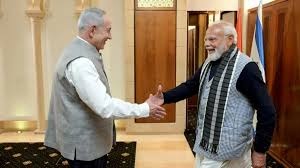
Netanyahu’s decision to greet Modi at Ben-Gurion Airport alongside his wife, Sara, was framed as a high honour—one recently extended only to US President Donald Trump. In Israeli political theatre, such gestures are rarely casual; they signal hierarchy, intimacy, and political endorsement.
Ahead of the visit, Israel’s ambassador to India, Reuven Azar, described the new phase of relations as a deepening of defence-industrial cooperation, with updated frameworks designed to enhance confidentiality and expand technological sharing. He spoke of joint production, including “new categories” of weapons systems, and noted that drones and ammunition were already being developed collaboratively, with the new agreement intended to broaden and elevate the technological sophistication of production.
One thread in the public commentary surrounding Modi’s trip was the promise of Israeli air defence systems, including the Iron Dome and the more conceptually disruptive Iron Beam. Military experts argue that the May 2025 India-Pakistan escalation demonstrated how traditional interception systems are costly and can be overwhelmed by volume. A high-energy laser system, if operationally scalable, would alter the strategic arithmetic by making each interception far less expensive than firing a missile interceptor.
India and Israel have also built substantial cooperation in water management, agriculture, innovation, and technology. The narrative is reinforced by the constant refrain of complementarity: Israel’s innovation and scientific expertise paired with India’s scale and market depth. Modi highlighted the Bilateral Investment Treaty signed last year and spoke of negotiating a free trade agreement.
Data shows that bilateral trade peaked at $10.7 billion in 2022-23, before declining to $6.5 billion in 2023-24 and further to $3.6 billion in 2024-25. Diamonds account for 33.1 per cent of India’s imports from Israel, while refined petroleum products constitute 43.7 per cent of India’s exports to Israel.
According to data cited from the Stockholm International Peace Research Institute, India accounted for over 38 per cent of Israel’s arms exports between 2014 and 2024. India has emerged as one of Israel’s largest arms customers, with its share exceeding 30 per cent in recent years.
During the visit, both sides launched a new initiative on Critical and Emerging Technologies, led by the National Security Advisers of the two countries. They emphasised that the initiative would synergise their respective strengths in niche technologies and foster a focussed, future-oriented partnership. The leaders called on both sides to advance this initiative expeditiously.
Modi also referred to the ambitious India-Middle East-Europe Economic Corridor (IMEC), which stalled following Israel’s war in Gaza. Announced on September 9, 2023, during the Group of 20 summit in New Delhi, the IMEC corridor aims to connect India, West Asia, and Europe through an integrated rail and shipping network. According to the project’s website, it would traverse India, the United Arab Emirates, Saudi Arabia, Jordan, Israel, and Greece, incorporating railways, ports, and highways to facilitate logistics and promote the free flow of trade.
Modi also invoked the India, Israel, US, and United Arab Emirates grouping, known as I2U2, presenting it as a natural platform for growth. In response, Netanyahu introduced the “hexagon” concept, a proposed alignment including India, Greece, Cyprus, and other unnamed partners, positioned against what he described as “radical Sunni and Shia axes”. By invoking these axes, he appeared to be alluding to Saudi Arabia, Qatar, Iran, and Türkiye in the region, and to Pakistan in India’s neighbourhood.
For India, openly adopting enmity towards Saudi Arabia or Iran for the sake of Israel would be a complex and potentially costly proposition. India has historically maintained ties with Iran and invested strategically in projects such as Chabahar port. A deeper structural alignment with Israel could intensify pressure on New Delhi: it would have to balance its strategic interests while avoiding the perception of having entered an anti-Iran axis, a perception strengthened by Modi’s premature visit.
If India’s alignment with Israel becomes more entrenched, the costs of preserving its ties with Tehran may rise, and its West Asia policy could increasingly be viewed not as multi-alignment but as a gradual shift towards one camp.
On the second day of the visit, Modi and Netanyahu oversaw the signing of 16 economic, security, and diplomatic agreements. Memoranda of understanding were concluded in agriculture, geophysical exploration, heritage, science, education, the economy, cyber cooperation, technology, security, and artificial intelligence, signed by their respective Ministers and counterparts, as well as India’s Ambassador to Israel, J.P. Singh. The agreements also included provisions allowing 50,000 Indian workers to be employed in Israel over the next five years, according to India’s Foreign Ministry.
“We know that the meeting of minds and hearts that we’ve had here will also continue in this remarkable G2G that is long overdue and will create an even greater boost to the enormous benefits that we can bring to each other, and I think, to humanity at large,” Netanyahu said during the conference.
Validation to Netanyahu
For Israel’s leadership, Modi’s visit provided high-profile validation at a time when many Western capitals are constrained by domestic politics, legal scrutiny, and public outrage over Gaza. He arrived as a leader who could be showcased as evidence that Israel is not isolated, that it retains partners beyond the Euro-Atlantic sphere, and that the language of “innovation and democracy” can still be performed on an international stage.
Palestinian leader and former Minister Ahmed Majdalani recalls that India, with its access and credibility in Israel, could use its position to advance peace in a manner reminiscent of Norway in the early 1980s.
In 1979, when substantial petroleum reserves were discovered within Norway’s maritime boundaries, influential Jewish organisations and the US exerted pressure on Oslo to supply oil to Israel, as Arab oil producers were denying Israel energy, and the Iranian revolution had destabilised supply chains. However, Prime Minister Odvar Nordli sought the Palestinian perspective and consulted Palestine Liberation Organisation leader Yasser Arafat before making a decision.
Majdalani recounts that Arafat adopted a pragmatic stance, telling the Norwegian leader that Israel would secure energy directly or indirectly in any case, but that Norway could leverage its position to encourage Israel to open quiet channels with the Palestinians. Fourteen years later, those contacts culminated in the Oslo Accords, the return of Arafat to Palestine, and the endorsement of the two-state formula.
“Oslo ultimately faltered under the weight of mistrust, settlement expansion, and political upheaval. But the fact remains: a small state leveraged friendship with Israel into leverage for dialogue,” Majdalani said.
Experts argue that India, as a much larger economy, a major defence buyer, and a state with global ambitions, possesses far greater weight than Norway. Its ties with Israel, especially in defence technology, are deeper and more extensive. India has the capacity to speak to all sides and to calibrate its symbolism carefully, while pressing quietly for a credible political horizon for Palestinians.
In the end, diplomacy is shaped not only by the agreements signed but also by the spaces a leader chooses to inhabit. Skipping Zawiya al-Hindiya while foregrounding the Knesset, Yad Vashem, and Israel’s innovation ecosystem did not signal a leader centring Palestinian dignity or expressing visible unease.
Instead, in West Asian diplomatic circles, it suggested a calibrated minimum in rhetoric, paired with maximum investment in partnership optics that carry significance in Benjamin Netanyahu’s domestic politics and Israel’s global narrative.
This contrast sharpens the distance between India’s older anti-colonial reflex, rooted in solidarity with Palestinian self-determination, and its current practice of strategic embrace without public friction over Gaza or the West Bank. As proceedings at the International Court of Justice and actions at the International Criminal Court intensify global scrutiny, diplomatic hedging may prove increasingly difficult to sustain. A leader’s presence is a form of currency, and Modi chose to spend it in Israel.
He could have walked to Zawiya al-Hindiya and allowed the cameras to capture India’s plural memory in Jerusalem. Many believe that it would not have constituted an anti-Israel gesture, but rather a quiet affirmation of a country aspiring to lead the Global South while remembering all strands of its history.
Appendix: Outcomes of Modi’s two-day visit to Israel
- Strategic partnership upgraded: India and Israel elevated ties to a “Special Strategic Partnership for Peace, Innovation and Prosperity,” expanding cooperation across defence, technology, trade and people-to-people domains.
- Artificial intelligence cooperation formalised: An MoU on artificial intelligence was signed, along with a separate education-focussed AI agreement between the two countries.
- National security advisers to lead critical technologies initiative: A new initiative on critical and emerging technologies will be led by the National Security Advisers of both countries, creating a high-level institutional mechanism linking AI, cyber, semiconductors, and other frontier sectors with national security planning.
- Indo-Israel cyber centre of excellence: A Letter of Intent was signed to establish an India–Israel Centre of Excellence in Cybersecurity in India, alongside a structured multi-year cyber cooperation roadmap and regular Cyber Policy Dialogue.
- Joint research funding increased: Contributions under the India–Israel Joint Research Calls were raised from $1 million to $1.5 million each, strengthening university-level scientific collaboration.
- Free trade agreement negotiations accelerated: Terms of reference for a free trade agreement were signed and the first negotiating round held, with both sides committing to expedite negotiations.
- Bilateral investment agreement framework strengthened: The India–Israel Bilateral Investment Agreement was highlighted as a mechanism to boost investor confidence, ensure transparency and provide dispute resolution safeguards.
- UPI link with Israeli payment system: An MoU between NPCI International and MASAV, Israel’s central automated clearing house, will examine linking India’s Unified Payments Interface with Israel’s fast payment system for cross-border payments.
- 50,000 additional Indian workers: Both sides agreed that up to 50,000 more Indian workers may arrive in Israel over the next five years, with new sector-specific implementation protocols signed.
- Agriculture innovation and fisheries cooperation expanded: An MoU was signed to establish the India–Israel Innovation Centre for Agriculture, alongside new fellowships and a Joint Centre of Excellence in Fisheries and Aquaculture.
[Iftikhar Gilani is an Indian journalist based in Ankara. Courtesy: Frontline magazine, a fortnightly English language magazine published by The Hindu Group of publications headquartered in Chennai, India.]