Invisible Hands, Absent Rights: The Struggle of India’s Women Workers – 2 Articles
❈ ❈ ❈
Invisible Hands, Unrecognized Labour: India’s Domestic Workers and the Limits of Women’s Empowerment
Trishna Sarkar
I continue to retain a career that required efficiency, emotional equilibrium, and timeliness for more than 20 years. Like many urban working women, I frequently attributed my ability to manage work and home to my discipline and fortitude. Honesty, however, necessitates a correction: my domestic worker’s unseen labour has been the foundation for my participation in the formal economy. Her presence subtly maintained my productivity, while her absence instantly revealed the brittle framework of my independence. Actually, I’m always reminded of how I had to overwork during the COVID-19 era, juggling work-from-home obligations with housework and the never-ending demands of my family.
This lived experience made recent court rulings concerning domestic workers feel less surprising and more inevitable. When the Supreme Court declined to intervene in pleas seeking stronger wage protections and formal recognition for domestic workers, it reinforced a troubling truth: despite being essential, domestic work in India remains insufficiently recognized as labour deserving enforceable rights and protections.
When compared to the size of the industry, this exclusion is even more noticeable. One of the biggest sectors of India’s urban informal economy is domestic work. India employs more than 50 million domestic workers, most of whom are women and migrants working without formal contracts or social security benefits, according to estimates from the International Labour Organization (ILO). According to the Periodic Labour Force Survey (PLFS) and research conducted by labour rights organizations, the majority of domestic work is still done informally, with irregular pay, no pensions, no paid leave, and unstable employment.
Delhi alone illustrates the magnitude of this dependence. According to reports referenced by labour collectives and urban employment studies, the capital has several lakh domestic workers, most of them migrant women from economically weaker states. Organisations such as the National Domestic Workers Movement (NDWM), Self-Employed Women’s Association (SEWA), and local worker collectives attempt to provide legal awareness and welfare support, yet coverage remains limited compared to the size of the workforce.
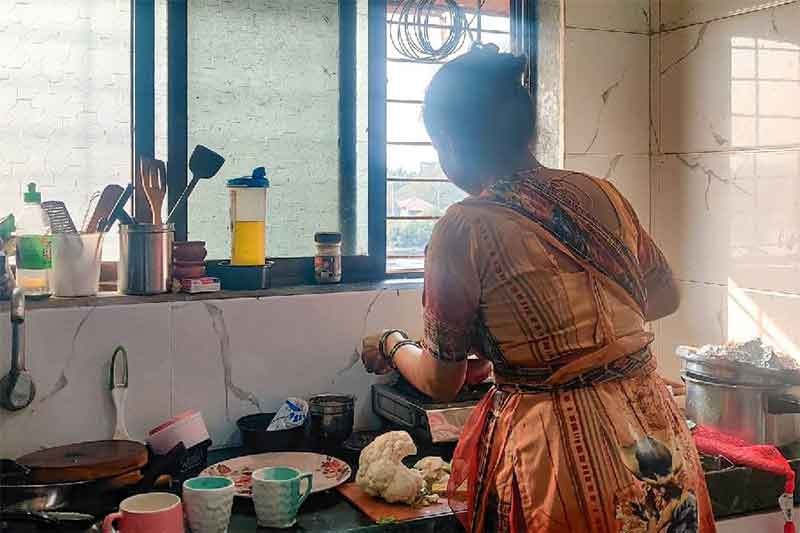
Their work profile extends far beyond the phrase “house help.” Cleaning, mopping, cooking, washing, childcare, elder care, and managing the invisible logistics of daily life form part of their routine. They are called didi, bai, aunty, or sometimes by name, terms suggesting intimacy but masking structural inequality. Over time they become indispensable to households, yet remain dispensable within policy frameworks.
The irony is both social and economic. By facilitating urban middle-class employment, domestic workers indirectly increase productivity and demand for consumer goods. To put it another way, they encourage economic expansion without being acknowledged as its drivers. However, their weaknesses are still glaring. There are no uniform employment contracts, no pension security, no guaranteed minimum wage enforcement across states, and frequently no health benefits. Rather than being governed by labour laws, employment conditions are mostly determined by personal relationships with employers. The prevailing principle is still ruthlessly straightforward: no work, no pay.
One topic that is rarely discussed is health, particularly mental and reproductive health. A small, informal survey of 120 upper-middle-class households in a Delhi neighbourhood where nearly all of the families had domestic help revealed significant awareness gaps. Although most employees had a basic understanding of menstruation and hygiene, almost none of them understood menopause, even those who were currently going through it. Despite being commonly reported, depression, mood swings, anxiety, joint pain, and sleep problems were rarely associated with physiological changes. Suffering is normalized rather than addressed when there is a lack of health awareness or access.
Institutional invisibility was equally revealing: despite the existence of advocacy groups, none of the workers polled were registered with NGOs or worker organizations. In addition to influencing employment, informality also influences awareness.
These realities stand in sharp contrast to the language dominating public discourse as International Women’s Day approaches. Corporate campaigns celebrate empowerment. Social media timelines fill with messages about equality and sisterhood. Panels discuss breaking glass ceilings.
Curious about this celebration, I once asked my domestic worker if she knew about Women’s Day.
She laughed softly and replied,
“Didi, ye bade gharon ki mahilaon ke liye hota hai… WhatsApp mein dekha tha. Bahot saare offer chalte hai us din.”
[Didi, that is for women from big households… I saw it on WhatsApp, many discounts are offered on products for women.]
I began explaining its purpose, rights, dignity, empowerment, recognition. She listened patiently before responding with disarming clarity:
“Log apne ghar ka bathroom tak use karne nahi dete… aur aap haq ki baat kar rahe ho. Chaliye kaam kar leti hoon. Aapko bhi daftar ke liye der ho jayegi. Der ho jaaye toh baju wali ghar ke pagar kat jaati hai.”
[People don’t even allow us to use the bathroom in their homes… and you are talking about rights. Let me finish my work and leave. You’ll get late for the office too. If I get late, the people in the next house cut my salary.]
Her words captured what policy debates often miss. Rights exist most comfortably in speeches, far less in kitchens and corridors where informal labour survives.
The Supreme Court’s decision may be legally sound, but it exposes a social hierarchy in which domestic workers are treated more like members of private households than as legitimate employees and are not granted formal labour protections. As Women’s Day approaches, public celebrations of empowerment and accomplishment will take place, enabling others to participate in those very celebrations, despite the fact that millions of domestic workers still carry out their daily labour under hazardous circumstances. The contrast reveals a deeper irony: many women, especially domestic workers, are still waiting to be included in the definition of empowerment, despite its widespread praise.
[Dr Trishna Sarkar is Asst Prof, Dept of Economics, Dr Bhim Rao Ambedkar College, University of Delhi. Courtesy: Countercurrents.org, an India-based news, views and analysis website, that describes itself as non-partisan and taking “the Side of the People!” It is edited by Binu Mathew.]
❈ ❈ ❈
Women Without Work: Capitalism, Care Labour and India’s Failed Growth Model
Sahasranshu Dash
India has one of the lowest female labour force participation (FLFP) rates among major economies, and that fact sits uncomfortably at the centre of the country’s economic transformation story. Even after some recent improvement, only about a third of working-age Indian women participate in the labour force by internationally comparable estimates, compared to roughly three-quarters of men. The World Bank places India’s female labour force participation rate at around 32–33 percent, while the global average for women is closer to 48–50 percent. Male participation in India remains above 75 percent, producing one of the widest gender gaps in labour markets anywhere in the world.
For a country aspiring to become a major economic power in the twenty-first century, leaving such a large share of its working-age population outside the world of paid work is not merely a gender issue. It is one of the most significant structural constraints on India’s growth potential. Several economic studies have shown that raising women’s participation in the labour force could significantly accelerate India’s economic growth. Estimates by institutions such as the World Bank and IMF suggest that closing gender gaps in labour force participation could add roughly 1–2 percentage points to India’s annual GDP growth over time, while some broader simulations suggest that achieving parity in labour force participation could increase India’s GDP by as much as 20–25 percent in the long run. When half the population is only marginally integrated into the economy, the country operates far below its productive capacity. Increasing women’s employment would raise household incomes, expand the tax base, stimulate consumption and improve productivity across the economy.
The issue of women’s economic participation therefore lies at the heart of India’s development trajectory, raising a deeper question about the nature of India’s growth model itself: what kind of economic system produces growth without generating sufficient employment for women?
The Origins of International Women’s Day
The origins of International Women’s Day offer an important historical reminder. The day did not begin as a symbolic celebration or a social media ritual, but emerged from labour struggles that linked women’s emancipation directly to economic participation and workers’ rights. One of the earliest recorded versions was a “Woman’s Day” organized by the Socialist Party of America in New York in 1909. In solidarity with these mobilisations, the German socialist activist Clara Zetkin proposed the celebration of a global “Working Women’s Day” at the International Socialist Women’s Conference in Copenhagen in 1910. Later, Vladimir Lenin formally declared 8 March as International Women’s Day in 1922 in recognition of the role women workers played in the Russian Revolution.
The message behind the day was clear: women’s liberation is inseparable from their participation in the world of work. Economic independence was seen not merely as a personal achievement but as a precondition for social and political equality. Seen from that perspective, the Indian context raises uncomfortable questions. Each year International Women’s Day is marked by celebratory messages about empowerment and opportunity, yet millions of Indian women remain excluded from the labour market and the economic structures that sustain this exclusion remain largely unchanged.
Rising Participation, Persistent Informality
According to India’s Periodic Labour Force Survey (PLFS), female labour force participation has risen in recent years—from about 23 percent in 2017–18 to roughly 41–42 percent in 2023–24 for women aged fifteen and above. At first glance this appears to signal a dramatic improvement in women’s economic participation. But the story beneath the headline numbers is far more complicated.
A significant portion of the increase has been driven by rural women entering or re-entering work, often in self-employment or agriculture, rather than in stable, salaried employment. In rural India today, nearly three-quarters of working women remain concentrated in agriculture, frequently as unpaid family workers or in low-productivity self-employment. While such work contributes to household survival, it rarely provides the economic independence associated with formal employment.
Urban India presents a different but equally troubling picture. Female labour force participation in urban areas remains below 30 percent, despite rising levels of female education. India thus exhibits a well-known paradox in development economics: women’s educational attainment has increased substantially over the past two decades, yet labour force participation has not increased proportionately. Millions of educated women either struggle to find jobs that match their qualifications or withdraw from the labour market due to a combination of social constraints, lack of suitable employment opportunities and safety concerns. The result is an economy where women are either pushed into informal survival activities or pushed out of the labour market entirely.
Capitalism and the Invisible Labour of Women
One of the most important yet under-recognized barriers to women’s employment in India lies within the household itself. Time-use surveys consistently show that women spend three to five times more time than men on unpaid domestic and care work—cooking, cleaning, childcare and eldercare. This labour sustains families and reproduces the workforce that capitalism depends upon, yet it remains invisible in national income statistics and unpaid in economic terms.
Marxist feminist analysis has long emphasized that capitalism relies not only on wage labour but also on this vast sphere of social reproduction. The unpaid domestic labour performed largely by women effectively subsidizes the formal economy by reducing the costs of sustaining workers and households. In India, this hidden subsidy is enormous: women’s unpaid labour allows the economy to function while simultaneously restricting women’s own economic independence. The burden of care work limits women’s ability to seek paid employment, while the absence of public childcare and care infrastructure reinforces this cycle.
Safety concerns and mobility constraints further compound the problem. For many women in India, commuting to work involves navigating unreliable transport systems and concerns about harassment or violence. Social norms reinforce these structural barriers as well. In many households, women’s paid work is still viewed as secondary to domestic responsibilities, and as household incomes rise women sometimes withdraw from low-paying or socially stigmatized work without necessarily finding better alternatives. The result is a labour market that systematically undervalues women’s work while simultaneously depending upon it.
Development Without Jobs
The persistence of low female labour force participation cannot be understood without examining India’s broader development model over the past decade. The Modi government has projected an image of a rapidly modernizing economy defined by infrastructure expansion, digital innovation and global ambition. Yet the underlying structure of economic growth has remained heavily tilted toward capital-intensive sectors and high-end services, rather than labour-intensive manufacturing.
Programmes such as Make in India promised to transform the country into a manufacturing powerhouse. In practice, however, manufacturing has not generated employment at the scale required. Instead of large numbers of stable factory jobs, what has expanded most visibly is the informal economy—platform work, gig labour, precarious services and small-scale self-employment. For women, the consequences have been particularly severe. Labour-intensive sectors that historically employ women—garments, textiles, food processing and light manufacturing—have not expanded rapidly enough to absorb the millions of women entering working age each year.
In contrast, many successful industrialization experiences in East and Southeast Asia were accompanied by large-scale entry of women into factory employment, which played a critical role in both economic growth and women’s empowerment. India’s growth pattern has largely bypassed this stage. Instead, the past decade has seen an expansion of credit-based self-employment schemes and micro-entrepreneurship programmes, including Self Help Groups and Mudra loans, often presented as pathways to women’s empowerment. While such initiatives can expand financial access, they cannot substitute for the large-scale creation of stable, productive employment.
At the same time, limited public investment in childcare, healthcare and social services has effectively shifted the burden of care work back onto households—and therefore onto women. The weakening of labour protections and the expansion of precarious employment further erode the possibility of secure livelihoods. In this sense, the past decade has produced a striking paradox: India celebrates economic growth while millions of women remain excluded from the labour market. A development model that sidelines women cannot be called inclusive development.
Women’s Work and the Future of India’s Economy
Reversing this pattern will require more than symbolic commitments to empowerment. It demands structural changes in how work, care and economic opportunity are organized. Expanding access to affordable childcare and eldercare services would reduce the unpaid care burden that falls disproportionately on women, while improving safety in public transport and workplaces would enable greater mobility and access to employment. Equally important is the need to expand sectors capable of generating large-scale employment for women. A development strategy centred on labour-intensive industrialisation, stronger labour protections and secure employment would create opportunities for millions of women who remain excluded from the labour market today.
More than a century ago, the socialist movements that created International Women’s Day understood a simple truth: women’s liberation begins with economic independence. Economic agency changes the balance of power within households and societies alike. The struggle for gender equality therefore cannot be separated from the struggle for decent work, fair wages and economic justice.
The journey toward equality does not end with earning an income. But without the possibility of economic independence, the journey of liberation may never even begin. Until India builds an economy in which women can participate fully and equally in the world of work, its story of development—and its promise of inclusive progress—will remain incomplete.
[Sahasranshu Dash is a research associate at the International Centre for Applied Ethics and Public Affairs (ICAEPA), an independent research organisation in Sheffield, the United Kingdom. Courtesy: Countercurrents.org, an India-based news, views and analysis website, that describes itself as non-partisan and taking “the Side of the People!” It is edited by Binu Mathew.]