❈ ❈ ❈
4th Venezuela Popular Consultation: A Decisive Step Toward Grassroots Democracy
teleSUR Desk
25 November 2025: Venezuela is gearing up for its fourth Venezuela Popular Consultation, a nationwide participatory exercise through which citizens will directly choose 10,662 community projects set to begin implementation next week. These new initiatives will join the 23,000 projects already approved and executed over the past 18 months, reinforcing the government’s strategy of grassroots-driven development.
Organized under the framework of the Plan de las 7 Transformaciones 2025—2031, the Venezuela Popular Consultation seeks to decentralize decision-making and place local needs at the heart of public policy. The outcomes will determine which infrastructure, health, education, and cultural projects receive funding in each community, with results feeding directly into the formation of Comités Bolivarianos de Bases Integrales—integrated grassroots councils tasked with overseeing execution.
“This is not just voting—it’s governing,” said one community organizer in Barinas, echoing a sentiment repeated across the country. The consultation reflects Caracas’s long-standing emphasis on what it terms “protagonistic democracy,” a model that positions citizens not as passive recipients of state services but as active co-creators of policy.
Scope and Organization of the Venezuela Popular Consultation
The electoral machinery behind this participatory process is extensive. According to Minister Ángel Prado, over 19,926 Electoral Commissions have been activated nationwide to manage voting centers ahead of the 2025 electoral calendar, which includes three constitutional votes. These commissions—staffed by volunteer polling station members—are designed to ensure transparency and accessibility at the local level.
Of the 10,662 proposed projects up for selection in this fourth round, 50% (or 5,331 initiatives) are dedicated to public services, with significant allocations also targeting healthcare, education infrastructure, sports, recreation, culture, and communal economy. This distribution underscores the government’s focus on social welfare amid ongoing macroeconomic challenges.
Minister Vladimir Padrino López, head of the Ministry of Popular Power for Defense, announced that more than 170,000 personnel from the Bolivarian National Armed Forces (FANB) have been deployed across the national territory to security and logistical support. He described the event as a “great democratic and popular festival”—a characterization meant to emphasize civic engagement over partisan politics.
Padrino López further stressed that despite what he called “economic, psychological, and external threats”—a clear reference to U.S. sanctions and geopolitical pressure—Venezuela remains committed to deepening a participatory, protagonistic, and direct democracy where “constituted power obeys the will of the people.”
The logistical scale is notable: from remote Andean villages to urban barrios in Caracas, citizens will gather at neighborhood assemblies or digital kiosks to cast their preferences. While the process is non-binding in a legal sense, authorities treat the outcomes as politically binding mandates, with ministries required to allocate resources accordingly.
Geopolitical Context: Participatory Governance as a Sovereign Strategy
The Venezuela Popular Consultation must be understood not only as a domestic policy tool but also as part of a broader geopolitical stance. In a region where liberal representative democracy has faced declining public trust, Caracas positions its model as an alternative to Western-centric governance paradigms.
This approach aligns with Venezuela’s long-term strategy of “civilian-military union” and community sovereignty, aimed at reducing dependence on traditional state bureaucracy and international financial institutions. By channeling resources through communes and directly elected base committees, the government seeks to insulate local development from both market volatility and foreign intervention.
Globally, this model resonates with movements advocating for deliberative democracy and economic self-determination, particularly in the Global South. At the same time, critics—particularly from U.S.-aligned think tanks—dismiss the consultations as performative exercises that lack independent oversight and reinforce one-party dominance.
Yet, regardless of interpretation, the process highlights a critical trend: the reconfiguration of sovereignty through localized, collective decision-making. In an era of rising authoritarianism and democratic backsliding worldwide, Venezuela’s experiment—however contested—offers a distinct vision of how power can be structured from the ground up.
Empowerment Beyond Politics: The Communal Economy Vision
Central to the Venezuela Popular Consultation is its integration with the communal economy, a pillar of the Plan de las 7 Transformaciones. Unlike traditional top-down development models, this framework treats communes as autonomous economic and political units capable of managing production, distribution, and social services.
Projects selected through the consultation often include urban agriculture cooperatives, community health clinics, cultural centers, and neighborhood water systems—initiatives designed to enhance resilience against external shocks, including sanctions and supply chain disruptions. Community members not only vote on projects but also participate in their design, budgeting, and monitoring, fostering a sense of collective ownership.
“It doesn’t matter your political preference,” stated a government communiqué released last week. “The power of the people is above partisanship.” This rhetoric aims to depoliticize the process and encourage broad participation, including from opposition-leaning communities that may otherwise disengage.
Indeed, evidence from previous consultations suggests that even in areas with strong anti-government sentiment, participation rates remain high when tangible improvements—like repaired roads or new schools—are linked to the vote. This pragmatic appeal may be key to the consultation’s endurance, transcending ideological divides in favor of immediate material gains.
Moreover, by involving all levels of government—from municipal to national—the model seeks to streamline bureaucratic bottlenecks and accelerate project execution. Ministries are required to “simplify, improve, and support” each communal proposal, creating a feedback loop between citizens and state institutions.
[teleSUR is a Latin American multimedia platform oriented to lead and promote the unification of the peoples of the SOUTH. It seeks to be a space and a voice for the construction of a new communications order.]
❈ ❈ ❈
Venezuela: Communards Gather to Make ‘Communal Feminism’ a Priority
Ricardo Vaz
Dozens of Venezuelan communards held a three-day gathering dedicated to advancing communal feminism and committed to future meetings in other states.
The meeting was co-organized by the Communard Union and the Ministry of Communes’ School for the Strengthening of Popular Power (EFPP) and geared towards grassroots leaders from around 20 communes in Caracas and nearby states Miranda, La Guaira, Aragua and Carabobo.
Communard Union organizer Manuela Sánchez Avilán told Venezuelanalysis that the meeting represented another step to “build and put into practice a feminism that reflects the reality and needs of the Bolivarian Revolution.”
“The present reality, with an economic blockade, disproportionately affects women,” she said. “It was important to have a space to share experiences and work together towards common solutions.”
Sánchez explained that female communards often face a triple work burden, balancing formal employment, domestic care and local grassroots organizing.
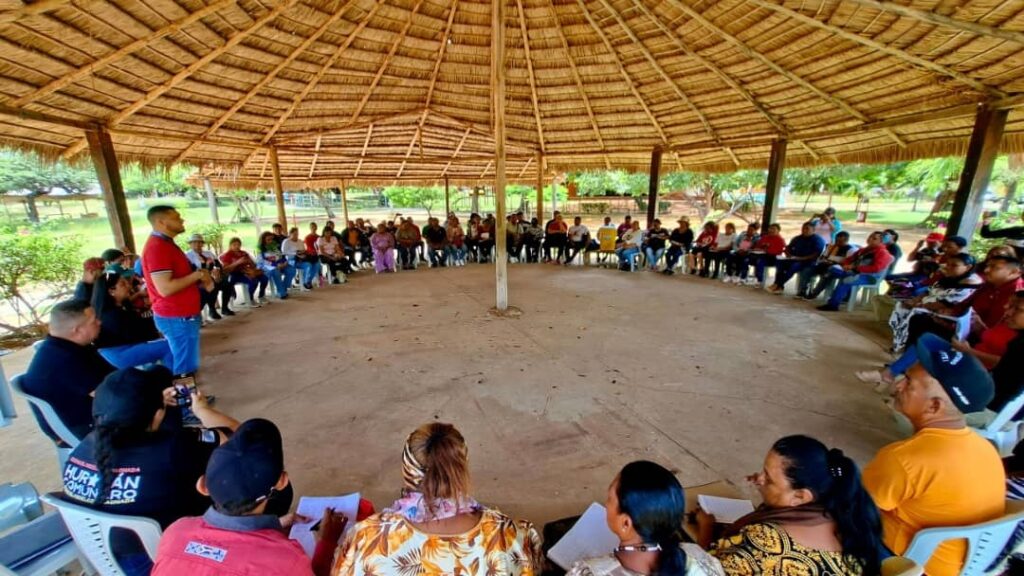
From October 4 to 6, 40 women gathered at the “Produciendo en Revolución” Agro-Touristic Commune in Miranda state for debates, lectures, planning sessions and cultural activities centered on the role of women in popular power organizations.
“The Communard Union has identified the construction of communal feminism as a priority, to communalize and collectivize care responsibilities,” she affirmed. “This activity followed up on our national meeting in March and we set up a plan to replicate it in the different territories.”
The communal feminism gathering featured lectures and debates on political participation, feminist economy, preventing gender-based violence, and sexual and reproductive healthcare. Members from Brazil’s Landless Workers Movement (MST) shared experiences from the organization’s initiatives.
Participants likewise analyzed Venezuela’s present political context, including the growing U.S. military threats and the role of grassroots organizations.
Sánchez, who also serves as EFPP director, emphasized the importance of state institutions supporting popular initiatives and classified the meeting as “very productive.”
“We had very meaningful formation sessions and debates which also helped add an ideological dimension to the realities witnessed in the different territories,” she concluded.
Officially founded in 2022, the Communard Union aims to bring together communes to form an alliance on a national scale. Former President Hugo Chávez defined communes, which are territorial self-government instances, as “building blocks” for the construction of socialism.
The organization, which currently groups 136 communes from 18 states, has several running initiatives focused on territorial work, political education and local economies.
The School for the Strengthening of Popular Power (EFPP), an institution under the umbrella of the Ministry of Communes, is responsible for organizing educational efforts with popular power collectives across Venezuela.
[Ricardo Vaz is a writer and editor at Venezuelanalysis. His articles have appeared on Investig’Action, Monthly Review, Truthout, Counterpunch, and other alternative media. Courtesy: Venezuelanalysis, an independent website produced by individuals who are dedicated to disseminating news and analysis about the current political situation in Venezuela.]
❈ ❈ ❈
Venezuela: Popular Organizations Push Direct Distribution Routes to Boost Food Security
Ricardo Vaz
September 1, 2025: Venezuelan grassroots collectives held fish and vegetable distribution initiatives as part of ongoing efforts to increase food security and expand alternative economic channels.
On Friday and Saturday, Plan Pueblo a Pueblo coordinated the delivery of one thousand packs, each carrying 3.8 kilograms of fish and seafood, alongside popular movements and worker groups in Caracas, Yaracuy, Lara and Trujillo states.
A group of workers from the Ministry of Communes likewise benefited from the initiative. The package carried blue runner, stingray, shrimp and arca zebra (“pepitona”) at a total cost of US $13. The price represents savings of 50-60 percent compared to fish markets in Caracas.
“We are very happy to be receiving fish and seafood directly from organized fisherpeople,” Egle Aponte, spokeswoman from the Forjando Los Sueños de Zamora Commune in Coche, southwest Caracas, told Venezuelanalysis. “Not only are they fresh and good-quality products, but they are also affordable because we are getting rid of intermediaries.”
Pueblo a Pueblo organizer Ricardo Miranda explained that the sea products were supplied by Popular Power Fisherpeople Councils (CONPPA), including several women-led collectives, from different towns in Sucre state, eastern Venezuela.
“This is an effort that goes straight from fisherpeople to consumers in communities, without any middlemen involved,” he stated. “We are going to do this every four weeks and expand to more areas in Caracas and other cities.”
Founded in 2015, Pueblo a Pueblo has pushed campesino organization and the construction of political and economic ties between urban and rural movements. It has also emphasized food sovereignty and agroecology principles in agricultural production.
In recent years, it has focused on securing the distribution of healthy produce for school canteens in a joint program with the food and education ministries, supplying around 100 monthly tons during the last school year for around 100,000 children.
Pueblo a Pueblo has likewise developed an alliance with grassroots fishing organizations in Sucre state to supply protein-rich foods to schoolchildren as well as organized communities in Caracas and other parts of the country. The collective has also promoted the exchange of fish products for fruit and vegetables that are scarcer in coastal areas.
Communard Union vegetable route
Venezuela’s Communard Union (Unión Comunera) also held a food distribution event over the weekend, with vegetables sourced from the Comandante Supremo Commune in Valera, Trujillo state, and delivered at the Negro Miguel and Agua de Obispo Communes, in the Simón Planas and Torres municipalities of Lara state, respectively.
The shipment consisted of 3.5 tons of produce, including potatoes, carrots, onions and tomatoes, that were sold on Saturday. Between 500 and 600 people purchased fruit and vegetables, according to local sources, at prices around 40 percent below the market.
Carlos Vegara “Carache,” a spokesperson from Negro Miguel Commune in Buría, highlighted the importance of building direct ties between communes, “with no need for intermediaries.”
“This was an excellent initiative because it allowed local communities to access produce that is hard to find in this region at affordable prices,” Vergara told Venezuelanalysis. “It is an important step towards food security.”
Vergara added that people valued the arrival of fresh vegetables to such a remote part of Lara state.
Officially founded in 2022, the Communard Union aims to bring together communes to form an alliance on a national scale. Former President Hugo Chávez defined communes, which are territorial self-government instances, as the “building blocks” for the construction of socialism.
Juan Lenzo, a member of the Communard Union, told Venezuelanalysis that the organization aims to sustain and expand direct distribution efforts to link different communes with its own transportation units. According to Lenzo, such processes will strengthen the communal economy by bypassing traditional market channels and retaining surpluses.
The Communard Union currently brings together 136 communes in 18 Venezuelan states, with initiatives centered on territorial work, political training and local economies.
[Ricardo Vaz is a writer and editor at Venezuelanalysis. His articles have appeared on Investig’Action, Monthly Review, Truthout, Counterpunch, and other alternative media. Courtesy: Venezuelananlysis, an independent website produced by individuals who are dedicated to disseminating news and analysis about the current political situation in Venezuela.]
❈ ❈ ❈
On Anniversary of Chávez’s ‘Strike at the Helm’ Speech, President Maduro Touts 20,000 Communal Projects
Orinoco Tribune Staff
October 20, 2025: Venezuelan President Nicolás Maduro marked the 13th anniversary of Commander Hugo Chávez’s historic “Strike at the Helm” speech on Monday, highlighting the completion of more than 20,000 communal projects nationwide.
Through social media, Maduro recalled that Chávez entrusted him with the most important mission of Venezuela’s Bolivarian Revolution. “At that crucial moment, he entrusted me with the Revolution’s most important mission, saying ‘Nicolás, I entrust the communes to you as my own life.’ That gesture was an act of profound education and supreme trust, which set the course for the new society,” the president stated.
He emphasized the enduring validity of the dreams, theory, and guidelines that Chávez left behind. The Comandante, Maduro said, planted the idea of People’s Power and citizen empowerment, transforming the innate rebellion against imperialism into a creative and emancipatory force. “That is why his mandate, ‘commune or nothing’, is the unavoidable horizon,” he said.
Chávez’s “Strike at the Helm” speech has been described as the masterful route to building a participatory and protagonist democracy, the 21st-century political model that is burying what Chavez referred to as the “failed and exhausted bourgeois representative democracy.” This mandate was extended by Chávez to his adminsitration in order to deepen Venezuela’s “socialism of the 21st century.”
20,000 communal projects
On Monday, President Maduro also announced the completion of 20,808 projects across the country carried out by Venezuelan communities and youth. He noted that this work is part of the youth and the government’s commitment to consolidate the communal state and respond promptly to the needs of communities.
The president inaugurated the self-government cabinets of the Las 8 Raíces Commune, located in the Los Mecedores sector of the Sucre parish in Caracas. This event is the result of various popular consultations held across the country which seek to promote the active, democratic, and leading participation of people in implementing projects aimed at solving collective problems and ensuring a better quality of life.
Maduro reported on the progress of establishing 5,327 self-government cabinets, representing 99.8% of the total. Venezuela has 5,336 communal circuits and 3,652 communes in place as mechanisms to continue strengthening the people’s power. President Maduro emphasized that by 2027, there should be 6,000 communes nationwide.
During the address, President Maduro detailed some of the projects being completed in various parts of the country. These included a robotics workshop inaugurated at the Caracas Cathedral, a space offering training in science and technology to the nation’s new generations as part of a project proposed and approved at the First National Youth Consultation.
[Courtesy: Orinoco Tribune, an independent news outlet created in 2018 and specially designed to provide relevant progressive information about Venezuela or related to Venezuela.]