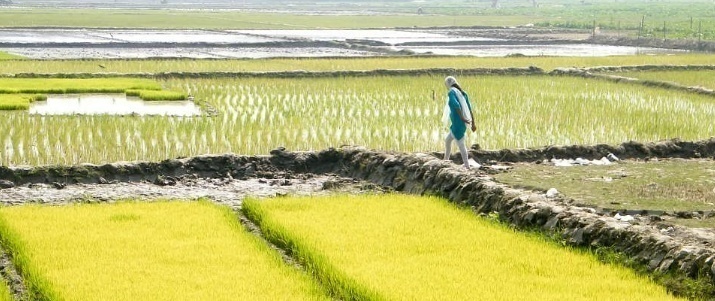
In Simbroh village of Punjab’s Patiala district, 70-year-old Gurjant Singh looked out over his five-acre farm with a mix of pride and resignation. When he began farming in 1978, he cultivated a variety of crops – bajra, vegetables, cotton and pulses. But since the late 1980s, he has been narrowing his focus.
Because of government price support for select crops, the higher market risks associated with diverse crops and an attempt to increase production, Singh has been mainly growing rice and wheat.
This kind of monocropping, often attributed to the Green Revolution – launched in the 1960s, which transformed India’s agricultural landscape by introducing high-yielding seed varieties, chemical fertilisers and advanced irrigation methods – is not specific to just Simbroh or Punjab. It has been adopted by farmers in most Indian states.
But experts warn that monocropping – cultivating a single crop on the same field year after year, often in a defined row pattern – leaves farmers exposed to market and climate fluctuations. In addition, studies have shown that monocropping depletes soil nutrients and increases vulnerability to pests and diseases.
Over the past six months, this reporter, as a part of the Environmental Data Journalism Academy fellowship, conducted a data-driven investigation into the impact of monoculture on farmers and soil. This three-part series presents our findings in detail. The first part of the series considers the factors that drive and sustain monocropping practices.
The monocropping pattern
India has embraced this monocropping system on a large scale, our analysis shows.
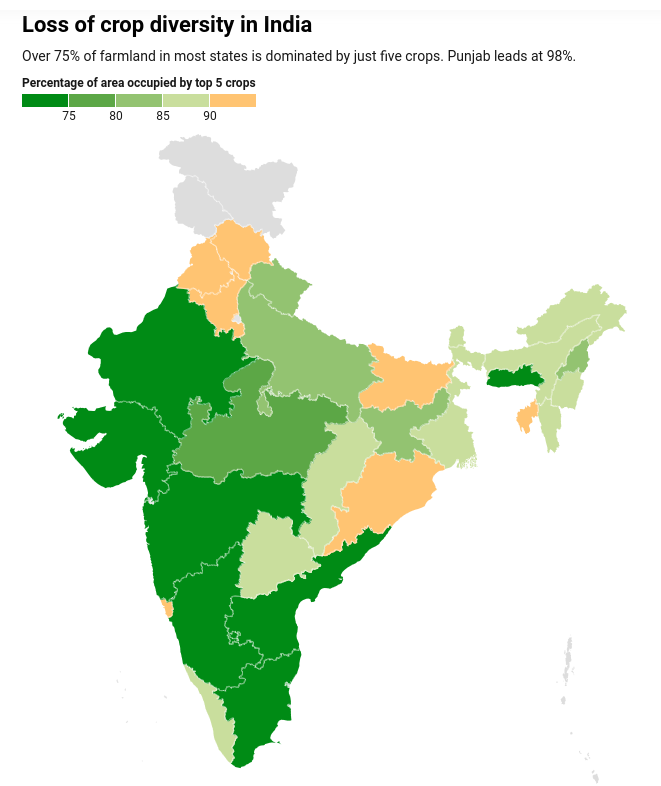
In nearly 80% of India’s states, just five or fewer crops have dominated the majority of farmland over the last decade.
In most states, rice or wheat occupy the largest share of the cultivated area. Both are highly water-intensive.
In seven states, more than 90% of the cultivable land has just five or fewer crops being grown on it.
Punjab leads the pack, with 98% of its land being used for wheat, rice, cotton, maize and sugarcane.
This lack of diversity has undermined soil health and resulted in an increased use of fertilisers and pesticides, our data suggests.
Over the years, the authorities have pushed for crop diversification, specifically in Punjab and Haryana, states that were the focus of the Green Revolution.
In addition, the National Mission on Natural Farming has aimed to get farmers to increase the variety of crops they cultivate. But farmers have failed to do so – despite the benefits this practice could offer.
Several studies show that crop diversification helps maintain soil health and sustainability, reduce pest attacks and improve the quality and variety of food for humans and livestock. On top of this, it increases farmers’ income.
But monoculture persists because it is sustained by government policy, said Ramanjaneyulu GV, the executive director of the Centre for Sustainable Agriculture.
“Around 60%-70% of the government’s incentives are concentrated on a few crops like paddy, wheat, and cotton, creating a cycle where more technologies, resources and support systems are developed specifically for these crops,” he said.
As a consequence, “farmers gravitate toward cultivating them, as the incentives for inputs, knowledge, practices, and guaranteed market outputs are overwhelmingly fixed for these select crops”.
Among the main incentives is the Minimum Support Price at which the government buys crops from farmers. It is meant to act as a safety net for farmers, with the government directly buying a crop from them if the market price falls below the price it has set.
The Centre fixes a minimum support price for 23 agricultural commodities grown in the kharif and rabi seasons. However, in practice, it consistently buys only rice and wheat for its food security schemes, implicitly encouraging farmers to grow mainly these crops.
Ramanjaneyulu explained that this monoculture-centric approach poses significant risks to sustainable agriculture. “By prioritising rice and wheat, the system discourages diversification, leaving farmers vulnerable to market fluctuations, pests, and climate-induced challenges,” he said. “Moreover, it undermines soil health, depletes water resources, and reduces the resilience of farms.”
A failed attempt?
Though several official schemes have promoted diversification over the years by encouraging the cultivation of crops such as oilseeds and pulses, these attempts have largely been in vain.
Gurjant Singh’s stab at diversification in Punjab’s Simbroh in 2004 illustrates some of the challenges inherent in the push. Spurred by the local administration’s push for crop diversification, he had planted moong dal in his five-acre fields. His expenses per acre, including the cost of manure, fertilisers, and seeds, was approximately Rs 2,500.
But since no machines were available for harvesting green moong, the task required manual labour. The workers did not get a wage but agreed to a 70-30 share of the harvest. However, they later demanded a 50-50 split because of the labour-intensive nature of the work.
“This was not viable for me,” said Gurjant Singh.
Struggling to meet these demands, Gurjant Singh managed to have only two acres harvested before the labourers left for more lucrative wheat fields.
The remaining three acres stood unpicked for weeks, leaving Singh no choice but to destroy the crop. “It felt like losing something precious – like taking the life of an 18-year-old son I had nurtured,” he recalled.
Gurjant Singh’s attempt at diversification and subsequent failures are not an isolated instance.
Gurdeep Singh, 65, from Balbehra village of the same district, had a similar experience. For decades, he mainly cultivated paddy and wheat on his 5.5-acre plot. But between 2017 and 2022, he decided to plant potatoes on four acres.
He spent Rs 20,000 per acre on seeds and Rs 5,000 per acre on fertilisers. However, when he attempted to sell the produce, the market prices had dropped significantly, going as low as Rs 2 per kg.
“The average yield on my farm was around 300 quintals. However, I could sell only about 250 quintals, earning approximately Rs 60,000. This amount wasn’t enough to recover my investment. A significant portion of my produce went to waste as I waited for prices to improve, but they never did,” he said.
Gurdeep Singh was forced to take loans of Rs 3 lakh for two consecutive years in 2020 and 2021, accumulating to Rs 10 lakhs with interest.
To repay the debt, he had to sell a portion of his land for Rs 15 lakh.
“Imagine buying a packet of potato wafers for Rs 10 but selling 5 kg of potatoes for the same price,” Gurdeep Singh said. “How are we supposed to sustain ourselves with such rates?”
He added: “The financial burden and the unsustainable agricultural conditions have been devastating, forcing me to make tough decisions just to survive.”
The lack of incentives for other crops has forced farmers to return to crops with guaranteed Minimum Support Price – sustaining monocropping.
“There is an urgent need to shift the focus of incentives from merely procurement to a more holistic approach that includes input and output support,” said Ramanjaneyulu.
He emphasised the importance of supporting farmers not just with procurement guarantees but also access to better seeds, irrigation systems, as well as training in sustainable farming practices.
“Only through comprehensive support can we bring about a meaningful change in farmers’ practices and promote agricultural diversification,” he said.
❈ ❈ ❈
Part II:
Thirsty Crops, Tired Soil: Vicious Loop Threatens India’s Food and Water Security
Beyond the banks of the Tangri river in Haryana’s Ambala district, paddy fields stretch far, lush and green. But they hide a troubling truth. The soil here, once soft and porous, has hardened into what locals call daakar mitti – hard clay that is unable to absorb water or replenish groundwater.
“It no longer absorbs water, and the groundwater refuses to rise,” explained farmer Gurdas Singh, from Mohra village of Haryana’s Ambala district. But almost two decades ago, this region used to have retili mitti, he said – sandy, water-soaking soil that sustained their livelihoods.
The farms in this region were once rich with diverse vegetable crops – cauliflower, radish, carrots, brinjals, ladyfingers, among them. Now, they know only paddy and wheat.
This monocropping, scientists say, is further depleting the soil of its vitality.
“I own 16 acres of land, where we primarily grow kanak [wheat] and jeeri [paddy],” Singh said. “These crops have been cultivated on this land since 1988, a tradition started by my father that we continue to this day.”
For most farmers like Gurdas, especially after the Green Revolution in the 1960s, a key reason to favour the combination of rice and wheat was the stability and predictability of the income it provides. This is largely due to the Minimum Support Price at which the government guarantees that it will buy these grains.
Singh’s concerns about the changing texture of the soil on his farm are echoed by many farmers across Punjab and other states that are now growing less diverse crops – many of them which use a great deal of water.
Around the world, paddy, wheat, sugarcane, cotton and potato are considered to be the most water-intensive crops.
Interviews with over 30 farmers, researchers, scientists, and farmers as well as an analysis of the data shows that many states are experiencing soil degradation and groundwater depletion due to their excessive reliance on monocropping of water-intensive crops. This traps them in a vicious cycle of fertiliser dependence, deteriorating soil quality and decreasing crop yields.
Yet farmers who attempt to diversify their crops receive little government support and face financial instability. This situation, if left unaddressed, could threaten India’s food and water security, warn agricultural experts.
Over the past six months, this reporter conducted a data-driven investigation to uncover these challenges. This three-part series presents our findings in detail. This the second part of the three-part series and it focuses on the monocropping of water-intensive crops and its impact on the soil.
Crop diversification challenges
India accounts for more than one-fifth of the global production of rice, sugarcane and cotton, according to the United States Department of Agriculture. Many of the Indian states that are the largest producers of these crops are also grappling with water scarcity. Studies suggest that the Minimum Support Price and other subsidies may have led to a 30% overproduction of water-intensive crops.
For instance, Punjab, where farmers extensively cultivate paddy and wheat, draws five times water for irrigation than the national average.
Producing 1 kg of paddy alone needs 2,500 litres of water. According to a study conducted by Punjab Agriculture University from 1998 to 2018, the groundwater levels in Punjab have fallen 98 feet during that period.
“Earlier there was water at the surface and we did not have to dig very deep borewells,” said Lakhwinder Singh, 42, a farmer from Balbehra village of Punjab’s Patiala district. “Now we find water at 250 feet-300 feet deep. The cost of digging a borewell has also increased.”
Of his 11 acres of land, he uses 1.5 acres to grow desi gram and cow feed. This is used by his household. The rest of the farm is dedicated to paddy and wheat. Lakhwinder Singh largely depends on his tubewell for irrigation.
Across India, 60% of farms depend on groundwater for irrigation. The remaining 40% of irrigated land is canal-fed.
In 2017, the government’s National Bank for Agriculture and Rural Development released a report on why water-intensive cropping was becoming more widespread. The report suggested optimising water usage through improved water management techniques like micro-irrigation, solar irrigation, etc, and adopting less water-intensive crops like legumes and millets.
Even in states with marginally higher levels of crop diversity, where the majority of total cultivable land holds at least six crops, a large proportion of land is still allocated to thirsty crops.
In India, the top three states with the highest area under water-intensive crops are Tamil Nadu, Gujarat, and Maharashtra – all of which have marginally higher crop diversity.

Experts say a large part of this is because both the state and Central governments’ incentives encourage monoculture. They emphasise that incentives such as subsidies and knowledge support must be shifted to supporting diverse agroecological practices such as mixed cropping and sustainable land use.
“Incentives should not be commodity-based for the processes,” said Soumik Banerjee, an ecological expert and researcher with the Alliance for Sustainable and Holistic Agriculture.
Instead, he said, the health of the soil and ecosystem depends on adopting diverse agricultural practices, that include cultivating a variety of crops instead of relying on a single crop, practicing mixed cropping, covering the soil, and integrating livestock.
“These processes will lead to diversity.”
Soil health
Our data suggests that there is a direct linkage between crop diversity and soil health. Monocropping and water-intensive crops degrade soil quality by depleting nutrients, increasing salinity and reducing microbial diversity.
Among states with less crop diversity, Punjab and Haryana have the lowest levels of macronutrients and organic carbon and higher levels of soil salinity. In both states, nearly 50% of the districts face low levels of soil macronutrients and organic carbon, along with higher salinity and alkalinity.

Experts explain how the soil has ended up in such a poor state.
“Continuous monocropping can deplete the soil of a particular nutrient, leading to imbalances and poor soil health,” said Sagar Jadhav, a soil scientist and senior research officer at BAIF Development Research Foundation, a non-profit in Pune. “Adopting crop rotation helps maintain nutrient balance by varying the demands placed on the soil.”
Ecological expert Banerjee reiterated the direct linkage between crop diversity and soil health. The plants share exudates with the soil organisms, he said.
“So when you have diverse crops, you have diverse exudates,” Banerjee said. “And diverse exudates create diverse microbes which enrich the soil with nutrients.”
Yet crop diversity on its own will not be a solution for the groundwater woes of Indian farmers.
Even states with high crop diversity experience poor soil health if a large portion of their cultivable land holds water-intensive crops.
Among the seven Indian states showing marginally higher crop diversity than others, only two states – Karnataka and Andhra Pradesh have good soil health, with above average levels of macro-nutrients and organic carbon and below-average salinity.
Experts attribute this to several factors. Explaining how water from external irrigation sources often brings unwanted substances such as salts and heavy metals, Jadhav said,
“Excessive salts or heavy metals in the soil can disrupt the availability of essential nutrients,” he said.
He added that too much water from growing water-intensive crops reduces the air in the soil, making it difficult for most soil organisms to survive. “Since these organisms need oxygen, their numbers decrease, allowing oxygen-free [anaerobic] organisms to take over, which can harm soil health,” he said.
Banerjee added that cultivating water-intensive crops degrades the soil because so much water is added, the air is reduced. Most of the soil organisms are aerobic organisms, so they can not survive properly. In such a situation, anaerobic organisms start dominating.
Despite this, experts say that a change in cropping or variety of crop being cultivated could help restore the lost nutrients in the soil.
“Even for these water-intensive crops, there are so many varieties which do not require as much water, for instance Durrham wheat and indigenous paddy,” Banerjee said.
He explained that crops develop symbiotic relationships with soil microbes, which are crucial for nutrient cycling. “Cereals often deplete nitrogen from the soil, but legumes can help restore it by fixing atmospheric nitrogen through their association with nitrogen-fixing bacteria,” said Banerjee.
He noted that by growing cereals and legumes together or in rotation, farmers can maintain a balance between nutrient absorption and replenishment, ensuring long-term soil fertility and productivity.
But many farmers are unaware of what exactly is undermining the quality of their soil and what they need to do to restore it.
The soil as they know
Even farmers who understand the need to test their soil face hurdles.
Daljeet Singh, a 39-year-old farmer from Shahpur village in Haryana’s Ambala district explained that one significant challenge was the lack of nearby soil-testing facilities, with the closest lab being at least 20 km away. He had his soil tested about 10 years ago, but despite making repeated requests, he never received the report.
“Without proper testing, how can we know what the soil needs or lacks?” he asked.
His joint family owns 30 acres of cultivable land. Today, they mainly grow paddy and wheat. Paddy dominates but occasionally, in the winter, in addition to wheat, they cultivate other crops too. For instance, this year, they planted potatoes on six acres, mustard on four and wheat on 20. But during the paddy season between June to November, that crop occupies the entire 30 acres.
Jadhav said that even when farmers have access to soil health cards, they often lack the knowledge to utilise them effectively. “These cards do not provide adequate guidance on the next steps, such as which crops to grow, the specific fertiliser requirements, or how to balance inputs with crop needs,” he said. “As a result, farmers frequently cultivate crops and apply fertilisers indiscriminately, even when not necessary.”
Gurdeep Singh, a farmer in Patiala district of Punjab, explained that while it is clear that the quality of the soil on his 5.5-acre farm is deteriorating because of the depleting groundwater and because he uses a great deal of fertiliser, he has few options.
“If we stop using fertilisers, our yields decrease significantly, affecting our income,” he said. “It’s a difficult cycle to break. As much as we want to care for the land, survival challenges leave us with no alternative. The problems aren’t isolated or simple. They’re part of a larger web of causes and consequences.”
❈ ❈ ❈
Part III:
The Fertiliser Addiction of Indian Farming is a Crisis
Under the soft winter sun, Gurdeep Singh ran a handful of soil through his fingers, watching it crumble all too easily. The 65-year-old farmer from Balbehra village in Punjab’s Patiala district had seen the earth on his five-acre farm change over the decades – from fertile and self-sustaining to now being dependent on chemicals for survival.
“People talk about Punjab’s youth getting addicted to drugs, but no one mentions how our soil has become addicted to chemicals and fertilisers,” he said, looking out at the young wheat sprouting across his plot. Rising costs and declining yields, he explained, were symptoms of this deep-rooted crisis.
Once the poster child for the Green Revolution in the 1960s that resulted in an increased production of grains from 50 million tonnes to over 300 million tonnes in nearly five decades, Punjab faces a silent crisis – soil dependent on fertilisers, pests resistant to chemicals and declining crop yields despite rising input costs.
The problem is not unique to Punjab. Most Indian states face the same problem. This crisis signals a grim future for the country’s agriculture sector, threatening the sustainability of Indian agriculture and imperilling its access to safe and healthy food.
The final part of the three-part series on monoculture of water-intensive crops, and its impacts explores the ground realities of fertiliser use, the struggles of India’s farmers and considers the advice of experts for why reform is urgently needed.
Cropping diversity, fertiliser use
As monoculture dominates India’s farm sector, the overuse of fertilisers and pesticides has taken a toll on soil health, groundwater reserves and rural livelihoods.
Our analysis found direct links between monocropping and fertiliser use. Among the top 10 Indian states that consume the most fertiliser, six mainly cultivate just five crops on over 90% of the land.
Punjab ranks second in fertiliser consumption, while Haryana ranks fifth.
Ecological expert Soumik Banerjee explained this link. “Monoculture leads to increased fertiliser use because each crop type absorbs certain nutrients in large amounts,” he said. “When the same crop is grown season after season, those nutrients are rapidly exhausted, requiring artificial fertilisers to restore them.”
But when farmers plant diverse crops, the “different plants replenish and balance soil nutrients”, he added.

However, even with states that show greater crop diversity, a little over half of them use more fertiliser than the national average. This increased fertiliser usage is impacted by the cultivation of water-intensive crops despite crop diversity, which also require more fertilisers than crops that use less water.
States that cultivate a more diverse range of crops also tend to allocate a larger proportion of their agricultural land to water-intensive crops. In India, the top three states with the highest area under water-intensive crops are Tamil Nadu, Gujarat, and Maharashtra – all of which are known for their high crop diversity.
Among the crops grown in India, sugarcane consumes the most fertiliser, followed by potato, cotton, wheat and paddy, all of which are water-intensive crops.
Banerjee said that water-intensive crops use more fertilisers because they are often cultivated as monocrops. This depletes soil nutrients rapidly.
Even in states with diverse agriculture, large portions of farmland are dedicated to these crops. “This dominance leads to higher fertiliser use to replenish lost nutrients and sustain yields,” Banerjee explained.

Experts emphasise the need for systemic reforms to reduce the reliance on fertilisers and pesticides and to encourage crop diversification and including diverse crops like legumes, which are natural nitrogen fixers. The overuse of chemical fertilisers poses significant environmental challenges both in India and globally.
Studies have shown that only 46% of applied nitrogen fertilisers are absorbed by crops – the remainder is washed away into water bodies. This causes the growth of algae, which depletes oxygen levels and harms aquatic life.
Several studies indicate that nearly two-thirds of nitrogen and more than half of phosphorus applied as fertilisers become environmental pollutants.
The fertiliser-yield loop
Speaking with farmers in rural Punjab and Haryana, we found that they strongly believe fertilisers are essential to maintaining their yields and sustaining their incomes.
“Over the years, my use of fertilisers has risen dramatically, from six quintals to 20 quintals annually,” said Gurdeep Singh in Balbehra. “A lot has changed in the last two decades. Earlier, we didn’t rely on fertilisers and still cultivated successfully.”
But after the Green Revolution, he said, fertilisers became indispensable. “If we reduce the quantity, the yields drop significantly,” he said. “With groundwater levels depleting and soil quality worsening, we have no choice but to keep using these chemicals.”
This pattern has led to increased input costs, reduced yields and lower pest resistance.
Jarnail Singh, a 70-year-old farmer from the same village, said that fertiliser consumption has increased over the years on the three-acre farm on which he grows only paddy and wheat.
“Earlier, a 50 kg bag of urea or DAP [diammonium phosphate] was enough for one acre, but now, I need three 45 kg bags, each costing Rs 450, just for paddy,” he said.
He added that wheat cultivation is facing greater challenges with a proliferation of pests and weeds. “Earlier, one spray was sufficient,” he said. “But now, pests have become more resistant, making at least two sprays necessary.”
The rising need for weedicides and pesticides has added to farmers’ costs.
Losing soil and yield
Experts note that overusing fertilisers, pesticides and herbicides harms the microbial population in the soil. This disrupts the nutrient cycle and further diminishes soil fertility.
Ecology expert Banerjee explained that fertiliser raises the nitrate content in plants, making them more vulnerable to pest attacks. He noted that “nitrate is a very good food for insects”, which have simple digestive systems.
“Unlike complex molecules such as amino acids and proteins, which are harder to digest, pests prefer crops with excess nitrogen, especially those grown in monoculture,” he said.
Experts also emphasise that reducing fertiliser use can be effectively achieved through greater crop diversity. For instance, cultivating pulse crops can naturally fix around 60 kg of nitrogen in the soil, equivalent to the amount of nitrogen provided by three bags of urea.
Ramanjaneyulu GV, the executive director of the Centre for Sustainable Agriculture, an independent research organisation, explained how diversifying into different nonwater-intensive crops could help reduce this reliance. The government spends Rs 2,800 to subsidise each bag of urea – which works out to Rs 7,000 for three bags, he said.
That means that the country spends the same amount of money to import both urea and pulses.
“If pulse production is subsidised in states like Punjab and Haryana, it could address both issues – reducing the dependence on imports and fertiliser use,” he said.
In the 2025-’26 budget, Rs 1.7 lakh crore has been allocated towards fertiliser subsidies, along with GST exemptions to further lower costs.
However, experts say that while this subsidy-driven price benefits farmers in the short term, it leads to fertilisers being overused.
“Many farmers apply more than the required amount of fertiliser, believing it will enhance crop yields,” Ramanjaneyulu GV said. But this depletes soil health and increases the long-term dependency on chemical fertilisers, affecting agricultural sustainability.
However, farmers believe that if they are to increase their yields, it is essential for them to increase their use of fertilisers too.
“Yields have remained steady over the years, but only because fertiliser use has increased significantly,” asserted Daljeet Singh, a farmer from Shahpur village in Haryana. “If we were to reduce fertilisers or cultivate naturally, there’s a high risk that crops wouldn’t grow.”
Daljeet Singh checks his potato plantation. While most of his farmland is occupied by paddy and wheat, he allocates a few acres to potato with wheat plantation. Credit: Aishwarya Mohanty.
But despite the increased use of fertilisers, states have reported lower yields. As per our data, nine out of 10 states cultivating less diverse crops have reported yields less than the national average.
States that cultivate less diverse crops have seen a 20% drop in yields in the last ten years. Haryana leads with a 88.95 % decline. In Punjab, the figure is 14.51%.
However, states with high crop diversity with relatively better soil health have shown a higher average annual yield than the national average. Over the last 10 years, Andhra Pradesh ranks second while Karnataka ranks eighth in terms of annual yields.
Ramanjaneyulu said that though farmers believe that fertilisers are becoming less effective, the real problem lies in declining soil productivity.
“The soil is losing its nutrients,” he said.
He highlighted the alarming rate of soil degradation. “Every year, 16 tonnes of topsoil are lost per hectare, and it takes nearly 200 years to regenerate,” he said. “In 10 years you will lose one inch of soil so you are losing fertile soil rapidly and this has reduced yields over the years.”
[Methodology : The author conducted data analysis and interviews to produce this report. The data sets used for the study were data on the area, production, and yield of various crops, state-wise for 2013-2023, soil health data available for 2023-’24, and fertiliser and pesticide use data available from the fertiliser statistics 2021-22. The author analysed the area under cultivation for each state and identified states with low crop diversity as the ones cultivating five of less than five crops in more than 75% of their total area under cultivation. These states were then analysed for their soil health, fertiliser use, pesticide use, yields, and area under cultivation for water-intensive crops.
Aishwarya Mohanty is an independent journalist based in Bhubaneswar, Odisha. She writes on gender, rural issues, social justice and environment. Previously, she worked with the Indian Express. Courtesy: Scroll.in, an Indian digital news publication, whose English edition is edited by Naresh Fernandes.]