❈ ❈ ❈
Venezuela’s Window of Opportunity for Economic Recovery: Buying Time to Rebuild While Under Siege
Roger D. Harris
Although progressives are rightly concerned about US-coerced compromises and concessions, it is equally important to understand the resilience and continuing successes of Venezuela’s Bolivarian Revolution. Focusing only on the half-empty aspect of the proverbial glass obscures the strength of the resistance and conceals the vulnerabilities of the imperial juggernaut.
On a delegation to Venezuela, the constant refrain from both high-ranking government officials and grassroots Chavistas – supporters of the movement led by former President Hugo Chávez – was that they were urgently “buying time.”
A quarter-century of US hybrid war on Venezuela, especially the unilateral coercive measures (sanctions), has had a corrosive effect. The current fraught détente with Washington is a window of opportunity to recover an economy operating at roughly 30% of its pre-sanctions level.
President Maduro’s kidnapping
The kidnapping of President Nicolás Maduro and First Lady Cilia Flores by US special forces on January 3 was “the one scenario we didn’t expect,” according to former Venezuelan deputy foreign minister Carlos Ron.
Abducting a lawful head of state – an egregious violation of international law – is not, however, unprecedented. In 2004, the US flew Haiti’s Jean-Bertrand Aristide to the Central African Republic in what Washington claimed was a voluntary decision, but which Aristide called a kidnapping. In 1990, following a bloody invasion, the US extradited Panama’s Manuel Noriega.
Leading up to January 3, Washington had incrementally tightened its stranglehold over Venezuela. Initial sanctions imposed in 2015 evolved from targeted measures to broad sectoral restrictions, especially on oil and finance. “Secondary sanctions” followed, penalizing non-US actors engaged with Venezuela. By December an outright military “total and complete blockade” piratically seized oil tankers.
Trump also designated the so-called Cartel de los Soles as a terrorist organization, allegedly headed by Maduro. A $25-million bounty on Maduro under Biden was doubled in August. The following month, the US commenced extra-judicial murders of alleged drug runners in small boats in the Caribbean and the eastern Pacific. By October, Trump suspended all communication with the Maduro government.
Resilience and continuity
Despite post-kidnapping concessions, it is instructive to consider what hasn’t happened. The political leadership did not splinter, and the country did not descend into chaos. The US-directed fate of Libya in 2011 was not to be repeated in Venezuela.
Venezuela maintained constitutional continuity. Shortly after the strike, then Vice President Delcy Rodríguez was sworn in as acting president. Other top leaders – National Assembly President Jorge Rodríguez, interior minister Diosdado Cabello, and defense minister Vladimir Padrino López – remained in place and unified. The civic-military unity held fast.
Under intense US pressure, high-ranking militants have been replaced. Padrino, who was swapped for Gustavo González López, another committed Chavista, remains influential in his new cabinet position heading the critical agricultural ministry. In this whack-a-mole scenario, the major exception to the government’s strategy of yielding in form to US pressure but maintaining a Chavista essence is the new vice foreign minister for North America and Europe, Oliver Blanco, who is from the opposition.
Another triumph is that a highly divided population did not erupt into civil conflict. Instead, the attack produced a rally-around-the-flag effect, with some moderate opposition figures showing a new openness to the ruling party.
Nor was Noble Prize winner and far-rightist María Corina Machado imposed as president. She had signaled that if she took power there would be a retaliatory bloodbath against Chavistas. Meanwhile, the US effectively abandoned the bogus claim that Maduro headed the Cartel de los Soles.
Diplomatic thaw and economic openings
On March 7, Washington formally recognized the Venezuelan government led by Rodríguez, marking a reversal of its policy since 2019. Trump even informally referred to her as “president-elect,” though the return of Maduro from US imprisonment as the rightful chief remains Venezuela’s national priority. On April 27, the US modified sanctions to allow the Venezuelan government to pay Maduro’s defense lawyers.
Financial easing is proceeding. In the late 1990s-early 2000s, the US bought more than half of Venezuela’s oil exports. Oil sales have again resumed under a highly restructured and controlled system, while the US has also taken steps to shield Venezuelan state assets from creditor seizure. The Rodríguez government is in the process of regaining control of Citgo Petroleum, the “crown jewel” of Venezuela’s foreign assets, which the US had seized.
Washington has authorized transactions with Venezuela’s central bank and major state banks, reversing the 2019 measures that had effectively cut them off from the global financial system. This policy change allows dollar-denominated transactions and access to US financial channels.
For the first time in years, Venezuela’s core financial institutions can operate in international banking channels. What makes this significant is that it allows oil revenues from US transactions to enter the domestic economy. That in turn helps stabilize liquidity, reducing the need for monetary expansion that had fueled inflation.
On April 16, the International Monetary Fund (IMF) resumed engagement with Venezuela. Previously, the US-dominated IMF had cut Venezuela off from its $5-million “special drawing rights” (SDR). Rodríguez said she will only access its rightful SDR account to be used for social programs and not apply for loans.
Still, the core US sanctions framework remains in place, with most transactions subject to case-by-case authorization. Full unrestricted access to global capital markets has not been restored. What has been achieved is not a lifting of sanctions, but a controlled re-entry into international finance under US licensing and oversight.
Prospects
Gross Domestic Product (GDP) continues its consecutive 20-quarter expansion. New and long-considered legislative reforms for hydrocarbons and minerals encourages needed foreign investment vital for economic recovery. Although the changes involved some bitter pills, the rationale is that it is better to compromise than to keep these resources in the ground where they generate no income.
Rodríguez lauded a new amnesty law, creating a “new historical moment…of national reunification.” The long-polarized Venezuelan people yearn for domestic tranquility, according to Jesús Rodríguez-Espinoza, editor of the Caracas-based Orinoco Tribune.
Venezuela has so far escaped the severity of the economic strangulation that Cuba is now suffering or the military pummeling on the scale of Iran. The US/Israeli war in the Middle East may even be creating a temporary opening for Venezuela, as Trump needs the prospect of freely available Venezuelan oil to help calm jittery oil markets.
Trump may have also calculated that engagement with the Chavistas offered greater strategic benefits than assassination or a large-scale invasion, while using the kidnapping to placate domestic hawks pushing for full regime change. Significantly for US imperial objectives, Venezuela’s connections with other counter-hegemonic countries were curtailed.
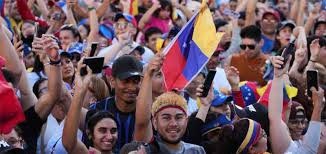
Washington’s strategy since January 3 has focused on Venezuela’s stabilization and economic recovery. Their deferred third phase, “political transition,” is another word for regime change. Rodríguez has made clear that “free and fair” elections can be held only if the blackmail of US sanctions is removed. Thousands marched in a national “Pilgrimage for a Venezuela Without Sanctions and Peace.”
The kidnapping was a military success for the US. But politically Washington had no viable alternative to the Chavistas retaining power, given their strength, according to former Venezuelan foreign minister Jorge Areaza. The only other option for the invader was to face a Vietnam style guerilla war. The Bolivarian Revolution has persisted and is still fighting. On balance, the glass is decisively more than half full.
[Roger D. Harris is with the Venezuela Solidarity Network, the Task Force on the Americas, and the US Peace Council. Courtesy: Countercurrents.org, an India-based independent online journal founded in 2002, publishing articles on peace, democracy, social justice, ecology, secularism, and people’s movements. Edited by Binu Mathew, it is known for giving space to progressive, grassroots, and alternative voices often ignored by mainstream media.]
❈ ❈ ❈
What Cannot Be Unlearned: The Defense of the Bolivarian Revolution
Cira Pascual Marquina
I was recently in an assembly in the west of Caracas where communards were debating how to prioritize scarce resources. The discussion was not easy. People disagreed about whether to invest first in a water system, a productive initiative, or repairing a community space. Voices overlapped at times, arguments were made and remade, and decisions did not come quickly. From the outside, it might look like a routine and even tedious meeting. From within, it is very much something else: a collective effort to think through material life under pressure.
Assemblies like this are not exceptional. They are part of the ordinary functioning of a society that, even under conditions of imperialist siege, continues to organize its material and political life. This is something that is often missed in accounts of Venezuela written from afar, where attention tends to focus on “high politics”—institutional declarations, negotiations, geopolitical responses—while overlooking the dense fabric of everyday political practice that sustains the process.
My argument here is that what might be perceived as simple inertia is better understood as something deeper: the expression of an ongoing historical process that has, over more than two decades, transformed not only institutions, but the capacities of the people themselves.
To grasp the durability of the Bolivarian Revolution just four months after the kidnapping of President Maduro and the attack on the country, it is not enough to look at the state, leadership, or even economic policy, although we should not forgo the analysis on that terrain. One also has to examine a different terrain: the production of political consciousness. What is at stake is not only sovereignty in its formal sense, but the extent to which a society has developed the capacity to understand, organize, and reproduce itself—what I have referred to elsewhere as “popular sovereignty.” This is where the question of popular education becomes central.
Imperialism operates not only through material force, but through the production of meaning. Its violence is not merely destructive; it is pedagogical. Coups and coup attempts, bombardments, kidnappings, and blockades are designed to weaken a country materially, but also to instill lessons: that resistance is futile, that sovereignty is unsustainable, that submission is inevitable.
This pedagogy extends into the symbolic realm. Mainstream media narratives speak of “normalization” in Venezuela—that is, a gradual realignment with a global order dictated from the North—or, alternatively, they refer to a “dictatorship” still in place, over which looms imminent collapse. In both cases, the operation is the same: to overwrite lived reality and produce a common sense in which alternatives to the capitalist and imperialist order appear unthinkable. In this way, imperialism seeks to shape not only what people can do, but what they believe is possible.
Unfortunately, some Left sectors end up reproducing a similar framework, albeit in a different language. When they suggest—explicitly or implicitly—that what has occurred in Venezuela after January 3 amounts to treason or capitulation, they not only misrepresent the process; they also erase the agency of the Venezuelan people. In doing so, they reproduce a logic that reduces Chavistas to spectators, rather than recognizing them as protagonists of a process they have actively built and sustained.
Learning Through Struggle
Yet this discourse encounters limits when it confronts a politically organized society. In Venezuela, imperialism’s attempt to impose a pedagogy of resignation collides with something I encounter daily: a pueblo that has learned, through practice, to interpret and act upon its conditions. Of course, this process has unfolded unevenly—as is the case in any revolutionary experience, where political consciousness and organization develop at different rhythms across territories and sectors. But that unevenness does not negate the transformation. What exists here today is a society marked by the experience of shared political practice that spans close to three decades.
From its inception, the Bolivarian Process placed education at the center of its project. Under the leadership of Hugo Chávez, it was never treated as a secondary or technical matter, but as a decisive terrain of struggle. This orientation drew from the “Tree of Three Roots,” which includes not only independence leader Simón Bolívar and campesino revolutionary Ezequiel Zamora, but also Simón Rodríguez.
Rodríguez, the teacher of Bolívar, argued that emerging Latin American republics could not be built on inherited colonial forms of thought. His insistence that “we either invent or we err” served as a methodological principle: social transformation requires the production of new ways of thinking, grounded in practice. Chávez’s emphasis on popular education can be read as a continuation of this Robinsonian tradition (Robinson was Rodriguez’s pseudonym) under contemporary conditions.
This perspective found concrete expression in initiatives such as Misión Robinson, which, with the support of Cuban internationalist brigades, brought literacy to 1.5 million Venezuelans. But to reduce the pedagogical dimension of the revolution to formal programs would be to miss its most decisive aspect. What has unfolded over the years is something broader: a vast process in which learning takes place through participation in social and political life itself—through assemblies, mobilizations, land struggles, and organized action. It was complemented by a sustained effort at political formation, in which Hugo Chávez played a central role as a popular educator, consistently linking history and theory to the concrete, lived challenges of building socialism.
Land struggles, countercoups, and communal assemblies are not only forms of action; they are processes of formation. In them, people learn to deliberate, to confront entrenched relations of domination, to manage collective resources, to overcome non-antagonic contradictions, and to assume responsibility for shared outcomes. Through these practices, new political subjects are formed—capable of understanding, organizing, and transforming their reality.
The result has been a broad, if uneven, transformation. The revolution has not only altered access to resources or institutions; it has expanded the number of people able to think and act politically.
Irreversibility: What Cannot Be Undone
It is here that the question of irreversibility, which Chris Gilbert brought up in a recent article, becomes decisive. Drawing on the work of the Hungarian philosopher István Mészáros, Chávez argued that revolutionary processes could, under certain conditions, reach a point of no return. This notion is often interpreted in institutional terms, but its most profound dimension is at the grassroots level, where change is, for lack of a better word, molecular.
After more than twenty-seven years, the Bolivarian Revolution has generated a dense accumulation of lived political experience. Millions have participated in processes of organization, decision-making, and struggle. They have not only witnessed politics, they have practiced it.
From within that process, it becomes clear that such experience cannot be easily reversed. Institutions can be transformed, policies overturned, and resources reallocated. But the knowledge produced through lived practice—the capacity to interpret and organize—does not disappear so readily. People (including the political direction of the process) cannot simply “unlearn” what they have lived.
If the Bolivarian Revolution has functioned as a vast field of political learning, its most developed expression lies in the communes. There, collective decision-making is a daily practice. The commune is not a local refuge from the system, nor a mere administrative unit. It is a space where new social relations are forged—where, potentially, cooperation displaces competition, and where politics becomes inseparable from the organization of life itself.
At the same time, it would be a mistake to treat the communal project as self-sufficient or all-encompassing. From a Chavista, Marxist, and Leninist perspective, the commune cannot remain isolated to fulfill its truly revolutionary potential. It must become national, articulated with other spheres of power, including the government. The horizon is not a mosaic of disconnected local experiences, but the transformation of society as a whole.
This is not an abstract concern. From where I stand, it is clear that communes—still marginal in the national economy—cannot sustain or expand themselves if the state is lost to forces hostile to the revolution. Losing the government would not mean the immediate disappearance of popular organization, but it would interrupt the possibility of advancing toward a substantive democracy capable of eroding the metabolism of capital that begins to emerge in the communes.
This does not imply that support for the government must be uncritical. The relationship between popular power and the state has been contested at times since the early days of the revolution. There have been moments when the government distanced itself from the communal project, only to return to it later under pressure from organized sectors.
Against the ‘Safe’ Bet
This brings us back to the defeatist declarations of Left intellectuals that I was mentioning earlier, who insist that the Bolivarian Revolution has already ended, that the government has capitulated, that what remains is little more than a hollow shell. From the outside, this can appear as realism. From within, it reflects a profound misunderstanding of the process. At its core lies a failure to grasp irreversibility.
Those who declare or imply that everything has been lost tend to focus on the government as if it were the sole repository of the revolution. From that perspective, any concession or retreat appears as definitive proof of collapse. What disappears from view is the accumulated political experience of millions of people who have learned, over decades, to organize, deliberate, and act collectively—and, through that practice, are also able to identify errors, advance critique, and push for rectification when needed.
This omission is not neutral. It often reflects either a Eurocentric lens that renders the Global South’s political subject invisible, or a crude geopolitical lens that privileges institutional form over lived experience and underestimates the agency of organized people. From that vantage point, the revolution becomes something that can be declared “over” from afar. From where I stand, that claim does not hold.
Declaring that “it’s over” is not simply an analytical mistake; it has political consequences. It makes it harder to struggle in a very difficult historical moment, contributes to demoralization, and weakens the collective capacity to navigate difficult terrain.
It is always, of course, a much “safer” intellectual wager to declare capitulation, to distance oneself, to preserve analytical purity—it is safer since the reality on the ground is rarely pretty and never certain. But that is a wager made from the outside. Within the Bolivarian Process, the defining feature has been different: a refusal to abandon the struggle while conditions remain open. Moreover, accusations of treason or capitulation are not only false but also politically harmful. They flatten complex dynamics into moral judgments and obscure the strategic terrain on which the process unfolds.
This is not simply a question of competing narratives, but of how reality itself is produced and understood. In Venezuela, these narratives encounter a specific difficulty: they collide with a politically organized movement that has learned to interpret reality together.
There are, of course, decisions in which people do not participate directly, but the debate is always present. Moreover, in robust communes, life does not follow a logic imposed from above; it is produced together, forged in assemblies and in everyday practices. That is why listening to the Chavista base—sometimes critical of specific policies but supportive of the government—matters: it makes it possible to distinguish between what is said about our reality and what is actually lived.
To defend the Bolivarian Revolution in 2026, then, is not only to denounce external aggression. It is to defend and deepen the processes through which a pueblo is learning to govern itself. And what has been learned does not disappear with a policy shift or a moment of retreat. It persists as capacity and consciousness. And that, of course, has material implications in the struggle.
There are no guarantees of victory. Revolutionary processes unfold in adverse conditions, shaped to some degree by forces that are often beyond their control. Marx compared the revolution to a mole that might go underground but remained a telluric force. What exists in Venezuela today is not an exhausted project waiting to collapse. It is a people that has learned—unevenly but decisively—to organize, to study reality, and to struggle collectively.
That accumulated experience cannot be dismissed or wished away. Nor can it be abandoned in favor of the intellectually “safe” prediction of defeat. Chavismo, forged through years of struggle and marked by a historical accumulation of political learning, remains a force with the capacity to defend, correct if necessary, and advance the process.
[Cira Pascual Marquina is a popular educator at the Pluriversidad Patria Grande, the educational initiative of El Panal Commune. She is also a member of the International Communal Democracy Network. With Chris Gilbert, Pascual Marquina is coauthor of Venezuela, the Present as Struggle: Voices from the Bolivarian Revolution (Monthly Review Press), the book series Resistencia comunal frente al bloqueo imperialista (Observatorio Venezolano Antibloqueo), and Protagonistas: construcción comunal en tiempos de bloqueo imperialista (Observatorio and PT). They are also founders and hosts of Escuela de Cuadros. Courtesy: MR Online, a forum for collaboration and communication between radical activists, writers, and scholars around the world, started by Monthly Review, the famed socialist magazine published from New York.]