❈ ❈ ❈
Trump’s Iran Adventure: Miscalculation of the Century
Vijay Prashad
Last year, in July, the United States and Israel bombarded Iran’s nuclear energy and nuclear research facilities over 12 days. After a few days, the two belligerent powers—who had no United Nations authorisation for this war of aggression—opened the door for a ceasefire. At that time, believing that this might very well be the basis for a full negotiation, the Iranian government led by Supreme Leader Ali Hosseini Khamenei agreed to the terms set out—an immediate end to the strikes and no escalation. The missile launchers went quiet, but the deal was very fragile. There was no long-term peace agreement, no binding enforcement or monitoring mechanisms, no settlement on the nuclear issues, and no agreement to end U.S. and Israeli sabotage and attacks on Iran. This was not an end to the war imposed by the U.S. and Israel on Iran, but only an agreement to stop one battle. Khamenei described the U.S.-Israel aggression as futile and said that they ‘gained nothing’, while at the same time saying that Iran forced a ceasefire and would ‘never surrender’.
Oman has a decades-long reputation as a neutral intermediary between Iran and the U.S. (with Israel lurking in the background). Between 2012 and 2013, it was Oman that hosted the U.S.-Iran talks that resulted in the 2015 Joint Comprehensive Plan of Action (JCPOA) between Iran and the P5+1 (U.S., UK, France, China, Russia + Germany) and the European Union—reducing sanctions with some promises on nuclear enrichment. A secure and discrete channel existed through Muscat for Tehran and Washington, and this communication line became active after July toward a proper negotiation to clarify red lines and to reduce the risk of miscalculation. In fact, the conversation broadened and Iran came to the point of accepting that its uranium enrichment would be capped, that its highly enriched stockpiles would be diluted, and that the International Atomic Energy Agency could re-expand monitoring and inspections. This was not a final deal, but it was a negotiation framework with conditional nuclear restraint and an ongoing practice of de-escalation. Both Supreme Leader Khamenei and President Masoud Pezeshkian had the political will for a deal, which was very much on the horizon. Iran’s Foreign Minister Abbas Araqchi said less than a day before the U.S. and Israeli attack that a deal was ‘within reach, but only if diplomacy is given priority’.
In fact, the U.S. and Israel took the other path, a war of aggression that violated the UN Charter (Article 2). On the very first day, on 28 February, the U.S. and Israel assassinated Supreme Leader Khamenei and killed 180 girls at the Shajareh Tayyebeh Elementary School in Minab. The U.S. and Israel believed that this barrage of strikes against political leaders, key infrastructure, and civilians would immediately lead to a popular uprising that would remove the Islamic Republic. The U.S. and Israeli intelligence overestimated the protests that began in December 2025 around the depreciation of the rial and rising inflation. But there is an enormous difference between a cycle of protests against economic issues and the appetite to rise up and overthrow an entire system. When the missiles killed the Supreme Leader, who has a reputation even amongst his critics for piety (he was elevated by the Society of Seminary Teachers at Qom as a Marja-e Taqlid or Source of Emulation in 1994), and when they killed the school children, the public mood was electrified by patriotism. It was impossible in this situation to take the side of the imperialist war against innocent children. The nature of the U.S. and Israeli attack, and the fact that Iran was able to strike Israeli targets as well as U.S. targets in the Gulf Arab states, focused the population of Iran around its own survival and its ability to defend itself. That is the current mood amongst Iranians for the most part.
Since the U.S. wars on Afghanistan in 2001 and Iraq in 2003, U.S. war planners have not set aside the concept of the escalation ladder and have used the concept of rapid dominance (through decapitation strikes, paralysis of command, and total dominance of the adversary’s military). This worked with Afghanistan and Iraq, where the scale of the U.S. violence destroyed the capacity for retaliation. It was truly ‘shock and awe’. Such a military framework did not function with Iran. The Iranians had prepared for a full-scale U.S. and Israeli attack for decades. Their political leadership understood the vulnerability of decapitation strikes, and therefore created eight levels of replacements for most of the top, essential leaders. The military hastily formed different kinds of weapon systems, from hypersonic cluster missiles that could overcome air defence systems to the fast inshore attack crafts that employ swarm tactics in the Gulf waters. These, alongside the pro-Iranian militias from Lebanon to Iraq, are the many rings of defence that the Iranians have built. This means that while the U.S. opens with rapid dominance and does not have an escalation ladder, the Iranian response to the U.S. and Israel was strategically built on starting with its simplest missiles to its more sophisticated cluster missiles—while it has been holding back its small boats and its militias. These have not been deployed, as Iran remains reliant upon its missiles and its hold on the Straits of Hormuz (now only open to ships from certain countries).
Iran’s intelligent response to the U.S. and Israel has pinned them down, leaving them with no choice but to beg for a ceasefire. The Iranian leadership says that it is uninterested in a partial ceasefire, as in July 2025, that would simply allow Israel and the U.S. to rearm and return with another round of violence. Iran says that it wants to have a grand bargain that includes Iran, Iraq, and Lebanon—not just Iran—and that it wants total sanctions withdrawal, an end to the genocide of the Palestinians, and other requirements that the U.S. remove its threatening base structure that encircles Iran. If the U.S. and Israel agree to these demands, it would mean an absolute victory for Iran—despite the tragic losses of human lives from the vicious attack by Israel and the U.S. Having killed Supreme Leader Ali Khamenei, who had been eager for the ceasefire in July 2025, the U.S. and Israel have lost someone who would perhaps have argued again for a ceasefire. The current leadership, including the new Supreme Leader Mojtaba Khamenei, has made an accurate assessment that a ceasefire without a grand bargain is merely about time and not about peace. The Iranians want peace for the region, not war, ceasefire, war, an endless war that results in austerity and pain.
The Israelis have not said much about the war in Iran, preferring to strike with their missiles and block any news coverage of the Iranian missile strikes on Israel. Would they be governed by a peace deal made by Trump? Unlikely. The Israelis have an eschatological view of the Middle East, eager to take the land from the Nile to the Euphrates, which would need them to silence their biggest and most consequential critic in the region, namely Iran. For Israel, this is a fight to the end. They have dragged the U.S. into this battle, even though there is no realistic gain for the U.S. regarding the existence or not of the Islamic Republic (which has not threatened the U.S. at all). Israel wants to see the Islamic Republic uprooted, but that is an unlikely outcome given its deep roots in Iranian society. The U.S. would, on the other hand, be content with the management of the Islamic Republic with a pliant leadership. Neither option is on the cards. And the only option for military escalation is for either the U.S. or Israel to launch a nuclear strike against Iran—which would, after the egregious impact on the lives of Iranian civilians, evoke a totally negative response from global opinion.
There are no good options for the U.S. and Israel. They can remain with their bombing, but they will continue to see Iranian escalation that inflicts harm on Israel and on U.S. interests in the region. The U.S. and Israel will have to face the world as fuel and food prices skyrocket upwards. This was a miscalculation by the U.S. and Israel. Iran will not bend so easy. Hundreds of years of a proud civilisation is at stake. Its leaders know that. They are not just standing for the Islamic Republic or the Iranian Revolution of 1979, but for Iran itself. They will not back down.
[Vijay Prashad is an Indian historian, editor, and journalist. He is a writing fellow and chief correspondent at Globetrotter, and the director of Tricontinental: Institute for Social Research. He is a senior non-resident fellow at Chongyang Institute for Financial Studies, Renmin University of China. He has written more than 20 books. Prashad’s latest books are On Cuba (with Noam Chomsky, The New Press, 2024) and The International Monetary Fund Suffocates the World (with Grieve Chelwa, Inkani Books, 2025). Courtesy: People’s Democracy.]
❈ ❈ ❈
Iran Is Winning the War with the U.S. – This Is How
Ben Norton
More than a month has passed since the United States and Israel launched a war of aggression against Iran on February 28.
It is now clear that Iran is winning this war.
The Donald Trump administration has failed to carry out regime change or state collapse. The Iranian government has proven to be resilient.
Tehran has used asymmetric tactics to defend itself, targeting the weak points of the U.S. empire and exacting a heavy price on its military, economy, and allies.
In fact, Iran has successfully destroyed the U.S. military bases in West Asia, forcing many American troops out of the region. The Pentagon is primarily waging this war from bases in Europe.
Western media admits Iran is winning the war
The fact that Iran is winning the war is even being admitted by major Western media outlets.
The British newspaper The Independent printed an article titled “Iran is the clear winner as Trump’s desperate bid for peace shows he wants out of the war”.
Politico published an op-ed arguing that the “war against Iran is a far bigger strategic error” than the U.S. invasion of Iraq in 2003.
Ironically, this article was written by the former U.S. ambassador to NATO, Ivo Daalder, who had previously supported the war on Iraq.
Most U.S. media outlets helped to promote the George W. Bush administration’s invasion of Iraq, which blatantly violated international law. In fact, the corporate press has supported every major U.S. war for decades, including the wars in Korea, Vietnam, Yugoslavia, Iraq (twice), Afghanistan, Libya, Syria, Yemen, the list goes on and on.
This is the first major U.S. war in decades that the Western media is criticizing from the very beginning.
So the writing is on the wall. It is clear to everyone that this conflict is a disaster, and Iran is winning.
Foreign Affairs is the official publication of the Council on Foreign Relations, whose members are a veritable Who’s Who of the U.S. ruling class. Yet even Foreign Affairs published an article acknowledging that Iran is winning this war.
The author of the essay, Narges Bajoghli, is a professor at the prestigious Johns Hopkins University, which is a significant recruiting ground for the U.S. State Department.
Bajoghli wrote the following in Foreign Affairs (all emphasis added):
Judging by the metrics of conventional conflict, Iran is not faring well against the United States and Israel. Its adversaries are destroying crucial targets in Iran, killing its commanders and degrading its military assets. But these are the wrong measures for assessing Iran’s position in the war. The right measure is not even an assessment of whether Iran is absorbing punishment well—which it is. The question that will matter when the fighting ends is whether Tehran is achieving its strategic objectives. And on that count, Iran is winning.
This outcome is not accidental. Tehran has been preparing for this war for nearly four decades, since the new revolutionary government faced its first major military test in the Iran-Iraq War, which lasted from 1980 to 1988. And it is now executing a strategy that has managed to neutralize key U.S. and Israeli air defense batteries, severely damage U.S. military bases in the Persian Gulf, inflict substantial economic pain, and drive a wedge between the United States and its Gulf allies. The Iranian regime, in other words, is not just surviving the U.S. and Israeli bombardment. The serious economic and political problems it is creating for its adversaries are, on a strategic level, giving Iran the upper hand.
Iran’s strategic objectives in the war
To assess if Iran is winning the war, it is necessary to analyze Tehran’s goals.
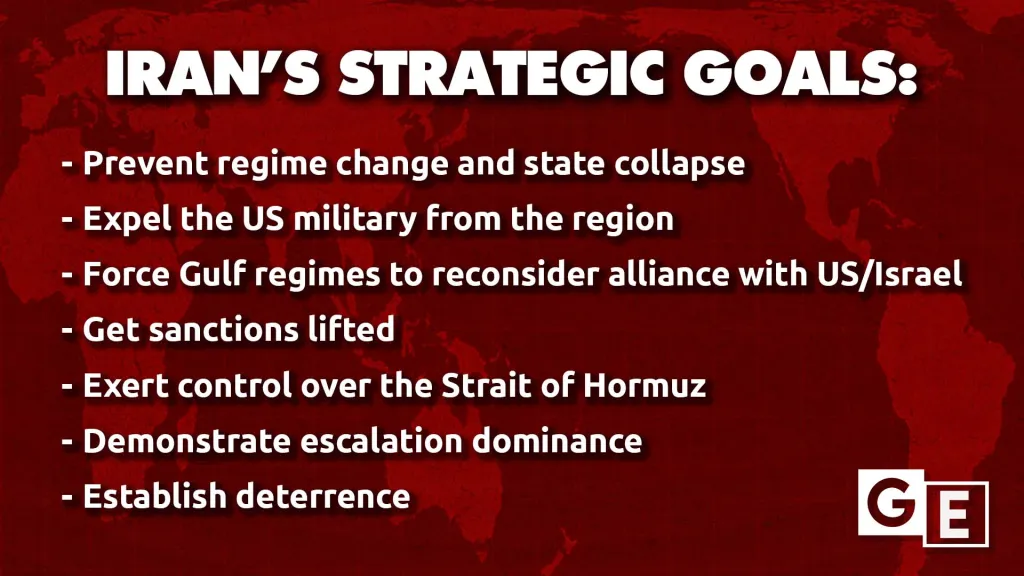
The first and most obvious strategic objective of Iran has been to prevent regime change and state collapse.
The Trump administration initially thought it could overthrow the Iranian government by carrying out so-called decapitation strikes, assassinating its senior political and military leaders.
Nevertheless, Washington has failed to orchestrate regime change. In fact, the Iranian government has not only shown that it is resilient; it has probably become even stronger now, because it has more popular legitimacy.
Many Iranians who were critical of the Islamic Republic have rallied behind the flag and are supporting the state, to prevent the U.S. from taking control of their country (and exploiting its oil, natural resources, and other lucrative natural resources).
More than 850 public demonstrations were held in Iran in support of the government in the first month of the U.S.-Israeli war.
Iran destroyed U.S. military bases
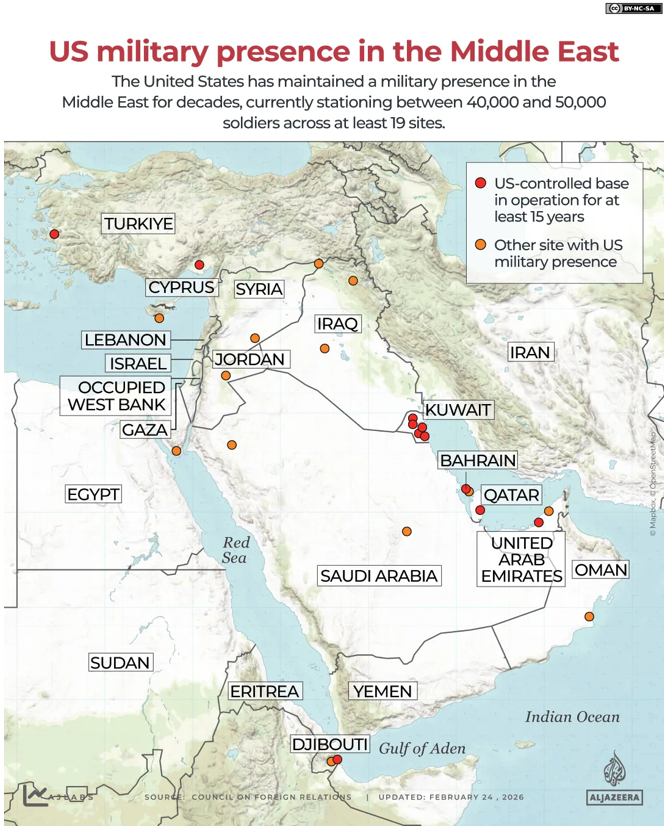
A longtime strategic goal of Iran has been to expel the U.S. military from West Asia.
The U.S. surrounded Iran with roughly two dozen military bases, which were developed over decades.
In response to the U.S.-Israeli war of aggression, Iran has pummeled most of these bases in the Persian Gulf.
Iran launched at least 5,471 missile and drone attacks against the U.S. and its allies in the first month of the war, according to official data compiled by Turkish state media outlet the Anadolu Agency.
These Iranian attacks have been remarkably successful.
In fact, the New York Times reported that the U.S. military has essentially been pushed out of West Asia (a more accurate term for the Middle East).
“Many of the 13 military bases in the region used by American troops are all but uninhabitable”, the Times wrote in an article titled “Iran’s Attacks Force U.S. Troops to Work Remotely”.
Among the U.S. facilities that have been severely damaged is the Al-Udeid Air Base in Qatar, which is the biggest U.S. base in West Asia; as well as the headquarters of the Navy’s Fifth Fleet in Bahrain.
The major U.S. newspaper reported the following:
Iran has bombed U.S. bases across the Middle East in retaliation for the U.S.-Israeli war, forcing many American troops to relocate to hotels and office spaces throughout the region, according to military personnel and American officials.
So now much of the land-based military is, in essence, fighting the war while working remotely, with the exception of fighter pilots and crews operating and maintaining warplanes and conducting strikes.
Before Trump launched this war of aggression on February 28, the U.S. had approximately 40,000 troops in the region. In the first month of the war, thousands of these U.S. forces were sent to Europe.
The American troops that remain in West Asia have been relocated to “makeshift” and “alternative” sites, off base, the Times reported.
Critics have pointed out that, given that U.S. soldiers are waging war on Iran from hotels and office spaces, this means the Pentagon is essentially using civilians in these areas as human shields.
US military is waging war on Iran from bases in Europe
In short, Iran has largely succeeded in expelling the U.S. military occupiers from West Asia.
This fact was further confirmed by an article in the Wall Street Journal titled “Europe Is Quietly Playing a Crucial Role in the Iran War”.
The newspaper reported:
While many European leaders have publicly decried the U.S. attacks on Iran, behind the scenes their military bases are facilitating one of the most logistically complex operations the U.S. military has been involved in for decades.
In recent weeks, U.S. bombers, drones and ships have been fueled, armed and launched via bases in the U.K., Germany, Portugal, Italy, France and Greece, officials say.
Attack drones are being directed from a sprawling U.S. base at Ramstein in Germany, the nerve center of America’s operations against Iran, according to German and U.S. officials. Heavy B-1 bombers have been photographed loading munitions and fuel at RAF Fairford in the U.K. The USS Gerald R. Ford, the world’s largest aircraft carrier, is currently docked at a naval base in Crete to undergo repairs after suffering damage from a fire.
U.S. Air Force Gen. Alexus Grynkewich, the North Atlantic Treaty Organization’s top military commander, said in recent Senate testimony that most European allies “have been extremely supportive.”
The continent, which is home to around 40 U.S. military bases and 80,000 U.S. service personnel, is a launchpad for U.S. operations in both the Middle East and Africa. “The distances are shorter, it’s less expensive, and it’s much easier to project power with our network of bases and allies,” he said.
There are two major takeaways from this report.
Firstly, some European governments have publicly criticized the U.S. war on Iran, acknowledging that it violated international law and constitutes an illegal war of aggression. However, behind the scenes, most EU states and the UK are helping Washington wage this war, allowing the Pentagon to use their territory to attack Tehran. Europe is therefore a party to the conflict.
Secondly, Iran has succeeded in destroying the major U.S. military bases in West Asia and expelling most American troops from the region.
This is one of several reasons why it is clear that Tehran is winning this war.
[Ben Norton is a journalist, writer, and filmmaker. He is Editor-in-Chief of Geopolitical Economy Report. Courtesy: Geopolitical Economy Report, an independent news outlet that provides original journalism and analysis to understand the changing world.]
❈ ❈ ❈
Iran Has the Last Laugh
M.K. Bhadrakumar
March 27, 2026: Wars are always unpredictable. The most famous instance is of another armada like the US’ in the Persian Gulf at the moment — the Spanish Armada, a 130-ship naval fleet sent by Spain in 1588 commanded by Alonso de Guzmán, Duke of Medina Sidonia, an aristocrat appointed by Philip II of Spain to invade England, depose Queen Elizabeth I, and restore Catholicism.
Despite its strength, the Spanish Armada was defeated in the English Channel by a smaller English force using fireships and better artillery, then largely destroyed by storms while retreating around Scotland and Ireland.
The US president Donald Trump’s much-touted armada has more or less the same mission as the Spanish Armada — ranging from regime change to overthrow of the Islamic system of governance to the unspoken leitmotif of a Crusade. Curiously, it seems destined for a similar miserable ending too, the US’ overwhelming military superiority notwithstanding.
Sir Alexander William Younger KCMGUS, former head of MI6, said in an interview with the Economist on Monday that Iran has gained the “upper hand” in the ongoing war with the United States and Iran. Sir Alexander complimented Iran.
More than one factor contributed to this “paradigm shift” of the Big Boy coming out second best. Bad planning, lack of a coherent strategy, over-confidence over the US’ apparent military superiority– all these played their part in the undoing of the plot against Iran that the two aggressors hatched.
It is now out in the open that, incredibly enough, just 16 days into the war, it the US forces were already running out of ATACMS/PrSM ground-attack missiles; and, Israel is about to expend its entire Arrow interceptor missiles by the end March.
The Royal United Services Institute in London published on March 24 an analysis / expert opinion highlighting that the war in Iran has virtually hollowed out the inventory of the US and Israel’s “most critical assets” with no prospects of replenishment anytime soon in a near future due to the fragilities of the US defence industrial base.
The findings are a stark warning that with the conflict having “settled into a grinding trial of attrition” after the first 96 hours, the inventories of long-range interceptors and precision strike weapons are nearing exhaustion.
The CEO of Rheinmetall, Armin Papperger warned on 19 March that global stockpiles are “empty or nearly empty” and if the war continues another month, “we nearly have no missiles available”.
To be sure, Iranians are watching closely and that explains their defiant stance that “Iran will end the war when it decides to do so and when its conditions are met.” Tehran has warned that it will continue to deal “heavy blows” across the Middle East. Media reports confirm Iran’s claim that it has rendered dysfunctional the US bases all across the region. Had it not been about a war, there is cause for celebration when the notorious bully gets thrashed by a little brother.
Word is spreading in the US despite the cover-up by the administration that “The U.S. war in Iran is taking a mounting toll on America’s military, with rising casualties, dwindling munitions stockpiles, a sidelined aircraft carrier and numerous downed aircraft just three weeks into the conflict,” to quote from The Hill, an influential newspaper that circulates among lawmakers in the US Congress.
The report adds, “At least 13 U.S. service members have been killed, while another 232 have been injured since the U.S.-Israeli war against Tehran began on Feb. 28. In addition, some 16 American aircraft have been destroyed, the USS Gerald R. Ford aircraft carrier was damaged in a laundry room fire earlier this month and American forces are quickly blowing through stocks of air defence and long-range munitions.”
The commentary carried by RUSI says that Iran has damaged at least a dozen US and allied radars and satellite terminals, which has impacted the efficiency of interception. Evidently, using 10 or 11 interceptors for one Iranian missile or 8 patriot missiles for one Iranian drone becomes unsustainable going. ahead.
It underscored that the US military is “approximately a month, or less, away from running out of ATACMS/PrSM ground-attack missiles and THAAD interceptors. And Israel is in an even more precarious spot, with its Arrow interceptor missiles likely to be completely expended by the end of March.”
In real terms, this implies accepting greater risk for aircraft and tolerating more Iranian missiles and drones damaging US-Israeli forces and infrastructure. The audacious Iranian attacks this week on Dimona, Israel’s nuclear city, is a vivid example.
“The precariousness … could possibly explain why President Trump is already suggesting the ‘winding down’ of the Iran war; it could take years to replace what was expended in only 16 days,” the commentary points out. Given the limitations of the US defence industrial base, “it will likely take at least 5 years to replenish the 500 plus Tomahawk missiles already fired in the war.
“Worse, sourcing critical defence minerals, rare earths, and materials to make the weapons and munitions is complicated by China. China controls most of the world’s gallium and germanium, and Beijing has imposed numerous mineral export controls since 2023, to prevent the US and its allies from acquiring these necessary inputs for the defence industrial base.”
The “strategic consequence” of all this is that continued fighting with Iran not only increases the risk to forces in-theatre but engenders the bigger risk of what it does to deterrence and defence elsewhere, such as “protecting Taiwan and supporting Ukraine”.
Besides, if the US prioritises replenishing its own stocks, it slows deliveries to other partners. Allies are already signalling concern that “an American focus on its own military replenishment will delay weapon and munition deliveries they have already paid for.”
The reigning superpower that was Spain in the 16th century saw its power crumble after the defeat of the Armada, while England would soon control an empire that the sun never set on. Is history repeating on a similar template in our world in transition?
[Ambassador M.K. Bhadrakumar served the Indian Foreign Service for more than 29 years. Courtesy: Indian Punchline, the author’s blog.]
❈ ❈ ❈
Befooled by Iran’s Grand Strategy, Trump Hits Out. But to What End?
M.K. Bhadrakumar
April 6, 2026: To borrow from William Congreve’s 1697 play The Mourning Bride, “Heaven has no rage, like love to hatred turned, / Nor hell a fury, like a woman scorned”. This predicament explains the uncontrollable rage of the US President Donald Trump, a megalomaniac with an Amazonian ego, when belatedly he came to know that the Strait of Hormuz was not just one waterway amongst the 8 in the world.
By then Trump had already washed his hands off Iran’s move to shut down the Hormuz saying it was none of his concern, and left it the Europeans and the Gulf Arab sheikhs. Now he is staging a comeback and the turnaround is a wild swing, as he realises that if Iran is allowed to preside over the strait of Hormuz, it would have profound implications for “de-dollarisation.” Iran’s Majlis is already seized with legislation introducing a toll system to regulate the use of the waterway by foreign ships.
By a rough estimate, the revenue from the toll system will amount to something like one billion dollar or so annually by a conservative count. Iran and Iran-friendly Oman in whose territorial waters lies the Strait of Hormuz will jointly operate the new regime.
The mystique of the Strait of Hormuz is that regional states who know that the income generated out of the oil flow is the lifeblood of petrodollar cycling, which fuels the western banking system and gives the status of “world currency” to American dollar, will not talk about it or that it gives the US the unique privilege of printing paper currency freely to finance America’s interventionist projects in faraway lands to consolidate the US’ global hegemony.
Trump is horrified that control over the Hormuz waterway enhances Iran’s global influence. Put differently, Iran will have no more need to negotiate with the US. Tehran, in anticipation of the new regime for the Strait of Hormuz, has already proposed to the European Union an agreement on the new regime for the strait. Three days back, Iran green lighted a ship to sail through to France.
Trump’s fury is like that of a woman scorned who has been taken for ride. Never in the annals of international diplomacy would a world leader have used such expletives to abuse Iranians for making him look so foolish in the eyes of the world opinion — while his armada was winning battles, the ground beneath his feet was shifting and he didn’t even know that he has all but lost the war to Iran. Trump wrote on Truth Social announcing that he was giving time till tomorrow, Tuesday, to “open” the Strait of Hormuz:
“Tuesday will be Power Plant Day, and Bridge Day, all wrapped up in one, in Iran. There will be nothing like it!!! Open the Fuckin’ Starit, you crazy bastards, or you’ll be living in Hell — JUST WATCH! Praise be to Allah. President DONALD J. TRUMP”
Trump is threatening to punish Iran by bombing all the power plants and bridges in that country to bring it down to its knees. Trump is even otherwise having a difficult time, as the war is in drift and there is no gain to show. Iran also brought down so many American planes already that the world lost count.
In the estimation of Air Marshal (Retd.) Anil Chopra, a decorated Indian Air Force veteran and fighter test pilot himself, “As of early April 2026, the US has sustained several air asset losses during the conflict with Iran, including the downing of three F-15E Strike Eagles (friendly fire). An additional F-15E was downed over western Iran on April 3, 2026.
“One F-35 Lightning II aircraft, one A-10 Thunderbolt II, one E-3 Sentry AWACS, 17 MQ-9 Reaper drones, and damage to KC-135 aerial refuelling tankers make it an expensive military campaign for the US.
“Three Sikorsky UH-60 Black Hawks were also reportedly damaged that were involved in the F-15 search and rescue efforts, which were struck by Iranian fire, according to reports… A mid-air collision killed six crew members, while an Iranian missile strike on Prince Sultan Air Base damaged another six KC-135 tankers. Iran also hit high-value US ground radars linked to the THAAD AD System, as well as other early-warning radars.
“Iran’s strategy aims to create a “war of attrition” to increase costs for the US and its allies, despite US air superiority. Iran’s strategy aims to create a “war of attrition” to increase costs for the US and its allies, despite US air superiority.”
Will Iran be browbeaten by Trump’s spiteful threats? No way. If he carries out his threats tomorrow, Iran will most certainly pay back in the same coin. An “informed source” told the semi-official Tasnim news agency in Tehran which is affiliated to the Islamic Revolutionary Guard Corps [IRGC]: “If Trump intensifies his madness by carrying out these threats, he will only make his defeat more glorious! And of course, he should know that in this case, in addition to burning all American interests in the region, the consequences of the war will probably reach American territory… Trump will see that they will experience severe turmoil from within American territory… Iran is ready to escalate the tension to any extent.”
The Americans have never understood the Islamic Republic of Iran — its actions and ambitions on the world stage. Behind the veneer of theocracy and Islamic ideology, Iran is pursuing a grand strategy aimed at securing the country internally and asserting its place in the region and the world, as Prof. Vali Nasr wrote in his latest book Iran’s Grand Strategy.
Nasr traces the roots of Iran’s strategic outlook to its experiences over past four decades, especially the American containment strategy. These experiences have shaped a geopolitical outlook driven by pervasive fear of America and its plans for the Middle East.
It is a wrong notion that Iran’s foreign policy simply reflects its revolutionary values or theocratic government. Far from it; the country’s resistance to the US, its nuclear ambitions, and its pursuit of influence and proxies across the Middle East are driven by a grand strategy based on the legacy of colonialism and a constant search for independence and security. Thus, Iran will never capitulate. Trump will learn this home truth ultimately, and it is going to be a humbling personal experience that may even destroy his presidency.
[Ambassador M.K. Bhadrakumar served the Indian Foreign Service for more than 29 years. Courtesy: Indian Punchline, the author’s blog.]
❈ ❈ ❈
US Suffered Major Strategic Defeat in Failed Isfahan Operation
Press TV
US President Donald Trump’s frantic threats in the past few days to target Iran’s civilian infrastructure, including power plants and bridges, are a direct consequence of the heavy defeat suffered by the US forces in the Isfahan operation.
The failed raid was carried out after the enemy conducted extensive aerial reconnaissance operations in the days leading up to the attack, according to the exclusive information.
During those initial infiltration and reconnaissance missions, the US and possibly the Zionist regime lost a significant number of aircraft, including at least one A-10 Thunderbolt II and two Black Hawk helicopters.
The information obtained by Press TV reveals that “zero hour” for the failed Isfahan operation was set during a secret meeting at the White House under the direct supervision of the US president himself.
It has now become clear that this operation had no connection to the claimed rescue of a downed F-15 fighter pilot, a narrative initially pushed by American officials. Instead, evidence examined and confirmed by Press TV indicates that the real objective was to infiltrate and attack one of Iran’s nuclear facilities in Isfahan.
The landing site for C-130 transport aircraft, chosen based on previous reconnaissance, was an abandoned airstrip located dangerously close to one of these nuclear sites.
The Americans miscalculated, believing that Iran’s air defense would be unable to confront the aircraft involved in the operation. However, Press TV learned that the deployment of numerous US aircraft occurred while the Iranian Armed Forces were in full alert, waiting for them. In fact, American special forces fell directly into a trap set by Iranian forces.
The Iranian Armed Forces, including the Army, Law Enforcement (Faraja), the Islamic Revolution Guards Corps (IRGC), and local popular forces, initially did not show a serious reaction to the landing of the first C-130, which was carrying dozens of special forces commandos. Evidence shows this aircraft veered somewhat off the runway while landing at the abandoned dirt airstrip.
Minutes later, a second C-130 aircraft approached, carrying specialized vehicles, several MH-6 Little Bird helicopters, and other support equipment. At that moment, Iranian forces on the scene targeted the second aircraft before it could land, turning its normal landing into an emergency one. Two Black Hawk helicopters also arrived shortly after.
It was at this moment that the aircraft, helicopters, and commandos who had disembarked from the first plane became perfect targets for the Iranian Armed Forces.
After the special forces realized they had fallen into the trap, the White House situation room made a critical decision: the main operation to infiltrate the nuclear site was changed into a desperate rescue operation for the dozens of US commandos trapped under Iranian fire.
The Americans immediately sent several smaller aircraft to extract their forces, barely managing to gather the individuals and withdraw them from the deadly situation.
The rescue operation was conducted so hastily that some soldiers and officers abandoned their equipment, including, according to the evidence possessed by Press TV, the identification document of an American officer left behind in the area, to save their lives.
After the commandos were evacuated, American fighter jets established a line of fire with a 5-kilometer radius to prevent Iranian forces from approaching the abandoned C-130s at the airstrip. The jets also carried out heavy bombing of their own equipment to prevent it from falling into Iranian hands.
In this failed operation, US special forces did not even have the chance to fly the special Little Bird helicopters; some were destroyed on the ground, while others were destroyed inside the second C-130 aircraft.
Following this disgraceful and heavy defeat, Trump hastily and chaotically held multiple press conferences to cover up the failure and falsely portray it as a pilot rescue operation.
The information obtained by Press TV describes these propaganda shows, led by Trump and his Secretary of War Pete Hegseth, as reminiscent of Hollywood films – lies that have not even been accepted by many American audiences.
The information available notes that Trump will continue to fabricate other “Hollywood-style” operations to falsely claim achievements and appease public opinion in the US.
However, his and Hegseth’s repeated storytelling and lying, which have reduced public confidence in him both in the US and across the world to the lowest possible level, have made his “Goebbels-style lies” very difficult to believe.
People in the US and across the world are asking a pointed question: “How is it that a country which supposedly has neither air defense left nor an army or armed forces has managed to shoot down and destroy so many fighter jets and various aircraft, and continues to add to its album of different types of destroyed fighter jets, planes, helicopters, and drones,” a highly-placed source in Tehran told Press TV.
The heavy defeat of the Isfahan operation, he noted, could be recorded in history as the worst and most disgraceful failure of the US military, even worse than the failed Tabas operation of 1980, which saw a botched rescue attempt end in disaster for Washington.
The information obtained by Press TV notes that the heavy aftershocks of this “great debacle” for Trump will affect not only the fate of the ongoing war against the Islamic Republic of Iran but also the political future of “America’s gambling and ignorant president,” his Republican party, and the American political scene for years to come.
[Courtesy: Press TV, a 24-hour English-language news channel launched in 2007 and operated by Iran’s state broadcaster, aimed at a global audience.]