
❈ ❈ ❈
Trump’s Unprecedented Program of National Self-Destruction
John Feffer
It’s always been something of a shock to return to the United States after a stay in Europe or northeast Asia. Things just run better in those parts of the world. The public transportation is fast and efficient. The medical services provide universal care. Infrastructure isn’t in a state of decline. Green spaces are well maintained. Industrial agriculture doesn’t dominate the countryside.
Sure, there are exceptions. Japanese bureaucracy, British trains, Italian unemployment, South Korean work hours: these are nothing to boast about. But in general, the United States ranks pretty low in quality of life compared to its European and Asian competitors. In the U.S. News and World Report’s Quality of Life index, the United States is a middling 22 out of 89 countries, below Belgium, Japan, and Ireland. It’s tied for seventeenth place in the latest UN Human Development Report, below Hong Kong, Singapore, and Canada. That’s pretty lousy marks for the largest economy in the world.
Returning from South Korea this week, I was once again reminded of the continual slippage of the United States. Passport control at Logan Airport was short-staffed. I had to navigate the virtually incomprehensible maze of South Station in Boston to find the bus terminal. Then there was the four-hour bus trip to cover the 92 miles to get back home. By comparison, the 167-mile trip from Seoul to the southern city of Gwangju—where I participated in a conference last week—took me a mere two hours by express train.
On top of the general entropy the United States has been experiencing since the 1970s, there’s the Trump factor. Whatever additional time I had to wait on the passport line at Logan bears no comparison whatsoever to the horrifying experiences of Canadian and Western European tourists detained at the border, residents with green cards or travel permits taken into custody and readied for deportation, and the Venezuelans, Afghans, and Haitians whose Temporary Protected Status has been summarily revoked.
The quality of life for anyone but permanent residents in the United States has thus dropped to near zero.
Lest you feel excluded from the general slide downward under Trump, his attacks on government services is having a negative effect on everyone living in this country. The recently rechristened (by me) Department of Government Chaos, Revenge, and Patronage is making sure that the United States falls even further in the global rankings of quality of life. This Department—and all the accompanying executive decrees—are accelerating the free fall of the United States to the status of what Trump famously labeled a “shithole country,” a place that people all over the world are increasingly trying to avoid.
Jeez, do I have to spell it out?
The Politics of DoGCRaP
It’s common for Americans to criticize their government. A joke that Ronald Reagan made famous was: “The nine most terrifying words in the English language are ‘I’m from the government and I’m here to help.’” Americans typically disparage federal help even as they receive their Medicaid benefits. They don’t understand that federal dollars support infrastructure like roads and bridges. They don’t see that federal money supports education, public media, and research that improves their overall health and wellbeing.
As Joni Mitchell put it in her song “Big Yellow Taxi”—“Don’t it always seem to go/That you don’t know what you’ve got ’til it’s gone?”
Now that Donald Trump and his minions are eviscerating the federal government, Americans are suddenly starting to realize that the 10 most terrifying words in the English language are: “I’m from the Trump administration and I’m here to help.” (Psych!)
The three key elements of Trump’s effort to deconstruct government are chaos, revenge, and patronage. The budget cuts are designed to send federal programming into a death spiral that generates unprecedented chaos. Trump is targeting in particular all the elements of society that did him wrong: the liberal media, law firms that brought suit against him and his businesses, institutions like the Kennedy Center and the National Institutes of Health that indirectly challenge his lack of competence and credentials. Finally, because the federal government controls a considerable amount of money, Trump is doing all he can to loot public resources for the benefit of himself and his friends.
None of this is going through the proper channels. Congress has been transformed in the Trump era into a vestigial branch of government, an American appendix. Government lawyers are trying to argue that the administration doesn’t have to abide by any court decisions, even those of the Supreme Court. Internal resistance might ordinarily throw sand into the gears of Trumpism. But Trump is busy throwing the sand-throwers out of the civil service.
The Four Rs of National Self-Destruction
Let’s examine the mechanisms by which the Trump administration is chipping away at the foundations of American democracy.
Republicans have always been interested in “regulatory reform,” otherwise known as deregulation, otherwise known as canoodling with corporations. Given the sheer difficulty of pushing through any type of governmental change, past Republican administrations (and some Democratic ones) have largely engaged in a form of nip-and-tuck, slicing away here and sewing things back together there. Trump is not interested in cosmetic surgery. He prefers the guillotine approach.
As The New York Times reports:
Across the more than 400 federal agencies that regulate almost every aspect of American life, from flying in airplanes to processing poultry, Mr. Trump’s appointees are working with the Department of Government Efficiency, the cost-cutting initiative headed by Elon Musk and also called DOGE, to launch a sweeping new phase in their quest to dismantle much of the federal government: deregulation on a mass scale.
If he can’t eliminate an agency altogether—as he has tried to do with the Voice of America’s parent agency, the National Endowment for the Arts, and the Department of Education—Trump is embracing the strategy of “death by a thousand cuts.” As agencies reel from cuts in staff, in funding, and in the regulations themselves, the business world is liberated to do whatever it wants.
In many cases, regulations are dying simply because the administration is forcing agencies to stop enforcing the laws, which is like local police no longer monitoring speeding or issuing tickets. “At the Environmental Protection Agency, Trump officials have scaled back enforcement of rules intended to curb air and water pollution from power plants, oil refineries, hazardous waste sites and other industrial facilities,” The New York Times reports. “At the Transportation Department, enforcement of pipeline safety rules has plunged to unprecedented lows since President Donald Trump’s inauguration.”
At the pettiest level, the administration is just making it impossible for government employees to do their jobs, for instance by cutting off the supply of printer toner or placing a $1 limit on government credit cards. Government labs can’t do their work because the administration refuses to approve new purchases.
Which brings us to the second R: a reduction in research.
Going after Scientists
The United States has long been a leader in research and development, measured by amount of money invested and number of patent applications (at least until around 2019, when it was surpassed by China). Donald Trump is determined to undermine U.S. leadership in research by changing the rules governing grantmaking. So, for instance, the administration established a cap on indirect costs that the National Institutes of Health covers in its grants. That might seem like a trivial change, but it will strip many research institutes of their capacity to do work. As one institute director told NPR, “Cutting the rate to 15% will destroy science in the United States. This change will break our universities, our medical centers and the entire engine for scientific discovery.”
In early May, the administration froze all grants issued by the National Science Foundation. New rules will be applied to determine whether new proposals align with “administration priorities” (i.e., proving that the world is flat, the 2020 election was stolen, and fluoride in the water system causes Marxism). The administration is also using the charge of “anti-Semitism” to threaten research funding at major institutions like Harvard, Columbia, and Princeton.
The administration’s overall budget proposal reveals an even greater determination to destroy the federal programs that fund scientific research. As Nature points out,
the proposal would cut all non-defence spending by 23%, but it targets the US National Science Foundation (NSF) for a 56% funding reduction, and would slash the budget of the US National Institutes of Health (NIH) by roughly 40%. The Environmental Protection Agency (EPA) would be hit by a 55% cut as the administration seeks to eliminate what it calls “radical” and “woke” climate programmes. On the day the budget was released, the EPA announced plans to dismantle its primary research division.
It’s no surprise that scientists are looking to relocate abroad. Welcome to brain drain, Trump-style.
Retribution and Remuneration
Donald Trump doesn’t hide his intentions. During the 2024 campaign, he promised his followers that “I am your retribution.” It could have been a line from a villain in a superhero movie (though, of course, his followers heard it as a line from the superhero instead).
In late April, NPR reported on its investigation into the Trump administration’s implementation of retribution. He has gone after disloyal members of his first administration, political opponents, law enforcement officials who investigated Trump, lawyers who tried to convict him, and universities that have stood up to him (Harvard). He has instructed a range of agencies to carry out what can only be termed a “witch hunt,” the term that Trump falsely used to describe the campaigns to bring him to justice.
Ed Martin, the interim U.S. district attorney for Washington, DC, participated in the January 6 insurrection and later defended the perpetrators in court. Those perpetrators are all free, thanks to one of Trump’s executive orders, and Martin is going after the people who jailed them. More than a dozen of the prosecutors on those cases have been fired, in a letter signed by Martin.
Two days after this NPR report appeared, Trump issued an executive order freezing all federal funding for NPR.
The flip side of this drive for retribution is the campaign to reward followers. Autocrats always rule in this manner: one hand giveth, the other taketh away.
The primary beneficiary of Trump’s largesse is, of course, himself. He has made money off his meme coin and crypto more generally thanks in part to investments from Gulf states. His businesses—hotels, golf courses—have benefitted from U.S. government expenditures as well as those of foreign governments. He even netted $40 million from Amazon for a documentary about Melania Trump.
It’s not just the Trump family. Elon Musk is poised to make billions in government contracts for satellites, rocket launches, and, most lucratively, the “Golden Dome” boondoggle. Musk also tagged along on Trump’s trip to the Middle East and signed billions of dollars in contracts.
Trump allies on Wall Street were not happy when the market took a dive after his “Liberation Day” tariffs were announced. The market has recovered some of that wealth, but the real remuneration will come with Trump’s threatened privatizations. The postal service, Social Security, Amtrak: these all could be transferred to private hands over the next four years. Then there’s the asset-stripping that is taking place as the government sells off federal properties.
Remember what happened in Russia during the privatization mania of the 1990s? The new Yeltsin government sold off state enterprises for a song. Billions of dollars were transferred out of the country to foreign banks, and a new class of oligarchs emerged from the rubble.
Guess where Russia is today on the Quality of Life index? Off the charts—and not in a good way.
How Will It End?
Perhaps the average Trump supporter hates universities, scientists, and NPR. Perhaps they don’t ride Amtrak. Perhaps they don’t go abroad to discover just how un-great America really is by comparison.
But Trump’s destruction of government will eventually hit home for them as well. They’ll face sticker shock at WalMart, thanks to the tariffs. They’ll encounter problems getting their Social Security checks or their Medicare benefits. They’ll die because life-saving vaccines are no longer available.
Will they understand, by the time of the mid-terms, that everything Trump says is a 180-degree swerve from reality? The witch hunt he decries has become the witch hunt he directs. The efficiency gains and budget cuts he promises have become a huge increase in the national debt?
And MAGA, in the end, is just a load of DoGCRaP.
(John Feffer is the director of Foreign Policy In Focus, where this article originally appeared. Courtesy: CounterPunch, an online magazine based in the United States that covers politics in a manner its editors describe as “muckraking with a radical attitude”. It is edited by Jeffrey St. Clair and Joshua Frank.)
❈ ❈ ❈
Science Decommissioned!
Robert Hunziker
“But truth’s a menace. Science is a public danger.” (Aldous Huxley, Brave New World, 1932). Huxley’s “World State” promotes stability and social harmony over scientific progress. According to the dystopian World State, science is a threat that challenges existing beliefs, which leads to “questioning the established order.”
2025 – America Decommissions Science
The decommissioning of government-funded science appears to be a directive calling for: “Decommission but leave just enough of a shell to make it appear to be operational.”
In reaction to deep budget cuts, America’s most respected science journal, Nature reports: “Trump Proposes Unprecedented Budget Cuts to US Science”, d/d May 2, 2025: “Huge reductions, if enacted, could have ‘catastrophic’ effects on US competitiveness and the scientific pipeline.” Excusez-moi! What about Making America Great Again?
Or is America’s premier science journal “making stuff up about competitiveness?” Here’s where science becomes a nuisance by exposing haphazard wussy illogical policy decisions that serve to diminish the economy, unless, of course, Nature is erroneously making stuff up, but nobody can Make America Great Again by undercutting ‘competitiveness’. That’s backwards, not forwards.
Looking forward: “Federal funding for basic scientific research delivers demonstrable returns on investment. A recent economic impact study found that every dollar invested in federal biomedical research funding generated nearly $2.56 in economic impact, supporting more than 400,000 jobs and catalyzing nearly $95 billion in new economic activity nationwide in 2024. Economists have also found that government investments in scientific research and development have provided returns of 150% to 300% since World War II.” (The Science Coalition)
Science Budget Cuts Will Target US GDP, Down!
Over the past 50 years, science research and development (R&D) have contributed significantly to economic growth, with estimates ranging from one-quarter to one-half of the total growth (Source: Association of American Universities). Sorrowfully, the Trump administration budget cuts, as well as proposed additional cuts, to federally funded science research are certain to cut GDP growth, based upon 50 years of statistics.
Indeed, the Bulletin of the Atomic Scientists picked up on the damage caused by outrageous, unnecessary budget-cuts to science: “Decommissioned, Retired, Paused: The Weather, Climate, and Earth Science Data the Government Doesn’t Want You to See”, May 20, 2025: “On May 12, the Unidata program paused most of its operations due to a lapse in funding from the National Science Foundation… Shuyi Chen, a professor of atmospheric and climate science, told the Bulletin that virtually any university faculty member who teaches oceanography, atmospheric science, or climate science uses Unidata for research and educational purposes. But it’s not just researchers, in the United States and abroad, who depend on Unidata. These are also tools used for weather forecasting and preparing for extreme events, like floods, winter storms, hurricanes, and wildfires. She also has had students go on to work in the insurance industry, many of whom use Unidata for risk analysis.”
But Unidata is only one of many data sources vastly cut by the new administration. NOAA recently announced that it is retiring the Billion-Dollar Weather and Climate Disasters database, which has tracked the damage from floods, hurricanes, and other large disasters since 1980. Twenty-two other NOAA data products have likewise been retired or decommissioned over the past month.
The DEI Sham
The Trump administration has made radical reductions in staffing and funding in U.S. science-related agencies, including the National Institutes of Health (the nation’s crown jewel of healthcare research) and the Food and Drug Administration. The elimination of key NIH programs based on concerns about DEI will severely damage effective solutions for health research. It is bone-headed.
“Over the past two decades, the NIH has, as the Trump administration decries, prioritized expanding the scope of populations considered in the research it funds. It did so for very good, evidence-based reasons.” (“The Trump Administration’s NIH and FDA Cuts Will Negatively Impact Patients”, Brookings, May 14, 2025).
The key to effective healthcare research has universally moved away from discoveries and treatments based upon restricted, homogeneous sample populations that disregard diversity of populations; rather, recognizing DEI for its value proposition as previous discoveries/treatments based upon narrowly defined homogeneous samples once introduced to the real world proved to be inadequate, hence the term “efficiency effectiveness gap.” DEI makes research much more effectively broad reaching and profitable.
“DEI is not some free-floating ideology that considers a range of backgrounds, treatment differentials, and geographical gaps as ends in themselves. In practice, the NIH infrastructure shifted toward a prioritization of conditions and approaches that evidence indicated were more likely to close the gap between technological development and effectiveness in practice.” (Ibid.)
America’s Crippled Interior DoD
Cuts to agencies within the United States Department of Health and Human Services such as FDA, CDC, and NIH are cuts to the “interior department of defense” much as the Pentagon is the Department of Defense against foreign attack. Yet, the Pentagon budget at $850 billion hasn’t seen a foreign invasion since Pearl Harbor (1941). Meanwhile. the department of interior defense, where budgets are being heavily slashed at FDA, CDC, NIH met the challenge of 103,000,000 Americans hit by Covid-19 with 1,200,000 deaths five years ago by performing a “medical miracle,” orchestrating/funding a vaccine within one year to save millions of lives. Previously, the record time to bring a vaccine to market was four years for the mumps outbreak in the 1960s
Indeed, interior department of defense agencies should be on the same budgetary footing as the Department of Defense for the Pentagon. Yet the budget for the nation’s interior department of defense, NIH, FDA, CDC is unbelievably slashed. For example, the largest most important of the three agencies for internal defense, NIH’s budget for 2025 was/is $48.5billion but Trump proposes cutting to $27 billion for 2026. This is the “crown jewel” of biomedical research in America. Former NIH employees, anonymously, claim the next pandemic or epidemic will be the disaster of all disasters. Meanwhile, the Pentagon ($850 billion), twiddling its thumbs, patiently waits, and waits, and waits for the next “Pearl Harbor.”
Repeating the obvious: That’s $850 billion to prevent the next Pearl Harbor versus $48 billion (soon dropping to $27 billion) for NIH interior defense against diseases.
Already, the NIH has $2.4 Billion in canceled and frozen grants and contracts, fired 1,200 employees, plus induced retirement and resignations from a yet unspecified number. The Trump administration’s 2026 Budget proposes a 37% further cut to the agency. Meanwhile, over 3,500 jobs at the FDA have been eliminated, and the administration has hinted at further restructuring of the agency. The former head of the FDA claims the FDA ‘as we know it’ is gone for good.
Eureka! Ninety-three years since Huxley’s epigram, “Truth is a menace. Science is a public danger” resurfaces in full living color in the year 2025, as America’s interior department of defense for healthcare is ironically crippled, and the country reverts to principles espoused in literature on the heels of the Roaring Twenties (1920-29) at the doorstep of the Great Depression (1929-39) in a time of indecisive decisions, once again, history repeating itself. How’d that work out?
(Robert Hunziker is a freelance writer and environmental journalist from Los Angeles. Courtesy: CounterPunch, an online magazine based in the United States that covers politics in a manner its editors describe as “muckraking with a radical attitude”. It is edited by Jeffrey St. Clair and Joshua Frank.)
❈ ❈ ❈
Trump’s ‘Big Beautiful’ Cuts to Social Security, Medicare, Medicaid and More
Louisiana Workers Council
May 30, 2025: Following is a fact sheet about how Trump’s “big beautiful” budget bill cuts essential services and benefits for workers to give to the wealthy. The fact sheet was put together by the Louisiana Workers Councils. Some examples relate to Louisiana, but most of the statistics are for the U.S. as a whole.
Louisiana Workers Councils Fact Sheet
Medicaid and ACA Subsidized Insurance
Medicaid is being ripped to shreds
The MAGA movement claims to support health care for vulnerable Americans, but their budget tells a different story. 13.7 million people will lose Medicaid–nearly 1 in 5 current enrollees. Nationally, 72 million rely on Medicaid, including 1.6 million in Louisiana and 180,000 in New Orleans. Another 500,000 low-income Louisianans get subsidized ACA coverage. Everyone on Medicaid or ACA plans will suffer from these cuts.
Here’s What They’re Really Doing:
- $715 billion slashed from Medicaid–the biggest cut in history.
- 13.7 million kicked off Medicaid immediately, including 304,000 Louisianans.
- States forced to pay double–Washington currently covers 80% of Medicaid costs, but Trump wants a 50-50 split. Killing the provider tax (how states fund their share) means massive cuts–fewer covered, fewer services, more suffering. Louisiana lawmakers will jump at the chance to gut care even further.
- 175,000 Louisianans already lost Medicaid in the past year–not because they didn’t qualify, but because of paperwork traps.
- New costs and fewer benefits:
- Copays for doctor visits
- Fewer covered medications & services
- Lower pay for doctors (so fewer will accept Medicaid)
- Yearly spending caps (once you hit the limit, no more care)
- Rural & urban hospitals / clinics will close as funding dries up.
- Red tape nightmare: Recertification every 6 months with stricter rules–many will lose coverage just from missed paperwork.
- Nursing home disaster:
- Mass closures from funding cuts
- No more minimum staffing rules (elderly left neglected)
- Home health care slashed–forcing disabled & seniors into institutions
- ACA subsidies eliminated–500,000 low-income Louisianans will lose insurance. Most can’t afford replacements.
- Work requirements = poverty trap:
- Unemployed adults must work 80 hrs / month to keep Medicaid
- Forces desperate people into exploitative low-wage jobs
- 21% of New Orleans youth (16-24) are unemployed–where will they find work?
- Disabled people abandoned: Cuts to in-home care will force many into institutions or homelessness.
- No more food / benefits on Medicare Advantage plans.
- WIC & Meals on Wheels starved: Severe cuts or total shutdowns–hunger will skyrocket.
The Bottom Line:
This isn’t “saving money”–it’s a war on the poor, sick, and vulnerable. Millions will suffer, hospitals will close, and families will be bankrupted–all to fund tax cuts for the wealthy. These cuts are cruelty by design.
Housing Assistance
The Trump administration’s budget slashes billions from critical housing programs. In New Orleans alone, 20,000 people remain on the Section 8 and public housing waiting lists, which are now closed–meaning no new applicants can even get in line for help.
- Key Housing Cuts in the Proposed Budget:
- Gutting Section 8 & Federal Rental Assistance
- $26.7 billion cut to federal rental aid, effectively ending Section 8 as we know it.
- Shifts responsibility to cash-strapped states, leaving millions without support.
- Currently, only 1 in 4 eligible families (2.3 million) receive vouchers due to funding shortages (actual need is closer to 10 million people).
- 645,000 fewer people would lose assistance nationwide, including 14,000+ in Louisiana.
- Arbitrary Time Limits on Rental Aid
- Imposes a two-year limit for adults without disabilities, kicking thousands off assistance.
- Thousands of children will also lose housing when their parents are cut off.
- Eliminating Affordable Housing Programs
- Cuts $3.3 billion in Community Development Block Grants, halting construction and repairs nationwide.
- Ends the HOME Investment Partnerships Program, stripping funding from affordable housing providers.
Consequences:
-
- More families lose homes due to unaffordable maintenance/insurance costs.
- Due to tax and insurance increases, rents in New Orleans rose 14% in 3 years.
- Slashing Homelessness Assistance
- Caps homeless aid at 2 years and “consolidates” programs, leading to massive job and resource cuts.
- 166,000 permanent supportive housing units for the formerly homeless would lose funding. • Homelessness already rose 18% between 2023 and 2024–a record increase–yet the budget cuts homelessness prevention grants by 12%.
- Cutting Disaster & Emergency Housing Aid
- Reduces disaster recovery assistance (critical for hurricane survivors in Louisiana).
- Eliminates 70,000 emergency housing vouchers from the American Rescue Plan, hurting people at risk of homelessness and domestic violence survivors.
- Because emergency vouchers under the American Rescue Plan come as a block grant (meaning it has limited funding) funds are already running out more quickly due to soaring rents–now they’ll vanish faster.
SNAP
867,000 Louisianians depend on SNAP benefits / 86% are Children, Seniors, and Disabled People
- Nationwide, 1 in 8 people receive SNAP benefits, which are already inadequate. At the maximum benefit, SNAP provides barely more than $2 per person per meal. Trump’s proposed cuts would be the largest cuts to SNAP in history, resulting in millions of people going hungry.
- Congress wants to cut $230 billion from food assistance programs over 10 years.
- The budget also cuts $425 million from CSFP, which provides food for low-income seniors.
- It raises the age limit for SNAP work requirements from 54 to 64.
- Previously, people with dependents under 18 were exempt from work requirements; now, that age is lowered to seven.
- Their budget transfers SNAP costs to the states, going from 50% federal money to 25%.
- Without funding or support, some states will stop providing SNAP completely. Over the next 10 years, Louisiana would lose $4.7 billion in SNAP funding.
- These cuts will cause significant job losses, with about 143,000 lost nationwide and 78,000 losses in agriculture, grocery, and food processing.
- Over 600,000 students in Louisiana use the free or reduced-price lunch programs, which is 91.9% of students participating in school lunch programs.
- Following the lead of U.S. Secretary of Health and Human Services Robert F. Kennedy, Jr., many states are restricting what food can be bought with SNAP or other food programs. These restrictions, which include limits on buying products made with flour, would limit food access in areas where “healthier” options aren’t available or affordable.
- The Trump administration is not actually interested in providing healthier food: they already ended two programs in Louisiana that brought fresh, local food to food banks, schools, and childcare centers. This was a cut of $660 million nationwide, about $12 million for Louisiana. They also added extra restrictions on food assistance programs, making it harder for schools to access funds by increasing the percentage of students from low-income families attending the school from 40% to 60% minimum. This will mean 12 million students will lose access to food aid. In Louisiana, 469 schools no longer qualified.
Social Security
Social Security operates independently from the federal budget, funded by its two trust funds, which hold $2.9 trillion in reserves. For 30 years, Social Security ran a surplus. But these funds have been repeatedly drained by the Treasury–often to finance military budgets.
Even after these withdrawals, the trust funds remain solvent–but the situation is getting worse. Under current law, the ultra-wealthy pay just one month of Social Security taxes, while the Treasury and Commerce Department continue siphoning money from the program.
Trump is aiming to sabotage the Social Security Administration, setting the stage to push for privatization. If privatized, Social Security funds could be invested in the stock market or cryptocurrencies instead of secure Treasury bonds–jeopardizing retirees’ financial security. In the recent Wall Street crash, many 401(k) pension funds lost a lot of money. It is worth remembering that billionaires were pre-warned about tariffs that crashed the system and made billions selling stocks in advance.
The proposed budget bill grants $4.2 trillion in tax cuts to millionaires and billionaires–without exempting Social Security from taxation. But the biggest threat is the deliberate sabotage of the system, endangering benefits for current and future recipients.
- No Increase for the Most Vulnerable
- Over 40% of Social Security recipients rely solely on their benefits, with no other income.
- Rising living costs erode real income yearly while poverty-level Social Security payments remain the same.
- The decline of employer pensions has forced more retirees to depend entirely on Social Security.
- Office Closures Despite In-Person Requirements
- The Social Security Administration (SSA) is shutting down offices while forcing new applicants to apply in person, creating barriers to access.
- Sharing Sensitive Data with Elon Musk & DOGE Affiliates
- Private entities, including Elon Musk and DOGE-linked groups, are being granted access to Social Security information, raising serious privacy and security concerns.
- Severe Staffing Shortages
- The SSA has cut thousands of jobs, leaving staffing at historic lows–delaying services and worsening backlogs.
- Political Sabotage of Experienced Leadership
- Qualified administrators are being replaced by Trump loyalists who aim to dismantle and privatize Social Security rather than protect its stability.
- MAGA Takeover
- Howard Lutnick, Trump’s Commerce Secretary overseeing Social Security, mocked beneficiaries, saying only “frauds” would care about missed payments after a court ruling threatened shutdowns.
- Deliberate System Disruptions by DOGE-Linked Groups
- Cyberattacks and system failures–orchestrated by DOGE-affiliated gangsters–have crashed phone and online services, leading to extended outages and wait times.
War Budget
Survival Programs Get Cut, War Profiteers Get Rich
75% of Trump’s proposed budget–our tax dollars–funds war and repression (DOD, DOJ, CIA, DHS, etc.). Total spending on war and repression exceeds $2.5 trillion when including:
- The Department of Energy (which manages nuclear weapons)
- $952 billion in interest payments on debt from past military spending
The U.S. maintains 900 foreign military bases–compared to China’s one overseas base. The U.S. military budget is larger than the next 10 countries combined.
Budget Priorities: Guns Over People
✓ Pentagon: $1.01 trillion (+13%)
✓ DHS (Border Patrol, ICE, migrant prisons): $107 billion (+65%)
✗ HUD (housing): -$34 billion (-43%)
✗ Health & Human Services: -$33 billion (-26%)
✗ Education: -$12 billion (-15%)
Who Profits?
The Treasury is looted by:
- Oil / gas corporations
- Weapons manufacturers
- Big Tech
- Wall Street banks
Many war-profiteering corporations pay $0 in taxes. Many even get more in rebates than they pay in taxes. GE, for example, got $423 million in rebates in 2023.
Billionaire Elon Musk Gets Rich By Stealing Our Tax Money
While Trump and Musk’s DOGE slash social programs and lay off thousands, his company SpaceX is set to receive $25 billion for Trump’s “Golden Dome” space weapons program. As of February 2025, Musk has received $38 billion in U.S. government contracts, loans, and subsidies (Washington Post).
Nuclear Madness
Trump demands $12.9 billion more for nukes–despite the U.S. already having 5,000+ nuclear weapons (enough to end human civilization many times over).
(Courtesy: Struggle-La Lucha, a US based socialist publication.)
❈ ❈ ❈
Disappearing the America We Once Knew
Karen J. Greenberg
In these first 100-plus days of the nation’s 47th presidency, President Donald Trump and his sidekick Elon Musk have cast a frightful spell over the country. As if brandishing wands from inside their capes — poof! — offices and their employees, responsibilities and aims, norms and policies have simply disappeared. The two have decreed a flurry of acts of dismantlement that span the government, threatening to disappear a broad swath of what once existed, much of it foreshadowed by Project 2025, the Heritage Foundation’s blueprint for drastically reorganizing and even dismantling government as we know it during a second Trump administration.
To my mind, the recent massive removals of people, data, photos, and documents remind me of the words of Czech novelist Milan Kundera in his classic novel The Book of Laughter and Forgetting: “The struggle of man against power is the struggle of memory against forgetting.”
Dismantling the Institutions
By the middle of March, the new administration had already eliminated dozens of departments and offices, as well as thousands of staff positions, with the supposed goal of “government efficiency.” Buyouts, layoffs, reassignments, and a flurry of resignations by those who preferred not to continue working under the new conditions all meant the elimination of tens of thousands of government workers — more than 121,000, in fact, across 30 agencies. The affected agencies included the Department of Energy, Veterans Affairs, the National Oceanic and Atmospheric Administration, and the Internal Revenue Service, as well as multiple offices within Health and Human Services, including the U.S. Food and Drug Administration, the Centers for Disease Control and Administration, and the National Institutes of Health. The Department of Education lost nearly half its staff. And then there was the U.S. Agency for International Development (USAID). By the end of March, the administration had closed its offices and reduced its staff from approximately 10,000 personnel to 15.
The gutting of such offices and their employees is — I’m sure you won’t be surprised to learn — expected to cripple significant government services. At the Department of Education, for example, billions of dollars of institutional aid as well as student loans will be affected. Cuts at the Office of Veterans Affairs, which faced one of the largest staff reductions, are predicted to deprive veterans and their families of healthcare services. USAID’s end will cut programs that addressed poverty, food insecurity, drug trafficking, and human trafficking globally. At the Department of Health and Human Services, the availability of vaccines, the tracking of infectious diseases, and all too much more are threatened and could, according to the executive director of the American Public Health Association, “totally destroy the infrastructure of the nation’s public health system.”
But, as novelist Kundera reminds us, the toll won’t just be to government officials and the positions they’re leaving in the dust of history. The cuts also include a full-scale attack on the past.
Records Gone Missing
As part and parcel of this bureaucratic house-clearing, an unprecedented attack on the records of government agencies has been taking place. Basic facts and figures, until recently found on government websites, are now gone. As I wandered the Internet researching this article, such websites repeatedly sent back this bland but grim message: “The page you’re looking for was not found.”
Many of the deletions of facts and figures have been carried out in the name of the aggressive anti-DEI stance of this administration. As you’ll undoubtedly recall, in the first days of his second term in office, Donald Trump declared DEI programs to be “illegal” and ordered the elimination of all DEIA (Diversity, Equity, Inclusion, and Accessibility) “policies, programs, preferences, and activities in the Federal Government, under whatever name they appear.” A Pentagon spokesperson then tried to explain such acts this way: “History is not DEI.”
And indeed, at the Pentagon’s website, at least 26,000 portraits, ranging from a World War II Medal of Honor recipient to the first women to graduate from Marine infantry training, were scheduled for removal in the name of the administration’s anti-DEI agenda. In addition, articles were deleted from the site, including a story on baseball great Jackie Robinson, who had served in World War II, as well as mentions of women and minorities. On the website of Arlington National Cemetery, information about Blacks, Hispanics, and women went missing as well. At the Smithsonian Institution, where Vice President JD Vance was put in charge of the world’s largest museum enterprise, consisting of 21 separate museums and the National Zoo, the mandate similarly became to “remove improper ideology” from those museums, as well as from the education and research centers that its portfolio includes.
Following a storm of protest, some efforts at restoration have occurred, including the material on Jackie Robinson, the Washington Post reports that “the categories ‘African American History,’ ‘Hispanic American History,’ and ‘Women’s History’ no longer appear prominently.” Yet some information and artifacts, officials predict, have been lost forever.
The attack on history is perhaps most strikingly apparent in the disruption of the National Archives and Records Administration (NARA), the institution whose mission is precisely to preserve government records. As the Associated Press summed it up, “As the nation’s recordkeeper, the Archives tells the story of America — its founding, breakdowns, mistakes and triumphs.” The attack on NARA has come in the form of staff reductions, including the firing of the Archivist of the United States and the departure, owing to firings, buyouts, or resignations, of half of that office’s staff. (Remember, NARA was central to the federal criminal case brought against Trump for his alleged mishandling of classified documents, a case which was eventually dismissed.) Notably, the Department of Justice reportedly removed a database which held the details surrounding the charges and convictions that stemmed from the January 6th attack on the U.S. Capitol.
At USAID, an agency founded more than 60 years ago and now utterly eviscerated, the destruction of past records has been a top-line item. As ProPublica first reported, and other news sources later detailed, employees at USAID were ordered to destroy classified and personnel records. “Shred as many documents first,” the order read, “and reserve the burn bags for when the shredder becomes unavailable or needs a break.” Meanwhile, massive layoffs at the Department of Health and Human Services (HHS) are expected to drastically curtail the access of Americans to public records. At the CDC, cuts have included gutting the public records staff (though HHS Secretary Robert F. Kennedy, Jr. has claimed that he plans to reverse that).
Perhaps not surprisingly, the assault on the facts and figures of the past includes an adamant refusal to keep records for the future, a tendency that also marked the first Trump administration and has already proved striking in the first 100 days of his second term.
The Signalgate scandal is a case in point. In the group chat held by then-National Security Adviser Mike Waltz on the Signal app, instead of a designated classified communications channel, discussing an imminent attack on Yemen, national security officials communicated classified information outside of approved channels. In addition to violating norms and laws governing communications involving classified information, the fact that the app was set to auto-delete ignored the law that mandates the preservation of official records.
Nor was Signalgate a one-off. Trump administration officials have reportedly taken to using Gmail, while Elon Musk’s Department of Government Efficiency (DOGE) has been relying on Google Docs for the drafting of government documents, in each case attempting to bypass laws regulating the archiving of public records by potentially “failing to preserve all iterations of its drafts as well as comments left on shared documents.”
Of course, the president’s aversion to creating records in the first place long predates the present moment. During his first term, for example, he had a tendency to rip up documents as he saw fit. “He didn’t want a record of anything,” a senior official told the Washington Post. Notably, he refused to have notes taken at several meetings with Russian President Vladimir Putin and, after one encounter with the Russian president at a Group of 20 meeting in Hamburg, Germany, in 2017, he confiscated the interpreter’s notes.
Evading the Law
In such an ongoing obliteration of the records of government activities, the violations that have already taken place have essentially rendered the law invisible. The Federal Records Act, as Lawfare reminds us, requires any federal agency to ”make and preserve records containing adequate and proper documentation of the organization, functions, policies, decisions, procedures, and essential transactions of the agency.” And when it comes to presidential records, the Presidential Records Act categorizes them as the property of the United States and requires the president to take “all such steps as may be necessary” to preserve those records.
There is, however, a giant carve-out to that requirement. During his tenure in office, the president can seek to withhold certain records on the grounds that the documents have ceased to have “administrative, historical, informational, or evidentiary value.” In order to make such a decision, however, the president must first consult with the national archivist, a position that at present belongs to the now four-hatted Secretary of State Marco Rubio, who is currently the acting head of the National Security Agency (NSA) and USAID, as well as the National Archives. It’s worth noting that there is no enforcement mechanism in place to address a decision to dispose of documents, or to challenge the legality — or even the wisdom — of such a decision. The law, as one scholar argues, remains essentially “toothless.”
Why History Matters
Historians like me are particularly sensitive to the destruction of government records. Archival materials are our bread and butter. Who knows what new information we might find and what new insights we might gain from a fresh look at the letters of John Adams on the eve of the outbreak of the American Revolution or the records of the dissenters in George W. Bush’s administration in the run-up to the War in Iraq? With the new insights that documents and records provide can come new understandings of who we are as a country, what ills our leaders have (or haven’t) addressed, what tragedies might (or might not) have been avoided, what successes might (or might not) have been more likely to come about. In sum, the records of the past hold innumerable lessons that could guide us into a more sustainable and just future.
That documentary record helps — or at least until this fragile moment, helped — us understand the pathways that have brought us here in both moments of glory and times of trouble. The record feeds us, inspires us, and allows us to feed and inspire others. It’s through the telling of history that we have come to understand our collective selves as a nation, our individual selves as actors, and our leaders’ decisions about the future.
All that is, of course, now changing and the spell cast by the administration’s ongoing destruction of those records, the emptying or altering of the nation’s cache of documents, has been enhanced by another spell — that of suspicion over the contents of what documents remain, based on accusations that the record itself is partisan and tainted, and so deserving of eradication.
For historians and the public we serve, when record-keeping is marred or even annihilated by a political agenda, as is happening today, such acts can carry special interest for scholars of the past. After all, purposeful deletions from and false additions to the historical record offer a truly grim possibility: the creation of what could pass for a new history of this country. As of now, the Trump administration is functionally acting to rewrite the prevailing narratives of our past — a past of progress towards equal rights, fact-based education, and lessons learned from mistakes and achievements. In sum, to alter or erase the historical record amounts to erasing our knowledge of ourselves.
David Corn, in his newsletter Our Land, recently posted a piece entitled “Trump’s War on History.” In it, he quotes George Orwell from his classic dystopian novel 1984: “Who controls the past controls the future. Who controls the present controls the past.” As Corn points out all too ominously, expunging history was an early tactic of the Nazis, who sought to turn the clock back to a time before the French Revolution and its values altered the course of history. As Corn puts it, for the Nazis, “the animating ideas of the French Revolution, such as liberty, civic equality, and human rights, were to be crushed.”
For Orwell, as for Kundera, owning history with a firm grip is a power of immense consequence, never to be lightly dismissed. Memory and the records that sustain knowledge of the past are essential to humankind’s struggle against the worst sort of naked power grabs, never more so than now.
[Karen J. Greenberg is the director of the Center on National Security at Fordham Law. She is also the editor-in-chief of the weekly Aon CNS Cyber Brief. She is the author of Subtle Tools: The Dismantling of American Democracy from the War on Terror to Donald Trump and co-editor with Julian Zelizer of Our Nation at Risk: Election Integrity as a National Security Issue. Courtesy: TomDispatch, a web-based publication, founded and edited by Tom Engelhardt, aimed at providing “a regular antidote to the mainstream media”.]
❈ ❈ ❈
Trump’s ‘Big Beautiful Budget Bill’ a Disaster for Black Workers
LaToya Parker and Dedrick Asante-Muhammad
The House recently passed a massive Trump budget bill that will cut trillions in taxes for the ultra-wealthy while eviscerating Medicaid, SNAP, and other services for working Americans. It has now moved to the Senate.
This bill has been called a massive transfer of wealth from the poor to the rich. It will also entrench racial economic inequality, subsidizing dynastic wealth for the majority white top 0.1% while defunding the public-sector jobs and benefits that have long sustained the Black working class.
Among other tax breaks for the wealthy and corporations, this bill eliminates the estate tax for ultra-wealthy households. The federal estate tax currently applies only to estates worth more than $13.99 million per individual (or $27.98 million per couple) in 2025. That’s just 0.1% of estates. Repealing the estate tax would cost the federal government billions in lost revenue and benefit only the very wealthiest households.
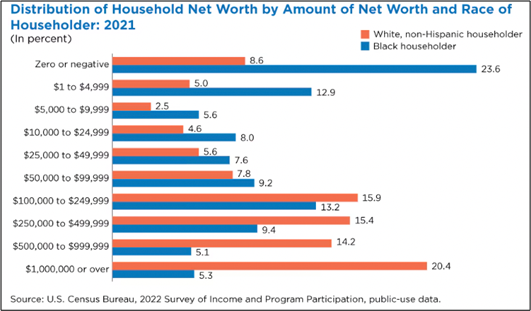
Racially, the impact is stark: Black families hold less than 5% of U.S. wealth, despite making up over 13% of households. And the median white household has ten times the wealth of the median Black household. Repealing the estate tax would be a massive wealth transfer to the already wealthy, doing nothing for the 99.9% of Americans—especially Black households—who are far less likely to inherit wealth.
To offset the cost of these massive tax breaks for the wealthy, the bill slashes all kinds of programs that working Americans rely on. One particularly cruel cut is to reduce benefits for federal employees and gut civil service protections. These changes threaten one of the most secure avenues for Black economic progress—government employment—for “savings” of just over $5 billion a year in a bill that will cost trillions.
Today, Black employees make up 18.7% of the federal workforce. This is no accident—it reflects decades of civil rights gains, anti-discrimination laws, and the promise of fair hiring. Federal jobs have long provided higher wages, stronger benefits, and greater job security for Black workers than much of the private sector.
Nowhere is this more evident than in the D.C.-Maryland-Virginia (DMV) region—the epicenter of the federal workforce. Across the DMV region, more than 450,000 federal workers are employed. Black workers account for over a quarter of federal workers in D.C., Maryland, and Virginia alike.
This corridor has long been a cornerstone of Black economic advancement. It’s where federal jobs have helped Black families build generational wealth, send children to college, and retire with dignity.
In the South as well, where Black workers face the nation’s largest racial wage gaps and persistent barriers to private sector advancement, federal employment has provided a crucial counterbalance. Well over a third of federal workers in Mississippi, Alabama, South Carolina, and Louisiana are Black—along with nearly 44% in Georgia.
These figures reflect more than representation—they underscore federal employment as a stabilizing economic force in Black communities.
Federal retirement benefits—including pensions and annuities—are a rare form of guaranteed income in retirement. For Black workers who still face the racial wealth divide as a barrier to economic security, these benefits are foundational. Nearly half of Black families have zero retirement savings, making federal pensions critical to avoiding poverty.
Together, these policies amount to a reverse wealth transfer: enriching wealthy heirs while undermining public servants. Instead of gutting benefits and eliminating the estate tax, we should invest in the systems that have historically offered a path forward for Black workers—and workers of all colors—and develop policies that would expand these wealth-building programs beyond government employment.
This isn’t just a policy question. It’s a question of national values.
(LaToya Parker is a senior researcher at the Joint Center. Dedrick Asante-Muhammad is the President of the Joint Center for Political and Economic Studies. Courtesy: People’s World, a voice for progressive change and socialism in the United States. It provides news and analysis of, by, and for the labor and democratic movements.)
❈ ❈ ❈
A Death Sentence for Thousands and Thousands of People
Bernie Sanders
The American people, whether they are Democrats, Republicans or Independents, understand that we have a corrupt campaign finance system which allows billionaires and their lobbyists to play an enormously powerful role in electing candidates, defeating candidates and in crafting legislation. This is true of the Democratic Party and it is true of the Republican Party.
Today, with Republicans in control of the White House, the U.S. Senate and the U.S. House, we are seeing how this corrupt process plays out for the priorities of the Republican party and for their billionaire campaign contributors.
This so-called reconciliation bill, President Trump’s “big, beautiful bill” that the Republicans are rushing through the House right now is a rather extraordinary piece of legislation. In many respects, given the crises facing our country, this legislation does exactly the opposite of what should be done.
It is no secret that we have more income and wealth inequality in our country today than we have ever had.
Today, the wealthiest man in the world, Mr. Elon Musk, who is now worth more than $400 billion, owns more wealth than the bottom 52% of American society. The top 1% owns more wealth than the bottom 93%. And CEOs of large corporations now make over 350 times what their workers make.
Unbelievably, according to the RAND Corporation, over the past 50 years, nearly $80 trillion in wealth has been redistributed from the bottom 90% of the American people to the top 1%.
What we have seen is the very wealthiest people in America are becoming much richer while at the same time, 60% of Americans are living paycheck to paycheck and many millions of families are struggling to put food on the table. That is the economic reality of today.
What does President Trump and Republicans’ reconciliation bill do to address this grossly unfair and unstable situation? What are they doing when the very rich are becoming much richer while working families struggle?
Here’s the answer: this legislation makes the rich and wealthy campaign contributors even richer while making life harder and more stressful for the working families of our country.
This legislation provides massive tax breaks to the top 1% and large corporations in our country and pays for these tax cuts by cutting Medicaid, the Affordable Care Act, nutrition, education and other programs that are life and death for working families.
Let me give you one example of how outrageous this legislation is.
As currently written, this bill provides a $235 billion tax break to the top two-tenths of 1% by increasing the estate tax exemption for couples to $30 million.
The estate tax is only applicable to the very wealthiest people in this country who inherit substantial sums of money from a relative.
Under this provision, a couple that inherits $30 million would now pay ZERO tax on that inheritance. Once again, this provision applies only to the top two-tenths of 1% of Americans – the very, very wealthiest people in this country. 99.8% of Americans would not benefit by one nickel under this provision.
Further, this legislation would provide a $420 billion tax break to large, profitable corporations that are stashing their profits in the Cayman Islands and other offshore tax havens and who, by the way, are replacing American workers with robots.
Bottom line: The tax provisions in the reconciliation bill provide huge benefits to the people in our country who need them the least while doing great harm to ordinary Americans.
whether you’re a Democrat, Republican or Independent, you know that our current health care system is broken, it is dysfunctional, it is cruel and it is wildly expensive.
Despite spending almost twice as much per capita on health care as any other major nation, some 85 million Americans are uninsured or underinsured. And we remain the only major country on earth not to guarantee healthcare to all as a human right.
So, given that reality, how does this reconciliation bill address the horrific health care crisis in America? Does it expand health care to more Americans and lower the number of uninsured? Does it take on the greed of the insurance companies and the drug companies who make tens and tens of billions of dollars every year by ripping off the people of our country? Is that what this reconciliation bill does? Not quite.
What this legislation does do is cut Medicaid and the Affordable Care Act by $715 billion, which the Congressional Budget Office has estimated would eliminate health insurance for over 13.7 million Americans. In other words, this legislation makes a very bad situation, in terms of our health care crisis, catastrophically worse.
If we were to pass this bill, the number of Americans who would be uninsured or underinsured would rise to almost 100 million Americans. In other words, instead of lowering the number of uninsured or underinsured people in this country, this bill greatly increases that number. But that’s not all that this legislation does.
This bill forces millions of Medicaid recipients who make as little as $16,000 a year to pay a co-pay of $35 each time they visit a doctor when they get sick – up to 5% of their annual income. What will be the impact of that?
According to a study from Yale University some 68,000 Americans die every year because they don’t get to a doctor on time.
Now, if you’re making a couple of hundred thousand dollars a year, the odds are that a $35 co-payment will not deter you from going to the doctor. You may not like it, but you fork over the $35 to go to the doctor when you are sick.
But if you are a low income American and you are struggling to pay the rent, or you’re struggling to buy food for your kids or pay for child care, that $35 co-pay may be just too much – and the result is that you don’t see the doctor when you should.
When you throw almost 14 million Americans off the health insurance they have and when you force low-income people to pay a $35 co-payment that they can’t afford to pay, no one can deny that many thousands more Americans will die if this bill is signed into law.
This bill is a death sentence for many thousands and thousands of people.
Further, when Trump and the Republicans in the House make massive cuts to Medicaid, they are also talking about making massive cuts to community health centers which provide primary health care to over 32 million low-income and working class Americans.
Community health centers rely on Medicaid for 43% of their revenue. When you make massive cuts to Medicaid you are significantly cutting back on the access that millions of low-income and working class Americans will have to primary health care.
It is not just community health centers that would be devastated by this legislation. All across this country, rural hospitals are shutting down and facing enormous financial pressure. This legislation will only accelerate those closures and bring increased hardship to rural America at a time when rural America already has enough problems.
Here is what Rick Pollack, the president and CEO of the American Hospital Association said: “These proposed cuts will not make the Medicaid program work better for the 72 million Americans who rely on it. Instead, it will lead to millions of hardworking Americans losing access to health care and many of our nation’s hospitals struggling to maintain services and stay open for their communities.”
Further, I hope my colleagues will listen to what Bruce Siegel, the president and CEO of America’s Essential Hospitals said in opposition to this bill: “Hospitals, which already operate on thin margins, cannot absorb such losses without reducing services or closing their doors altogether.”
That is exactly what rural America does not need. We don’t need more hospitals shutting down. We cannot allow that to happen.
And let’s be clear: It’s not just hospitals and community health centers that are opposed to this legislation. Physicians throughout this country have also come out in strong opposition to this legislation.
Let me read from a statement issued today in opposition to this bill from the American Academy of Family Physicians, the American Academy of Pediatrics, the American College of Obstetricians and Gynecologists, the American College of Physicians and the American Psychiatric Association: “Our organizations, representing more than 400,000 physicians who serve millions of patients, are alarmed by proposals to implement cuts or other structural changes to Medicaid during the budget reconciliation process. Cuts to Medicaid will have grave consequences for patients, communities and the entire health care system. With reduced federal funding, it will be harder for patients to access care, states will be forced to drop enrollees from coverage, and it will limit the health care services patients can access and cut payment rates … The impact of cuts to Medicaid funding is significant and wide-reaching, and it must be reconsidered.”
That’s what medical organizations in our country representing 400,000 doctors are saying about this disastrous piece of legislation.
Further, at a time when 22% of our seniors are trying to survive on less than $15,000 a year, this legislation will make it much harder for seniors and people with disabilities to receive the care they desperately need in nursing homes. When Medicaid provides over 60% of the revenue nursing homes rely on, slashing Medicaid will be a disaster for the seniors and disabled who need to live in nursing home care.
And that’s not all that this legislation is doing.
For the vast majority of Americans, including myself, who believe that women should have the right to control their own bodies, this bill essentially defunds Planned Parenthood which provides vital health care to millions of women.
But it is not just our health care system that would be devastated under this legislation.
While this bill provides massive tax breaks to billionaires, it would cut $290 billion from nutrition programs that would take food away from an estimated 4 million children and about half a million seniors.
I don’t know if there is any religion in this world where it would be morally appropriate to take food out of the mouths of hungry kids and frail seniors in order to provide more tax breaks to billionaires?
Further, For the many young people in our country struggling with student debt and others who wonder how they will ever be able to afford to go to college, this bill cuts federal funding for education by more than $350 billion.
What does that mean? Among other things, it means that the average student loan borrower with a bachelor’s degree in America would see his or her loan payments increase by about $3,000 per year – or some $244 a month.
At a time when college is now unaffordable for millions of young people, at a time when we desperately need a well-educated population and the best educated workforce in the world, this bill moves us in the wrong direction.
Finally, at a time when we already spend more on the military than the next nine nations combined and when everyone knows there is massive waste and fraud in the Pentagon, this bill increases defense spending by $150 billion.
And this is just some of what’s in this terrible bill. There are many other horrific provisions which are equally damaging that I have not touched upon.
It seems to me that this bill reflects exactly what is wrong with our current corrupt political system. When we have massive income and wealth inequality, our job is to demand that the wealthy and large corporations start paying their fair share of taxes, not give huge tax breaks to the very rich.
When 85 million Americans are uninsured or underinsured, our job should be to guarantee health care to every man, woman and child in this country, not throw 13 million Americans off of the health care they currently have.
When children and seniors go hungry here in the wealthiest country on Earth, our job should be to make sure that all Americans have the nutrition they need to lead healthy lives, not increase the level of hunger in our country.
I many respects, this bill represents exactly why many Americans are giving up on democracy and have such contempt for Congress. At a time when the richest people have never had it so good, they see Republican leadership working overtime to make the billionaire class even richer.
At a time when a majority of Americans are struggling to put food on the table and pay for health care, they see Republican leadership making life even more difficult for average Americans.
[This is the slightly edited text of Senator Bernie Sanders’s floor remarks on the Trump budget bill. Bernie Sanders is a US Senator, and the ranking member of the Senate budget committee. He represents the state of Vermont, and is the longest-serving independent in the history of Congress. Sanders’ speech is available at: https://www.sanders.senate.gov.]