[On the southern shore of Lake Maracaibo, Palmarito is an Afro-Venezuelan community shaped by centuries of history, culture, and resilience. Its people carry forward traditions rooted in their African heritage and in the fishing trade. Central to Palmarito’s way of life is the socialist commune, a form of popular self-government that transforms everyday life and work into a shared project.
The town forms part of the “pueblos santos,” a cluster of Afro-descendant communities bound together by devotion to San Benito of Palermo, the “Black saint,” and the ritual rhythms of the Chimbánguele. Life in Palmarito has always revolved around the lake—its fish provide sustenance and its water routes connect those living along its shores. From the struggle against enslavement and the creation of maroon communities in colonial times to today’s communal self-governance, Palmarito’s story is one of resistance and collective action.
In Part I of this testimonial series focusing on the Afrodescendant Palmarito Commune, explores the organization’s origins and the history of the town. The second part, focuses on the role of culture in Palmarito. Upcoming installments will address Palmarito’s fishing economy and on the impact of the US blockade.]
● ● ●
Part I: A Story of Resistance and Renewal
Palmarito’s Commune
Founded in 2011, the Afrodescendant Palmarito Commune brings together some 3000 people along the southern coastline of a large lake connected to the Caribbean Sea.
Leonardo Pirela [Leonardo Pirela, the son of fisherfolk, is the Fishing and Aquaculture Ministry representative for Merida state]: The commune is the project that Chávez left us, but here in Palmarito, the spirit of the commune is much older. Long before the word existed, we were already a tight-knit community.
We are part of the pueblos santos, a cluster of Afro-decendant towns along the southern shore of Lake Maracaibo marked by the devotion to San Benito, our Black saint clad with a deep blue garment, and by the Chimbángueles [drumming tradition] and chants that bring us together in celebration of him and of community life.
To San Benito we sing: Ajé, San Benito Ajé. [Note: Ajé is a sacred chant dedicated to San Benito in the Afro-descendant towns of the Sur del Lago. Scholars trace the word to West African, likely Yoruba, traditions where ajé signifies power and the capacity to give life. In Palmarito, the chant is sung collectively with the Chimbánguele drums.] Ajé is the syncretic counterpart to San Benito.
Our history is one of resistance—first against enslavement, later against criollo domination—and out of that came a community capable of standing on its own. Life here has always been defined by fishing and by our cultural practices with African roots.
San Benito and the Chimbánguele, the commune, and the fisherfolk councils [CONPPAS] are how we carry forward life with dignity. The commune is more than a structure of governance; it is our way of affirming that we exist as a people with our own history and destiny.
Nereida González Vásquez [Nereida González Vásquez is a communal spokesperson and the coordinator of the local medical ambulatory]: This commune brings together eight communal councils. In 2011, we took the step of formally constituting it, but Palmarito has always been a community with strong traditions of organization.
For me, the commune is a tool—a means for us, as working people, as fisherfolk, as pueblo, to solve our problems. We come together in assemblies and from there set our priorities: building a new wing for the school, repairing the roads, and tackling the numerous problems with services, which have become impaired by the United States imposed blockade.
The strength of the commune is that it is not about the government telling us what to do—reproducing old colonial ways—nor about some bureaucrat who knows nothing about how we live attempting to “solve” the problems he projects on our community through institutions that are almost always sluggish and ineffective.
The commune is about people coming together to decide what matters most and charting a path to address it collectively. Communes are popular self-governments, and as Chávez often said, they form the foundation of socialism—a socialism that grows from the grassroots, from the people themselves.
Luisana Antúnez [Luisana Desirée Antúnez Chourio is a communal spokesperson and the director of the San Benito de Palermo High School in Palmarito]: Palmarito is known for its cultural traditions—our devotion to Saint Benito and the Chimbángueles that we play in his honor—and our life as fisherfolk who draw their sustenance from the lake.
But there is something else that defines our commune: from its early days, women have been at the forefront of this process. Palmarito’s commune is marked by the leadership of women. We are at the heart of communal life, caring for health, defending education, organizing culture, and assuming political responsibilities. In Palmarito, women are not only caretakers of the home, fisherfolk, and teachers; we are also caretakers of the community. And the commune gave us the space to make that visible, to make our leadership into something tangible.
Yoglis Solarte [Yoglis Solarte is a communard and a PSUV member]: What we have built here is possible because the Chimbánguele and the fishing trade taught us to work together. Long before Chávez spoke to us about the commune, we already had a kind of communal structure in the Chimbánguele. Everyone takes part in organizing the San Benito festival, even though the ensemble has its mayordomo, capitanes, and a director.
These figures carry moral authority and are elected by the community; they embody a leadership that the people recognize. This living tradition made it natural for us to seize upon the commune as a way forward. That’s why, when Chávez called us to organize, it was as if the soil was already prepared—the seeds of the communal project, which is nothing other than socialism, had already been planted.
There is something I always say: the only salvation for the world is socialism. Socialism is community, humility, equality, and giving power to the people. In the Fourth Republic [1958-1999], the government did nothing for us, and there were no participative spaces beyond the ones we carved out ourselves at the local level. Now things are different.
This government is humanist and promotes protagonism; who can deny that? Let’s compare: do the people in the United States have power? No, they don’t. Here we have many problems, but in the commune, the people are the ones who decide.
There’s still a long way to go: there are contradictions and we have a big problem with imperialism, but we are moving in the right direction.
Francisco Segundo Estrada Balza [Francisco Segundo Estrada Balza is a campesino, Chimbánguele capitán, and a founder of the Palmarito Afrodescendant Commune]: When we speak about Palmarito, we cannot separate it from culture, from fishing, and from tending to the conuco [small diversified plot]. The Chimbánguele and the fisherfolk councils are part of the same social fabric. The ASOCHIPA—the association that safeguards the tradition of the Chimbánguele—works together with the commune, as do the CONPPAs [fisherfolk councils]. And the commune, hand in hand with the government, addresses the problems we face. It’s a single body with many limbs, but all moving toward the same goal.
Leonardo Pirela: Our commune has a productive vocation. We live from fishing, but we also farm yuca, plantain, banana, and topocho, and our beautiful beach becomes a seasonal destination during the holidays. Each activity sustains life, but the commune allows us to integrate all these activities into a common project. That way, what each family does is not isolated: it becomes part of something larger, something that belongs to everyone. That is what makes the commune powerful: it transforms mere survival into a shared future.
The commune is Chávez’s legacy.
The History of Palmarito
The story of Palmarito’s people is linked to their African heritage and their traditions of resistance.
Before the 20th Century
Arsenio Chourio Morante [Arsenio Chourio Morante is a maestro (teacher) and a local historian]: Long before Palmarito existed as the town we know, this territory was home to Indigenous peoples—the Bobures, Quiriquires, Motilones, and others, all of them Caribs. Along the lake’s shores and in the lowlands, communities survived through fishing, hunting, and small-scale farming. That still defines our life, but they were the first to understand the lake’s rhythms, its cycles of abundance and scarcity.
That practical knowledge of how to live from the lake and the surrounding land was passed down from generation to generation.
With colonization came violence. As early as 1528, enslaved Africans were brought to this region via Maracaibo. By the late 16th century, the neighboring town of Gibraltar had become one of Venezuela’s largest ports and a central hub for the transatlantic slave trade. At the same time, there are accounts of Indigenous resistance near Gibraltar that lasted until 1668, when they were subdued and enslaved.
The colonizers in this region possessed large plantations of cacao, coffee, banana, maize, beans, tobacco, and sugarcane, relying on enslaved people to work the land. Yet, wherever there is slavery, there’s also resistance.
There are stories—and even some documents—about uprisings of enslaved people, and there are accounts of their cumbes [maroon communities]. Here, people speak of the Cumbe del Parral and the Cumbe de Si Dios Quiere, which were self-defense territories organized by formerly enslaved people. Of course, these cumbes were tucked away, closer to the mountains, not in plain sight on the shore of the lake, where Palmarito stands.
It is said that among the Africans who were brought here were Mandingas, reputed to be tall and strong. Perhaps that is why in places like Santa María, a neighbouring town that was fully settled long before Palmarito, the population is taller. Other towns like San José de Era in Sur del Lago were populated by enslaved people from other African peoples.
There are also many accounts of pirate attacks, including [Henry] Morgan’s raids, on the lakeside towns during the seventeenth century. One such event is the burning of Gibraltar in the 1660s, when the entire church was destroyed except for the figure of Jesus. From this event emerged the devotion to the Black Christ of Gibraltar.
The histories of our people have been passed down through generations, and some events are also preserved in written documents.
Leonardo Pirela: The memory of resistance is not just history. It’s our identity. When we say that Palmarito is part of the pueblos santos, we are saying that we belong to a chain of communities of Afro-descendant people along the Sur del Lago who survived slavery, resisted all forms of domination and oppression, and preserved their traditions and celebrations. Palmarito is culturally, historically, and geographically bound to Gibraltar, Bobures, Santa María, and San José de Era. Each town is different, but all are linked by the common devotion to San Benito, a Black saint, a symbol of resistance.
The 20th Century
Arsenio Chourio Morante: My parents told me that back when this was just a caserío [hamlet], the Sugar Company and Maracaibo’s HL Boulton had a plantation here. Their sugarcane fields stretched from this lakeshore all the way to the Pan-American Highway—a span of about 13 kilometers. They left around 1940. As you know, sugarcane production was highly exploitative, and our ancestors would have had to work under those harsh conditions.
Nereida González Vásquez: Our grandparents tell us that Palmarito was a small caserío on the lakeshore, a dock where small boats arrived with goods. At first, people came to trade cacao, plantain, or fish. Then some stayed, built their homes, and formed the town. Coastal transportation in small boats—cabotaje—was the way of life. The lake was the highway and Palmarito was one of its ports. It was in the mid-20th century that Palmarito became a larger town.
Arsenio Chourio Morante: Palmarito has always been a crossroads and a place of encounter. The piraguas [small boats] brought products and also news, music, and people. This meant that despite being small, Palmarito was connected. Later, in the twentieth century, came electricity, a health post, and the school.
Some people ask why Palmarito, on the southern shore of Lake Maracaibo, is part of Mérida—a state known for its mountains and Andean culture—while the remaining pueblos santos are in Zulia. This is an old story about borders. Administratively, we have belonged to Mérida since 1904, and we are proud of that. But culturally, we are deeply connected to the pueblos santos. We carry both identities: Mérida on the map and in our hearts, and the Afro-descendant traditions of the lake in our daily lives and in our blood. We are proud of both identities.
Luisana Antúnez: The history of Palmarito is shaped by the lake. The lake nourished the town, connected it to other places, but it also threatened it with floods and storms. Even with those dangers, our people never abandoned this land. On the contrary, they held on because the territory was more than soil—it was a community with its own traditions.
Part II: Culture and Resistance
Culture
Devotion to San Benito of Palermo, a Black saint symbolizing both spirituality and resistance, plays an important role in the culture of Palmarito. The chants, drums, and rituals associated with the sain function both as religious practices and as forms of collective organization, memory, and identity.
Chimbánguele and Gaita De Tambora
Nereida González: Culture and commune go hand in hand. They are like siblings. If we don’t have culture, we don’t have a commune.
At the heart of our Afro-descendant culture in Sur del Lago is San Benito. We in the community are his vasallos [vassals], his devotos [devotees], and the ASOCHIPAL [Asociación Cultural Chimbánguele de Palmarito] is the organization that oversees, guides, and organizes the festivities. Like spokespeople in a communal council, its leaders are elected by the people and serve the community. Each year, we choose them: everybody in town can participate.
Francisco Segundo Estrada Balza: Over time, our African ancestors who were brought here founded cumbes, small self-defense communities in the Sur del Lago region. From them, we learned how to cultivate the “porcelain” variety of cacao, one of the finest in the world. They also passed on their drums and toques [rhythmic patterns]. Above all, we inherited a spirit of resistance from them.
I always insist on remembering our roots, which is why I say we should not call our devotional music Chimbánguele; the original word is Imbánguele, which can be traced back to the Imbangala people of Africa.
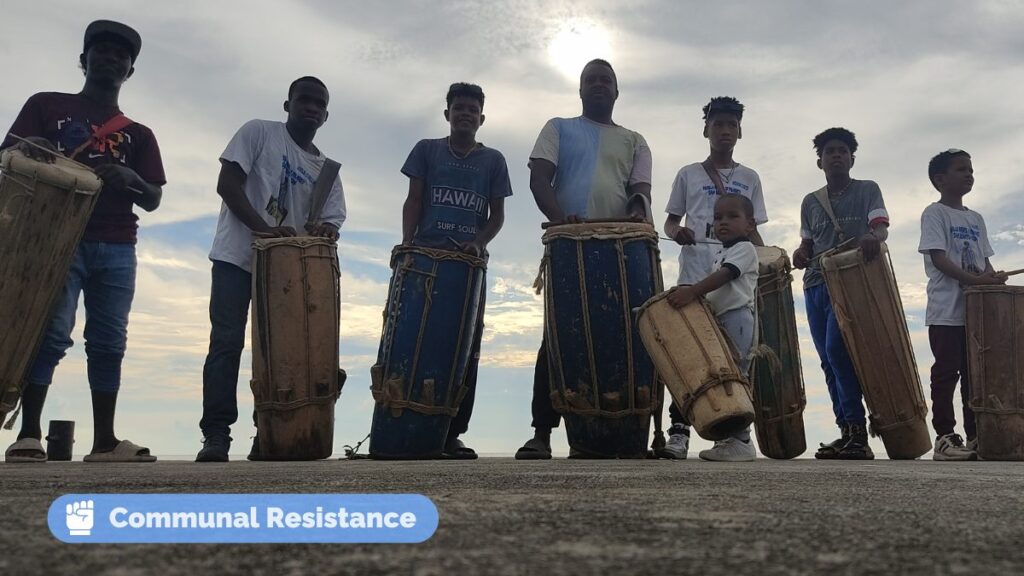
The Imbánguele is the soul of Palmarito. Without the drums, there is no San Benito, no protection, no fiesta, no pueblo. The Imbánguele cycle begins in late October and runs until January 7, when the saint figure is returned to the church.
Luisana Antúnez: If we look at our cultural traditions, the organization of the Chimbánguele mirrors that of the commune. Our ancestors handed it down over the generations with clearly defined roles: the mayordomo, who carries the saint; the capitanes, who lead the procession; the director of the band, who guides the musicians; and the capitán de lengua, who preserves the litanies and rituals for bringing the saint in and out of the church.
This tradition made it easier for us to adopt the commune, with its spokespeople, each with their role, but always considering the community above all else. A commune without identity is lost, and for us, that identity is Afro-descendant culture.
Here, everyone participates in the Chimbánguele—the elders, the youth, the women, even the children who learn by watching and imitating.
Leonardo Pirela: The vasallo—the collective around San Benito—chooses its authorities every January: these include the mayordomo, the capitanes, the director, and the abanderado [standard-bearer]. This comes from our African heritage, where the community had its elders and its recognized leaders. In Palmarito, this system has endured. It is part of how we organize ourselves today.
Francisco Segundo Estrada Balza: While women participate as vasallos in the Chimbánguele, they don’t play the instruments, they don’t hold the saint, they don’t bear the flag. However, the Gaita de tambora, which involves women, is also part of our heritage.
Luisana Antúnez: The men play the Chimbánguele, but we women have our own voice in the fiestas: the Gaitas de tambora. Through the Gaitas, we express our thoughts, share stories, celebrate, joke, and denounce. The Gaitas are our way of participating in these events, of ensuring that the saint also hears us, of being heard by the community as a whole.
Wilbida Andrade [Wilbida Andrade is a confectioner and a Gaita signer]: I began singing Gaita when I was twelve or thirteen years old. Later, I lost my sight, but the saint protected me: I’m an old woman, but my voice is strong. San Benito is my saint, but he also protects my community.
We hold a vigil on the night of the 26th of December until the dawn of the 27th, singing and drumming for San Benito. We blend our devotion to the saint with humor, wit, and social critique, making our voices a central part of the festivities.
Yoglis Solarte: The Chimbánguele is not just music—it is a school for politics. Through the Chimbánguele, we learn that no one alone can carry the weight of the saint, that leadership is recognized because of service to the people, and that joy can be rebellious.
The Chimbánguele taught us what it means to govern ourselves.
Instruments and Chants
Francisco Segundo Estrada Balza: There a variety of drums in the Chimbánguele. Traditionally, there were seven, but here in Palmarito, we added an eighth drum in the 1930s. Each has its own voice: the three requintas, which are ”female” drums with sharp tones, and the five “male” drums with deeper voices, which we call in turn mayor, respondón, cantante, pujón, and medio golpe. These drums are the first to start the rhythm, but they all speak.
I myself play the cantante, the pujón, and the medio golpe.
Omar Solarte [Omar Solarte is a musician, campesino, and a member of the ASOCHIPA (Palmarito’s Chimbánguele Association)]: The drumming has its rhythm and sequences. We chant “Ajé, Ajé Benito Ajé” and we sing “Chocho eh, venga Chocho eh.” We also chant to the Misericordia golpe [drumbeat] in moments of disaster. The Misericordia comes to ask for mercy, accompanying the religious procession through the town or wherever help is needed. The Misericordia has a dual role as a plea for compassion and for remembrance.
All the golpes leave room for improvisation. The drums set the rhythm, the elders chant verses, and the urumbo flute weaves in its melody, adding texture. Each element has a meaning. Even San Benito’s blue garment is significant. It is an affirmation of our identity against the Church’s insistence that he, as a friar, should be dressed in brown. For us, blue is the color of the sea and of the sky, and that’s why we dress San Benito in blue.
Luisana Antúnez: The chants are sacred. Ajé Benito is used to ask the divinity for rain and abundance. Misericordia is played when we are facing hardships, which are many in these times of blockade. Other songs curse the Spanish colonizers in their own tongue.
This is how our traditions became a form of resistance.
Leonardo Pirela: In difficult times, San Benito is not left in the chapel. When there are problems, we bring him out. During the pandemic, for example, we brought the saint to the pier and prayed. He protected us: we had no deaths from Covid in Palmarito!
More recently, when the rains threatened to destroy the San Pedro bridge, we took San Benito there and sang a Misericordia. The rain stopped.
This is how faith, music, and community action come together.
Argenis Duarte [Argenis Duarte, drum maker and baseball trainer]: Drum-making is also an art, and each instrument has its own secret. We cut the balsa wood only after asking permission from God, from nature, and from the tree itself. The tree must be felled during the waning moon, usually on the fifth, sixth, or seventh day of the cycle—that is when the wood will last longer. Each drum has its own skin — goat or sheep — which is chosen for the sound it makes. This is knowledge that has been handed down to us from our elders.
The Community Comes Together
Francisco Segundo Estrada Balza: The exchanges between the pueblos santos are very important for our communities. For more than 300 years, delegations from Palmarito and Gibraltar have visited each other once a year, bringing their manifestaciones [saints and vasallos] along. In the past, the drummers would carry their instruments and chant along the lakeshore at night, crossing rivers even when they were swollen.
Even today, when we no longer need to ford the rivers, these exchanges go on. They involve a sequence of events, including the meeting of the manifestaciones, chants, visits, and rituals such as the pelea de bandera [flag fight], where the standard-bearers from Gibraltar and Palmarito’s Chimbánguele show their prowess in mock struggle until their flags entwine three times.
Luisana Antúnez: When Gibraltar visits Palmarito on October 31, which is All Saints Day, we prepare the meal, and after the procession, we all sit together around the table.
On December 7, the eve of the Immaculate Conception, we return the visit to Gibraltar. We leave here at 10 pm and arrive around 2 am. There, the entire community is waiting to receive us and replicate the reception we gave them back in October. We spend the entire day in Gibraltar, and then in the evening, we make our way back.
In preparation for the incoming visit, we have the tradition of the pedigüeño [beggar], when a group of villagers goes house to house with a cart, asking for contributions such as meat, plantains, cassava, rum, whatever families can give. Each household contributes something, however small, because the fiesta belongs to everyone. When the collection is complete, all the food is brought to the plaza and cooked in large pots to make a communal stew. The meal is shared among all the people of Palmarito and the visitors. Leftovers go to the most needy families.
This is how solidarity is practiced: we all eat together and nobody is left out.
Nereida González: Celebrating the saint, chanting, and sharing food at one table, this is all part of who we are.
The Chimbánguele is a living practice, and it shapes our lives. Recently, in these times of blockade, we have also reconnected with some culinary traditions. We have rekindled the cooking fire of our ancestors and now are making enyucado, a yuca cake with coconut and anise, and plantain arepas. We are also cooking again with coconut milk and coconut oil, just as our grandmothers did.
Perhaps it comes as no surprise that in a town called Palmarito—where palm trees line the lakeshore—people cook with coconut. Yet these ancestral culinary practices had almost been lost. We won’t celebrate the blockade, but it is true that we have recovered some traditions since it began.
Yoglis Solarte: Our culture is one of resistance. The colonizers tried to strip us of everything, but we kept the drums, our saint, and our community. They were not able to break us.
Palmarito’s Afro-descendant culture is not only about memory but also organization. The Chimbánguele, the Gaita, the visits among the pueblos santos, the collective meals, and the making of drums—all these practices link the commune to its African heritage. Here, culture is both identity and the seed of socialism.
(Cira Pascual Marquina is Political Science professor at the Universidad Bolivariana de Venezuela in Caracas. Chris Gilbert teaches Marxist political economy at the Universidad Bolivariana de Venezuela. Courtesy: Venezuela Analysis, an independent website produced by individuals who are dedicated to disseminating news and analysis about the current political situation in Venezuela.)