❈ ❈ ❈
The Wobbling Planet – It’s Destabilizing!
Robert Hunziker
Science is under attack throughout the world. Meanwhile, there’s substantial scientific evidence that the planetary system is turning unstable. This may not strike most people as a big problem because ‘life goes on,’ an attitude that’s more and more prevalent and one of the factors behind anti-science attitudes. But if, in fact, the planetary system is becoming unstable, if it is true, life will be hell.
Johan Rockström, joint director of the Potsdam Institute for Climate Impact Research/Germany, internationally recognized for his work on global sustainability, recently gave a 30-minute speech that specifically addresses the stability of the Earth system. This is a synopsis of his remarks, including some editorial comment.
“We are facing, undoubtedly, in all forms of risk assessment, a decisive moment for humanity’s future on planet Earth… I’m talking about for the first time in human history on planet Earth that we are forced to seriously consider the risks we are destabilizing the stability of the entire planet.” (Johan Rockström, Potsdam Institute speech Publica 25: Decisive Decade: From Global Promises to Planetary Action)
“We are hitting the ceiling of the biophysical processes, the hardwired process that regulates the very functioning of the Earth’s system.” [Ibid.]
All parameters of planetary health for human well-being have similar trajectories, sharply upwards. Until the 1950s, we had a linear system (relatively stable and predictable but unsustainable exploitation). Starting in 1955, with 3.5 billion people, an exponential rise suddenly took off, characterized by overexploitation of biodiversity, acid rain, and massive deforestation. All forms of pressure on the planet took off to the point where today we are in an entirely new geological epoch, and it’s happening within only one generation, remarkably, in the context of a stable planetary system ever since humans first huddled together around fires. It’s potentially the most momentous happening in all of human history, period!
Civilization is exiting the Holocene, entering the Anthropocene. Humans are now the dominating “force of change.” This is too new, too quick for a 4.5-billion-year-old planet system accustomed to old-fashioned ways. We’re already hitting the ceiling of stable planetary processes and starting to push through. For example, last year marked the first time in history that a full year exceeded 1.5°C above pre-industrial levels, the warmest temperature on Earth over the last 100,000 years. We’re starting to feel it, see it, smell it, and taste it, record wildfires, record floods, record hurricanes, record tornados, record coral bleaching, record glacial melt, record droughts, record sea level rise, record dry riverbeds, record heat deaths, record ocean acidification, record insect loss, and record marine loss. Humans are the only gainers.
The 2023 Watershed Year
According to Rockström: “We are already outside of the Holocene range of variability… let me bring you to why we are so nervous today. Why we have over the past 12 months heard scientific language that I’ve never experienced in my whole career, mind-boggling, shocking data, observations that we never thought was possible, that we would never be able to predict in our models… it’s the observation of air temperature and sea surface temperatures”:
“We have a global climate crisis.”
“We are in a situation of dire need of change.”
In 2023, a 0.3°C jump in global temperature occurred. The planet experienced a sudden 10-times increase in only 12 months; it’s unheard of.
Under normal circumstances, with the 2023 watershed year, when global temperature suddenly spikes up, it stabilizes for a period of time, but it demonstrated an alarming change in behavior and serious cause for concern because El Niño (natural warming phase) and La Niña (natural cooling phase) cycles that always influence the climate system are not having any impact, none!. This has never happened before.
Rockström: “There is something wrong. What is happening?” Honest answer: “We do not know yet.”
The rapid escalation of planetary instability has sparked unprecedented concern as the interplay of human activity with natural systems has created a volatile environment, thunderstorms become more severe, rainstorms more powerfully destructive as atmospheric rivers suddenly bring flash floods, and droughts longer, hotter.
Increasingly, feedback mechanisms include the accelerated release of methane from thawing permafrost, which is a potent greenhouse gas, and the retreat of polar ice, which diminishes the planet’s reflection of solar radiation and further intensifies warming. The urgency of the situation has led to calls for systemic change, not only in reducing greenhouse gas emissions but also in restructuring economies and societies to prioritize sustainability over short-term gains. Yet, global emissions continue, and international agreements fall short of binding commitments or fail altogether in implementation.
The risks are glaring, for example, the latest data on the Brazilian Amazon rainforest tells the story, as Earth’s richest ecosystem, the Brazilian portion of the rainforest, which is the largest part, has already tipped. It’s no longer a carbon sink. It’s a carbon source. This has ominous warning signs written all over it. For the first time, we are seeing signs of the planet losing its resilience, losing its buffering capacity, which the science community refers to as “climate sensitivity.”
We now have the evidence of what occurs as certain limits are exceeded. For example, coincident with 1.5°C, “we’ve never before seen the frequency, amplitude, and strength of droughts, fires, floods, heat waves… There’s been a 60% increase in droughts.” The signs are everywhere. The planet is leaving the all-important “corridor of life.” The planet, for over one million years, never exceeded +2°C during warm interglacial and never below -5°C deep ice age. It’s the biogeochemical system that we depend on. It is threatened.
It’s already approaching the high end of that range. There are 16 tipping elements that regulate the Earth system. Six of those are in the Arctic, which is ground zero for Earth: 1) Greenland ice sheet, 2) boreal forest, 3) Arctic winter ice, 4) permafrost system, 5) connected by the North Atlantic and AMOC. Also impacting, the Amazon rainforest, all three big systems, Antarctica, and tropical coral reef systems. These regulate the stability of the climate system.
Risk of Domino Effect
Temperatures at which a system tips from a state that helps us survive to a state of self-amplified warming include threats to the Greenland Ice Sheet, West Antarctica Ice Sheet, abrupt permafrost thawing, tropical coral systems, collapse of Labrador Sea ice and collapse of Barren Sea ice. These are all at risk. There is strong evidence that these systems interact with each other, meaning, there’s a risk of cascading impacts. Where one system triggers several others. These six systems are already outside the boundary of safe space. This is an extremely significant development for the first time in human history.
We’re at a point where we need to buckle up for a challenging journey. The probability of not exceeding 1.5°C on a sustained 10-year basis is no longer possible. No matter what course is taken going forward, “it will get worse before it gets better.” And every tenth of a degree warming has big impact going forward. Along those lines, science has identified big costs to the global economy based upon current economics with up to 20% costs over the next decades as a result of loss of planetary stability.
The amount of time remaining to take mitigation measures is running short. Based upon analyses by the Intergovernmental Panel on Climate Change (IPCC), we only have 200 Gt CO2 remaining in the global carbon budget to achieve a 50/50 chance of holding to 1.5°C, after an expected upcoming overshoot to 1.7°C. That’s five years of global emissions. Five years to accomplish “decades of work” to hopefully hold the line.
(Robert Hunziker is a freelance writer and environmental journalist from Los Angeles. Courtesy: CounterPunch, an online magazine based in the United States that covers politics in a manner its editors describe as “muckraking with a radical attitude”. It is edited by Jeffrey St. Clair and Joshua Frank.)
❈ ❈ ❈
Global Heating isn’t Just Getting Worse. It is Getting Worse Faster.
Courtesy: Climate and Capitalism
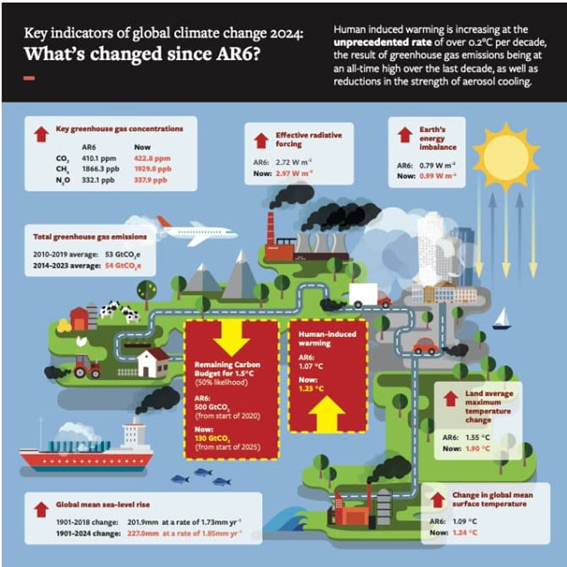
At current emission levels, a 1.5°C global temperature increase will be unavoidable in a little more than three years, and 1.6°C or 1.7°C could be exceeded within nine years.
That’s a key finding of the latest Indicators of Global Climate Change report, released this week. Between 2015-2024 average global temperatures were 1.24°C higher than in pre-industrial times, with 1.22°C caused by human activities, meaning that, essentially, our best estimate is that all of the warming we have seen over the last decade has been human-induced.
The equivalent of around 53 billion tonnes of CO2 (Gt CO2e) has been released into the atmosphere each year over the last decade, primarily from burning fossil fuels and deforestation. In 2024, emissions from international aviation – the sector with the steepest drop in emissions during the pandemic – also returned to pre-pandemic levels.
Surplus heat, accumulating in the Earth system at an accelerating rate, is driving changes in every component of the climate system. The rate of global heating seen between 2012 and 2024 has about doubled from the levels seen in the 1970s and 1980s, leading to detrimental changes of vital components, including sea level rise, ocean warming, ice loss, and permafrost thawing.
The ocean is storing about 91% of this excess heat driven by greenhouse gas emissions, which leads to ocean warming. Warmer waters lead to rising sea levels and intensified weather extremes, and can have devastating impacts on marine ecosystems and the communities that rely on them. In 2024, the ocean reached record values globally.
Between 2019 and 2024, global mean sea level increased by around 26 mm, more than doubling the long-term rate of 1.8 mm per year seen since the turn of the twentieth century. Sea-level rise in response to climate change is relatively slow, so we have already locked in further increases in the coming years and decades.
Other key findings:
(Climate and Capitalism is an ecosocialist journal, edited by Ian Angus.)
❈ ❈ ❈
Climate Change is Making Hurricanes More Destructive
Andrew Dessler
Because hurricanes are one of the big-ticket weather disasters that humanity has to face, climate misinformers spend a lot of effort muddying the waters on whether climate change is making hurricanes more damaging.
With the official start to the hurricane season in the North Atlantic coming up (June 1), I figured it was time to explain why we can be so confident that hurricanes are indeed more destructive today due to climate change.
Note: from here on out, I’ll refer to hurricanes as tropical cyclones (abbreviated TCs), which is a more general term for this type of storm.
1. Tropical cyclones are becoming more destructive: sea level
We have 100% confidence that sea level is rising because humans are heating the planet. And higher sea levels mean today’s TCs do more damage than an identical tropical cyclone in a cooler climate because the storm surge is riding on a higher sea level.
As Prof. Adam Sobel said in Congressional testimony a few years ago:
The most certain way in which hurricane risk is increasing due to climate is that, because of sea level rise, coastal flooding due to hurricane storm surge is becoming worse. Storm surge occurs when the winds from a storm push the ocean onto the land. The total flooding is determined by the surge (the part produced by the wind), the tide, and the background average sea level. As sea level has risen … the flooding is exacerbated by that amount.
Climate misinformers will respond that sea level only contributes a small fraction to the total flood depth. But the non-linearity of flood damages means that even a small contribution from sea level rise to total flood depth can increase damages a lot.
For an example, imagine that your front door is six feet above a river. If the river rises 5 feet 11 inches, there is no damage. If climate change causes it to rise another 2 inches, you’ll have tens of thousands of dollars of damage.
For a more concrete example, in 2011, Hurricane Irene hit the New York region with a storm surge of around 1.5 meters; existing flood infrastructure was able to handle that and there was little damage. Just a year later, Hurricane Sandy hit the New York region with 2.75 meters of storm surge, overwhelming flood infrastructure and leading to massive damages of $62B.
This shows the non-linearity of climate damages: you get zero damage until a threshold is passed (somewhere between 1.5 and 2.75 m) and then damages increase exponentially.
Bottom line: Because of sea level rise, you can say with 100% certainty that climate change is making every TC more destructive.
2. Tropical cyclones are becoming more destructive: rainfall
Climate change will increase TCs’ rainfall due to the following logic chain: 1) much of the water vapor in air flowing into a tropical cyclone’s core will fall out as rain when the air ascends in one of the rain bands, 2) in a warmer climate, the air flowing into a tropical cyclone’s core holds more water vapor. Put points 1 and 2 together and you get more rainfall!
That’s it. You don’t need any fancy physics to understand why we’re so confident that tropical cyclones will produce more rain as the climate warms. In fact, the IPCC says that we are already seeing this:
There is high confidence that anthropogenic climate change contributed to extreme rainfall amounts during Hurricane Harvey (2017) and other intense TCs.
They also say it’s going to get worse as the climate continues to warm:
It is very likely that average TC rain rates will increase with warming.
Bottom line: You can be confident that TCs are already producing more rain due to climate change, and this is another way they are increasingly destructive. The future is for more of this.
3. Tropical cyclones are becoming more destructive: intensity
The physics is clear: A warmer climate should fuel stronger hurricanes. Indeed, the IPCC says there is likely a trend in past hurricanes:
It is likely that the global proportion of Category 3–5 tropical cyclone instances … have increased globally over the past 40 years.
Here’s where it gets muddy: While we can see that hurricanes have gotten stronger, scientists are still debating exactly how much of this trend is due to climate change versus natural variability.
But when we look to the future, the uncertainty disappears. Climate models consistently show that, as the planet continues to warm, we’ll see a higher fraction of Category 4 and 5 hurricanes:
the proportion of Category 4–5 TCs will very likely increase globally with warming.
Bottom line: TCs are getting more intense, but the evidence on the cause of the historical trend is mixed. For the future, we can have high confidence that climate change will shift TCs to higher intensity.
4. What we’re not sure about: number of tropical cyclones
Here’s a surprising fact: scientists don’t really know what controls the number of TCs in our atmosphere. We get about 80 of these storms globally each year, but we lack a solid theory for why it’s that number rather than 8 or 800. Without understanding the fundamental controls on storm formation, we can’t confidently predict whether warming will bring more or fewer TCs.
But even if the total number of TCs decreases, we could still end up with more of the most destructive storms. How? Remember from the previous section that climate change is shifting the intensity distribution — we’re getting a higher proportion of major hurricanes. So even with little change in the number of storms, the shift in proportion means we could still see increasing numbers of Category 4 and 5 monsters.
This matters enormously because storm damage doesn’t scale linearly with intensity. The most intense storms — Category 4 and 5 TCs — cause the vast majority of destruction. So any reduction in Category 1 or 2 TCs offers little benefit, as these storms typically cause little damage, but an increase in Category 4 or 5 TCs would bring enormous costs to society.
Bottom line: We don’t know whether climate change will bring more or fewer total TCs. But what really matters for human suffering and economic damage is what happens to the strongest storms. Even in a world where total TC numbers don’t change much, we could see numbers of the strongest TCs go up.
5. What we’re not sure about: monetary damage from tropical cyclones
If there’s anything climate misinformers love love love to talk about, it’s how there’s no trend in the economic damages from TCs. The conclusion they want you to reach is that TCs are obviously not getting more destructive.
I could explain why this is wrong, but Kerry Emanuel already did it and you should just read what he wrote.
A more reliable yardstick of TC’s economic destructiveness is to ask the people who have money on the line: insurance companies. If you do that, the verdict is clear: insurance premiums are skyrocketing and companies are fleeing places that are vulnerable to TCs (Florida, Louisiana) — exactly what you would expect in a world where the risk of TC damage was going up.
Bottom line: The “no increase in damages” argument is not very good for many reasons. It deserves to be dropped into the dustbin of history, but it’s so useful to climate misinformers that I’m sure it will never disappear.
Summary
This post has only touched on the ways that TCs are getting more damaging. There are even more ways, such as changes in the tracks of TCs moving to higher latitudes, more frequent rapid intensification, or the slowdown of TC translation speed, all of which can also increase destructiveness.
Climate misinformers usually don’t dispute any of this. Rather, their method of misinformation lies in cherry picking the facts that bolster their stance. For example, they will focus on statistics like the number of TCs (or, worse, landfalling hurricanes), emphasizing that we don’t see any trend while conveniently omitting that climate science doesn’t predict increases in these.
And they fail to acknowledge the actual factors that are driving destructiveness, such as the increase of storm surge damage caused by sea level rise or the fundamental physics that tells us that TCs will produce more rain as the climate warms.
Instead of the selective offering of climate misinformers, you should look at all of the data. If you do that, it’s clear that hurricanes and other TCs are getting more destructive.
(Andrew Dessler is Professor of Atmospheric Sciences & climate scientist at Texas A&M. Courtesy: Climate Brink, a blog authored by Andrew Dessler and focuses on climate change and its related issues.)