❈ ❈ ❈
What the Forbes’s 40th Annual World’s Billionaires List Reveals About Our World?
Bhabani Shankar Nayak
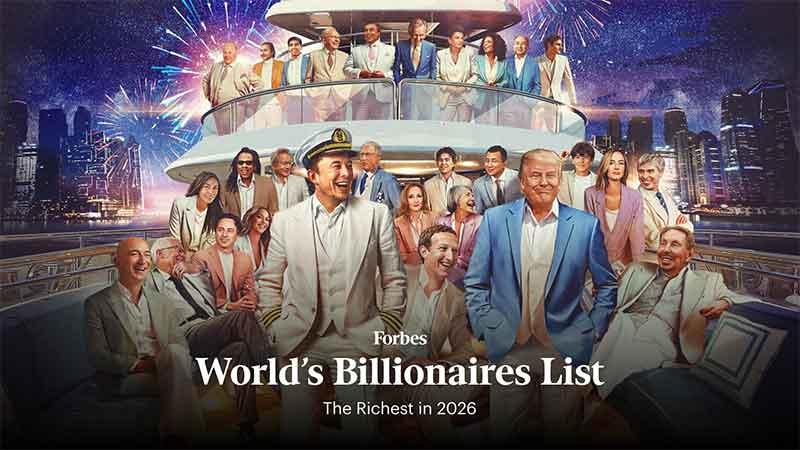
In the middle of all the chaos in the world, Forbes magazine did not forget to celebrate its ritual of publishing its 40th annual World’s Billionaires List on 10 March 2026. The list not only reveals the continuing billionaire boom in the numbers and the growing concentration of power and wealth, but also highlights the rise of global inequality. Fortunes and fault lines move together in a world of plenty and pleasure controlled by so few, while the vast majority of people struggle to manage their everyday lives and to fulfil their basic needs for a dignified living.
According to the Forbes list, there are 3,428 billionaires in the world, and their combined net wealth has increased from $1 trillion in 2000 to $20.1 trillion in 2026. In the last year alone, billionaires’ wealth increased by $4 trillion from 2025 to 2026. In 2026, 400 billionaires were added to the list—the highest number since the publication of the Forbes Billionaires List began in 1987. This means the world has produced more than one billionaire per day over the past year while millions of people lost their jobs. In this year’s list, there are 20 billionaires with 12-figure fortunes as members of the $100 Billion Club, collectively owning $3.8 trillion, while 700 million people struggle to survive on $2.15 per day.
These billionaires are not merely the products of their own talent, hard work, creative abilities or family linages, just as the 700 million people living in poverty do not suffer because of a lack of hard work, skills, or talent. The concentration of wealth in the hands of a few, and the suffering of marginalised masses, are products of the marketisation of politics in which people’s labour generates profits for these billionaires. States and governments create policies that facilitate the concentration of wealth by perpetuating conditions of poverty and inequality under the exploitative working conditions of capitalism, which defines and dominates the political economy of capitalist development across much of the world. Corporate-driven states and governments are responsible for producing these billionaires, who in turn control the state directly and indirectly—through funding, promoting propaganda for electoral manipulation, owning media, consultancies, public relations and advertisement industries and influencing policymaking to serve their interests at the expense of the people.
Geographically speaking, out of a total of 3,428 billionaires, more than half (1,757) are from the United States (989), China (539), and India (229). American billionaires own the lion’s share of global billionaire wealth—$8.4 trillion out of the total combined billionaire wealth of $20.1 trillion. These three countries face enormous challenges of rising wealth inequality amid a continuing billionaire boom, which creates very different life experiences based on ownership, access to power, and the everyday struggle to survive the pressures of marginalisation.The ten richest Indian billionaires alone own more than $1 trillion, while India’s GDP today is around $4.51 trillion. This not only reveals the scale of wealth ownership and inequality, but also reflects the nature of the state and government in India, which appears to stand with the billionaire class while leaving the working masses to face a deepening cost-of-living crisis.
The profit-making market machine is never dull for these individual billionaires, as the state and government stand firmly behind them. Meanwhile, working people make all the money: they produce all the goods and provide all the services, harvest all the food, and construct all the schools, colleges, universities, roads and communication networks, houses, and hospitals. Yet they themselves often suffer from hunger, homelessness, illiteracy, and ill health. These facilities are not accessible for working people. These conditions are not accidental; they are the outcome of the design of the capitalist system and its control over states, governments and their policies. In this process, billionaires have effectively transformed democracy into a form of billionaire oligarchy and society into an orderly marketplace of commodities, where profit over people has become the rule rather than merely an outcome.
The Forbes list of billionaires not only reveals the scale of wealth concentration as a form of economic injustice rooted in different regimes of capitalist exploitation, but also points to the political structures that facilitate such an economic system—one that benefits 3,428 billionaires who are not blessed by gods or goddesses, but by the policies of states and governments across the world. In a world of 8.3 billion people, only a tiny fraction—the 3,428 billionaires—live lives of extraordinary privilege, while the vast majority struggle to manage and survive in 2026. These numbers tell the story of the exploitation of the masses amid limitless wealth accumulation by billionaires that extends beyond the boundaries of nation-states. These billionaires are not merely wealthy individuals with corporate ownership; they are also powerful shareholders of capitalist system.
These billionalires club represent a class network of collaboration and cooperation without territorial boundaries, fuelling the forward march of right-wing reactionary forces and their war-mongering imperialist agendas. As cheerleaders of capitalism, they preside over a system that ruins the lives and livelihoods of people in order to amass wealth, undermines citizenship rights, and erodes economic justice—thereby breeding inequality and exploitation, the very lifeblood of capitalism. Therefore, the struggle against the capitalist system remains central to ensuring a more equitable distribution of wealth and to building an egalitarian society grounded in fairness and justice in all its forms.
[Bhabani Shankar Nayak is a political commentator. Courtesy: Countercurrents.org, an India-based independent online journal founded in 2002, publishing articles on peace, democracy, social justice, ecology, secularism, and people’s movements. Edited by Binu Mathew, it is known for giving space to progressive, grassroots, and alternative voices often ignored by mainstream media.]
❈ ❈ ❈
‘A System Rigged’: Untaxed Wealth of Richest 0.1% Is More Than Assets of World’s Poorest Half
Stephen Prager
The richest 0.1% of people on Earth are hiding more than $2.8 trillion in offshore accounts to avoid taxes. That money alone is more wealth than is owned by the entire bottom half of humanity, more than 4.1 billion people.
These findings were published in a report released Thursday by Oxfam International on the 10th anniversary of the 2016 Panama Papers, which provided an unprecedented look at how the world’s most powerful capitalists, financiers, political leaders, celebrities, and criminals exploited offshore tax havens to stash their money.
“Ten years on, the superrich are still sequestering oceans of wealth in offshore vaults,” said Christian Hallum, Oxfam International’s tax lead.
The percentage of untaxed wealth in offshore accounts has dropped in the past 10 years, in large part due to global reforms like the adoption of the Organization for Economic Cooperation and Development’s Automatic Exchange of Information framework (AEOI), which allows revenue authorities around the world to easily share information and crack down on cheats.
However, many nations in the Global South are excluded from this system, even though they need the tax revenue the most.
Oxfam found that a staggering $3.5 trillion, more than 3.2% of the global gross domestic product, still remains in untaxed accounts. That’s more than the entire GDP of France and is more than twice the combined wealth of the world’s 44 poorest nations.
And while the percentage of untaxed wealth is shrinking, that doesn’t mean inequality has shrunk.
On the contrary, the December 2025 “World Inequality Report” found that the richest 0.001% of humanity—fewer than 60,000 multimillionaires and billionaires—now have three times as much wealth as the poorest half of the world’s population combined.
Inequality has surged around the world in part due to taxation policies and pandemic recovery packages that overwhelmingly favor the rich. The most glaring was adopted in the world’s financial hub, the United States, last year.
The megabudget passed by Republicans and signed into law by President Donald Trump handed a $1 trillion tax cut to America’s wealthiest 1% while slashing more than $1 trillion in spending from Medicaid, food assistance, and other safety net programs. It has been described by some economists as the largest upward transfer of wealth in US history.
While the global top 0.1% holds about 80% of untaxed offshore wealth, an even smaller group of uber-wealthy individuals does most of the cheating. The world’s richest 0.01%, who hold at least $50 million apiece, control about half of all money in global tax shelters—$1.7 trillion.
According to the Tax Justice Network’s Corporate Tax Haven Index, Caribbean islands under UK ownership, including the British Virgin Islands, the Cayman Islands, and Bermuda, are among the worst offenders. Other notable tax havens include Switzerland, Singapore, Hong Kong, Ireland, and the Netherlands.
A February Oxfam report on Elon Musk, who is well on his way to becoming the world’s first trillionaire, found that his company, Tesla—which managed to pay zero dollars on its $2.3 billion income in 2024—has not published a country-by-country report on its taxes and that it has subsidiaries in many countries considered to be tax havens.
Big Pharma companies, including AbbVie and Merck, also used tax shelters to lower their total tax expense in 2025 by more than $1 billion, according to a report released earlier this month by the Financial Accountability & Corporate Transparency Coalition.
“This isn’t just about clever accounting—it’s about power and impunity,” Hallum said. “When millionaires and billionaires stash trillions of dollars in offshore tax havens, they place themselves above the obligations that bind the rest of society.”
“The consequences are as predictable as they are devastating,” he continued. “We see our public hospitals and schools starved of funds, our social fabric shredded by rising inequality, and ordinary people forced to shoulder the costs of a system rigged to enrich a tiny few.”
Even a fraction of the money currently stashed away by the world’s wealthiest could alleviate untold amounts of suffering.
In November, the United Nations’ World Food Program estimated that extreme hunger, which currently affects more than 318 million people around the world, could be eradicated by 2030 with investments of about $93 billion per year, but that global hunger programs instead remain “slow, fragmented, and underfunded.”
According to a 2021 UN Educational, Scientific, and Cultural Organization (UNESCO) report, investments of around $114 billion per year would similarly be enough to ensure that everyone on Earth has access to safe drinking water and sanitation.
Oxfam called on governments around the world to increase coordination to prevent the wealthy from hiding their riches from tax authorities. It also urged them to adopt more aggressive policies to tax the 1%’s wealth at home, including taxes on income and on extreme wealth.
[Stephen Prager is a staff writer for Common Dreams. Courtesy: Common Dreams, a US non-profit news portal.]
❈ ❈ ❈
It’s Time to Tax the Rich
Lawrence S. Wittner
With the deadline for paying federal income taxes fast approaching, the thoughts of American taxpayers turn naturally toward the age-old question: Why isn’t there a fairer tax system?
Currently, in fact, campaigns for state tax-the-rich legislation are flourishing in California, Colorado, New York, Oregon, Rhode Island, Texas, and Virginia, and have already succeeded in getting such legislation adopted in Massachusetts and Washington. Similarly, in Congress, Senator Elizabeth Warren and Representative Pramila Jayapal have introduced the Ultra-Millionaire Tax Act, while Senator Bernie Sanders and Representative Ro Khanna are sponsoring the Make Billionaires Pay Their Fair Share Act. The tax-the-rich proposals range from increasing the tax rate for the very highest annual income earners, to instituting an annual wealth tax on the very richest Americans, to a combination of both.
Although the most affluent Americans, like other Americans, have always paid taxes to fund public services, the dispute has been over how much they should pay. Sales taxes and property taxes place a heavy burden on people of modest means, but a much lighter burden on the wealthy. Therefore, the wealthy have tended to favor these generators of public revenue and to oppose a progressive income tax, under which the rich would pay at a higher rate than the poor. A lengthy political battle for a tax system based upon ability to pay led to passage of the 16th Amendment to the U.S. Constitution, which empowered Congress to levy an income tax.
Initially, the new income tax, though progressive, was rather small-scale. But as the federal government took on new and costly tasks―particularly funding U.S. participation in two world wars and the Cold War―the federal income tax grew accordingly. By 1944, the official tax rate for the highest income earners stood at 94 percent―although, thanks to deductions, loopholes and the rate’s confinement to the top increment of their income, the richest Americans actually paid at a much lower rate.
Like their well-heeled predecessors, many wealthy Americans were outraged at funding public services that benefited people whom they often regarded as their inferiors. Why, they wondered, was their money being “wasted” on things like public schools, public housing, and public healthcare, when “the best people” went to private schools, lived in private mansions or gated communities, and employed private “concierge doctors”? While chatting with their friends over lunch on their yachts or at their tennis clubs, they complained of “welfare queens” and the “ungrateful poor.”
Consequently, Congress―badgered by the wealthy, their corporations, and conservative ideologues―cut the progressivity of the federal income tax. In 1964, the top marginal tax rate was reduced from 91 percent to 70 percent, in 1981 to 50 percent, and in 2018 to 37 percent.
Given these dramatic cuts in the federal income tax rate, plus preferential tax treatment for dividends and appreciation in the value of stock, bonds, and other investments―the wealthiest Americans managed to secure a much lower tax rate than most Americans. According to a ProPublica investigation, the 25 richest Americans, who had $401 billion in income from 2014 to 2018, paid taxes on it at a rate of just 3.4 percent. Indeed, during some years, the world’s top billionaires―including Elon Musk, Jeff Bezos, Michael Bloomberg, and Carl Icahn―paid no federal income taxes at all.
When it came to corporate income, the federal government slashed the corporate tax rate from 53 percent to 21 percent between 1969 and 2025. And this, too, produced enormous benefits for very affluent Americans, who own most stock market wealth. According to the Institute on Taxation and Economic Policy, 23 of the largest and most profitable U.S. companies paid no federal corporate income taxes at all from 2018 to 2022. And 109 corporations paid no federal tax in at least one of those years.
The Trump administration’s tax policies lifted the fortunes of the wealthy to unprecedented heights. According to a September 2025 report by Americans for Tax Fairness, the wealth of the 15 richest U.S. billionaires increased by over 300 percent after the passage of the first Trump-GOP tax cut in December 2017. The wealth of the very richest of them, Elon Musk, grew 20-fold. In the first year of Trump’s second term, marked by another huge tax cut for the rich, U.S. billionaire wealth jumped from $6.7 trillion to $8.2 trillion.
Not surprisingly, government taxation policy―coming on top of low wage rates, corporate outsourcing, assaults on unions, and government subsidies for big business―has resulted in rising economic inequality in the United States. By late 2025, the richest 1 percent of Americans possessed some $55 trillion in assets―roughly equal to the wealth held by the bottom 90 percent. “Household wealth is highly concentrated and becoming steadily more concentrated,” reported the chief economist at Moody’s Analytics, a major financial research firm.
This rising economic inequality enhances the growing power of the wealthy in public affairs. Increasingly, in politics, big money talks―and on behalf of Republicans. Federal election contributions from the nation’s 100 richest Americans averaged $21 million between 2000 and 2010, but rose beyond $1 billion in 2024. In that year, contributions to Republicans surged from roughly $300 million to just under $1 billion, while donations to Democrats dropped from roughly $300 million to less than $200 million. A rightwing political party, led by a demagogic billionaire promising more tax cuts, proved irresistible.
By contrast, most Americans support proposals to raise taxes on the rich. According to a March 2025 Pew Research Center poll, large majorities of Americans surveyed favored increasing taxes on the wealthy and corporations. In January 2026, an Economist/YouGov poll reported that 80 percent of American respondents viewed wealth inequality as a problem, 80 percent said the rich had too much political power, and 78 percent said taxes on billionaires were too low.
It’s time to tax the rich. Or, as Pete Seeger used to sing: “Take it easy, but take it.”
[Lawrence S. Wittner is Professor of History Emeritus at SUNY/Albany and the author of Confronting the Bomb (Stanford University Press). Courtesy: Countercurrents.org, an India-based independent online journal founded in 2002, publishing articles on peace, democracy, social justice, ecology, secularism, and people’s movements. Edited by Binu Mathew, it is known for giving space to progressive, grassroots, and alternative voices often ignored by mainstream media.]