❈ ❈ ❈
Punjab Floods: Rivers Overflow, 3 Lakh Acres of Crops Affected
Kusum Arora
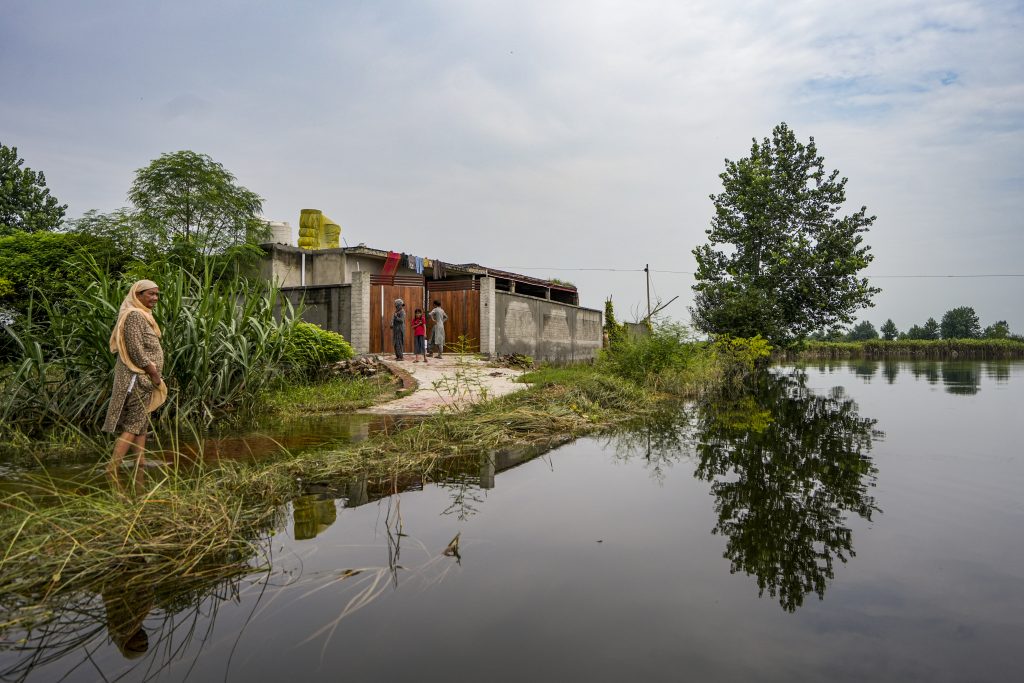
The floods in Punjab following a surge in the Ravi, Beas and Sutlej rivers have killed over 26 people, displacing hundreds and affecting over 3 lakh acres of crops. The waters have submerged village after village and brought the state’s economy to a halt.
The Indian Meteorological Department (IMD) has predicted more rainfall in the next three days from August 31 to September 3 in Punjab, worrying farmers and locals, both.
Following heavy rain and a rise in the water level of Beas on August 31, the local administration issued an alert urging people to rush to safer locations. The Beas water level has now increased to 2.35 lakh cusec, deputy commissioner Amit Kumar Panchal said.
Week-long rains and cloudbursts in Himachal Pradesh, the Jammu region and in the catchment areas of Ravi, Beas, and Sutlej rivers – coupled with heavy discharge of water from Bhakra, Pong and Ranjit Sagar dams – led to the water levels surging in Punjab.
The floods have affected over 16 districts in Punjab out of which Gurdaspur, Amritsar, Tarn Taran, Pathankot, Kapurthala, Ferozepur, Fazilka, Hoshiarpur and parts of Mansa and Patiala near Ghaggar river are badly hit. The Punjab government has so far evacuated 11,330 people and set up 77 relief camps, sheltering 4729 flood affected people.
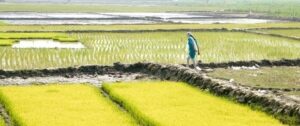
Over 3 lakh acres of crops affected
Talking to The Wire, director of the Punjab Agriculture Department Jaswant Singh, said, “As per our estimate, around 3 lakh acres of crops have been affected because of floods in Punjab. The Punjab government is yet to conduct ‘girdawari’, an official crop survey to officially assess the extent of damage.”
He pointed out that in Gurdaspur district, which is the worst affected, over 42,000 hectares of paddy crop has been affected. “The water level in most of the villages in around 16 districts of Punjab – Gurdaspur, Tarn Taran, Pathankot, Kapurthala, Ferozepur, Fazilka, Hoshiarpur, Rupnagar was close to 8 to 10 feet, directly hitting normal life,” he added.
Fix accountability for devastating floods: Pandher
Sarwan Singh Pandher, the president of Amritsar-based Kisan Mazdoor Sangharsh Committee demanded an impartial probe by the AAP led Punjab government and the Union government into the Punjab floods.
“Will CM Bhagwant Mann raise this issue with the center government? Punjab did not face incessant rains, it was the heavy discharge of water from Bhakra, Pong and Ranjit Sagar dams that led to floods. The Punjab government should fix accountability for the devastating floods. Who asked the Dam officials to stop water earlier and then release it later?” he said, pointing out that prime minister Modi has not spoken a word about Punjab floods.
Pandher said that during these floods, 14.11 lakh cusecs of water was released into the Ravi river, submerging Gurdaspur, Amritsar and Pathankot districts. “As compared to this in the 1988 floods, only 11.20 lakh cusecs of water were released in Ravi. This time, the rains were less and the extent of water released was huge,” he said, demanding an investigation to study the data of last eight to 10 years of water released in Punjab rivers during floods.
Farmers’ question Punjab’s drainage system maintenance
Agitated farmers and villagers questioned the AAP government for its preparedness to tackle the floods, when there were enough inputs by the Indian Meteorological Department (IMD) about rains in Punjab, Himachal Pradesh, and Jammu region.
“This time we want the Punjab government to fix accountability for the floods. We cannot let Punjab bear losses every alternate year because of man-made disasters,” said a farmer at Ajnala near the Indo-Pak border which has been severely affected by the overflowing Ravi.
A Punjab government official admitted that an inquiry into the Punjab’s drainage system is a must to ascertain the extent of loss and the reasons behind it. However, he refused to comment on the issue of maintenance and repair of the drainage system but said that all these factors would come to light only after the flood situation comes under control.
The Wire tried to reach out to the chief engineer of the canals department, Sher Singh, but he was not available for comment.
[Courtesy: The Wire, an Indian nonprofit news and opinion website. It was founded in 2015 by Siddharth Varadarajan, Sidharth Bhatia and M. K. Venu. Note: This is an extract from the article published in The Wire. ]
❈ ❈ ❈
Activists and Environmentalists Question Role of Dams as Punjab Battles Flood
Vivek Gupta
The floods in Punjab – the second in the last three years and to many, the most destructive since 1988 – took place after torrential rainfall in the plains and Himachal led to the swelling of dams and rivers.
As per the latest government data, floods have so far claimed 46 lives and affected over four lakh people across the state.
Faced with such losses, many have questioned the role and functioning of dams. Today, September 8, a Ludhiana-based environmental group, the Public Action Committee, released month-long water discharge data from three major dams – Bhakra, Pong and Ranjit Sagar.
These dams directly influence water flow in the Sutlej, Beas and Ravi rivers which originate from Himachal and pass through Punjab.
The Public Action Committee has alleged that while heavy rains in the catchment of these rivers resulted in the swelling of these reservoirs beyond capacity, dam authorities did not release water gradually. The process of a sudden discharge, combined with Punjab’s own torrential rainfall, culminated in the disaster – one that, PAC members said, could have been mitigated with timely action.
The PAC also alleged that advance warnings were missed when releasing water from the dams. Water discharge data, they also alleged, showed that rainfall prediction issued by the Indian Meteorological Department as early as June was paid not much heed to.
Economist R.S. Ghuman told The Wire that better management of water discharge from these dams could have mitigated the impact of the Punjab floods, which he said was largely caused by torrential rainfall in the region.
What the PAC says
Flooding in Punjab began on August 25. Using this as a reference point, data from the Bhakra dam on the Sutlej river, as quoted in PAC report, shows that between August 1 and 24, the per-day average inflow was 57,430 cusec, while the average outflow was 27,100 cusec.
Over the next 11 days, from August 25 to September 4, continuous rainfall in the catchment raised the average inflow by 30% to 73,400 cusec.
In contrast, the average outflow nearly doubled to 53,000 cusec, peaking at 73,000 cusecs on September 4.
The situation was even more critical at Pong Dam on the Beas river where water inflow was more aggressive, the PAC finds. Between August 1 and 24, the average per day inflow was 77,000 cusec, against an outflow of 42,500 cusecs.
From August 25 to September 4, the average inflow surged by 57% to 1,21,600 cusecs, while the average outflow rose 107% to around 87,500 cusecs, peaking at 1.09 lakh cusec on September 1.
Both these dams are managed by Bhakra Beas Management Board (BBMB) in which Punjab is a member states along with Himachal, Haryana and Rajasthan.
‘Unprecedented’ versus ‘mismanagement’
Speaking to the media on September 6, the BBMB chairman Manoj Tripathi, as quoted by the Indian Express, stated that the board was forced to release excess water downstream due to unprecedented rainfall in the Beas and Sutlej catchments. “This year, we saw the historically highest-ever inflow in the Beas River,” he said.
Between July 1 and September 5, the inflow into Beas reached 11.70 billion cubic metres or BCM, compared with 9.52 BCM in 2023, 7.94 BCM in 1988, and 5 BCM in 2019. “Never before has the Beas seen such flow,” he added.
Environmental activist and PAC convener Jaskirat Singh told The Wire that water discharge data from Bhakra and Pong Dams shows the floods could have been mitigated if water had been released gradually.
“All weather reports predicted above-normal rainfall. Yet BBMB waited for both dams to reach maximum capacity before surging the outflow,” he said.
According to Singh, a similar situation occurred in 2023, when Punjab experienced floods, though not on the scale seen in 2025.
He also held the Punjab government responsible for failing to coordinate the inflow and outflow of dam waters with BBMB despite being a member state and a part of the decision making process at the board.
Singh said the situation was no different with the Ranjit Sagar Dam, which is directly under the state government’s control. The per day average inflow of Ranjit Sagar dam between August 1 and August 24 was 38,700 cusec against average outflow of 11,273 cusec, he said. Over 11 days between August 25 to September 4, it is not just the inflow that surged to 71,960 cusec, but the average outflow surged to 62,800 cusec, he added.
The Wire reached out to BBMB spokesperson Satnam Singh for a comment on the allegations of dam mismanagement. He said that the board chairman had already clarified the board’s position in a recent press conference.
Other factors
Another environmental activist, Kapil Arora, told The Wire that the Punjab government is also responsible for other factors worsening the disaster. “While erratic rainfall cannot be controlled, illegal mining along rivers, encroachments over riverbeds and natural water bodies, and failure to strengthen bunds after the 2023 floods have all contributed to the crisis,” he said. According to him, desilting of rivers and dams is another issue which was not taken on on priority.
He added that apart from human and economic losses, the floods have caused severe environmental damage, affecting biodiversity, wildlife, natural habitats, and tree cover.
“Recurring floods in Punjab are not just a natural calamity – they are a man-made disaster too,” Arora said. He added that because climate change is here to stay, it is important for agencies to change their approach and take flood prevention measures seriously.
[Courtesy: The Wire, an Indian nonprofit news and opinion website. It was founded in 2015 by Siddharth Varadarajan, Sidharth Bhatia and M. K. Venu.]