❈ ❈ ❈
Bulldozers at Midnight: The Jadavpur Eviction and the Resistance That Refused to Yield
Samprikta Bose
In the first week of June 2026, Jadavpur railway station, in the immediate vicinity of Jadavpur University, ceased to be merely a busy transport hub in south Kolkata. It mutated into ground zero for a tense confrontation over human livelihood, state coercion, and the right to the city witnessed in West Bengal in recent times. What the state apparatus justified as a routine “anti-encroachment” drive rapidly triggered a massive, cross-class resistance movement. Bringing together informal workers, street vendors, CPI(M)-led Left activists, university students, and the cultural vanguard of Bengal, the battle of Jadavpur has exposed the brutal realities of urban development under the emerging Bulldozer Raj. Left leaders—including Party Central Committee member Sujan Chakraborty, SFI General Secretary Srijan Bhattacharya, and celebrated theater personality Joyraj Bhattacharya—alongside countless activists, stood eye-to-eye against the batons of the police, RAF, and central forces. The Left has issued an unequivocal warning from the blood-slicked land of south Kolkata that the politics of the bulldozer will find no absolute rule in Bengal.
The Human Cost
At the heart of this conflict are hundreds of hawkers and small traders whose lives revolve around the station precinct. Tea sellers, fruit vendors, food stall owners, tailors, and cobblers have built modest livelihoods over generations of unremitting labor. Their stalls, cobbled together from tin sheets, bamboo poles, and tarpaulin, represent the fragile economic foundation of working-people households. These informal enterprises pay for school fees, life-saving medicines, rent, and daily meals, meaning entire families depend on them for survival.
On Tuesday, May 2, the administration made its first overt move, announcing that they were deploying bulldozers into the precinct, with the formal notice being served only that afternoon. Following this, the CPI (M) and various Left-leaning organizations launched an immediate door-to-door mobilization across the neighborhood. A fierce resistance was forged under the leadership of Srijan Bhattacharya and prominent lawyer Samim Ahmed. In a deployment mirroring a war zone, the administration pushed bulldozers into the area under the protection of hundreds of police and CRPF personnel. The specific issue in Jadavpur extends beyond hawking—a fundamental question of human shelter. After being confronted with the High Court order, the railway officials and police administration relented, promising that once the High Court reopens on June 8, they would deliberate on the ruling and grant a 21-day window starting from that date. The sit-in demonstration and protests continued late into the evening. Ultimately, defeated by the force of logic and legal precedent, the bulldozers were forced to retreat for the day. . This temporary reprieve did not calm anxieties; it merely signaled that a far more aggressive state intervention was imminent. Jadavpur entered a state of total, nocturnal vigilance.
To understand the sheer audacity of this eviction drive, one must look at the shifting political landscape of West Bengal. The newly installed BJP government has approached urban planning with a detached elitist entertainment. They openly question why street vendors should be permitted to display their wares on roadsides, summarily branding them as illegal encroachers who must be excluded from the urban space. Capitalizing on this arrogant mindset, the railway administration has embraced a corporate-centric model of development. The unstated yet clear directive is that corporate monopolies, not the working poor, shall profit from railway land.
Sensing a political head start and bereft of accountability, the central authorities determined that the moment was ripe to deploy bulldozers, obliterate station-side slums, and showcase their double-engine power by destroying the livelihoods of the poor.
Midnight Assault
Flouting all previous promises, the entire railway siding precinct was cordoned off with high guard rails starting yesterday afternoon, May 7. Word spread that the bulldozers were returning. Around 9:00 PM, a massive deployment of police, CRPF, and RAF personnel began patrolling multiple arterial roads. From 9:00 PM onwards, CPI (M) leaders alongside leaders of other Left-leaning organizations, made repeated appeals over microphones demanding an audience with any railway official, asserting that this unethical eviction would not be tolerated. The police flatly refused to relent, stating that nothing could be done as they were acting under strict orders from the DC South to execute the drive that very night.
After midnight, the situation grew tense. By then, the entire area had been transformed into a virtual war zone, swarming with police and the armed might of the state machinery. Right in front of the railway siding, CPI (M) and left and democratic activists formed a human chain, standing defiantly to block the bulldozers from entering. They were joined by a section of local residents and the affected hawkers—completely unarmed, holding onto the singular demand to have a dialogue.
Around 12:45 AM, the police ordered the bulldozers to crank their engines, escalating tension to a boiling point. The police barricaded the approaching crowd. Immediately, a brutal lathi charge was unleashed. The police charged indiscriminately, sparing neither men nor women. A vicious, unbridled baton charge raged for nearly forty minutes. The police pinned leading protestors. By then, the bulldozers had forced their way inside. One after another, shops and homes collapsed with a sickening crunch. Meanwhile, out on the streets, the police continued their reign of terror, brandishing batons and guns against innocent, unarmed citizens.
Cultural and Gendered Struggle
Rather than crushing the movement, the midnight violence catalyzed a massive counter-mobilization across the state. From 2:30 AM on June 8, Led by the Students’ Federation of India Kolkata, hundreds of students maintained a continuous blockade demanding the immediate release of the detainees and a halt to the illegal demolitions. This resistance found an immediate, powerful ally in Bengal’s cultural community.. In a region where art has long been the language of dissent, their songs and presence transformed the protest camp into bastions of moral defiance.
Simultaneously, working-class women stepped onto the front lines. Mobilizing massive protest rallies across south Kolkata. They highlighted the gendered brutality of the Bulldozer Raj, arguing that the destruction of a stall does not simply erase a business, but dismantles the fragile internal economy of a household, directly endangering children’s nutrition, healthcare, and education. On the legal front, Advocate Samim Ahmed publicly challenged the statutory basis of the operation, noting that the Railways had failed to produce any formal regulation authorising such an eviction. Even in cases of unauthorized occupation, he argued, due process, proper notice, and an opportunity for legal representation are non-negotiable.
Senior leaders sharpened the ideological critique; with CPI (M) Central Committee member Sujan Chakraborty arguing that informal workers cannot simply be erased from urban life for administrative convenience or corporate gains.
Relentless Resurgence
On Monday, June 8, the Court granted bail to Srijan Bhattacharya and the four other detained activists on personal bonds. Out of custody, the left wasted no time to vigorously articulate the critique against the state model of development, questioning whether progress was meant only for the elite while those surviving through small businesses were denied their fundamental rights as citizens. Subsequently, the streets of Jadavpur have reverberated with a massive, resurgent march through the affected areas where the crowds doubled with the central slogan of rehabilitation before eviction.
The Left stand remains clear and historically grounded that there is a profound socio-historical and economic context behind the existence of the rail hawkers and railway settlements. No one chooses a precarious, grueling life on the edge of a platform out of luxury or caprice. In many instances, most notably in the Jadavpur precinct, these occupations possess valid, legally cognizable grounds rooted in decades of urban survival, refugee resettlement, and structural underdevelopment.
The authorities maintain that these anti-encroachment measures are necessary to enforce public order and modernize urban space. But the flattened ruins of Jadavpur present a fundamental question that cuts to the heart of constitutional democracy regarding who has a right to occupy the city and whose claims to legality be recognized. The fierce, defiant resistance led by the Left in Jadavpur, Shyamnagar, and across the state has drawn a clearbarricade, sending a message to the new regime that despite the double-engine power of state suppression, the lawless rule of the bulldozer will not pass unchallenged in Bengal.
[Samprikta Bose is a freelance journalist and a former SFI member. Courtesy: Countercurrents.org, an India-based independent online journal founded in 2002, publishing articles on peace, democracy, social justice, ecology, secularism, and people’s movements. Edited by Binu Mathew, it is known for giving space to progressive, grassroots, and alternative voices often ignored by mainstream media.]
❈ ❈ ❈
Bonbibi vs the BJP
Saba Naqvi
Imagine a person who is both Hindu and Muslim. Now imagine an entire village of such people. These are not delusional split personalities or the residents of a crazy commune but a small community of folk artistes and storytellers who claim two religious identities. I wrote about this some years ago to describe the patachitra painters of West Bengal, who paint scrolls that mostly depict Hindu divinity and epics and traditionally narrate their stories in song as they unfold the scroll scene by scene. Your god, they say, is my god. I was fortunate to have briefly lived in their village, named Naya in Paschim Medinipur, while doing fieldwork on syncretistic traditions.
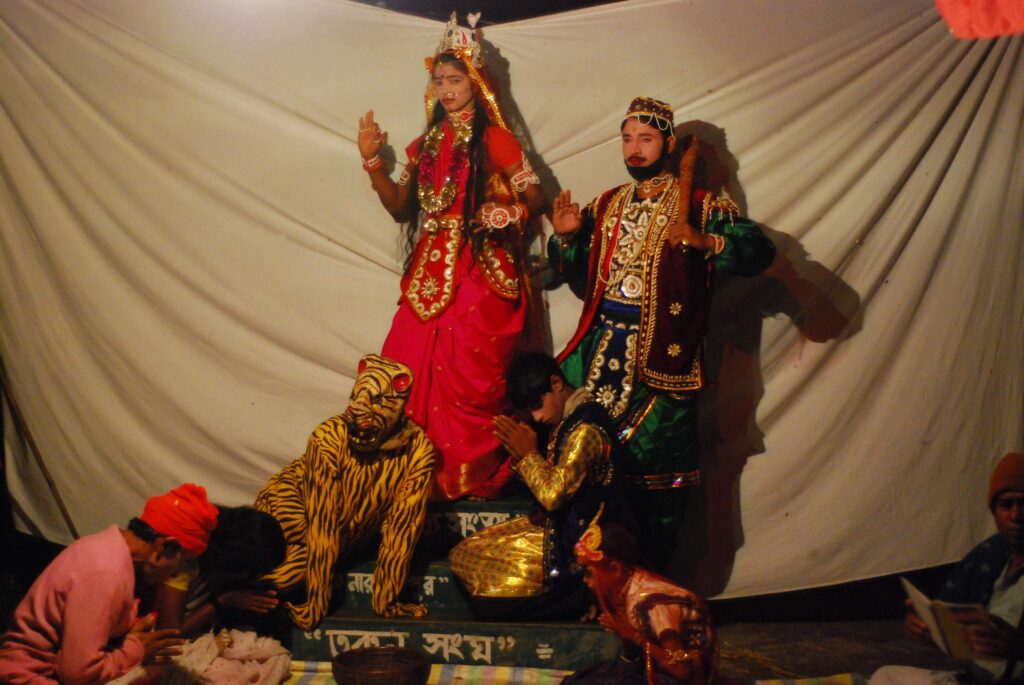
Imagine, too, the existence of a forest goddess who, local people insist, is Muslim. In imagery and form, Bonbibi resembles the several Shakti figures worshipped in West Bengal. But in the Sundarban, a vast tract of forest and swamp land, the largest mangrove forest in the world, people insist she is a Muslim who protects local communities from man-eating tigers. It is one of the most fascinating aspects of this land, with its shifting islands and seas, tigers, muddy embankments, mysterious forests, Muslim goddesses, and Hindu worshippers.
Much has been written about Muslims in West Bengal in the run-up to the Assembly election, many of them disenfranchised through the Special Intensive Revision (SIR) of electoral rolls. They are the profiled group against whom, it is believed, there was a decided Hindu consolidation. We have also been told of the many Muslim henchmen in the structures of the defeated party and heard the speeches of BJP campaigners and raving television anchors who define Bengali Muslims as either infiltrators or criminals. Post-election, we see protests in Kolkata against the ban on namaz said on roads when the mosques spill over, against the entry of the bulldozer, and the Kafkaesque new rules (take multiple permissions or face jail and fines) on animal qurbani (ritual animal sacrifice).
All these narratives present a certain stereotype of Bengali Muslims. But who are they? Most of them are cultivators and peasants who labour in the fields, and like the poor everywhere, many migrate out of the State in search of better wages. They are less urbanised than the Muslims in, say, Uttar Pradesh. In his seminal work on Bengal’s Muslims, the historian Richard M. Eaton wrote that the rise of the cultivator class of Bengali Muslims can be traced to their clearing of forests for agriculture. The Bengali Muslim identity is therefore built around a different local history than that in, say, southern India where they are prosperous trading communities. In the wonderful book The Islamic Syncretistic Tradition in Bengal, the historian Asim Roy examined the local beliefs of Bengal’s Muslims, originating from their lived realities in the Bengal delta and their pre-Islamic lore.
So, what will happen now to this 27 per cent of the population? The victorious BJP has more or less said that it does not intend to serve them and, in fact, will be actively hostile to them. “Detect and deport” are the words that BJP leaders used to describe what they would wish to do to Muslims here, one of their larger population clusters in South Asia.
There could possibly be a two-pronged strategy: an electoral one that involves cutting the population’s influence that arises from sheer numbers, and a cultural one to keep the community as an active hate object. The election that culminated in the BJP’s win in Bengal has been flagged as the most questionable in the country’s recent history, and some methods employed by the Election Commission of India are being legally challenged. The ruling party is anxious to put down roots in this non-traditional area where a large Muslim population always presented a numerical challenge.
Therefore, now that the SIR is over, we can also expect delimitation of constituencies to be done in the manner it was managed in Assam: to reduce the electoral clout of targeted sections of the population. Police cases and bulldozer action are also part of the playbook, apart from the constant push to disenfranchise and terrorise. The BJP got 45.84 per cent of the vote share, which means that over 50 per cent of the population did not vote for it in Bengal, and Muslims would form about half of those people. There will be upcoming election cycles that will reveal whether there is potential for opposition parties—the Trinamool Congress, the Congress, and the CPI(M)—to come together.
The corporation and municipal elections will take place in 2027, the panchayat elections in 2028, and the next Lok Sabha election will be held in 2029. In a State known for political retribution, who will occupy the opposition space? The national leadership of the Congress believes it should join forces with the Trinamool. The Left position is more complicated, with one school in the CPI(M) believing that the Left will be the eventual beneficiary of the demolition of Mamata Banerjee (even if the BJP is used for that). Will the Left (now embedded in the Right) become glued to power or will there remain a small left-leaning Left within the Right? Or are these all just deranged ideas and propositions?
The self-image of the Bengali “bhadralok”
Then there is the self-image of the Bengali “bhadralok”. They are mostly drawn from the powerful castes, as most loyal voters of the BJP in the Gangetic belt have been, so will Hindutva feel like a natural fit? Or will doubts and discomfort resurface among these people who have been at the vanguard of intellectual exploration? After all, much before the Hindutva brand of nationalism, before communism, and the subnationalism of Mamata, Bengal is the land where Raja Ram Mohan Roy founded and edited two newspapers to promote reform and awareness in society: a Bengali weekly, Sambad Kaumudi, and a Persian one, Mirat-ul-Akhbar. It is the land of the poet Rabindranath Tagore, who wished to break down “narrow domestic walls”, and the revolutionary Subhas Chandra Bose, who believed in the idea of a strong central state but was explicitly anti-communal.
The BJP victory in Bengal is the biggest escalatory event for the ideology of the Hindu Right after it won Uttar Pradesh in 2017. After the Gujarat model of Narendra Modi, one saw the Uttar Pradesh model. Will there now be a Bengal Hindutva laboratory or are the chemicals in the mix too volatile?
Will the political consciousness and unique cultural pluralism of Bengal be able to withstand the homogenising force of a northern Hindutva project? And how will the BJP target, suppress, control Bengal’s large Muslim population, a community woven into the very fabric of the State? Will they hunt them in the fields and farms and forests?
It is also moot to ask how this will pan out in the context of relations with Bangladesh. What we have today are partitions within partitions: a Bangladesh that allegedly mistreats Hindus (according to narratives of the BJP/RSS) on one side of the border and a West Bengal that is preparing to mistreat Muslims on the other side.
[Saba Naqvi is a Delhi-based journalist and author of four books who writes on politics and identity issues. Courtesy: Frontline, a fortnightly English language magazine published by The Hindu Group of publications headquartered in Chennai, India.]