❈ ❈ ❈
‘Fighting for Our Existence’: In Maharashtra’s Palghar, Huge Protests Against Development Plans
Meena Menon
“I wish the sea was far away from here,” said wada pao seller Ashok Dharmameher. “Then this project would not be here.”
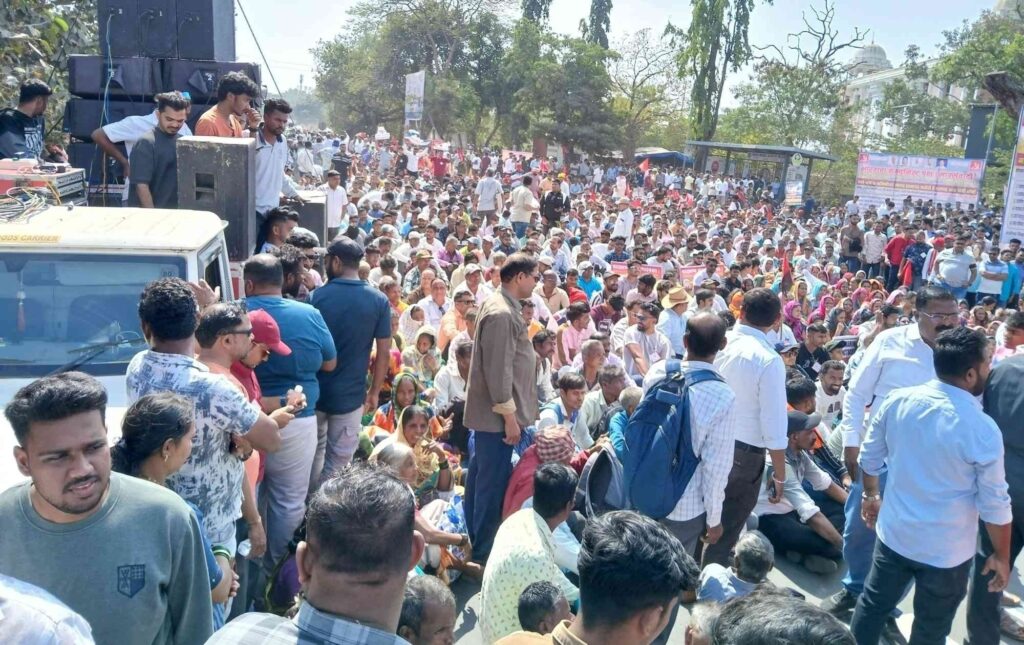
Dharmameher was among the thousands who participated in coordinated protests on Monday on National Highway 48 and the roads leading to the district collector’s office in Palghar district, 84 km north of Mumbai, to demonstrate against the proposed Vadhavan port, plans to build a “fourth Mumbai city” there and other development plans for the area.
One protest was led by the Vadhavan Bandar Virodh Sangharsh Samiti, an organisation that has been opposing the construction of the port. Another protest, led by the Communist Party of India (Marxist), related to problems with land acquisition for these projects. It involved a 44-km march that ended on Tuesday.
Some of the protestors, led by the Kashtakari Sanghatana, were demanding forest rights.
Dharmameher, a resident of Chinchani village village, 6 km from the proposed port, said that he earned enough to support himself and his wife. But with little information available about the projects in the area, he and many others fear they will be displaced from homes their families have lived in for decades.
Opposition to the Vadhavan port, planned off the coast in Palghar, has been mounting in recent years, especially from fishing villages in the district that fear they will lose their homes and livelihoods.
Though the port is planned to be located offshore, an extensive road and rail network will be built to connect it to National Highway 48 (which runs from Delhi to Chennai) and to other cities such as Nashik and Bhusawal. This would entail acquiring land in the area’s villages. In some places, residents have prevented surveys from being conducted.
The Rs 76,000-crore port is a joint venture between Jawaharlal Nehru Port Trust and the Maharashtra Maritime Board. It will be spread over 17,471 hectares. Of this, 16,900 hectares have been earmarked for the port and 571 hectares for rail and road connections.
The project will also require land to be reclaimed, for which about 200 million cubic metres of sand will be quarried from a pit located 50 km off the Daman coast in nearby Gujarat. The reclamation will also use stones from quarries in Palghar taluka.
Vadhavan port is being developed along with a “fourth Mumbai” that will involve acquiring vast tracts of land in Palghar district. (After Navi Mumbai was built in the 1970s to decongest Maharashtra’s capital, a “third Mumbai” has been proposed in Raigad district.)
Also proposed in the area are an offshore airport, a textile park at Kelve, a new expressway and a freight rail corridor. Already, residents have had land acquired for the bullet train project that will connect Mumbai with Ahmedabad.
On Monday, in a memorandum to the chief minister submitted to the Palghar collector, representatives of 11 organizations representing fisherfolk, farmers, adivasis stated that these projects should be stopped as it threatened their environment and livelihoods.
They emphasised that the port was not legally permissible as Dahanu taluka, where the port is proposed to be located is an eco-sensitive zone. That is why the Supreme Court-nominated Dahanu Taluka Environment Protection Authority had in 1998 rejected the location of a port here, they noted.
The project violates Article 21 of the Indian Constitution, which assures the right to life and dignity, they contended.
The memorandum also cited the Public Trust doctrine, which asserts that natural resources are not the property of the government but are a public resource. The government is only a trustee of these commons.
The memo said that the public hearing for the project in 2024 ignored the widespread opposition to the proposal by residents and the Social Impact Assessment Report did not have plans to regenerate livelihoods for those who would be affected by it.
Importantly it stated that though the port authority had agreed to not begin work till the land acquisition process was completed in the case before the Supreme Court filed in May 2025, it was violating that commitment in some places. This, the memo noted, was contempt of court.
Among the participants in Monday’s protest was Devashree Kini, the deputy sarpanch of Vasgaon village in the district. “We don’t want this port or their jobs,” she said. “We are self -sufficient. This port will wipe out our existence and our next generation will be finished.”
Also in the crowd was Sachin Patil from Chinchani village, who owns seven acres of a chikoo and mango farm. He employs four people and said that he earns Rs 1.5 to Rs 2 lakh a month. After visiting Mundra port in Gujarat, he fears that the displacement he witnessed there will be repeated in Palghar. “I saw that land around the port was used for so many things, and here too our villages will be affected,” he said.
Palghar is an Adivasi-dominated district that was bifurcated from Thane in 2014. It lacks basic amenities and a tertiary hospital. One section of protestors was focused on demanding forest rights.
The Forest Rights Act grants individual rights such as habitation and cultivation as well as community rights such as grazing, fishing and collecting minor forest produce to forest-dwelling communities
Brian Lobo of the Kashtakari Sanghatana said that while the government acquired land for new projects, it had not settled existing claims of Adivasis under the Forest Right Act. There were over 3,000 appeals related to forest rights pending in the area. Of these, 600 related to wrong survey numbers, a crucial detail in cases when land is being acquired.
Prasad Shinde from Chahade village said even if the port was located offshore, the roads to the highway would require land to be acquired. Even though the authorities had assured residents that they would get jobs on these projects, Shinde was sceptical.
The only jobs available for residents here, most of whom are not educated, would be as sweepers, he remarked.
“Why doesn’t the government take the project to the north?” he said. “That is where people migrate from isn’t it and look for jobs in Palghar. We don’t want this new city also because we won’t have a place in it and we don’t want this port which will destroy our land and livelihoods.”
Jyoti Meher, secretary of the Maharashtra Macchimar Kruti Samiti, one of the organisers of the demonstration, explained what was at stake. “We are fighting for our existence and rights over natural resources,” she said.
[Meena Menon is a freelance journalist and researcher. Courtesy: Scroll.in, an Indian digital news publication, whose English edition is edited by Naresh Fernandes.]
❈ ❈ ❈
Maharashtra: 50,000-Strong Adivasi, Farmer March to Palghar on Indefinite Dharna for Land Rights
Sabrang India
Demanding community ownership rights under the Forest Rights Act, 2006 and restitution of the Mahatma Gandhi Rural Employment programme (MNREGA), 50,000 women Adivasi and other farmers have been marching from Charoti to Palghar in Maharashtra with their demands. The key demands of this March are as follows: Rigorous implementation of the Forest Rights Act; Vesting of all temple, inaam and govt land in the name of the tillers; Restoration of MNREGA; cancellation of the Smart Metre scheme; Implementation of PESA; Repeal of the Labour Codes; Cancellation of the Wadhwan and Murbe Ports in the Dahanu coastal region; Water for drinking and irrigation; Increased facilities for education, employment, ration, health, and among others.
Protesters are mostly from the tribal communities of Palghar district. They had started their trek towards the collectorate, demanding better implementation of land rights, reinstatement of the MGNREGA, cancellation of the Vadhavan port and availability of water for drinking and irrigation purposes, among others. Accompanied by protest songs on microphones, striding purposefully with CPI-M flags and banners, chanting slogans, protesters reached the Collectorate office of Palghar on the evening of January 20, where they plan to camp until their demands are met – the most longstanding of which is the enforcement of land rights. Adivasis have been tilling forest and grazing land for centuries but still don’t own the plots they cultivate.
The Forest Rights Act, 2006, vests forest land and resource rights in Scheduled Tribes and other traditional forest dwellers who have resided in such areas for generations. Gram sabhas initiate claims, verified through sub-divisional and district committees, protecting dwellers from eviction until their rights are settled. But most of the tribal farmers at the rally have not had their claims approved. The last time that farmers marched in their thousands was from Nashik to Azad Maidan in Mumbai, a stretch of 180 kilometres with several marchers barefoot.
Mass organisations All India Kisan Sabha (AIKS), Centre of Indian Trade Unions (CITU), All India Democratic Women’s Association (AIDWA), Democratic Youth Federation of India (DYFI) and Student’s Federation of India (SFI) and Adivasi Adhikar Rashtriya Manch (AARM) have also joined this March in huge numbers. Beginning the long walk on January 19, the marchers have reached the Palghar Collectorate where they were denied permission for the dharna inside the Collectorate. Undettered they have begun the indefinite protests outside.
The March is being led by CPI (M) Polit Bureau member and AIKS National President Dr Ashok Dhawale, Polit Bureau member and AIDWA National General Secretary Mariam Dhawale, Central Committee member, state secretary and AIKS National Joint Secretary Dr Ajit Nawale, Central Committee member and CITU State Secretary Vinod Nikole, two-term MLA from Dahanu, State Secretariat member and AARM State Convenor Kiran Gahala, and many others. Later CPI (M) Polit Bureau member and AIKS National General Secretary Vijoo Krishnan also joined the March.
According to Palghar Police officials, as reported in The Hindu, around 30,000 protesters joined the long march. The demands include full implementation of the Forest Rights Act, the Panchayats Extension to Scheduled Areas Act PESA, revival of the Jal Jeevan Mission scheme to provide work, cancellation of the smart meter scheme, appointment to all the vacant posts in the government service of Palghar district, providing the benefits of the Gharkul scheme, and cancellation of the development of Vadhavan and Murbe ports.
CPI (M)’s women wing State secretary Prachi Hatiwlekar told the newspaper, “This struggle is age-old, starting from bonded labour to now working for long pending issue of land ownership transfer. Central government is only trying to dilute the Forest Rights Act.”
The protesters are also articulate and vocal against the smart metres, media reports indicate. They want that the government reinstall old meters and instruct their officials not to impose smart meters. Maharashtra State Electricity Distribution Company Limited (MSEDCL) rolled out the smart meters in 2021, which automatically record real-time power consumption and send the data to the electricity distribution company. However, the device has been criticised for bill hike, no consent for installation, and poor awareness about tariff changes.
The protest shows discontent among tribal communities over land ownership, large infrastructure projects in the district and changes to MGNREGA. All the protesters unanimously reiterated that unless and until “we don’t get all our papers stamped, we won’t go home”.
[Courtesy: Sabrang India, an online portal dedicated to fighting the cancer of divisive politics. It is edited by Teesta Setalvad and Javed Anand.]