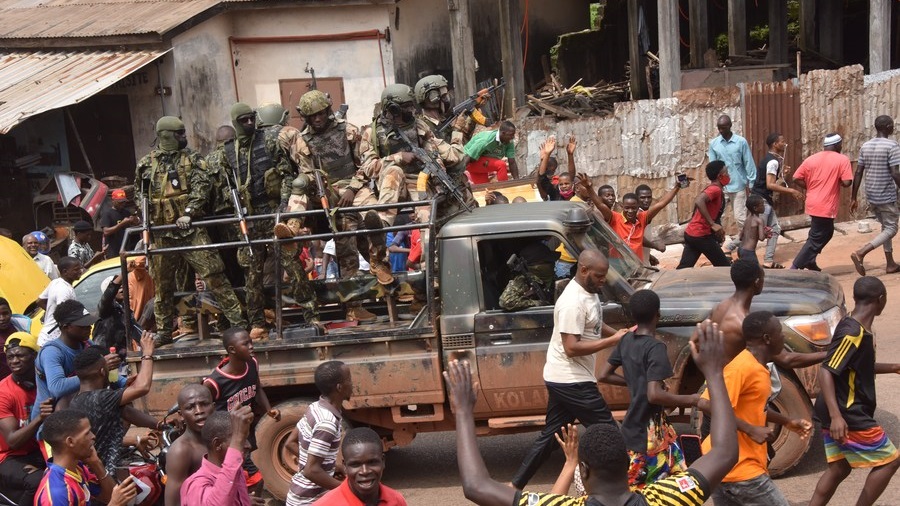
On October 20, 2022, in Guinea, a protest organised by the National Front for the Defence of the Constitution (FNDC) took place. The protesters demanded the ruling military government (the National Committee of Reconciliation and Development, or CNRD) release political detainees and sought to establish a framework for a return to civilian rule. They were met with violent security forces, and in Guinea’s capital, Conakry, at least five people were injured and three died from gunshot wounds. The main violence was in Conakry’s commune of Ratoma, one of the poorest areas in the city.
In September 2021, the CNRD, led by Colonel Mamady Doumbouya, overthrew the government of Alpha Condé, which had been in power for more than a decade and was steeped in corruption. In 2020, then-President Alpha Condé’s son—Alpha Mohamed Condé—and his minister of defense—Mohamed Diané—were accused of bribery in a complaint that the Collective for the Transition in Guinea (CTG) filed with the French National Financial Prosecutor’s Office. The complaint alleges that these men received bribes from an international consortium in exchange for bauxite mining rights near the city of Boké.
Boké, in northwestern Guinea, is the epicentre of the country’s bauxite mining. Guinea has the world’s largest reserves of bauxite (estimated to be 7.4 billion tonnes) and is the second-largest producer (after Australia) of bauxite, an essential mineral for aluminum. All the mining in Guinea is controlled by multinational firms, such as Alcoa (US), China Hongqiao, and Rio Tinto Alcan (Anglo-Australian), which operate in association with Guinean state entities.
When the CNRD under Colonel Doumbouya seized power, one of the main issues at stake was control over the bauxite revenues. In April 2022, Doumbouya assembled the major mining companies and told them that by the end of May they had to provide a road map for the creation of bauxite refineries in Guinea or else exit the country. Doumbouya said, “Despite the mining boom in the bauxite sector, it is clear that the expected revenues are below expectations. We can no longer continue this fool’s game that perpetuates great inequality” between Guinea and the international companies. The deadline was extended to June, and the ultimatum’s demands to cooperate or leave are ongoing.
Doumbouya’s CNRD in Guinea, like the military governments in Burkina Faso and Mali, came to power amid popular sentiment fed up with the oligarchies in their country and with French rule. Doumbouya’s 2017 comments in Paris reflect that latter sentiment. He said that French military officers who come to Guinea “underestimate the human and intellectual capacities of Africans… They have haughty attitudes and take themselves for the colonist who knows everything, who masters everything.”
This coup government—formed out of an elite force created by Alpha Condé to fight terrorism—has captured the frustrations of the population, but is unable to construct a viable agenda to exit the country’s dependence on foreign mining companies. In the meantime, the protests for a return to democracy are unlikely to be quelled.
(Vijay Prashad is an Indian historian, editor, and journalist. He is a writing fellow and chief correspondent at Globetrotter and the director of Tricontinental: Institute for Social Research. Courtesy: Globetrotter. Globetrotter is a project of Independent Media Institute, a nonprofit organization that educates the public through a diverse array of independent media projects and programs.)