On 25 March 2026, the United Nations passed a Ghanaian-led resolution naming the transatlantic slave trade a crime against humanity by a vote of 123 in favour and three against (the US, Israel and Argentina). The world’s wealthiest nations, holders of the strongest passports, the most militarily powerful and most diplomatically influential countries either voted no or refused to vote yes. Global South said yes. Global North said no–or said nothing, which in diplomatic language means the same thing.
Interestingly, these Global North nations were also the initiators of the capitalist transatlantic slave trade and practiced it for centuries, bleeding the African continent dry so that they could prosper on its systemic abuse and trauma. While forms of labor bondage existed historically across the globe, European powers scale-industrialized the practice to fuel global markets. The very prosperity these nations enjoy today—the infrastructure, the institutions, the financial systems, and their ‘developed country’ status—was built directly on the backs of enslaved African people.
This was not a procedural vote. It was a geopolitical declaration. There is a chess game in diplomacy, and this is exactly what happened with this resolution. Therefore, showcasing the capitalist foundations of the modern west.
The hybrid character: capitalism and feudalism entwined
The transatlantic slave system was fundamentally an amalgamation of feudalism and capitalism. It operated as a capitalist model in its core logic—human beings were brutally and inhumanely commodified, their bodies treated as tradeable assets in a global marketplace. Yet it retained feudal characteristics: enslaved people were considered the permanent property of colonial lords, sold and resold multiple times across generations, with no legal recourse. The system created a new form of domination that combined the profit-maximization imperative of capitalism with the permanent, hereditary bondage of feudalism.
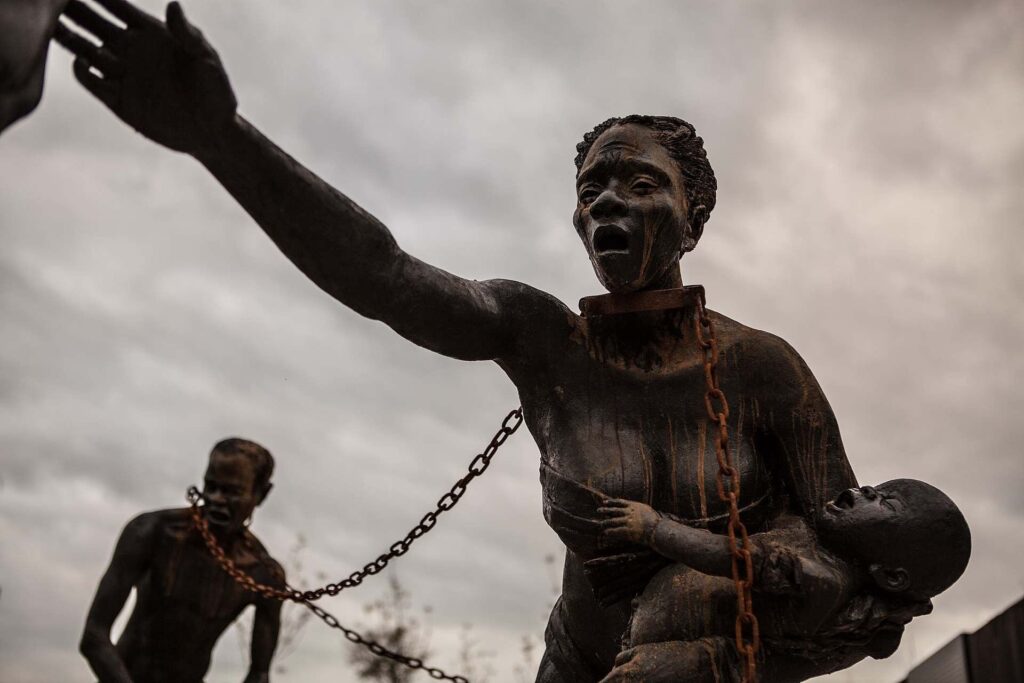
The violence against enslaved women reveals the particularly insidious nature of this hybrid system. Female slaves experienced not only the commodification of their labor but systematic sexual violence and reproductive coercion—they were sexually abused by enslavers, often forced into pregnancies that produced valuable “assets” for their owners, and frequently separated from their children, whom they might never see again. This gendered dimension of slavery—the weaponization of women’s bodies for both labor extraction and population control—demonstrates how the system weaponized intersecting forms of violence: racialized dehumanization, gendered sexual domination, and economic exploitation.
It cannot be denied that colonization began as a trading business–a capitalist venture–but as European powers spread across the world, this capitalism took on feudal characteristics in colonized territories. These lands were claimed as the permanent feudal domains of European nations, bled and depleted of resources, their populations stratified into permanent hierarchies that lasted for centuries.
Yet this was not simply feudalism disguised as capitalism. The system was fundamentally capitalist in its purpose: to maximize profit through the cheapest possible labor. Some Marxist scholars distinguish between feudal and capitalist modes of production, arguing that the New World slave system was a hybrid–combining feudal elements (legal unfreedom, personal domination, a ruling class with aristocratic pretensions, extra-economic coercion) with capitalist ones (commodity production for world markets, profit maximization, integration into global credit and trade networks).
This characterization is accurate. But the capitalist logic was structurally dominant. These were not plantations that happened to use enslaved labor; they were organized from their inception around mass commodity production for global markets. The system’s entire purpose was to maximize profit through the cheapest possible labor–which is capitalism, not feudalism. This is precisely what makes capitalism’s genesis: not slavery as an aberration, but slavery as the prototype for how capitalism would come to depend on racialized, coerced labor across the globe.
The unequal outcome: development and devastation
The Western world prospered: European wealth accumulated rapidly, fueling industrialization and the comfortable modernity we associate with the West today. The factories, universities, infrastructure, and democratic institutions of Europe were built on the backs of racialized slavery abuse. This is not metaphorical–it is literal wealth transfer.
Africa suffered profoundly: The continent faced centuries of instability–internal conflict, disrupted local economies, and derailed political development. The extraction of more than 12 million people didn’t merely represent loss of life; it represented lost knowledge, lost leadership, lost potential, lost generational wealth, and lost futures.
More than a century after slavery’s formal abolition in 1888, Africa continues to grapple with the structural legacies of this trade–poverty, political instability, and resource exploitation–while the wealth extracted remains concentrated in the Global North. The debt remains unpaid.
Ghana’s move: strategy and diplomatic positioning
Ghana’s President John Dramani Mahama announced in September 2025 that Ghana would bring this resolution to the General Assembly. That six-month window was not accidental. It was preparation–diplomatic groundwork, coalition building across the African Union’s 55 member states, and coordination with CARICOM nations whose histories are inseparable from the slave trade’s violence and the economic-psychological trauma associated with it.
The timing of the vote–March 25, the International Day of Remembrance of the Victims of Slavery–was equally deliberate. Symbolic dates carry enormous diplomatic weight. Voting against a slavery reparations resolution on the International Day of Remembrance requires a country to make an active, public choice to stand on the wrong side of history in front of the entire world. Ghana understood this clearly. It chose the date to maximise the moral cost of opposition. Ghana’s resolution move answers that question plainly–it used both, weaponising moral symbolism in service of strategic goals in the current multipolar world.
Ghana’s Foreign Minister Samuel Okudzeto Ablakwa was careful to frame the resolution in language that was difficult to reject without revealing something uncomfortable. This was not, he insisted, about blame across generations. It was about truth, education, humanitarian accountability, and honest conversation. It was about creating a framework–not a bill, and certainly not a reparations bill. By making the resolution non-binding and framing it around dialogue rather than immediate financial demands, Ghana lowered the threshold for support while establishing the principle that would make future demands harder to refuse.
Ghana did not simply table a resolution. It engineered a political trap–one where voting no or abstaining reveals precisely the calculation you are trying to conceal. The resolution passed with a powerful new transatlantic unity between Africa and its global diaspora–the AU-CARICOM alliance representing a coalition that colonial powers never anticipated would organise this effectively at the United Nations. Ghana’s diplomatic manoeuvre was years in the making, and its success is a testament to what a unified African voice can achieve on the world stage.
What the no votes reveal
The United States, Israel, and Argentina occupy different positions in global politics. What unites them in this vote requires an understanding of their domestic pressures and the positions of their binding allies.
The American position was stated plainly by Ambassador Dan Negrea, who argued that the United Nations “was not founded to advance narrow specific interests” and that Washington “does not recognise a legal right to reparations for historical wrongs that were not illegal under international law at the time they occurred.” This argument–that the legality of an act at the time of its commission determines its moral status in perpetuity–is one the United States has never applied consistently. It is an argument of convenience, deployed specifically when the bill for historical crimes arrives.
The deeper truth is simpler: the United States is the world’s largest economy, and a significant portion of that wealth was built on enslaved labour. Acknowledging the slave trade as a crime against humanity opens a door the United States has spent decades keeping shut–not because the history is contested, but because the implications are not. Furthermore, with a large Black American population in the United States, such an acknowledgment could lead them to demand reparations and additional legal protections in exchange–a political liability the current administration is unwilling to accept.
Argentina’s vote is equally revealing. A country that aggressively pursued accountability for its own crimes against humanity under its past military dictatorship–and built its modern democratic identity partly on that pursuit–voted against naming someone else’s crime against humanity. The contradiction is not incidental. Argentina’s vote reflects the interests of nations whose economic relationships with former colonial powers make solidarity with the Global South geopolitically costly. Recently, Argentina’s UN diplomacy has shifted dramatically, heavily influenced by a pro-US alignment strategy. The current far-right administration has fundamentally realigned its foreign policy, moving its diplomatic maneuvers in lockstep with U.S. strategic objectives.
Israel’s position is the most complex. A state founded explicitly on the recognition that crimes against people can be systematic, institutionalized, and demand international acknowledgment voted against that same principle being applied elsewhere. While Israel is a binding ally of the U.S., its voting alignment cannot be reduced to simple compliance; as demonstrated by its recent independent military strategies across the Middle East and Iran, Israel frequently acts autonomously in pursuit of its own agendas. Rather, its ‘No’ vote reflects a profound structural anxiety regarding international precedent.
By blocking a framework for transatlantic reparations, Israel seeks to insulate itself from future legal and financial accountability for its own ongoing record of grave violations against humanity. Yet, the deeper contradiction demands acknowledgment–Israel, as a Zionist state, draws its founding legitimacy from the world’s recognition of the Holocaust as a crime against humanity. How then can it stand by its own historical suffering while refusing to acknowledge the dark history of the transatlantic slave trade? Whatever the diplomatic calculations behind that decision, its symbolism is striking–and African diplomats will not forget it.
The abstention as strategy
The abstentions deserve more scrutiny than they typically receive. Fifty-two countries chose not to vote yes–including every European Union (EU) member state, the United Kingdom (UK), Canada, Australia, and Japan. These are not countries that lack positions on human rights. They are countries that have built entire foreign policy architectures around human rights discourse.
Considering the case of Canada and Australia, these countries were built up by the British Settlers, therefore their wealth, institutions, and identities were directly shaped by colonial history. Their abstention is a refusal to name that history as a crime, dressed as neutrality. Specifically, the European countries among these abstentions have their developed-country status precisely because of the systematic drain of wealth they carried out through colonialism in their colonies.
Their abstention is not neutrality. It is a calculation. Voting yes would open formal dialogue on reparations–apologies, financial compensation, debt cancellation, the return of looted artefacts. European nations hold African artefacts in their museums. European wealth is traceable, in quantifiable ways, to colonial extraction. A yes vote is the beginning of an accounting they are not prepared to undertake.
The EU’s stated position–that reparations are “inconsistent with international law” because slavery was legal at the time it was practised–is the same argument as the U.S. no vote, dressed in the language of abstention to avoid the reputational cost of an outright refusal.
In 2001, the major Western states walked out of the Durban conference to avoid precisely the language adopted in this resolution. In 2026, those states stayed, voted no or abstained, and saw 123 countries ignore their objections. The abstention in 2026 is more dignified than the walkout of 2001. It is not more honest.
The Netherlands remains the only European country to have issued a formal apology for its role in slavery. Every other European abstention is a refusal–dressed in diplomatic neutrality to avoid the reputational cost of an outright no.
Countries like Australia and Canada were built by the British Empire, which is precisely why they remain English-speaking nations today. Their wealth, their institutions, and their identities are directly shaped by colonial history–yet they chose to abstain from naming that history as a crime. Similarly, Japan also has a dark past linked to the abuse of Korean women and forced labour during wartime. Acknowledgment of this resolution would bring them into the conversation around reparations and accountability–and that is exactly what they are avoiding.
What does 123 yes votes actually mean?
The 123 countries that voted yes represent the majority of the world’s population. They include many Latin American states, most of Asia-Pacific, and the entirety of Africa. This coalition–broadly coterminous with what we call the Global South–has been building institutional solidarity for years through the African Union, CARICOM, the Non-Aligned Movement, and increasingly through South-South economic partnerships that reduce dependence on Western financial systems.
This resolution is not an isolated event. It marks the beginning of the African Union’s Decade of Action on Reparations and African Heritage, covering 2026 to 2036. The AU intends to institutionalise justice through a Global Reparations Fund and the appointment of an AU Special Envoy on Reparations. For African leaders, this is less about a simple apology and more about structural reform of the global trade and debt systems that originated during the era of enslavement. AU member states are being asked to establish national reparations commissions and engage formally with former colonial powers. The resolution is not the end of a process. It is the institutionalisation of a demand that will now have a decade of organised continental backing.
President Mahama used the occasion to go further–calling for permanent African representation on the UN Security Council and a reform of the global financial architecture. The slavery resolution and the Security Council demand are connected. Both are about the same fundamental question: who gets to make the rules of international order, and whose interests do those rules serve?
The answer, as the vote map makes clear, has always been the same. The resolution is Africa’s most visible challenge to that answer yet. The world consists of both the Global North and the Global South, and this means both should have an equal role in shaping international affairs–but that is not the reality. There is a deep rich and poor divide, and the Global South continues to be exploited year after year.
Beyond the vote: justice delivered and the long game
While UN General Assembly resolutions are not legally binding, they carry enormous normative weight. By passing this resolution, the proponents have made it socially and politically expensive for Western nations to continue denying the conversation. Every future negotiation on reparations, every future demand for debt cancellation, every future conversation about why African nations carry $746 billion in cumulative foreign debt while Western institutions hold wealth built on African labour–all of it now happens in a world where the UN has said, formally and by overwhelming majority: this was a crime.
One additional major dynamic worth noting is that the countries that voted “no” or chose to abstain may also be acting out of a strategic fear of the future. History demonstrates that global power is neither permanent nor static; it inevitably shifts. The nations that function as global powers today will not remain in those positions indefinitely, as international power dynamics are always in flux.
In the future, should an African nation emerge as a global superpower, it could leverage the precedent established by this resolution to hold the Global North accountable for the grave crime of slavery in ways that current leaders cannot yet anticipate. Current events in South Africa regarding land redistribution and historical redress serve as an early signal of how these reversals of historical power can begin to manifest.
The nations that abstained or voted no will argue the resolution changes nothing legally. They are technically correct and strategically wrong. Law follows politics. Politics follows power. And power, as the vote map demonstrates, is shifting.
The transatlantic slave trade built the modern world–its wealth, its institutions, and the global order that 52 countries chose to protect on 25 March 2026. Ghana’s resolution did not change that order. But it named it. And in international politics, naming something–formally, publicly, by overwhelming majority–is the first act of dismantling it.
The nations that abstained calculated that silence is safer than accountability. They may be right, for now. But they voted–or did not vote–in front of 123 countries who are watching, organising, and building the institutional architecture for what comes next.
Africa is no longer asking for recognition. It is building the conditions under which recognition becomes unavoidable. The question is simply this–will those who owe reparatory justice engage on their own terms, or on terms they no longer control?
[Priyanka Sharma is a researcher and analyst specializing in the political economy of the Global South and the structural legacies of colonialism. Her work examines the intersection of historical capital accumulation, gendered labor exploitation, and the shifting power dynamics within multilateral institutions. Courtesy: Review of African Political Economy (ROAPE), a journal that provides radical analysis of trends, issues and social processes in Africa, adopting a broadly materialist interpretation of change. Established by a group of scholars and activists in the UK and Africa, the journal is committed to understanding projects of radical transformation.]