❈ ❈ ❈
The Second Global Sumud Flotilla: Israeli Piracy and Abduction in International Waters
Binoy Kampmark and Jenny Farrell
They have become adept flouters of international law. When doing so, they justify such violations with streaky, anaemic interpretations of self-defence and security. The Global Sumud Flotilla’s encore effort to break the Gaza blockade, which has been in place with varying forms of severity since 2007, did have one meritorious claim. After vanishing under a news cycle saturated with the Iran War, the blockade of the Strait of Hormuz and a global energy crisis, the unpardonably miserable plight of Gazans did make a return to the media stage.
The state of catastrophic misery for those on the Gaza Strip is something the Israeli authorities refuse to ameliorate. Despite the illusory ceasefire that commenced on October 9, 2025, Israel maintains an asphyxiating role over the narrow territory, much of which it has subjected to occupation. Since then, it continues to permit an excruciatingly limited number of supplies to a largely displaced population. On April 10, the United Nations Human Rights Chief Volker Türk made remarks about the ongoing nature of the killings and depredations by Israeli forces. Till that point, 738 Palestinians had been killed since the ceasefire had come into effect. “For the past 10 days, the Palestinians are still being killed and injured in what is left of their homes, shelters and tents of displaced families, on the streets, in vehicles, at a medical facility and a classroom.” Humanitarian personnel and journalists also continue to feature in the casualty lists.
The purpose of the Global Sumud Flotilla, as with its mission in September 2025, was to “not only break Israel’s illegal siege and deliver life-saving humanitarian aid, but also to establish a sustained civilian presence.” Participants include doctors, nurses, eco-builders, war crimes investigators, civilian protectors (unarmed) and a miscellany of others. With missionary zeal, those involved intend to “begin rebuilding healthcare systems and basic infrastructure destroyed over the past two years” even under fire from Israeli forces.
On March 27, the Palestinian NGOs Network (PNGO) released a statement commending those involved in the Freedom Flotillas, praising the efforts of the organisers “of the new Global Sumud Flotilla, which is set to depart soon.” The group acknowledged the need to escalate and strengthen “solidarity efforts with the Palestinian people” in the wake of such distractions offered by the “ongoing war in the Gulf region and the Israeli-American aggression”. Following a symbolic launch in Barcelona on April 12, the flotilla, made up of 58 vessels, set out.
On April 30, the “Global Sumud Flotilla,” still in international waters off Greece, was attacked on the high seas on Wednesday night—over 1,000 kilometers from the Israeli coast. Around 10 p.m. on Wednesday evening, the signs intensified: drones circled, then a warship appeared on the horizon.
“The Israelis were picking off the boats one by one and arresting them,” recounts Irishman Jamie Goldrick. Radio communication collapsed; instead, pop songs suddenly played over the lines—a surreal acoustic backdrop for what followed.
On board one of the ships: the medical doctor Margaret Connolly, sister of the President of Ireland. Dr. Margaret Connolly, 67, was standing on the deck of her boat as the warship approached: “I packed up medications and passports.” Her boat escaped—the crew fled as Israeli speedboats boarded a neighboring vessel. Twenty-two of the 57 ships were attacked, 180 people detained, including seven Irish citizens. On board the Israeli warship, there was massive violence: activists were bound, dragged across the floor, beaten, kicked, and shot at. Thirty-four participants had to be treated in hospitals in Crete. Several suffered serious injuries.
Al Jazeera reported that the majority of 175 activists captured were taken to Crete, with Saif Abu Keshek from Spain and Brazilian Thiago Ávila proving worthy of being taken to Israel for questioning. According to Israel’s Foreign Ministry, both are affiliated with the Popular Conference for Palestinians Abroad (PCPA), a group they regard as clandestinely affiliated with Hamas.
There is grave concern for the fate of Spanish-Swedish-Palestinian activist Saif Abu Keshek and Brazilian Thiago Avila in Israeli custody. The Israeli human rights organization Adalah raises serious allegations: Avila was reportedly so severely abused that he lost consciousness multiple times and has since been held in isolation, bound and gagged. Abu Keshek reports that he was restrained for hours and held face down. Adalah has also challenged the legality of the entire proceeding: Israel has no jurisdiction over the actions of foreign nationals in international waters.
The interception troubled Amnesty International’s Senior Director for Research, Policy, and Campaigns, Erika Guevara Rosas. “The Israeli navy crossing hundreds of miles just to ensure civilian boats carrying food, baby formula, and medical supplies don’t make it to Palestinians reveals the lengths Israel is prepared to go in order to maintain its cruel and unlawful 19-year-long blockade of the occupied Gaza Strip.”
The conduct of the IDF did not go unremarked in a number of capitals. The Foreign Ministries of Spain, Türkiye, Brazil, Jordan, Pakistan, Malaysia, Bangladesh, Colombia, Maldives, South Africa and Libya issued a joint statement condemning “in strongest terms the Israeli assault” on the flotilla, “a peaceful civilian humanitarian initiative aimed at drawing the attention of the international community to the humanitarian catastrophe in Gaza.” Spain and Brazil are demanding the immediate release of their citizens.
The World Federation of Trade Unions expressed the firm view that the act had been one of piracy, involving the sabotage and destruction of boats, the assault and attack of activists and the abandonment of some of their number at sea “with no means of reaching land.” The WTFU also took issue with the illegal detention of Abu Keshek, a member of the World Federation and a trade unionist of the Catalan union IAC.
On May 3, the state attorney presented a list of offences to the Ashkelon Magistrates’ Court including “assisting the enemy during wartime” and “membership in and providing services to a terrorist organisation.” Spain’s Foreign Ministry unequivocally rejects the claims, insisting on Abu Keshek’s immediate release.
On May 5, the Court granted the state’s request to prolong the detention of Abu Keshek and Ávila being held at Shikma Prison till May 10. Their conditions feature total isolation, sleep deprivation through using high-intensity lighting in cold cells for 24-hour spells, and blindfolds when moved outside their quarters, including when medically inspected. Both have furnished testimony to the Israeli-based human rights group Adalah, which is acting on their behalf, noting “severe physical abuse amounting to torture”. The detainees are also undertaking a hunger strike, having only consumed water since April 30.
Adalah reasons that such a decision amounted “to judicial validation of the state’s lawlessness.” The six-day extension had also been granted “without imposing any limitations or judicial constraints on the interrogation period.” An appeal is being mustered by the group, which argues that an abduction undertaken over 1,000 kilometres from Gaza of non-Israeli citizens excludes the application of Israeli domestic law.
In drumming up such publicity, the question of effectuality arises. At what point does citizenry activism, decked out and decorated by high profile activists, win through? Do participants become, after a time, victims of their own futile publicity, their actions easily dismissed as stunts lost in the cul-de-sac of ineffective virtue? Figures such as the Swedish activist Greta Thunberg, who was on her second flotilla outing, can be easy fodder for the establishment machine, portrayed as privileged in grievance, cunningly exploited by the unscrupulous. This is certainly a line pursued by Israeli propaganda.
That line, however, has failed to neutralise the symbolic freight borne by the flotilla. Israel’s attempts to stifle the focus on Gaza has not worked, though the authorities were careful, unlike their previous violent outing of piracy and abduction, not to detain Thunberg longer than was needed. Low lying fruit, more easily bruised by faulty accusations of aiding a terrorist adversary, was preferred. It is an approach that is fast unravelling.
● ● ●
The “Free Gaza Movement” began in 2008. In 2010, Israeli soldiers boarded the “Mavi Marmara” in international waters—ten Turkish activists were killed. There were no legal consequences. Subsequent flotillas were also attacked—again without legal repercussions. In October 2025, as part of the first “Global Sumud Flotilla,” Israel detained over 450 people, including Greta Thunberg. Irish participants such as comedian Tadhg Hickey reported “inhumane” treatment: toilet water used as drinking water, insulin denied to a 75-year-old, and nighttime intimidation. Again: no consequences.
This year’s attack marks a new escalation. Israel targeted the flotilla more than 1,000 kilometers from Gaza. Dr. Connolly, who escaped the seizure, appealed to the Irish public: “Please ask that Shannon Airport stop being used by the U.S. military to bomb the hell out of Gaza and Palestine, 95% of the military aid comes from the U.S. and Germany. We totally object to our airspace being used to commit genocide.”
The “Global Sumud Flotilla” has not yet achieved its goal—the peaceful breaking of the naval blockade of Gaza and the enforcement of the international right to humanitarian aid. Many boats have been destroyed. Others are waiting for better weather in Greek territorial waters before once again setting sail toward Gaza.
[This article is a compilation done by us, based on the following two articles: “The Second Global Sumud Flotilla: Israeli Piracy and Abduction on the High Seas”, by Binoy Kampmark, published in CounterPunch; and: “Israel’s Growing Impunity: Naval Forces Seize Aid Flotilla with Irish President’s Sister Aboard”, by Jenny Farrell, published in People’s World. Binoy Kampmark was a Commonwealth Scholar at Selwyn College, Cambridge. He lectures at RMIT University, Melbourne. Dr. Jenny Farrell is a lecturer and writer in Galway, Ireland. She is an associate editor of Culture Matters and also writes for Socialist Voice, the newspaper of the Communist Party of Ireland.]
❈ ❈ ❈
The Global Sumud Flotilla Is a Mission of Mercy, Met with Cruelty
Yahia Lababidi
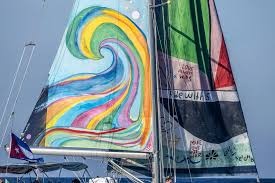
After a symbolic launch in Barcelona on April 12, the Global Sumud Flotilla set out across the Mediterranean Sea to bring aid to Gaza in what proved to be the largest civilian maritime convoy of its kind: 58 vessels, more than a thousand participants from over a hundred countries. Amnesty called on governments to guarantee safe passage. Greenpeace sent the Arctic Sunrise. And in the early hours of April 30, off the coast of Greece, Israeli naval forces moved in.
There is something deeply affecting in the sight of everyday people rising to perform the simplest offices of mercy while states and institutions, created for hours of peril such as this, withdraw behind procedure and delay. Across the Mediterranean, men and women gathered what aid they could carry, along with the inward resolve such a voyage demands, and turned themselves toward Gaza. Great structures, swollen with authority and self-protection, were suddenly made to look small beside a few fragile boats moved by fellow feeling.
That, for me, is the true subject here. The values-led flotilla and the light of humiliation it casts upon the official power structures. When private citizens must hazard sea and reprisal in order to bring food and medicine to the trapped, the failure has entered the marrow of public life. Whole systems, immense in apparatus and loud in self regard, stand exposed by a handful of human beings willing to cross water for strangers. The Greeks gave us words for it: demos, the common people, and kratos, their strength. A flotilla is democracy at its source.
In a relentless news cycle of death and destruction, there is something almost scriptural in the image of small craft setting out to relieve the besieged. A boat is a modest thing, rising and falling with the sea, vulnerable to delay, interception and fear. Perhaps that is why it can bear mercy so well. Mercy is among the most beloved names by which God is remembered in Islam, and these volunteers carried aid in their hold along with a quality of heart that official life has steadily thinned out.
The word sumud deepens the meaning further. For Palestinians, it has long meant steadfastness, a staying put in the face of erasure, a fidelity to land, memory and the human shape of one’s life. Here, steadfastness took to the sea. It left the olive grove and entered the waves. One remains steadfast by moving toward the wounded. One keeps faith by refusing distance.
By getting on those boats, the volunteers insisted that strangers are still our concern. A flotilla closes distance in the oldest human way, by drawing near, by consenting to inconvenience and risk because another people’s hunger has become unbearable to the soul.
To set out under such conditions is already a kind of testimony. One imagines the small practical gestures that attend such a voyage: the checking of ropes and provisions, subdued talk, private negotiations of fear, inward glances toward loved ones who would be left behind for a time. Heroism appears in a humble guise, the simple refusal to let danger relieve one of this duty. Those who boarded these vessels consented to exposure, and that consent lent the voyage its moral splendor.
There is something else that stirs the heart in such gatherings. The people who come together for a mission of mercy bring different languages, prayers and burdens of memory. Yet, for a brief and difficult passage they agreed to become answerable to one another and to those waiting beyond the horizon. This, too, is part of the beauty. A world daily instructed in difference and division still contains people capable of forming, under pressure, a fellowship. The boats carried supplies, certainly, though they also carried a living refutation of the lie that people are finally ruled by self-interest or tribe or fear.
Perhaps that is why maritime images can carry such spiritual force. The sea strips away illusion. No one sets out upon open water and remains wholly enclosed within self-regard. One enters a domain older than empires, where frailty and dependence are undeniable. To cross such waters in order to relieve the afflicted is to recover something ancient in the story, something older than diplomacy. It recalls the old belief that mercy is a labor asking something of the body. It must travel and bear fatigue and uncertainty. It must keep watch.
The greatness of the souls on this journey lies precisely in the fact that they remain recognizably human. They will be tired and perhaps seasick, maybe even afraid. They will carry their private griefs with them, along with the larger grief that summoned them to sea. Yet hope does not wait until the heart is free of trembling. It makes use of trembling and gathers what courage it can from love and shame, from prayer and the stubborn unwillingness to let the brutal terms of politics become the final measure of what is possible between us. Amid the daily grief, this is a welcome ray of light. Hope as an act of resistance, with wet sleeves and a steady hand on the rope. Hope that has looked at the world and, despite every inducement to resignation, continues to choose the human bond.
Those who sailed in April had already paid for this cause. In October 2025, Israeli forces arrested over 450 participants from the last flotilla attempt, among them the Swedish activist Greta Thunberg and Mandla Mandela, grandson of Nelson Mandela. Those survivors set out again, undeceived about what might await. Their willingness to return lent the voyage a grave authority. Events confirmed its cost.
The answer came in the early hours of April 30, in international waters west of Crete, 600 miles from Gaza. Israeli naval vessels surrounded the fleet, ordering activists to their knees at gunpoint. Twenty-two of the 58 boats were seized. One hundred and seventy-five people were held aboard an Israeli frigate for up to 40 hours, denied adequate food and water, the floor beneath them repeatedly and deliberately flooded. They were punched, kicked and dragged across the deck with hands bound. Shots were fired, live and rubber both. Thirty-four people were hospitalized in Crete with broken ribs, broken noses and serious neck injuries. Sixty went on hunger strike, before being released.
Two steering committee members were then taken separately to Israel: Saif Abu Keshek, a Spanish-Swedish Palestinian who had been on an observer boat that never planned to sail to Gaza, and Brazilian activist Thiago Ávila. Abu Keshek was forced to lie face-down from the moment of his seizure, kept hand-tied and blindfolded, his face and hands bruised. Ávila was dragged face-down across the floor and beaten so severely he lost consciousness twice. The Brazilian embassy, visiting under glass, observed visible marks on Ávila’s face and noted his significant pain. Both are in Shikma Prison in Ashkelon and still on a hunger strike. A court has now extended their detention until May 10.
Spain called the detention illegal; Spain’s Prime Minister Pedro Sánchez addressed Israeli Prime Minister Benjamin Netanyahu directly, saying his country would always protect its citizens and defend international law. Brazil stood with Spain. Turkey’s Foreign Ministry called the interceptions an act of piracy. New York Mayor Zohran Mamdani called them a brazen violation of international law. The Trump administration called the flotilla pro-Hamas and threatened consequences for any who had offered support.
Power has answered mercy with boots and bound hands. One wants to call this a surprise, but it is more precisely a revelation: something that was always there, now brought into the open. What the interception has laid bare, beyond the suffering of those detained, is the shape of the blockade itself. What kind of order must travel 600 miles from shore to intercept civilian vessels that are carrying bandages? What does a law protect when it meets unarmed people at sea with firearms and drags them face-down across wet decks?
Thirty-two boats remain anchored in Crete, where the organizers are regrouping and considering their next steps. The flotilla was seized in part. It was not silenced. And that refusal has done what no press release could: made the condition of Gaza impossible to look away from, at a cost borne by those who were willing to bear it.
The boats are small enough to be dismissed by cynics, and large enough to shame the world. They carry the old lesson that power does not hold a monopoly on reality. Power cannot produce the moral beauty that appears when human beings gather themselves for the sake of others. That beauty remains one of the last unpurchased things.
I think, in these dark years, about the difference between authority and worth. The first may be conferred by the world; the second is earned in the secret place where the heart decides whether it will remain human. Those who set out from Barcelona hold no office at all. Even so, they carry more of the world’s honor than many governments assembled beneath their flags. They carry it at sea, in the dark, with their hands bound, still keeping watch.
The lantern is still on the water. Mercy has been met with force, and answered the force with the deeper testimony of the body’s willingness to remain. Thirty-two boats sail on. The heart still knows the way.
[Yahia Lababidi is an Arab-American writer of Palestinian descent and the author of 16 books, including “Palestine Wail” and “Wherever You Are: Essays from East to West” (available for preorder). His forthcoming collection of essays is “If You Cannot Say Genocide” from New Village Press. Lababidi’s work has appeared in Liberties, Salmagundi, The New Statesman, The New Arab, DAWN. Courtesy: Waging Nonviolence, a nonprofit media organization based in Brooklyn dedicated to providing original reporting and expert analysis of social movements around the world. Its editor-in-chief is Eric Stoner, an American journalist, educator, and activist.]