❈ ❈ ❈
The Pendulum Swings: The Slow Death of Europe’s Pro-Israel Consensus
Ramzy Baroud
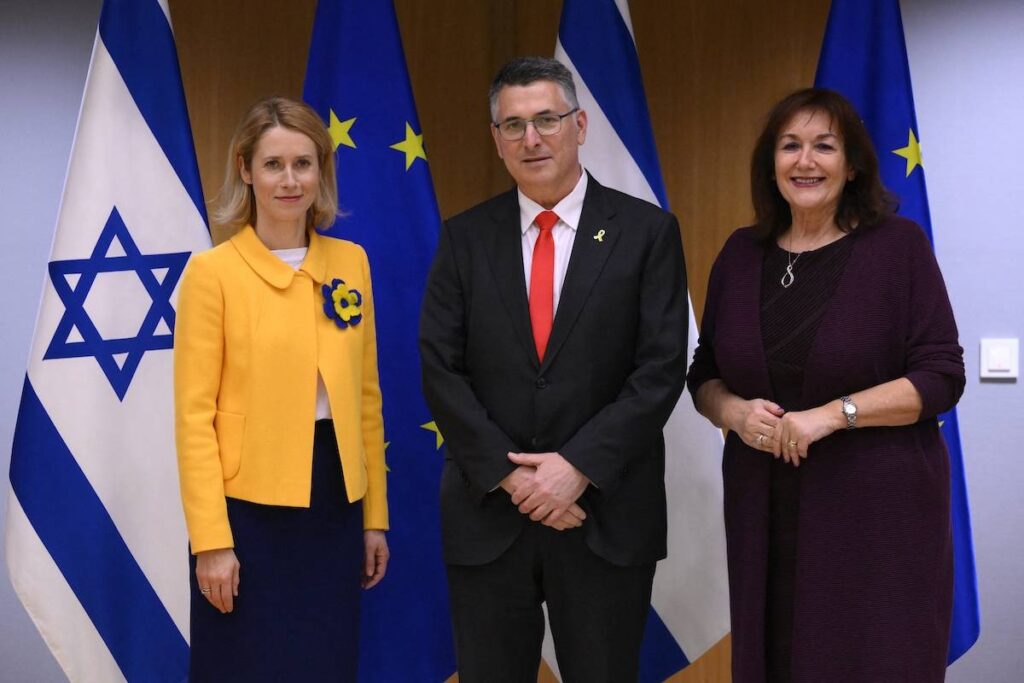
The European Union is the “chief of all cowards,” Amnesty International declared in a searing statement issued on April 21. The condemnation was a direct response to the European bloc’s systemic failure to sever ties with Israel during the Foreign Affairs Council meeting in Luxembourg.
Despite months of legal warnings, the EU once again prioritized procedural safety over the urgency of human life.
The efforts to press the EU to finally take a moral position were led by a coalition of Spain, Ireland, and Slovenia, later joined by Belgium. They argued that the EU-Israel Association Agreement—the legal framework governing their trade relationship—is predicated on the “respect for human rights.”
To maintain this agreement while the extreme violations in occupied Palestine continue is to render the EU’s own founding treaties meaningless.
Such a decision, even if belated, would have done immeasurable good. It would have restored a measure of the EU’s shattered credibility and re-enlivened the discussion on international law. More importantly, it would have initiated a series of concrete measures to hold Israel accountable and provided Palestinians with a tangible sense of hope.
None of that occurred, however, thanks to the lobbying of Germany and Italy. These nations acted as a diplomatic firewall, shielding Israel from consequences.
The German position remains consistent with Berlin’s hardline defense of Israel, a stance that has persisted even throughout the genocide in Gaza. As a country that should have been the world’s greatest advocate against mass extermination, Germany has repeatedly shielded Israel at the International Court of Justice (ICJ) and other global institutions.
During this genocide, Berlin has doubled down, insisting that the accusation has “no basis whatsoever.” This rigid stance remained unchanged even as Spain joined the South Africa case at the ICJ, signaling a profound rupture in European legal and moral consensus.
Therefore, it was no surprise that Germany’s leadership dismissed the Luxembourg proposal to suspend trade as “inappropriate.” Along with Italy, it insisted that the EU must remain in a “constructive dialogue” with Tel Aviv—a phrase that has become a euphemism for complicity.
Italy presents a more bizarre example. While Giorgia Meloni’s right-wing government remains aligned with the pro-Israel guard, the Italian people’s mobilization has been among the strongest in Europe.
The streets of Rome and Milan have seen mass protests and general strikes that rival the fervor seen in Spain. Yet, Meloni still refuses to heed her people’s call, with her ministers stating in Luxembourg that the proposal to suspend the treaty has been “shelved.”
Israeli Prime Minister Benjamin Netanyahu likely felt a great deal of relief following the vote. The Israeli economy is currently struggling under the staggering burden of continued wars, with the budget deficit ballooning as defense spending skyrockets. The EU remains Israel’s largest trading partner, with total trade in goods reaching over €42 billion.
This agreement provides a vital economic lifeline through preferential market access and high-tech integration; its suspension would trigger a devastating financial shock.
But the fact that Germany and Italy managed to sustain the treaty for now does not negate the imminent rupture already underway.
This rupture is not being led by governments, but by European societies. It would not be an exaggeration to suggest that Europe’s relationship with Israel is destined for pivotal change. The historical divide between Israel’s unconditional supporters, like Germany, and more sympathetic nations, like Ireland, is collapsing as the political pendulum swings toward Palestine.
The hardliner camp received its most significant blow recently with the political shift in Hungary. With the rise of Péter Magyar, who recently vowed that Hungary would respect ICC warrants for Netanyahu’s arrest, Israel has lost its most reliable “veto-man” in Brussels.
This leaves Germany increasingly isolated as the sole heavyweight protector of the status quo.
We are no longer talking about symbolic gestures. We are witnessing a critical mass of support for Palestine accompanied by direct action: encampments, legal challenges, and labor strikes. On April 14, it was reported that more than one million Europeans signed a formal “Justice for Palestine” petition calling on Brussels to impose sanctions.
This reflects a sustained pressure capable of shaping political agendas. Polling from this month indicates that only 17 percent of respondents in Germany now view Israel as a reliable partner. This exposes a widening gap between European publics and their governments. While Spain appears to be responding to public sentiment, Germany continues to act in defiance of it.
These same moral positions are reflected in attitudes toward other regional wars. Polling from March 2026 shows that 56 percent of Spaniards and Italians oppose US-Israeli military action in Iran. Public opinion increasingly sees these not as separate crises, but as interconnected fronts of a single, failed policy.
The rejection of war is part of a broader rejection of Israeli military policy and the alignment of European governments with it. These shifts have not only isolated Israel; they have begun to isolate its allies. Aside from Donald Trump and his full alignment with Netanyahu’s agenda, the era of a unified Western bloc catering unquestioningly to Israel’s demands is fading.
The traditional explanation for Europe’s backing—historical guilt over the Holocaust—no longer explains the conduct of political elites. A more accurate explanation lies in Europe’s own legacy of colonial violence and racial hierarchy.
However, the real shift belongs to civil society and the resilience of Palestinians who have bypassed traditional media filters to speak directly to the world.
Europe now knows that a genocide has been committed. This paradigm shift is unlikely to be reversed, regardless of whether Luxembourg’s bureaucrats manage to delay the inevitable.
[Dr. Ramzy Baroud is a journalist, author, and the editor of The Palestine Chronicle. He is the author of six books. His new book, Before the Flood: A Gaza Family Memoir Across Three Generations of Colonial Invasion, Occupation and War in Palestine was published by Seven Stories Press. His other books include Our Vision for Liberation, My Father was a Freedom Fighter, and The Last Earth. Baroud is a Non-resident Senior Research Fellow at the Center for Islam and Global Affairs (CIGA).]
❈ ❈ ❈
Exit Ramps from the U.S.: New Coalitions of the Willing
Daniel Warner
The expression “coalition of the willing” was first coined by an American political scientist in the 1970s and used by George W. Bush during the Iraq War. It was an American attempt to circumvent the United Nations to carry out peacekeeping or stabilization missions. Now that logic is being turned on its head. Coalitions of the willing are no longer imagined as supporting U.S. action, but as a hedge against U.S. uncertainty. What began as a tool of American leadership is now being reimagined. Ad hoc coalitions are forming to distance themselves from Washington rather than follow it.
The United States under Donald Trump has become an unreliable partner; trust between Washington and its traditional allies is diminishing. Amid disputes over NATO burden-sharing and allied support in the Iran crisis—a continuation of the pattern described in Barbara Tuchman’s The March of Folly: From Troy to Vietnam—Trump dismissed America’s closest ally. Decrying Britain’s lack of support in Iran, Trump declared: “We don’t need them any longer — but we will remember.” UK Prime Minister Keir Starmer called the remarks “insulting and frankly appalling.”
Distancing the U.S. from not just the United Kingdom but also from its closest military alliance, Trump declared in a March 2026 statement “We no longer ‘need,’ or desire, the NATO countries’ assistance — WE NEVER DID!”
As allied confidence in U.S. commitments weakens, and as Trump signals that the lack of trust is mutual, governments are increasingly searching for alternatives.
Europe is beginning its preparations. Given Trump’s continuing threats to leave NATO or his refusal to affirm a commitment to Article 5 of the Washington Treaty — which holds that an attack on one member is considered an attack on all — European Union countries are exploring how to defend themselves without relying on Washington. The EU has long had a common foreign and defense framework, but it has never been fully operationalized. A European army, for example, would require all 27 member states to act in unison—something that has never happened.
European leaders are now considering how to implement a rarely used article in the EU’s Treaty of Lisbon. Article 42.7 of the Lisbon Treaty obliges member states to provide military, humanitarian and financial aid to other member countries in case of attack, a form of mutual defense commitment. The Article states: “If a Member State is the victim of armed aggression on its territory, the other Member States shall have towards it an obligation of aid and assistance by all the means in their power, in accordance with Article 51 of the United Nations Charter.” Article 42.7 was only used once by France after the November 2015 terrorist attacks in Paris.
During a recent informal meeting in Cyprus, EU leaders began exploring how to implement Article 42.7, as reported in the New York Times and The Guardian. “We agreed last night that the [European] commission will prepare a blueprint on how we will respond in case a member state triggers” the provision, explained the Cypriot President Nikos Christodoulides. The closed-door meeting was described as a “confidential exercise” by an EU official.
“The treaty is very clear about the what,” said Ursula von der Leyen, the European Commission chief. “It is not clear about what happens when, and who does what.”
What was originally written as a complement to NATO could become a template for separation from the U.S. Even if Article 42.7 is never fully operationalized, the very fact that leaders are discussing it—and commissioning a follow-up paper—signals a growing uncertainty about reliance on the United States and a search for alternatives.
The shift away from the United States may not be only military. It could also be monetary. A second possibility of a coalition of the willing without the U.S. was presented recently in Geneva by a Canadian political scientist. Professor Fen Osler Hampson of Carleton University suggested: what if a coalition of middle powers decided to push back against the U.S. not militarily, but financially? “What would happen if Canada, Germany, France, the EU, Australia, South Korea, and Japan all decided to sell their dollars?” he asked. Hampson, a frequent foreign policy advisor to the Canadian government, argued that if there were true cooperation among that coalition of the willing, “the Lilliputians would tie up Gulliver,” as happened in Jonathan Swift’s Gulliver’s Travels.
Together, these countries hold about $2.0–2.2 trillion, or roughly 27–30% of all official USD reserves worldwide—enough that coordinated action, however unlikely, would not go unnoticed in Washington. As an example, Hampson proposed that threats by Danish investors to sell U.S. bonds reduced Trump’s enthusiasm to take over Greenland.
Initiating Article 42.7 or selling U.S. dollars may seem far-fetched. After all, the United States remains the world’s dominant military and economic power. But the fact that European countries and eventually advanced middle powers are looking for exit ramps to no longer rely on the U.S. militarily and financially is significant. These are not two separate shifts; they are part of a broader pattern of allied hedging by preparing to move away from relying on a benevolent Uncle Sam.
When Trump calls NATO “obsolete,” it is not just his critique of the current burden-sharing. It signals a deeper doubt about whether American leadership still functions as the organizing foundation of the Western alliance. Maybe it’s American leadership under Trump that is obsolete.
The United States is not about to be replaced as a powerful hegemon. But for the first time in decades, its allies are seeking ways to reduce their dependence on it through pragmatic exit ramps.
[Daniel Warner is the author of An Ethic of Responsibility in International Relations, published by Lynne Rienner Publishers. He lives in Geneva. Courtesy: CounterPunch, a U.S.-based independent left-wing magazine known for sharp commentary on war, imperialism, labour, environment, and civil liberties. It was co-founded by Alexander Cockburn and is currently led editorially by Jeffrey St. Clair and Joshua Frank.]