On 28 April, the Rashtriya Swayamsevak Sangh (RSS) organised “Yuva Kumbh”, an event to commemorate its 100th anniversary at Jamia Millia Islamia. During the event, the Vice-Chancellor (VC) reportedly remarked, “Our DNA has Mahadev’s DNA.” When located within the restructuring of higher education institutions under Prime Minister Narendra Modi’s government, the VC’s statement highlights a discernible pattern: universities increasingly being drawn into the monolithic Hindu-nationalism project of the right-wing regime.
Pulverisation of foundational values
Today, more than a century after its establishment, Jamia appears to be in the grip of homogenisation, institutional capture and anti-intellectualism.
Founded during the anti-colonial struggle, Jamia embodied a deeply plural, emancipatory and nation-building ethos. Its foundations were laid by those who envisioned it as a site of intellectual freedom and resistance to domination, a legacy now imperilled by forces seeking to recast it into an ideologically compliant space.
Jamia’s founders, who according to Sarojini Naidu built Jamia “stone by stone and sacrifice by sacrifice,” would have been outraged by the ongoing administrative oppression. The character of the institution, like many other universities, is changing to reward conformity, penalise dissent and steadily subordinate autonomy to the imperatives of cultural nationalism.
From dissent to discipline: A pattern of institutional restriction
The April 28 event cannot, therefore, be viewed in isolation. One must take a longer look at the political developments over the past decade to understand the rot that has set in.
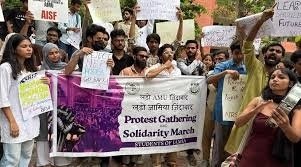
The approach adopted by the Jamia administration during the CAA-NRC protests in 2019 was particularly revealing of this changing tide. Instead of safeguarding the democratic rights of its students, it became complicit in the brutal suppression of protesters. Over time, this approach extended to almost every form of progressive or critical activity, from reading circles and student-led demonstrations to protests concerning social and political issues raised by students or faculty members.
The abrogation of the Jamia Teachers Association – which was later quashed by the Delhi High Court – suspension of protesting students, detention and filing of First Information Reports (FIR), suspension of a Social Work professor and increasing curtailment of peaceful assembly and free expression within the campus collectively substantiate a larger milieu of repression.
They also raise serious constitutional concerns regarding the erosion of freedoms guaranteed under Articles 19(1)(a) and 19(1)(b) of the constitution.
Perhaps the most alarming aspect is the increasing legitimisation of right-wing organisations within the university, enabling them, in effect, to speak on behalf of the institution itself.
Yet, despite these pressures, students of Jamia have continued to uphold the university’s historic legacy of dissent by challenging authority and resisting repression. Across universities in India, students have repeatedly stood against divisive and anti-people policies, confronting entrenched power structures even under increasingly hostile conditions.
At the same time, it is becoming evident that student movements in India are facing a serious structural setback. Institutional constraints, political pressure and administrative reprisals have together created conditions that systematically discipline dissent.
Institutional legitimisation of majoritarian politics
Celebration of events like the RSS’s centenary on campuses is problematic, as it raises critical questions about the idea of university space and philosophy, especially at Jamia. It further prompts questions about associating with an organisation whose affiliate was responsible for the assassination of Mahatma Gandhi, the very person who once mobilised support to help Jamia survive a financial crisis. Rabindranath Tagore once described Jamia as “one of the most progressive educational institutions of India.”
Public statements by the VC have further intensified concerns about the institution’s ideological direction. Every individual at the university, be it students, faculty or other members of staff, is regularly policed. Students who tried to organise study circles or demonstrations have been served with multiple show-cause notices and threats from the proctorial office.
More concerning is the involvement of the Delhi Police and Special Cell in university-related matters, used to terrorise students and anyone who dares to speak against the regime.
During 2021–22, while several fellow student leaders and I were involved in the “Campaign for Reopening of Jamia,” we encountered multiple forms of institutional surveillance and intimidation. What initially appeared as informal monitoring by faculty members gradually escalated into threatening calls from the Jamia police station and the Delhi Police Special Cell.
In retrospect, I came to realise that an individual who had approached me as a fellow student was, in fact, gathering information related to student organisations and student-led events, including reading circles on campus. He was not a student at all. According to other student activists, he seemed to be an Intelligence Bureau (IB) agent. Even after leaving Jamia, I continued to receive calls from the Delhi Police Special Cell regarding my political activities and career trajectory.
Such experiences reflect Michel Foucault’s theory of “panopticism,” where mere possibility of surveillance becomes a tool of discipline and self-regulation, altering the everyday political climate of university spaces.
Not an isolated shift
Jamia’s steady restructuring is not a singular change. Similar programmes have been organised in multiple colleges of the University of Delhi, which operates entirely under a VC who is a proud member of the Rashtriya Shikshan Mandal, an RSS-affiliate teachers’ body. He has permitted ‘Shakha’ activities inside the campus and facilitates recruitment of ideologically-aligned individuals as permanent faculty, raising serious concerns about academic standards and recruitment processes.
The same can be observed in Jawaharlal Nehru University and other universities across India. These acts enable the ideological hijacking of universities, filling the gap of RSS cadres within academia, along with advancing the neo-liberalisation of public universities. Exorbitant fee hikes, proliferation of self-funded courses and the mushrooming of private universities across the country all point towards this reality.
What is at stake
The celebration of organisations historically associated with exclusionary and divisive politics within university spaces is consequential. Jamia, once described by Rabindranath Tagore as among the most progressive in India, now stands at a crossroads.
The question is whether universities can continue to function as spaces of critical thought, dissent and inclusive nation-building. A few years ago, teachers and students were dissenting together against divisive politics. This solidarity is missing now; faculty members have increasingly refrained from speaking out, either due to constant surveillance or fear of losing their jobs.
This was evident from the suspension of JTA’s president, who had been critical of the current regime and administration. The silence of the academic community is a troubling abdication that risks undermining Jamia’s intellectual legacy.
As Jawaharlal Nehru warned in his December 1947 speech at the University of Allahabad, universities cease to serve the nation when they become “a home of narrow bigotry and petty objectives.” It is this democratic and emancipatory vision of higher education that is increasingly losing ground as right-wing forces advance across educational institutions in India. Nevertheless, students continue to uphold Jamia’s legacy of resistance through dissent and collective struggle.
[Shishu Ranjan is a Chevening Scholar who studied at Birkbeck College, University of London and Jamia Millia Islamia. He is a member of the presidium secretariat of the All India Forum for Right to Education (AIFRTE). Currently, he is working as an educational researcher. Courtesy: The Wire, an Indian nonprofit news and opinion website. It was founded in 2015 by Siddharth Varadarajan, Sidharth Bhatia and M. K. Venu.]