❈ ❈ ❈
Caspian Lifeline Redraws the Iran–Russia War Map
Aidan J. Simardone
The war pressure on Iran has always been mapped from the south. US bases ring the Persian Gulf, Israeli intelligence probes the region from Azerbaijan and beyond, and Washington’s naval power has long treated the narrow waterways around Iran as a pressure point.
But the more the US–Israel axis leans on the Gulf, the more Tehran’s strategic depth shifts northward, across a closed body of water that western planners cannot easily dominate.
The Caspian Sea now matters because it gives Iran and Russia something both states urgently need, a direct, politically controlled route outside the reach of hostile land corridors.
Overland trade must pass through states that are either aligned with Washington or unwilling to risk US secondary pressure. The Caspian, by contrast, links the two countries without a third-party gatekeeper.
Ships can still be hit by drones and missiles, but reaching them requires far deeper penetration into Iranian space and carries the danger of confrontation with Russia. In the short term, the Caspian offers Tehran a reliable supply line. Over the longer term, it could deepen Iran–Russia integration and become a central route connecting Russia to West Asia, India, and the wider world.
The legal battle over a closed sea
Is the Caspian really a sea? It’s not a trivial question. If it’s a sea, it’s subject to the UN Convention on the Law of the Sea (UNCLOS), under which territory extends 12 miles from the coastline, after which free navigation applies. If treated as a lake, the territory extends to borders mutually agreed upon by the surrounding states.
Until 1991, only two states occupied the Caspian: Iran and the USSR. In 1921, the Russo–Persian Treaty of Friendship prohibited other countries from navigating it. But when the Soviet Union fell, three new states joined the Caspian: Azerbaijan, Kazakhstan, and Turkmenistan. These former Soviet Republics disputed the 1921 treaty, insisting on negotiations that took UNCLOS into consideration.
All the former Soviet Republics, including Russia, wanted the Caspian to be treated like a sea, but because Iran’s short coastline would give it less territory, it insisted the Caspian was a lake. The potential for UNCLOS to apply would have also allowed the entry of foreign military vessels 12 miles away from Iran. This was not a hypothetical fear, given Azerbaijan’s close alliance with Israel. Were it to host the Israeli navy, Tel Aviv could open a front in Iran’s north.
The failure to come to a consensus made the Caspian’s legal status ambiguous, depriving the region of further integration. For instance, the proposed Trans-Caspian Pipeline would connect Turkmenistan with Azerbaijan, bringing oil and gas from Central Asia to Europe. But with no clarity on who owned the seabead, the project stalled.
In 2018, the five states came to a decision. The Caspian was not a lake or a sea, but a unique body of water that would be subject to the Convention on the Legal Status of the Caspian Sea, also known as The Caspian Sea Treaty.
Similar to UNCLOS, states would have 15 miles of territory from the coastline and a further 10 miles for fishing. The remaining area would be shared, and any state party to the treaty could lay submarine cables and pipelines.
But unlike UNCLOS, states not party to the treaty were prohibited from stationing their armed vessels. Iran did not secure its maximalist demand to have the Caspian classified as a lake, but the exclusion of outside militaries gave it the protection that mattered most.
Caspian cooperation
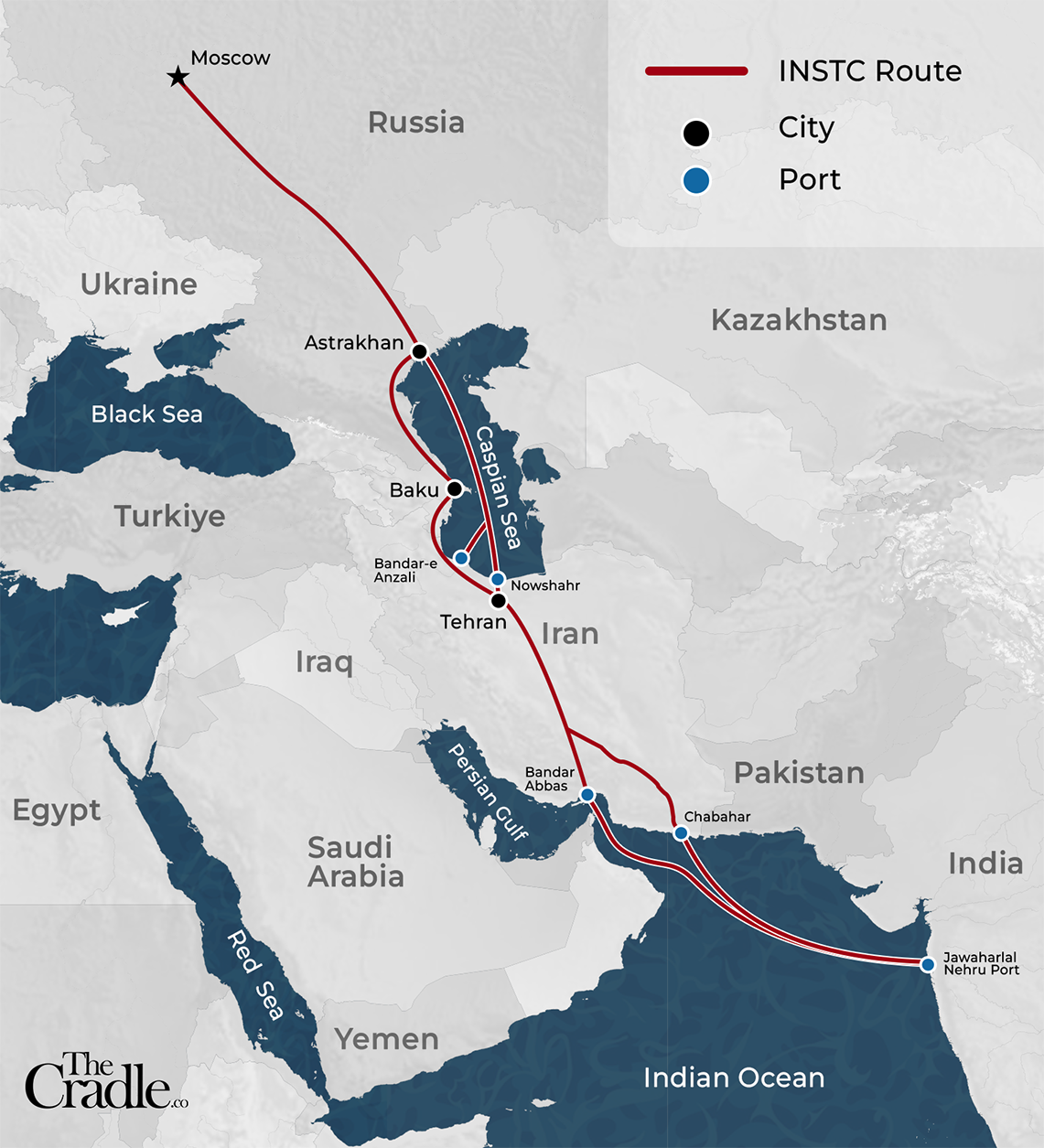
The treaty gave the littoral states a framework for cooperation, but for Iran–Russia ties, the Caspian remained underused as long as land routes were available. As cooperation over Syria deepened, Moscow proposed the International North–South Transport Corridor (INSTC) in 2013, a network of pipelines, railways, and highways linking Russia through Azerbaijan to Iran, then onward to India and the wider world.
Everything changed when Russia invaded Ukraine in 2022. While Azerbaijan did not impose its own sanctions against Russia, it did provide humanitarian aid to Ukraine and vocalized support for its territorial integrity, and claimed it was complying with secondary sanction rules.
Meanwhile, Iran–Russia cooperation accelerated. With Russia joining Iran in being sanctioned, there was no longer an incentive for Moscow to restrict trade with Tehran. Moscow also had to look for other suppliers for its military. Iran provided drones that were decisive on the battlefield.
Why rely on Azerbaijan when the Caspian was right there? Nearly 1,000 kilometers away from the Russia–Ukraine frontline, it provided a direct and covert route for weapons heading from Iran to Russia. In return, Russia supplied more goods to Iran.
In 2022, the Iranian port of Noshashr hosted its first Russian cargo ship in 21 years. That same year, Iranian and Russian shipping companies teamed up to form a new corporation that would develop the INSTC. In 2025, shipping at Iran’s port of Anzali was up 56 percent.
Map of the International North–South Transport Corridor (INSTC).
The northern route under fire
After the US-Israeli war of aggression on Iran, Washington blockaded the Persian Gulf. Land transport also became riskier, with neighboring states such as Azerbaijan, Pakistan, and Turkiye maintaining close ties with the US.
The Caspian became crucial again, this time with the flow reversed as Russia sent weapons and critical goods to Iran. A recent New York Times (NYT) piece alleges that Russia has been sending drone parts to Iran through the Caspian.
Drones proved vital for Russia in Ukraine, and they have also helped Iran strike US military installations across West Asia. Russian ships have reportedly carried basic goods, including food, to help Iranians withstand the blockade.
The US and Israel can strike ships or ports on the Caspian Sea, but the risks are significant. The Caspian sits far from Israel and US military bases near the Persian Gulf. Any attack on Iranian assets there also risks drawing Russia directly into the conflict, particularly when those ports serve as docking points and logistical nodes for Russian vessels.
That is why the publicly confirmed Israeli strike wave on Bandar Anzali in March 2026 triggered a sharper Russian response than a routine condemnation. The attack hit the largest Iranian port on the Caspian, a commercial and military hub tied into the same maritime route Russia uses to move cargo to and from Iran.
Russian Foreign Ministry spokesperson Maria Zakharova warned that the strike affected “the economic interests of Russia and other regional countries” with transport links to Iran, and said such “reckless and irresponsible actions” risked “dragging the Caspian states into the military conflict.”
The warning was repeated at a higher political level. After Russian Foreign Minister Sergei Lavrov spoke with his Iranian counterpart Abbas Araghchi, Moscow said both sides expressed concern over the “dangerous spread of the conflict provoked by Washington and Tel Aviv to the Caspian Sea area.”
Kremlin spokesperson Dmitry Peskov then said Russia would view any spillover of the Iran war into the Caspian “extremely negatively,” while declining to comment directly on reports that Israeli strikes had targeted vessels allegedly carrying Russian weapons to Iran.
Tehran also moved to turn the strike into a Caspian-wide security issue rather than a narrow bilateral matter. Araghchi warned that attacks on Bandar Anzali had “seriously endangered security and stability in the Caspian Sea,” calling on the coastal states to take a “firm and unified stance” against the destabilizing act.
The message was clear enough. Once the war reached Iran’s northern coast, it touched the interests of every littoral state that depends on the Caspian remaining outside the US-Israeli battlefield.
Ukraine has struck the Caspian three times in recent months. The timing, against the backdrop of the Iran war, is suspicious, though the targets so far have been Russian military assets. For Tehran, that means the Caspian route remains largely secure, especially when compared with the exposed southern approaches around the Persian Gulf.
Eurasian depth beyond the blockade
When the war ends, the Caspian will remain critical for both Russia and Iran. More than a decade ago, Moscow saw the INSTC as a way to reach India while bypassing Europe. Under conditions of western sanctions, war pressure, and the expansion of Atlanticist containment, that old plan has gained new weight.
If sanctions are eventually lifted and India moves further away from western dependency, the corridor could become one of the key arteries of a multipolar order. It would give Russia a route to the Indian Ocean, give Iran a central role in Eurasian trade, and weaken the US ability to isolate either state through maritime pressure or financial coercion.
Given its advantages, the Caspian took a surprisingly long time to reach its current importance. Its legal status was only clarified in 2018, and before the Ukraine war, overland routes still appeared viable. But as Moscow and Tehran tighten cooperation in a hostile international environment, the Caspian is no longer a secondary route. It is becoming one of the quiet pillars of the Eurasian answer to US hegemony.
[Aidan is an immigration lawyer & writer and has a master’s degree in Global Affairs. Courtesy: The Cradle, an online news magazine covering the geopolitics of West Asia from within the region.]
❈ ❈ ❈
Pakistan Opens Iran Trade Corridor Beyond Washington’s Control
F.M. Shakil
Only months ago, Pakistan looked cornered. After the Pahalgam attack and the killing of numerous Indian tourists, the country sat at the top of the list of states accused of promoting militancy, a charge that fed directly into a brief military conflict with India in April 2025. Global media painted Islamabad as a deserted US stooge, and few voices came forward to shield it from sweeping international censure.
Inside Pakistan, the same sense of siege ran through an economy drifting toward collapse and a political order bent under the weight of the military’s ambitions. The country’s most popular leader, Imran Khan, was languishing in jail on corruption charges, while the army openly manipulated the elections, putting Khan’s party, Pakistan Tehreek-e-Insaf, under the thumb to secure victory for its preferred political bloc.
That sense of isolation began to break almost overnight when Pakistan not only absorbed the Indian onslaught, but also inflicted heavy losses on the Indian air force by downing a significant number of fighter jets and drones.
From that moment, Pakistan’s stature rose sharply, with the US becoming all praise for Pakistani Field Marshal Asim Munir and Prime Minister Shehbaz Sharif, hinting at billions in investments for mineral exploration and cryptocurrency in Pakistan. Washington also showed significant interest in Balochistan, where China has already invested heavily in developing the deep-seaport at Gwadar.
With that shift in status, Pakistan’s strategic outlook has also begun to move. Inside the army’s inner circle, Iran is now being reconsidered as strategic depth, rather than Afghanistan, which many in the establishment now believe has never been a true strategic asset for Pakistan.
Washington embraces a former problem child
The relationship between Pakistan and the US has evolved to the point that Washington chose Pakistan as a mediator in its conflict with Iran. This development comes despite open dissent in US media and among lawmakers, who have raised concerns about Islamabad’s role.
Prominent legislators, including US Senator Lindsey Graham, have questioned Pakistan’s neutrality and urged Washington to reassess Islamabad’s position as mediator. Graham also called on the US State Department to warn Islamabad over trade with Tehran.
The Wall Street Journal (WSJ) took a similar line in its 21 May issue, questioning Pakistan’s mediation role and arguing that the nuclear-armed Islamic Republic is not a “reliable interlocutor” for such high-stakes negotiations.
US President Donald Trump, however, brushed aside these objections and continued to applaud Pakistan’s efforts toward a peaceful settlement, praising Munir and Sharif. Munir has become Trump’s blue-eyed general, shuttling frequently between Islamabad and Washington for closed-door meetings with the president.
Washington’s sudden closeness to Islamabad, despite its long distrust during and after the Afghan war, has baffled many observers. They have struggled to identify the force behind this growing synergy. Trump’s embrace of Pakistan’s military and civilian leadership has become so intense that he repeatedly snubbed his longtime ally, India, by counting the Indian jets Pakistan managed to hit during the war.
Trade routes through the pressure point
Washington has become so lenient toward Pakistan that, even while acting as mediator, Islamabad allowed Iran to move cargo through six overland routes to keep foreign trade flowing despite the closure of the Strait of Hormuz.
Although the move could have triggered US anger, business has continued as usual, and Pakistan has received neither a threat nor a warning from the Pentagon. The question, then, is why Washington is allowing Islamabad to extend trade facilitation to Tehran without visible pressure.
Aimen Jamil, a journalist and researcher covering West Asian affairs and Pakistan’s foreign policy, tells The Cradle:
“Pakistan’s decision to facilitate limited transit trade for Iran is less about joining an anti-US bloc and more about managing difficult regional realities in a very tense environment. The ongoing Iran crisis and disruption in the Strait of Hormuz have directly affected Pakistan’s economy, trade flows, and energy security. Pakistan depends heavily on Gulf trade routes, so instability in the region immediately creates pressure on imports, shipping, and the domestic industry. By opening overland transit channels, Islamabad is trying to ease commercial disruptions, generate some economic activity, and position itself as a regional connectivity state.”
For Jamil, geography is also decisive because Pakistan shares a long border with Iran and cannot afford serious instability on its western frontier while dealing with economic stress and internal security concerns. Maintaining workable relations with Tehran is therefore a practical necessity.
“Pakistan doesn’t want a confrontation with Washington and values its relationship with the US for economic, diplomatic, and security reasons. What we are seeing is more of a balancing strategy: maintaining close ties with China; improving regional connectivity with Iran and Central Asia; and exploring opportunities linked to Gwadar and the INSTC [International North–South Transport Corridor], while also keeping communication and cooperation open with the United States,” she explains.
She adds that Pakistani policymakers believe Islamabad’s current mediator role between Tehran and Washington gives the country diplomatic space. Because Islamabad is among the few capitals able to maintain communication with both sides despite deep mistrust, the US appears willing to tolerate limited Pakistani facilitation for Iran, provided it does not seriously undermine sanctions enforcement or broader US objectives.
Speaking to The Cradle, Sajjad Azhar, an Islamabad-based analyst, says:
“Trade corridors between Iran and Pakistan have always remained open. Transactions in bilateral currencies already take place, and this specific kind of trade arrangement has an element of humanity, also because Pakistan allowed the transit of food and essential goods at a time when the Strait of Hormuz was closed. I believe this step was most likely taken after taking the United States into confidence.”
Iran returns as strategic depth
Major Amir, a Pakistani analyst, Afghan affairs specialist, and former key member of the premier spy agency Inter-Services Intelligence (ISI), tells The Cradle that Iran has always been a cornerstone of Pakistan’s foreign policy.
In the 1960s, Pakistan signed the Regional Cooperation for Development (RCD) with Iran and Turkiye, and during the 1965 war with India, Iran served as strategic depth for Pakistan.
He recalls that, in 1987, the US planned to overthrow the Iranian government and sent an operative to Pakistan to create a spy network for that purpose. However, former Pakistani president Muhammad Zia ul-Haq ordered officials not to collaborate with the US spy, who returned without achieving his goal.
“The late Iranian supreme leader Ayatollah Ali Khamenei knew about this episode; hence, he had special regard for Zia Ul Haq and Pakistan,” he adds.
Amir, known for his role in “Operation Midnight Jackal” to oust slain Pakistani prime minister Benazir Bhutto in 1989, says Pakistan has never considered Afghanistan a strategic asset. The belief that Afghanistan was ever part of Pakistan’s strategic depth is, in his view, a misconception.
India, he argues, has always used Afghanistan against Pakistan, while Afghanistan has shown open hostility toward Pakistan. Iran, by contrast, has remained a loyal friend of Pakistan aside from a few minor incidents. As Amir argues:
“Since 1948, Afghanistan has been demonstrating animosity toward Pakistan. In 1948, they gave refuge to Prince Abdul Karim in conjunction with India and the erstwhile Soviet Union. Prince Karim went to Afghanistan with a militant force to fight Pakistan’s annexation of the Kalat division in Balochistan. In the 60s, Sher Bukhsh Muri revolted and sought refuge in Afghanistan with Indian help. Afghanistan provided training camps and sanctuaries to Pushtoon and Baloch militants in the 70s and Al-Zulfiqar in the 80s. Now they are harboring Tehreek-e-Taliban, Pakistan (TTP) with Indian support.”
Gwadar looks north
Pakistan took another step last week that points to a shift in Islamabad’s policy toward multipolarism and Eurasian integration, despite the risk of displeasing Washington.
Special Assistant to the Prime Minister (SAPM) Talha Burki disclosed that Pakistan was keen to become part of Russian President Vladimir Putin’s vision by linking the INSTC with Gwadar Port. Federal Minister Rana Mubashir Iqbal and Talha Burki were addressing the inaugural session of “Russia–Islamic World: KazanForum” in Kazan, Russia, on 13 May.
“Pakistan is not formally establishing a new group with Iran, Russia, and China, but it is deepening strategic ties with all three, particularly through economic and security cooperation,” Azhar says.
He also says this alignment reflects Pakistan’s desire to diversify its foreign policy under regional instability and US pressure:
“The US refrains from strong pressure due to Pakistan’s strategic value in regional stability, counterterrorism efforts, and its role in facilitating dialogue – especially between Iran and other nations. Additionally, Pakistan’s balancing act helps manage tensions in South Asia and the Middle East [West Asia] without escalating conflicts.”
Amir says Pakistan has military and economic collaboration with China, and Washington knows this well. He also says that the US has no concerns about transit facilities to Iran or the extension of the INSTC to Gwadar because Washington competes with China, not Iran or Russia. “Pakistan employs sometimes covert and sometimes overt diplomacy depending on the situation, which also benefits the US,” he stated.
[F.M. Shakil is a Pakistani writer covering political, environmental, and economic issues, and is a regular contributor at Akhbar Al-Aan in Dubai and Asia Times in Hong Kong. He writes extensively about China-Pakistan strategic relations, particularly Beijing’s trillion-dollar Belt and Road Initiative (BRI). Courtesy: The Cradle, an online news magazine covering the geopolitics of West Asia from within the region.]