Does the result of Nepal’s general election announced on March 12 mark the beginning of the end for its communists?
Until the Gen Z revolution in September, the Communist Party of Nepal-Unified Marxist Leninist and Communist Party of Nepal had 120 seats in the 275-member house. The CPN-UML ruled in a coalition with the centre-right Nepali Congress. Communist parties have been in almost all the governments for the past two decades, functioning as steady stakeholders in state power.
But in the election held on March 5, the communists won only 42 seats.
Even the Nepali Congress has been ideologically supplanted by another liberal party, the Rastriya Swatantra Party. It won 182 seats, just short of a two-thirds majority. Its 36-year-old leader Balen Shah is set to become the prime minister.
The communists face a huge ideological crisis. They simply do not have a platform to rally citizens around.
Their failures contributed to the emergence of Balendra Shah, popularly known as Balen, a rapper and structural engineer in his 30s, who is now on the way to become the prime minister of Nepal. To Nepali voters, Balen stood out because he is much younger than the septuagenarian politicians of the old parties. He is also not implicated in any corruption scandals.
During his three years as mayor of Kathmandu, he ruthlessly swept away street vendors. He also tried to bulldoze makeshift houses built by squatters on the bank of Bagmati river. Despite this, he came to be hailed as a representative of Nepal’s youth, someone who was eager to do the job, unlike the old and failing political class.
Balen now leads the four-year-old Rastriya Swatantra Party, which came as a reaction to the old parties. The Rastriya Swatantra Party, like Balen, does not reflect ideological renewal, but instead has filled the vacuum created by the Left’s retreat from discussions about class, labour rights and redistribution.
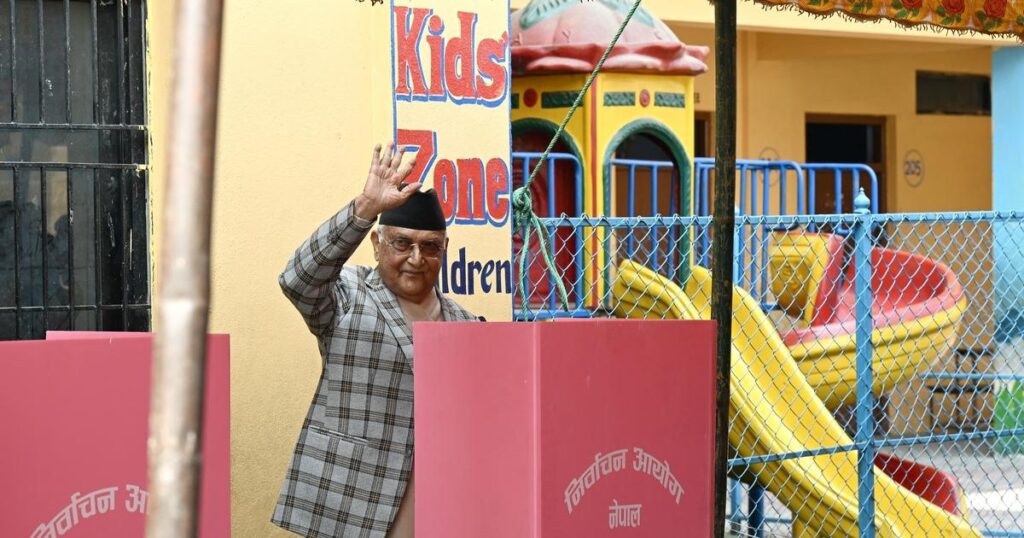
KP Sharma Oli, the chairperson of the Communist Party of Nepal-Unified Marxist Leninist (UML), who was the country’s prime minister until September 9 last year, faced a surge of protest when he banned social media firms in Nepal for failing to register and comply with regulations.
Thousands of students, some in their school uniforms, flooded the streets. On September 8, the government shot 19 people in Kathmandu who had participated in the largely peaceful protest. The next day, a crowd burnt down the parliament building.
This was an expression of pent-up anger about the governance of communists and Nepali Congress.
Oli has been linked to a land scam in his hometown of Jhapa. Former prime ministers from communist parties, Madhav Kumar Nepal and Dr. Baburam Bhattarai, were both involved in cabinet decisions to illegally privatise a portion of the public land in the heart of Kathmandu that houses the official prime ministerial residence, Lalita Niwas.
Two years before the Gen Z movement, when Communist Party of Nepal (Maoist Center) chairperson Pushpa Kamal Dahal was prime minister, his family had hosted a party with several thousand guests in one of Kathmandu’s most expensive resorts to celebrate his grand-daughter’s wedding.
He had gained a reputation for living in an expensive mansion and riding around the streets of Kathmandu in sleek cars.
Top Maoist leader Krishna Bahadur Mahara, a close associate of Dahal’s, had been arrested in a gold smuggling case. He had also been accused by a female civil servant of sexual assaults but was cleared of the charges.
Meanwhile, the per capita income of Nepal is only $1,456 (Indian Rs 134,289), compared to $2,694 (Rs 248,489) in neighbouring India. Twenty percent of Nepalis still live under the official poverty line, which is about $520 per year.
The country’s only international airport is usually packed with migrant workers leaving the country. Remittance income makes up about one-fourth of the national income.
In recent years, roads are being blacktopped and that is sold by politicians as development, but employment, education and health services are still sketchy. The steep hierarchies based on caste, gender and ethnicity remain locked despite communists having played a key role in the country’s governments for the past two decades.
Nepal’s communist parties have not just lost seats in parliament but also the spirit of social and economic justice. The Communist Party of Nepal was formed in Calcutta in 1949. In the 1960s, its leaders and cadres came to be inspired by the Naxalite movement in India. From then, they organised against Nepal’s absolute monarchy. They had the leadership role in every major political upheaval in Nepal.
In 2008, they helped establish a republic with a federal structure, decentralising power from Kathmandu in the constitution that was promulgated in 2015. They fought against caste hierarchies and spoke for workers and peasants. However, in September, the communists were the target of the Gen Z movement because they had abandoned their agenda for social justice.
For now, no one is shedding any tears for them on the streets of Nepal.
[Shreya Paudel is a PhD student in Global Studies at the University of California, Irvine, focusing on migration, labour and political economy. Courtesy: Scroll.in, an Indian digital news publication, whose English edition is edited by Naresh Fernandes.]