❈ ❈ ❈
Zohran Mamdani Triumphs Over the Democratic Establishment in New York
Yorgos Mitralias
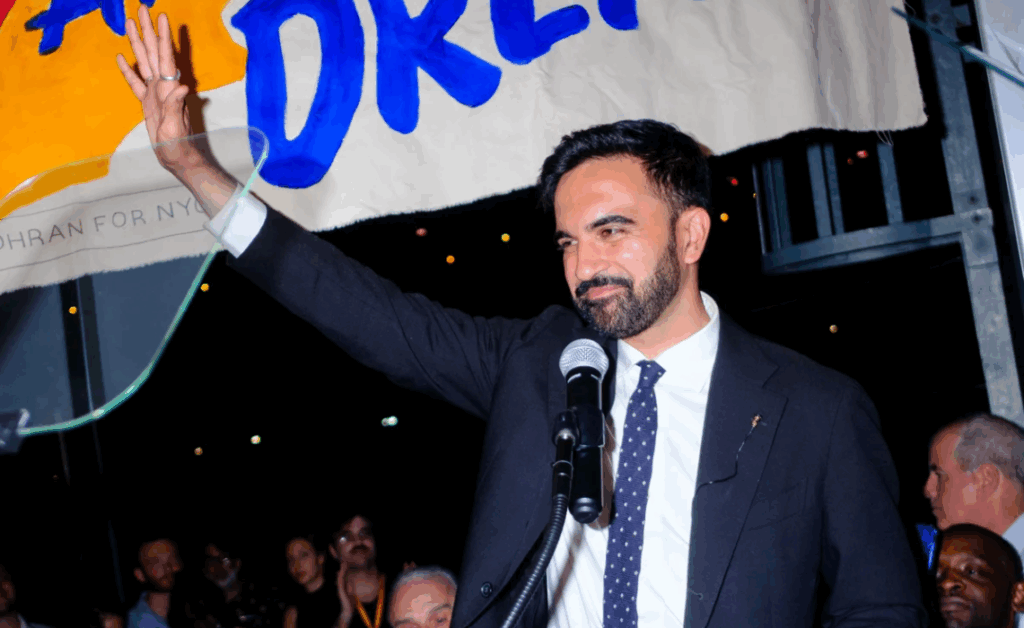
The American media, big and small, left and right, are unanimous in noting the historic importance of the victory of Zohran Mamdani, the 33-year-old Muslim Democratic Socialist of Indian origin, who fights for workers, migrants, the poor, the excluded and the Palestinians, and who only became an American in 2018 after living in Uganda and South Africa. And they are also unanimous in seeing him as the next mayor of New York, given his clear victory over the Democratic establishment heavyweight, ex-mayor and ex-governor of New York Andrew Cuomo. And to think that Zohran Mamdani, unknown to the general public, won with 43.5% of the vote in an election marked by a historic turnout, even though the polls last February gave him just… 1% of the preferences of New York Democrats!
So how could such a miracle have happened, especially as Mamdani was up against the Democratic Establishment supported by North American big business and, under the radar, even by Trumpism? The answer is well known and has already been widely discussed and analysed in the United States: Mamdani’s ‘surreal’ victory was achieved thanks to the 50,000 volunteers (!) who worked hard for his candidacy for months, mobilizing the poor and excluded in New York’s underprivileged neighborhoods, who traditionally abstain or even vote for Trump. The lesson of this historic victory for those at the bottom, as headlined by The Nation, is eloquent: ‘A Democratic dynasty was shattered. Bill Clinton and Jim Clyburn could not save Cuomo. Michael Bloomberg’s millions could not save Cuomo. An endless barrage of furious advertising on the television and radio for weeks on end could not save Cuomo. The New York Times editorial board could not save Cuomo. One city died last night, and another was born.’ [1].
However, even 50,000 volunteers would not be enough to produce such a ‘miracle’ if they did not have a radical program to defend, capable of speaking to the hearts but also to the minds of those on the ground. So, to better understand what Zohran Mamdani’s campaign was like, let’s give the floor to one of these volunteers, the socialist, fighting trade unionist and New York underground train driver John Ferretti, interviewed by John Reimann before Mamdani’s victory: ‘I’m campaigning for him because his victory would be a stake through the heart of the business, the corrupt business associated Democratic Party leadership in New York City, in New York state, it would be a reordering of political priorities in favor of centering the working class and its needs and fighting for free childcare, Fighting for free busses that are fast and safe, fighting for a city where you have city run grocery stores that actually lower the price of groceries. And I think that Mamdani does the most effective job that I have ever seen of any mainstream political candidate running for office of of explaining socialism concretely in terms of people’s lived experiences ’. Because ‘He proposed some of the measures he went on to fight for: a minimum wage of $30 an hour, free childcare, free buses, etc., and a Department of Public Safety that did not criminalise the homeless or those with mental health problems’. [2]
And Ferretti goes on to explain that Mamdani ‘is launching a campaign that’s very heavy on policy, very heavy on advanced ideas that working class people often don’t get to discuss and think about but he does so in a concrete, relatable way that workers can understand. So like when he goes to rallies, he can start his slogans and people finish the slogans. You know, we’re going to freeze the rent, we’re going to provide free childcare, like people understand through the slogans in a concrete way, how this connects to their life and their interests” (…) “with a movement behind him, like the one we’re seeing in the streets right now, and also with every provocation from the Trump regime, it adds fuel and fire to the mass movement that we’re just seeing start to erupt, and I think it has a base with much more class consciousness than, for example, previous generations of struggle, like, even George Floyd’s movement.”’
But John Ferretti goes further, tackling the thorniest political issue that has always plagued the American left, that of the third major party, the American Workers Party. So, he says, ‘I think that Mamdani would probably be in favor of a Labor Party. I mean, Mamdani is openly hostile and rejects the Democratic Party and the role that it’s played in abandoning workers over many, many decades. Um, he is not a Democrat. He is a Democratic socialist. He is. He does not he never introduces himself as a Democrat. He always introduces himself as a Democratic socialist, and he has basically said that Cuomo was funded by the same billionaires that put Donald Trump back in power!’
The 130 days leading up to the November elections for mayor of New York will see everything ultra-rich, reactionary, racist, obscurantist and establishment (both Democrat and Republican) in the US mobilized to the hilt, together with the panicked Zionist lobby, to prevent ‘catastrophe’ by blocking Zohran Mamdani’s path. Jacobin has already informed us that one of the pillars of Trumpism, ‘Billionaire Bill Ackman and his rich friends want someone, anyone, to bring down Zohran Mamdani” [3], promising to invest hundreds of millions of dollars. But, barring Mamdani’s assassination (the FBI is already investigating the threats to his life), no one and nothing seems able to stop this great young speaker with breathtaking charisma, an expert on Africa and a former composer of rap and hip-hop music, who speaks to New Yorkers of Asian origin in Hindi and Urdu, and has no qualms about going on hunger strikes lasting several days with striking New York taxi drivers, or leading demonstrations in support of the martyred Palestinians in Gaza. Already actively supported by the third candidate in the primaries (11.5% of the vote) and above all by a huge and growing grassroots movement, Mamdani will no doubt be supported even by the trade union bureaucracies that preferred… Cuomo, but which are now feeling the asphyxiating pressure of their workers’ base.
It’s no coincidence that no one in the United States is hiding the fact that the person who should be most afraid of what’s happening in New York is Trump himself, a Trump who was quick to declare that Zohran Mamdani… ‘is a 100% communist lunatic’! Because what is certain is that the impact of the victory of the Mamdani “phenomenon” goes far beyond New York and even the United States. As Daniel Falcone so aptly put it on Counterpunch, ‘Mamdani’s bid for New York City mayor exemplified how international solidarity, racial identity, and transnational justice can energize a municipal campaign in direct confrontation with Cuomo’s establishment-backed approach. Operating simultaneously at the city, state, national and global levels of analysis, Mamdani’s insurgency showed how local governance has become an important place for world politics.’. [4] In fact, was it not Zohran Mamdani who made the slogan ‘Globalize Intifada’ both the emblem of his campaign and the battle cry of his political and social struggle?
Footnotes
[1] With Zohran Mamdani’s Surreal and Historic Victory, One City Died—and Another Was Born: https://www.thenation.com/article/politics/mamdani-victory-cuomo-socialist-governance/
[2] John Ferretti interview – “Zohran Mamdani – part of workers movement against fascism & fascist collaborators”: https://oaklandsocialist.com/2025/06/20/video-john-ferretti-interview-zohran-mamdani-part-of-workers-moment-against-fascism-and-fascist-collaborators/
[3] A Billionaire Trump Backer Is Desperate to Stop Zohran Mamdani: https://jacobin.com/2025/06/ackman-mamdani-trump-campaign-finance
[4] All Politics Is Global: The Meaning of Zohran Mamdani’s Insurgent Victory: https://www.counterpunch.org/2025/06/25/all-politics-is-global-the-meaning-of-zohran-mamdanis-insurgent-victory/
[Yorgos Mitralias is a journalist and one of the founders and leaders of the Greek Committee Against the Debt, a member of the international CADTM network. Courtesy: The Committee for the Abolition of Illegitimate Debt (CADTM) is an international network of activists founded on 15 March 1990 in Belgium that campaigns for the cancellation of debts in developing countries and for “the creation of a world respectful of people’s fundamental rights, needs and liberties”.]
❈ ❈ ❈
Zoran Mamdani’s Win : Can it Catalyse a New Wave of Struggles?
Sankha Subhra Biswas
With the relentless advance of right-wing ideologies, driven by Donald Trump’s political resurgence, the nation is increasingly shaped by reactionary forces, while mainstream Democrats provide only weak opposition. In this context, Mamdani’s victory represents a significant achievement for the American left. He was well-qualified to represent the aspirations of the American working class at a time marked by rising inequality, housing crises, police brutality, and environmental disasters.
The road to city hall: a campaign of struggle, not show
Mamdani, the Ugandan-American son of the distinguished scholar Mahmood Mamdani and acclaimed documentary filmmaker Mira Nair, gained recognition as a member of the Democratic Socialists of America (DSA) and as a State Assembly member representing Queens. Faced with a hostile right-wing campaign and uninspiring opposition from Democratic challengers, Mamdani transcended identity and celebrity politics to champion working-class issues such as affordable housing, public transportation, and essential public services.
While his Democratic and Republican contenders concentrated their campaigns on issues such as economic growth, startup accelerators, and private security, Mamdani directed his attention to the needs of tenants, transit workers, food delivery drivers, and the unemployed. His vision for this election was that the working class, rather than landlords and billionaires, should own each city.
His campaign largely revolved around:
1. Affordable housing and immediate rent freeze – Over the past few months, the number of homeless individuals in New York City has reached a record high. This serious issue has been inadequately addressed by the current mayor, Eric Adams, who infamously stated, “I am real estate.” Adams, who is currently facing several indictments on corruption and bribery charges, appears to be aligned with the interests of landlords. Additionally, Andrew Cuomo, a prominent contender known for opposing tenant protection bills and supported by landlord groups, struggled to secure backing from working-class voters. In contrast, Zohran Mamdani ran a campaign centred around affordable housing and advocated an immediate rent freeze. Throughout his campaign, he consistently championed tenant rights, proposing the construction of 200,000 affordable housing units and a rent freeze to stabilise the city’s untenable situation.
Exit polls indicated that the predominant concern in this New York City election was the escalating cost of rental accommodations. The rationale presented by the real estate sector, asserting that rent hikes are necessary to maintain stable property values, experienced significant unpopularity. Individuals from various working-class backgrounds across the boroughs expressed a keen interest in Mamdani’s proposals.
However, it was very difficult to achieve this victory. Landlord-backed organisations were paying large amounts to sponsor Andrew Cuomo. According to housing rights activists, “The real estate lobby is spending big to make possible the election of the scandal-felled former governor. In the final weeks of the campaign, the New York Apartment Association contributed over $2.5 million to a Super PAC supporting Cuomo.” They also note, “Other high-profile real estate givers include Douglas Durst of the Durst Organisation, whose family controls an $8 billion fortune, and Douglas Eisenberg of A&E Real Estate, who is being sued by the city for several outstanding code violations.” Former Mayor Michael Bloomberg, who raised rents on rent-stabilised apartments by 33% during his time in office, recently gave $8.3 million to Cuomo’s campaign. Despite the landlord-injected funds, labour unions and socialist movements were able to channel their energy positively. Mamdani’s campaign was a strong symbol in the fight against well-established real estate capital power. He should be praised for his strong opposition to landlord-sponsored politics that harmed people.
2. Sustainable and environment friendly transportation program – At a rally with Senator Jeremy Sanders, Zohran Mamdani echoed the voice of thousands of people: “The government must deliver an agenda of abundance that puts the 99 per cent over the 1 per cent.” With temperatures in the US rising—forecasts say they will reach over 100°F and the heat index will reach 110°F—air conditioning has become a must. But the Mayor’s Office in New York City says that more than 30% of residents can’t pay their utility bills. This crisis is worsening due to the earlier start of NYC’s spring allergy season this year and rising costs, which are making it difficult for many people to afford basic living expenses.
Mamdani said that capitalist greed was to blame for the damage to the environment and that big investments in public transportation could help reduce carbon emissions. He suggested replacing bus fares with taxes to ensure that everyone could afford to use them. This idea upset his political opponents. However, the results clearly demonstrated that people are willing to ride if they can afford it, as evidenced by a 14% increase in ridership and a 30-38% increase in total rides.
Free and cheap public transport is vital for society and the environment. As rents rose, working-class people had to move to the outskirts, making access to public transportation even more important. Many who live in the outer boroughs are Afro-Americans and Hispanics, and they all supported Mamdani’s transit plan. It is thought that a large part of his support came from these under-represented groups.
3. Universal childcare and healthcare for everyone – Covid-19 exposed the extent of the dysfunction within America’s health care system, with New York City being particularly affected. Over 55,000 lives were lost, and the reliance on private insurance models failed to safeguard the most vulnerable members of society.
Mamdani advocated for a system of publicly subsidised healthcare, funded by increased taxes on more affluent citizens. This approach would reduce individuals’ dependence on private health insurance companies. He also proposed the introduction of a universal childcare plan to support working parents, which would include free pre-kindergarten care. This initiative would enable young parents to return to work, assured of their children’s well-being.
These compelling demands were grounded in the genuine experiences of everyday individuals. The election results indicated that the electorate was prepared for extensive reforms and had grown weary of neoliberal compromises.
4. Humanitarian solution to the Israel–Palestine issue – With the recent Israeli attacks on Palestine, which many have described as “live-streamed genocide” and were supported by the United States, massive protests erupted across the country. Protesters faced hostility from successive administrations, particularly under Trump, and a new wave of Islamophobia was unleashed throughout the United States. The media attempted to downplay the significance of the protests by labelling them as mere symptoms of “woke culture,” yet millions took to the streets to advocate for Palestinian justice. Solidarity with Palestine undoubtedly represented an anti-establishment mobilisation across the nation.
Mamdani emerged as a defender of those subjected to unfair treatment. He contended that the call for a ceasefire represents a principled stance rather than an extremist position, reflecting the interests of the working class. In response to slogans like “Globalise the Intifada,” he highlighted the need for tangible actions to safeguard human rights and dignity. His principled stance garnered strong support from Arab, Muslim, and anti-war voters throughout the city.
Given that there are around one million Jewish residents in New York City’s five boroughs, it’s not surprising that antisemitism was a major factor in the recent Democratic primary for mayor. There is zero proof that Mamdani has ever held antisemitic beliefs but the pro-Israel establishment is understandably terrified by his mayoral bid in New York City. The essential issue, though, is not antisemitism. The Democratic Party’s dwindling support for Israel is being twisted into an antisemitic narrative on purpose.
Busting the myth: grassroots organising instead of conventional campaigning
There are several factors that contributed to Zohran Mamdani’s victory; however, the most significant one is his demonstration that social media manipulation, advertising, and catchy slogans are not sufficient to secure electoral success. His march towards City Hall is fundamentally driven by genuine grassroots mobilisation.
The significance of Mamdani’s victory cannot be overstated. It offers hope to the working class and suggests that grassroots movements can overcome fear, economic power, and media influence. The following analysis will explore the broader political implications of this historic triumph.
Capitalist regime confronts working-class rage
Donald Trump’s surprise return to national politics was a leading factor in establishing the political tone in 2025. Mainstream media framed the issue as presenting only two options: Trumpian authoritarianism and the centrist Democratic Party establishment position with Wall Street. That false choice was echoed in the New York City mayoral election, where candidates framed their campaigns as struggles to “protect our city’s economic climate and freedoms.”
What they actually meant was that landlords can evict people, the NYPD can be brutal, and developers can gentrify neighbourhoods.
Here, Mamdani’s message was radical and true. He would not allow politics to be only about moral outrage regarding Trump. Rather, he declared that the far right expanded because centrist neoliberals did nothing to address the pain of working-class individuals.
While the rich reaped historic returns on the stock market and a seemingly recovering economy, Mamdani uncovered the realities behind the numbers: mass evictions, insecure labour, and exploitation in the gig economy. His triumph proves that liberal courtesy is no longer enough to conceal the built-in flaws of capitalism.
Victory of the issue, not an individual
If Zohran Mamdani’s victory is viewed merely as a triumph of a charismatic candidate, the true nature of this political moment may be overlooked. This campaign was not a top-down, race-based electoral effort; rather, it was a grassroots mobilisation that included NYC DSA, tenant unions, labour councils, and immigrant mutual aid networks.
From Brooklyn to the Bronx, organisers engaged in deep canvassing, connecting with individuals one-on-one and educating them about politics. Many who had not previously voted became first-time voters. It was not marketing that secured this success; it was militancy.
Mamdani has consistently emphasised that elections are not the ultimate goal. “Our aim is higher than just to win an election; we wish to build the capacity to shift the recipients of this city,” he has stated in various speeches. He pledged to govern in coalition with movements, rather than above them.
[This article is an extract. Sankha Subhra Biswas is a member of CADTM India and he is also an editorial board member of Alternative Viewpoint. Courtesy: The Committee for the Abolition of Illegitimate Debt (CADTM) is an international network of activists founded on 15 March 1990 in Belgium that campaigns for the cancellation of debts in developing countries and for “the creation of a world respectful of people’s fundamental rights, needs and liberties”.]
❈ ❈ ❈
Gilded City
Alexander Zevin
New York City politics can seem intensely local. Yet occasionally something happens here that transfixes the world. In 1886, the insurgent mayoral campaign of Henry George seemed to shake the foundations of power in the city, defeating the Republicans and coming close to beating the powerful Democratic machine. That George did so at the head of the recently created United Labor Party inspired Friedrich Engels to salute the creativity of the American masses – who on this ‘epoch-making day’ had contested the election as an independent political force. It seemed clear that the great commercial and industrial capitalists of the city had only prevailed through bribes, ballot stuffing and other forms of brazen cheating. Notwithstanding his reservations about George’s ‘confused’ and ‘deficient’ programme built around a ‘single-tax’, Engels was thus quite hopeful: ‘Where the bourgeoisie wages the struggle by such methods, the struggle comes to a decision rapidly, and if we in Europe do not hurry up the Americans will soon outdistance us.’
Zohran Mamdani’s campaign for mayor represents the most concerted outsider challenge to the ruling order of the city since that time – an indication both of how venerable the quest for a socialist alternative to the party duopoly here has been ever since the relocation of the First International to New York in 1872, and of how rare the moments when it has achieved any kind of mainstream breakthrough. Unlike George, Mamdani made use of the existing party apparatus. Like many DSA cadres, he relied on the Working Families Party, founded in 1998 by disillusioned Democratic operatives and labour and nonprofit organizers, to launch a run in the Democratic primary. But the potential threat he represents is reminiscent of his Gilded Age predecessor, as is his tactical focus on the cost of living. With the field polarized around the issue of affordability, candidates running as credentialled progressives never gained traction, and the contest became a straight match-up between the left of the party and its right – taking the WFP itself by surprise, since its initial ambitions were merely for Mamdani to nudge their more seasoned and typical choice in comptroller Brad Lander to the left.
George entered the mayoral race as the star author of Progress and Poverty (1879), a radical tract which argued that the first went hand in hand with the second due to the monopolization of land, whose owners reaped most of the rewards of progress in the form of rising land values. Bearing a similar message about inequality in a city of even more obscene wealth disparities, Mamdani is perhaps just as far from the typical mayoral candidate. Born in Uganda in 1991 to Indian parents, he moved with them to the Upper West Side at age seven, when his father was hired to teach postcolonial studies in Anthropology at Columbia. His mother is the filmmaker Mira Nair. Cut from this haut-diasporic intellectual cloth, he founded a Students for Justice in Palestine chapter at Bowdoin in Maine before returning to the city to work as a housing councillor. Joining the DSA in 2017, he worked on several election campaigns, running for State Assembly himself in Astoria in 2020. He used his time in office to strengthen the activism and organizing of the local branches – going on hunger strike in a bid to get debt relief for cabbies in 2021 – while pushing legislation on renewables, ‘good-cause’ eviction and public transport.
Five years ago, the primary process worked more or less as intended. Low turnout and a fragmented centre left empowered the local bosses and fixers, who were able to deliver support to one of their own on the right: Brooklyn borough president, police officer and monstre sacré Eric Adams. This time, deploying a volunteer army of around 50,000, Mamdani marshalled a fund-raising, door-knocking and get-out-the-vote operation more akin to the presidential campaigns of Bernie Sanders than a municipal primary, which he in effect overwhelmed. Carried throughout by a slick social media campaign, the candidate was shown hurling himself with good-natured grace across the five boroughs – walking, taking public transit, or in a yellow cab. Before election day, Mamdani traversed Manhattan on foot – an echo of the George campaign’s ‘monster parade’, in which 30,000 workers marched a few days before the polls opened.
Andrew Cuomo, meanwhile, entered the race enshrouded in a cloak of grim inevitability. Dubbed a ‘comeback’ by the press, there was more than a whiff of ‘fallback’ about his seeking an office he had persistently sought to diminish in his eleven years as governor. His spats with the then-mayor Bill de Blasio, presented as a personal feud, in fact turned on control of city resources, which Cuomo tried to rein in via deals in the State Senate. This had real consequences for city services, in cuts to Medicaid, public schools, funding for the MTA and the rollout of universal pre-K. His disdain for the sordid realities of the metropolis he had presided over from a safe distance in Albany came through in his appearances: tight-lipped at temples, churches, union and VFW halls, with no questions from the press.
Cuomo not only embodies a kind of holy trinity of the Democratic elite: scion of a political dynasty as the son of the former governor Mario, he married tumultuously into another via his first wife Kerry Kennedy before being made protégé of a third as the youngest member of the cabinet of Bill Clinton. He also symbolizes the cynicism and rot of the party managers and funders. By one count, almost half of the officials endorsing him had called for his head four years ago over sexual harassment allegations and a cover-up of nursing home deaths during COVID (the supposed deft handling of which earned him a $5 million advance for a book his staffers wrote). This gargoyle with feet of clay was the clear choice of Wall Street: Bloomberg, Ackman, Griffin, Loeb and a dozen other billionaires, according to Forbes, channelled $25 million into his PACs alone.
It took political will to escape the inevitable, and a real campaign to expose the strangely ersatz one helmed by the former governor. Here, for all of his reassuring politeness, Mamdani showed mettle by pointedly attacking his rival’s record; a parallel effort, to which other candidates signed on, simply instructed New Yorkers not to rank Cuomo. Mamdani also registered a more significant if provisional achievement. So far, he has shown the ability to weather the charge of anti-Semitism that has become the main weapon used across the West to disqualify the left as unfit for office wherever it has dared to call for justice for the Palestinians. In this centre of Jewish life that has seen the fiercest clampdown on pro-Palestine speech of any state in the Union, using this playbook against a practising Muslim was viewed as a safe bet. It has guided the calculations of the entire Democratic establishment – from the governor’s legal ‘probe’ into anti-Semitism at CUNY to the shameful conduct of Mayor Adams, who pushed for the NYPD to storm the encampment at Columbia and ordered city agencies to cooperate with the ICE agents who later kidnapped one of its leaders, Mahmoud Khalil.
Here Mamdani’s style of earnest engagement mixed with intransigence on essential points seems to have worked to blunt the assault. On the one hand, he offered constant reassurance – in the Forward and Yiddish-language Der Blatt, at synagogues like B’nai Jeshurun – that he would ‘protect’ and ‘listen’ to Jews and take steps to combat anti-Semitism. On the other, he developed – with some prevarications – straightforward responses to the relentless questions posed as to whether Israel had a ‘right to exist’: it did, he said, as a ‘state with equal rights’, which obeyed ‘international law’; he reiterated his support for BDS, without saying if he would apply it; and stood by his description of Israeli apartheid and genocide. At their most effective, these answers exposed the hypocrisy of the questioners and the brain-dead conformity of his opponents. Asked at a live debate where they would go as mayor on their first trip abroad, most candidates rushed to assure viewers they would be on the next El Al flight out of JFK; Mamdani said he would stay put to work on the problems facing New York.
But Mamdani’s astute handling of this issue was probably of secondary importance. For it is hard to shake the impression that the main reason the attacks against him did not work is that Democratic voters (70 percent of whom now have an ‘unfavourable view of Israel’) were actually consulted. Given the chance, they chose the clear and consistent supporter of Palestinian rights; and this included Jews, who showed they are good for more than being pandered to. Cuomo won 30 percent of their votes in round one, coming out ahead with the ultra-conservative Zionist Hasids and Orthodox as well as bastions on the Upper East Side, but Mamdani took second place with 20 percent.
The effects of this unusual campaign – at once more ideological and supremely well-organized on a volunteer basis – were visible well before election day. Turnout for early voting doubled from 2021 to 400,000. By then, several polls showing Mamdani gaining on Cuomo were capped by a final one that saw him winning in the seventh round of ranked choice voting, 52 to 48 percent. In the end, Mamdani’s lead of nearly eight points was so large after just one round that he could declare victory at around midnight, as the first choice of almost 44 percent of voters. What the polling had plainly missed was the motivation of young people. The three largest voter blocs were 25-29, 30-34 and 35-39 year olds (the participation of 18-24 year olds was not so far behind) – a distribution that defies obvious precedent. In the parts of the city where many still – just – manage to live, they delivered Mamdani whopping margins: in Williamsburg (+27), Bedford-Stuyvesant (+43), Astoria (+52), and Bushwick (+66), as against generally much smaller ones for Cuomo in his strongholds.
Beyond this clear generational dynamic, a debate has ensued over the class, racial and ethnic character of the Mamdani coalition. Establishment commentators have emphasized their affluence, with an implied wag of the finger at bookish leftists, out of touch with the lived reality of poorer blacks and ethnic whites. It is true that Mamdani failed to win over older black voters in neighbourhoods like Canarsie, while winning precincts with a majority of college graduates and middle and higher household earners in leafy Fort Greene or Clinton Hill. But this misses the point: in contrast to past ‘progressives’, his appeal was not limited to these layers. Mamdani won the youth vote across racial and ethnic lines with an even stronger showing among minorities than whites. He rallied South Asians in Jamaica and Kensington, won in the Chinatowns of Flushing and lower Manhattan, in Hispanic Washington Heights and where these populations rub shoulders in Jackson Heights and Sunset Park. These and other areas Mamdani won are working-class New York: home to chefs and busboys, delivery drivers, construction, hotel and airport workers; immigrants and their children who keep its service-dominated economy running. Reliance on public transport and renting seems to have been more predictive of voting preferences than education; Mamdani carried by 14 points precincts with a majority of renters, in a city where a third of these send half their pay to landlords, and fully half are defined as ‘rent-burdened’.
Mamdani’s emphasis on affordability and public services stitched together whiter and gentrifying zones with ethnic enclaves. According to one regression analysis, there was ‘no significant class gradient in Mamdani’s vote share’, and a negative correlation between it and income above $100,000 – meaning that in a city where median household income is $76,000, he won large shares of the lower and ‘middling classes’. The extent of his transversal appeal only grew when the full rankings were revealed, showing that Mamdani earned the lower choice votes of other candidates, including his ally Brad Lander, and pulled ahead of Cuomo by 12 points.
What prospects for this democratic socialist to take power in November, and to implement his programme if he does? In terms of the smears – which ranged from vicious to ridiculous: pro-Cuomo mailers lengthening Mamdani’s beard were a bit of both – the primary was clearly a dress rehearsal. The ruling class nationally is now laser-focused on Mamdani. New York is a citadel of their financial and media power, with which they will try to damage him: expect redoubled efforts to weave the anti-Muslim rhetoric of the war on terror years with HUAC-style witch hunts, dirty tricks and accusations of anti-Semitism. Kirsten Gillibrand, a cipher of the tobacco lobby from Albany, first elevated to her position as a New York senator, previewed one line of attack from Democratic leadership – refusing to back Mamdani on account of his ‘references to global jihad’ on WNYC. Rudy Giuliani, the impecunious ex-mayor-in-MAGA-land, offered another at a meeting of Trump’s new Homeland Security Advisory Council – with threats to arrest this ‘combination of an Islamic extremist and a communist’ should he block the city to ICE.
The real limit for Mamdani’s opponents is the structure of the general election itself: all deadlines to file have passed, and a write-in candidate faces bigger hurdles here than in Buffalo, where in 2021 the DSA’s India Walton won the primary only to lose in the general against the former mayor. Cuomo filed – and could run – as an independent, but his defeat in June was so decisive that he has so far ruled it out. In a display of his instinct for survival – shameless to the end – Eric Adams had plans to run on an ‘End Anti-Semitism’ line. But his mayoralty is so mired in corruption and scandal – his federal indictment on charges of bribery, conspiracy, wire fraud and soliciting, were only halted by a quid-pro-quo with Trump – that backing him would be a risky move for the Democratic mainstream.
Mamdani emphasized the headline-grabbing elements of his platform during the election: free and fast buses; a rent freeze for tenants in rent-stabilized apartments; a pilot programme of five city-owned grocery stores, to combat price-gouging and union-busting by the big chains; universal childcare; and a 2 percent tax on the incomes of the rich to pay for most of it, starting at $1 million. The perceived ambition of all this depends in part on how you periodize it: much can be seen as an extension of de Blasio’s policy platform, whose push for universal pre-K has been praised by Mamdani as a precedent for his free childcare plan – an affinity the Times noted with distaste in its anti-endorsement. Mamdani’s housing plan commits to constructing 200,000 affordable units over ten years. But although it pledges to put ‘the public sector in the driving seat’, it mainly consists of tweaks to existing tools related to zoning, planning review, subsidies, incentives and rules for building on city-owned land. As compared to the mayoralties of La Guardia, Wagner or even Lindsay, Mamdani’s vision is quite modest. If his feat is in many ways more impressive than that of George, coming at a low ebb for organized labour rather than in the midst of the Great Upheaval that buoyed the latter, the democratic socialism it envisions also reflects that altered context. The decision to run as – rather than against – the Democrats was a pragmatic one; inevitably, it entails a compromise with the outer limits of that party in its present form. In this new Gilded Age, business acts with a still greater sense of entitlement over the city it largely owns, and is unused to challenges at this scale to its perquisites.
There are likely two reasons for Mamdani’s relative moderation. The first may be strategic: to delay open confrontation with the best organized and most powerful of all capitalist interests in the city – the real estate sector, via the Association for a Better New York, the Real Estate Board, the Apartment Association. The second is that so much of this agenda depends on Albany. The power of the mayor of New York is more tightly constrained than that of perhaps any other big city in the country by the state government that overhangs it. At $115 billion, the city budget is larger than that of all but a few states, and Mamdani will be able to fund some of his plans by playing with the allocations inside it. But the mayor and council control precious few of the taxes that generate revenues. The property tax generates about a third of what the city takes in – but even this can only be raised based on a formula derived from state law. Governor Kathy Hochul has already voiced her opposition to the entire basis of the Mamdani program – a modest millionaire tax and rise in corporate tax – on the grounds that New York cannot afford to lose any more of its monied citizens to Palm Beach. In other words, the scenes of de Blasio begging at the Statehouse on ‘tin cup days’ were not an anomaly of the Cuomo years. Under Mamdani, they are bound to be replayed. For this is in fact the central mechanism for containing the social demands of the residents of America’s ‘capital of capital’ – whose unruliness (that is, its potential ability to hold those in power accountable at local level) has long been a serious concern for the glassed-in titans of Wall Street.
Until the mid-twentieth century, finance had to share the tip of Manhattan with the busiest docks in the world, which represented the largest concentration of industrial workers in the US, a quarter of whom were unionized. In her gripping book Fear City, Kim Phillips-Fein describes the decline of this force as a background condition to the bankruptcy crisis of 1975, when Albany stepped in to broker deals with the banks to restart the market for municipal bonds, effecting a power grab that has left the city in a kind of eternal receivership. The narrative used to justify this setup is of a profligate and poorly managed metropolis whose thirst for welfare and public services is so insatiable that it is constantly on the verge of disaster. The aim behind it is to prevent any resurgence of the ‘homegrown version of social democracy that made life in New York unlike any place else in the US’ in the mid-century. Luckily, Albany is there, 150 miles away, to guard against backsliding. Should he be elected in November, Mamdani will face its full force. In fact, given the difficulty of finding a suitable alternative to stop him, the Democrats and their donors might be wiser to wait: let Mamdani cross the finish line, then work to block his agenda in office, via the governor and legislature – disillusioning his supporters and discrediting his programme in a blow to the entire conceit of municipal socialism.
These are the stakes, whatever else Mamdani’s victory may mean for national politics. Yet this is not a counsel of despair. Mamdani and the DSA can respond by politicizing the upstate-downstate relationship in a way that has not been seen for half a century. It is not just a matter of building coalitions in Albany, as Mamdani has pledged to do. A new city charter and a state constitutional convention would be a natural complement to the comprehensive urban plan which Mamdani hopes to realize, and which New York has always lacked. That too is a remnant from the days of Tammany Hall and the mayoral runs of Henry George, when the cry of exasperated local politicians, inspired by the Irish, rang out as Home Rule for New York.
(Alexander Zevin is an Assistant Professor of History at City University of New York and an Editor at New Left Review. Courtesy: Sidecar, the blog of New Left Review. The New Left Review is a British bimonthly journal covering world politics, economy, and culture, which was established in 1960.)