❈ ❈ ❈
Lost Land and the State’s Warped Priorities: Why Adivasis Are Resisting in Odisha
Malika Singh
Pulingpadar (Kalahandi, Odisha): “I was picking mahua flowers when I saw three bulldozers, three Haiwa [how villagers refer to commonly seen Huawei sand dumpers], and three Boleros storm into Kurkuti,” Budhbari Majhi, an Adivasi resident of Pulingpadar from the Korsik clan, said while recalling the early morning of March 18.
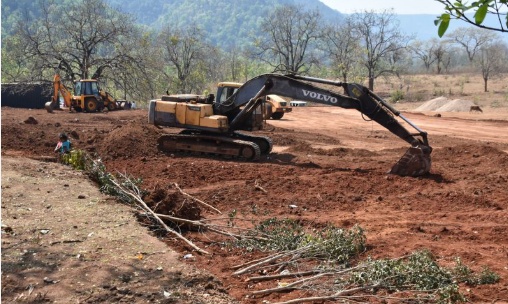
By the time Budhbari Majhi could inform and gather the rest of her community, 10 acres of Kurkuti was already levelled.
Kurkuti, a 42-acre patch of forest land roughly 1.5 km away from the nearest village of Pulingpadar, lies along the stretch of road from Bhawanipatna to Thuamul Rampur in the Kalahandi district of Odisha.
While factions of Kutia Kondhs are classified as a Particularly Vulnerable Tribal Group (PVTG) by the Indian state, this designation does not uniformly apply to all communities self-identifying as Kutia Kondh, including those in Pulingpadar.
Kurkuti Mauja (revenue circle) is part of the larger forests on the outskirts of Karlapat Wildlife Sanctuary around Khandualmali hills that are life to villages in the Mauja like Amtaguda, Bejuguda, Khuan, Ranpur and Pulingpadar.
On these hill slopes, communities practice podu – mix-cropping ragi with oil seeds, pulses like kandhul, and other millets. The forests of Kurkuti are also home to diverse tree species such as mahua, jaamun, imli, kataash, salap and khajur. On its uplands, around 60 families from Pulingpadar cultivate paddy, niger (oil seed), kandul (pulses) and kosla (little millet). Many also seasonally celebrate their mango and pineapple orchards, in what is referred to as the communities’ parab, a periodic tribal ritual offering newly harvested crops to ancestral deities followed by their communal sharing.
In the first week of January 2026, a 12-feet-wide path from the main road to the 42-acre land was carved through a stretch of forest by bulldozers. Since then, Kurkuti has become a site of intense confrontation between the Kalahandi district administration, Kalahandi Police, and the Adivasi and Dalit people of Kurkuti Mauja.
“It was only after I approached the tehsildar, Satya Sanatan Panigrahi, with some other village leaders that we all learnt about the repurposing of Kurkuti to a revenue colony for families of Tijmali who are to be displaced by Vedanta’s mining operations,” Kartik Majhi, an Adivasi resident of Pulingpadar from the Korsik clan actively involved in anti-mining people’s movements, shared.
Vedanta Limited, a mining giant headquartered in London, secured a mining lease in February 2023 as the Government of Odisha’s preferred bidder for extracting nine million tonnes per annum (MPTA) of bauxite from the bauxite-dense plateau of Tijmali (recognised as Sijimali in government records). The lease period is set at 30 years for over 1,549 hectares, of which 708 hectares is forest land. The plateau of Tijmali, and the two villages that fall under the mining lease area, Tijmali and Malipadar, are about 35 km from the base of Khandualmali, where Kurkuti sits.
Vedanta estimates that 140 Adivasi households across the villages of Malipadar and Tijmali are to be displaced as a result of its bauxite mining operations. An official circular by the Kalahandi district administration and the Government of Odisha on February 2, 2026 mandates that those displaced families are to be resettled in Kurkuti – thus explaining the bulldozer operations on the land.
“The land belongs to the Government of Odisha, and so they are entitled to transfer its ownership to Industrial Infrastructure Development Corporation (IDCO), which is the entity responsible for the resettlement project,” Sushant Gordia, a Field Operations Officer from Mythri, a sub-contractor company of Vedanta Limited, claimed. “Certainly, if the villagers attack these operations, police presence will follow,” he told The Wire.
While Kurkuti’s Record of Rights clarify ownership under the state’s government, its transfership to IDCO is dated as recently as March 10, 2026.
According to official guidelines issued by the Revenue and Disaster Management Department of Odisha in 2017, as well as the Forest Rights Act, 2006, any settlement in, and conversion of, forest lands into revenue villages is recognised entirely as a right of Adivasi and other forest-dwelling communities.
This means that while areas like Kurkuti Mauja can be formally recorded as revenue villages without altering their legal status as forest land, existing land use and community dependence ought to be recognised. Only after a Gram Sabha with community members as mandated under The Provisions of the Panchayats (Extension to the Scheduled Areas) Act, 1996 (PESA), can such resettlement be approved.
Since Pulingpadar and surrounding villages fall within a Fifth Schedule area, the Gram Sabha is the primary authority over land acquisition, displacement, rehabilitation and the use of natural resources. Under both the Forest Rights Act, 2006 and PESA, it is this body, not the state alone, that holds decision-making power over such land.
This Gram Sabha for converting Kurkuti into a revenue colony never happened, nor was a notice issued prior to the bulldozer operations. Every protesting villager spoken to in Pulingpadar testified to these facts.
Given this absence of appraisal about repurposing Kurkuti, and persisting presence of bulldozers despite recurring resistance, villagers from the Mauja have been camping in Thauguda, land only 15 metres away from Kurkuti, through chilly nights, the afternoon sun and stormy rains.
Meanwhile, alongside District Police Kalahandi and local magistrate vehicles, a CRPF bus with over 15 personnel has established a routine presence from 10 AM to 5 PM each day, followed by night duties starting around 8 PM until dawn.
“On the first day of our dharna, we lit a fire to get through the night. The police killed it. We had set up a big tent, they took it out,” Biswajit Majhi, a young Adivasi resident of Pulingpadar from the Korsik clan, said. “They don’t come and talk to us, or explain why they need to be here if the company is supposed to be in-charge, they just stand with their platoons all day,” he added, flagging police intimidation as an emerging norm.
“The villagers are protesting unnecessarily even though everything is happening legally, and they are armed, so the police deployment I have ordered is for law and order prevention,” Nagaraj Devarakonda, Superintendent of Police, Kalahandi claims, in addition to denying any presence of paramilitary on-site. “They pelted our vehicles with stones, and so we needed to establish our presence in case the matter escalates,” he continued. When asked about the number of personnel, vehicles and resources deployed, the matter was addressed as “internal”, and no further answers provided.
Said “arms” refer to indigenous hunting weapons such as taangya, taangi, bhala or barcha, that the Kondh and Jharnia Adivasis routinely carry while moving through their forests. None have been employed as means of violence against any state entities present in or around Kurkuti, villagers claim.
Ever since the police have established a presence, the women officers on night-duty have been staying in the Eklavya Model Residential school in the closeby village of Dabriguda, where their food is also prepared by local villagers.
“Every afternoon a drone flies above us, hovers for a few minutes, gets closer, goes farther, and then leaves,” Biswajit continued as he attempts to describe the growing atmosphere of surveillance that has come to define everyday life around Kurkuti.
On March 23, the day of this field report, local Adivasi leaders, along with Lingraj Azad, a long-time defender of Dalit and Adivasi rights from the Samajwadi Jan Parishad, and Suresh Patnaik, another Adivasi rights activist, took turns to address all those gathered.
After another day of waiting for the Kalahandi district collector, Sachin Pawar, to conduct a public hearing with regards to evolving circumstances, mounting frustration pushed this community dialogue.
“The amount of land we get to call ours is reducing without our knowledge, while the family count is increasing, so this fight is for the survival of future Adivasi generations, to get to call their forests their home,” Suresh asserted. “Those in power who are protecting the corporate giants, repressing us using state entities and resources, are supposed to be on the people’s side, but their public conduct as we can see is the opposite.”
The community reflected on the absence of political accountability, answers to their questions about the omission of a Gram Sabha, and militarisation of Thuagada as a response to their dissent. The Wire has reached out to the district collector over both phone and email for a response on these issues, and this article will be updated when a response is received.
“In our absence, the company officials commence their operations on our land. They stop when we resist. Are we expected to stay here in the open for all time so we can preserve our rights to this land? Who is going to pound our paddy? Graze our land? Who is going to go for wage labour?” Kunni Majhi asked, as the community experiences a sharp hindrance to their daily routines amid these protests.
On March 24, after Lingraj Azad and Suresh Patnaik decided to head back to Bhawanipatna, they received a phone call from Kartik Majhi informing them that Bolero vehicles were following them. “We couldn’t see the vehicle right behind us for a while, but soon after Kartik’s phone call two bikes and two Boleros emerged behind us. We began speeding, and so did they,” Suresh told The Wire.
“We had to turn sharply into the forests alongside the stretch of road, but it was dense, thorny and uneven, so we tripped over multiple times and I sprained my ankle,” he continued.
At 12:10 PM on March 25, the following day, Lingraj Azad was arrested from his home in Bhawanipatna by the Bhawanipatna Town Police. Subsequently, two hours later, Suresh Patnaik was also picked up from his residence by the same police. Both were then taken to Thuamul Rampur JMFC Court from where they were remanded to judicial custody for a case filed in the Karlaput Police Station last year.
On November 16, 2025, Lingraj Azad along with over 200 villagers of Thuamul Rampur block had gathered together for the annual Birsa Munda Jayanti, a Tribal Pride Day remembering the birth of, and indigenous resistance led by, Adivasi leader Birsa Munda. For the same, both Patnaik as well as Azad are charged with a veritable menu of charges including, but not limited to, attempt to murder, dacoity, unlawful assembly and rioting with arms. They are now lodged in Bhawanipatna District Jail, with their first bail appeal having been rejected, and a Session Court hearing in Kalahandi to follow.
Two leading voices of Adivasi and Dalit resistance getting arrested at a time of heightened mobilisation by communities for their rights over Kurkuti points to a criminalisation of dissent and therefore a protection of Vedanta’s mammoth corporate pursuit, locals believe.
“If Kurkuti is lost to this residential colony, the land will turn barren, and we will lose all sources of our nutrition as well as income. We will lose it all,” Kartik Majhi reiterated.
More palpable than the tangible and immediate loss of income, however, is the loss of the indigenous notions of belonging and sacredness, and the sovereignty the Kutiya Kondhs and Jharnias have long cherished over their seeds, forests, lands, hills, sacred burial grounds and groves within those hills, and perennial streams.
[Malika Singh is an independent field reporter and a remote MA student at SOAS University of London, currently based out of Jaipur. Courtesy: The Wire, an Indian nonprofit news and opinion website. It was founded in 2015 by Siddharth Varadarajan, Sidharth Bhatia and M. K. Venu.]
❈ ❈ ❈
Tijmali: An Undeclared Conflict Zone?
Ranjana Padhi and Dr Randall Sequeira
Adivasi villages of Tijmali, especially around Sagabari, Bantej, Bondel, Kantamal and Talaampadar, are witnessing an overwhelming presence of armed police and vehicles, drones flying on the area, and police on the lookout for the leading members of Ma Mati Mali Surakya Mancha, the organization leading the resistance to Vedanta’s bauxite mining project since almost three years now. On February 26, 27 and 28, around 200 police and paramilitary forces marched into three villages on consecutive days to paste arrest warrants issued by the SDM Rayagada and JMFC Kashipur on the walls of leading members of MMMSM. On February 26th they marched into Banteji, on 27th February, they marched right through the village of Kantamal, one of the strongholds of the movement and on 28th February they marched through Sagabari village. The warrants were not served personally and have also been put up on trees. Since then, drones and police vehicles became a regular feature until today.
Intensifying Repression
On the night of March 10, a confrontation of villagers of Talaampadar (Kalahandi district) with a pro-company villager escalated sharply. The police descended on the village in the middle of the night and picked up 21 adivasis, including 11 women. They raided houses at random and broke many doors and doorways. Of the 11 women, there is a nineteen-year old woman who is pregnant; there are three minors; and quite a few with very small children. They are languishing in District Jail of Bhawanipatna of Kalahandi district. The police force, that was in hundreds, also had some people in uniform as reported to us. Similarly, there were many private vehicles. These arrest of women in the middle of the night, no doubt, construe illegal arrests.
State repression has intensified in the wake of the padayatras held by villagers of Tijmali, Majhingimali and Kuturumali in mid-January claiming their land, hills and streams and asserting their autonomy over their sacred hills. This entire area is also protected under the Fifth Schedule Area of the Indian Constitution. The padyatras were in response to the Forest Advisory Committee recommending Stage-I (in-principle) approval for the diversion of 708.204 hectares of forest for Sijimali Bauxite Mines although the gram sabhas held by the district administration with the coercion of company goondas and police have been challenged in High Court by the people. The issues were plenty: they also demanded the release of over nine leaders confined: Padman Naik, Kartik Naik, and Labanya Naik (Bhawanipatna jail), and Naringi Dei Majhi, Jaleswar Naik, Ramakant Naik, Mithun Naik, Sundar Singh Majhi and Laxman Naik (Rayagada jail).
Coercion and repression is the only response of the BJP-led government headed by an Adivasi Chief Minister that is aiding mega corporations for mining, be it for bauxite in Tijmali or limestone in Sundargrah district. Drones and growing police presence have become a permanent feature in Fifth Schedule areas.
In a recent visit, many Adivasi peasants and wage workers reported how they are losing out on earnings as it is impossible to step outside. Going out to the forest and river for daily chores is also filled with uncertainty as there are drones flying. These drones are followed by patrolling of vehicles in a row – from 18 to 25 maybe, and long marches of armed police through the area. As there are hundreds of fabricated criminal cases as FIRS, there is a great deal of uncertainty about anyone being picked up by the police. Families lamented how they have not been able to even visit their dear ones in jail. Last but not least, the inability to work or to earn is resulting in families having only one meal a day nowadays.
March 10 to 13 witnessed mounting tension. Drones are used to detect people’s whereabouts and movements. On March 13, five leading members of Ma Mati Mali Surakya Mancha were chased by the police. As they outdid the police in running up the hill, Umakant Naik fell behind and was immediately arrested. This is the second time that he is confined.
Our previous update was put out in early November. Let us narrate a few important dates since then that also reveal how the targeted attacks by pro-company people or hired goondas and the active connivance of the district administration with the company is coming down heavy on the movement. Even then, the adivasis and Dalits opposed to mining are fighting it out legally in the courts and through large mobilization on the ground.
Birsa Munda Jayanti
There were hectic preparations on in Nakrundi panchayat in Kalahandi district for Birsa Munda Jayanti on November 15, 2025. On the previous day, Sanu Majhi from Amjhola village was detained for a few hours, while Mithun Naik from Kachalekha village was arrested and imprisoned in Rayagada jail. On the day of the event, some local youths attempted very hard to disrupt the event. However, the organizers peacefully intervened and persuaded them to leave the spot. It was admirable the manner in which the women kept the event going by sitting in strict discipline and refusing to budge as Birsa Munda Jayanti is one of the most sacred days for them symbolising the constant struggle of Adivasis to fight and protect their land.
That very day, an FIR was filed against some of the organizers. It is a shame that in a state led by an Adivasi Chief Minister, even this celebration was targeted. There were arrests on the previous day, engineered fights on the day followed by the arrest of Kartik Naik within a couple of days. Soon, Labanya Naik was arrested. It was Kartik Naik’s second time in jail. He spent four months in Bhawanipatna jail and was released on bail on March 18. He has heavy charges on him, including sections of the Arms Act. Labanya Naik is yet to be released.
Assault by Police in Plainclothes at Sunger Chowk
On December 7, a group of men entered the garage of Dayanidhi Naik (age 28) at Sunger Chowk in Kashipur block. This group of unidentified men, probably the Kashipur police, came in two vehicles. They assaulted him and dragged him to the vehicle. They said they were police staff but no one was in uniform. The vehicles did not have any police plate and there was no light on the top as police vehicles have. A group of people rushed to help him. Meanwhile, the police hit an 11-year-old boy badly on his leg. He was limping for a long time. And they threw away a little girl who was in her mother’s arms. Dayanidhi Naik fought back the police physically and managed to free himself from their grasp. The only person who the people could recognise was SI P.K. Swain from Kashipur PS. A large group of unidentified men forcefully abducting a person on a Sunday afternoon reveals the goonda raj fostered by the administration and company to intimidate and terrorise those in the movement who want to protect their land and forests from the perils of mining.
Illegal Acquisition of Forest Land for Vedanta
On December 2, 2025, the FAC recommended Stage-I (in-principle) approval for the diversion of 708.204 hectares of forest for Sijimali Bauxite Mines. The FAC also noted that several representations had been received alleging irregularities and fraudulent conduct of Gram Sabha proceedings. The hectic rush even before environment clearance is for the construction of the approach road to the mining area via Sagabari. Ma Mati Mali Surakhya Manch has been opposing the entry of police or administration to undertake this construction work since many months. And they have been sitting on vigil in a camp set up near Sagabari. The road leads to Malipadar and Tijmali villages situated on the hill top.
Lawyers Protest Illegal Land Acquisition
On 15 December, 2025, PUCL released a letter to the national media in which over 125 lawyers, legal professionals (faculty) and law students from across the country registered their protest against the illegal acquisition of forest and Fifth Schedule land in Odisha’s Rayagada and Kalahandi districts for Vedanta Ltd.’s proposed Sijimali bauxite mining project, and the sustained criminalisation and intimidation of Adivasi villagers resisting it. In a detailed petition addressed to the Governor of Odisha, the Director General of Police, and the district collectors and superintendents of police of Rayagada and Kalahandi, the lawyers demanded immediate intervention to halt land acquisition in Fifth Schedule areas, withdraw criminal cases against villagers, and curb what they call “colonial-era repression” unleashed to facilitate Vedanta’s mining project in Sijimali.
Invoking the special powers of the Governor under the Fifth Schedule of the Constitution, the lawyers urged immediate intervention to restore peace and good governance in Scheduled Areas, stressing that these constitutional responsibilities cannot be abdicated in favour of corporate interests.
The key demands included a review of the mining lease granted to Vedanta, withdrawal of all FIRs against villagers, release of detained leaders with compensation for illegal arrests and torture, and a complete halt to all project-related work until Gram Sabhas can take decisions in a fear-free environment. The lawyers also sought an independent inquiry into police and administrative excesses, a ban on company staff entering villages, and Gram Sabha approval for any police deployment in the area.
Student Protests at Sambalpur and Cuttack
Two spontaneous protests in solidarity with the struggle against bauxite mining took place on January 12 and 13, respectively, at Sambalpur University and at Ravenshaw University. These protests condemning the incarceration of Adivasis and Dalits and the growing police repression in the region also upheld people’s right to protect their Fifth Schedule areas and say NO to bauxite mining. The placard at Ravenshaw University said “Our Aravali: Sijimali!! We stand in solidarity with the people of Sijimali.”
March 8, 2026
On the morning of March 8, hundreds of women gathered in response to the intense surveillance and police patrolling. They marched from Kantamal to Sagbari shouting slogans Vedanta – Go Back and claiming the land as theirs. Be it any celebration or mass meeting, rally or demonstration the presence of women and girls is vibrant in huge numbers. They form the backbone of the movement.
Arrests, bails, and bail conditions
Getting bail becomes a huge celebration as villagers gather to greet those who emerge from the confines of the prison. On February 18, Narengi Dei Majhi, Sundar Singh Majhi and Ramakant Naik walked out free from Raygada Jail. Jaleswar Naik was released on March 11. The sacrifice of Adivasis and Dalits enduring incarceration for protecting their land is one of the most prominent aspect of the movement. Slogans of Jai Bhim resonated in the night sky along with the call to save Sijimali.
Laxman Naik was picked up from his residence in Raygada on December 1. He was granted bail on 16 December. Mithun Naik from Kachalekha village was arrested from Nov 14 to January 14. Villagers celebrated the release of both Mithun Naik and Laxman Naik on 15 December. However, Mithin Naik was arrested once again on 29 January and released on 28 February.
The circumstances of Mithun Naik’s arrest point to a growing reliance on hired goons and intermediaries. He had been deeply involved in organizing for the next day’s Birsa Munda Jayanti event and was returning along the Karlapat road when a group of nine men ambushed him on a bridge near a village. They beat him severely and snatched his bag. He was then abandoned at a location in Rampur, where another group arrived in a travel bus. Among them, he recognized two individuals, one of whom was a plainclothes policeman from Karlapat police station. They subsequently handed him over to the Rayagada police in Kashipur.
When he was produced before the court, he was in intense pain and shock, yet neither did the judge inquire about his condition, nor was he able to speak about the torture he had endured. He had been intimidated not to disclose anything before the court. However, after his release on January 14, he waited for some time before approaching the Karlapat police station to file an FIR regarding his abduction on November 14. The police recorded his complaint and asked him to return after a few days. The Karlapat police had neither registered his FIR nor made any diary entry. Instead, when he went back on January 29, he was informed that a warrant had been issued against him and was arrested on the spot. The entire episode has been a gruelling ordeal.
As done earlier by the High Court, the Raygada District Court imposed the same bail condition on Laxman Naik, Narengi Dei Majhi, Sundar Singh Majhi, Ramakant Naik and Jaleswar Naik.“The Petitioner shall clean the premises of the Kashipur Police Station in the morning hour (between 6.00 A.M. to 9.00 A.M.) for two months from the date of his actual release in the aforesaid case. The I.I.C of the Kashipur Police Station shall provide the cleaning article like broom, phenyl and other items to the Petitioner so that he can clean the said premises”.
Such bail conditions are not free from the prejudice against SC and ST communities. If such bail conditions become a judicial precedence, it will adversely affect the principle of right to bail, and lead to more executive highhandedness. It seems to be vindictive as perhaps pre-trial punishment as part of retributive justice system.
Resistance Brewing Nearby
On another front of the movement, the people of Pulingpadar and Chandgiri villages are also resisting land grab by Vedanta, which is forcefully trying to build rehabilitation colonies for the proposed evictees of the Sijimali Mining Project. Since 19 March 2026, hundreds of villagers of Pulingpadar have been indefinitely camping at the Kurkuti forest block to halt the company bulldozers from felling trees and destroying the sacred groves. They have have customary rights over this land as per the FRA.
It is evident how the state-industry-military nexus is hell bent on twisting every rule in the book and illegally get at the mining resources. Similar situation prevails in Sundargarh district where the administration is aiding Dalmia Cement in limestone mining with heavy police and paramilitary forces. These are Fifth Schedule areas that in principle grants autonomy to the people over their lands, forests, hills and streams and sacred sites. Tijmali is fast becoming a conflict zone. Let us uphold the right to dissent for Adivasis and Dalits as the state seeks to take over their lands, lives, livelihoods and all else. The endless incarcerations have to be halted. The drones have to stop! The police patrolling has to come to an end!
Stand in Solidarity with the Struggle of Adivasis and Dalits in Tijmali! Say No To Bauxite Mining!
[Ranjana Padhi is an Odisha-based social activist, researcher, and writer long associated with people’s struggles against mining-led displacement, especially Adivasi and Dalit resistance in regions such as Kashipur, Niyamgiri, and Sijimali/Tijmali. Dr Randall Sequeira is a medical doctor, researcher, and social activist who has worked in the interiors of Niyamgiri and other hill regions of Odisha, engaging with Adivasi communities and anti-mining campaigns. Courtesy: Countercurrents.org, an India-based news, views and analysis website, that describes itself as non-partisan and taking “the Side of the People!” It is edited by Binu Mathew.]
❈ ❈ ❈
Stop Attacks on Villagers Resisting Mining in Rayagada and Kalahandi Districts of Odisha!
Peoples Union for Democratic Rights
8 April 2026: PUDR strongly condemns the raids, attacks on villagers and destruction of their houses by the local police and goons in Kantamal village in Odisha’s Kalahandi District. As per accounts received from local people, at about 2 am on 7 April, police along with private persons entered the village. When people came out they were subject to tear gas shells. Many were beaten up with lathis; two women have sustained severe head injuries. The repression continued till the early hours of the morning. Kantamal is one of the strongholds of the movement against the Sijimali Bauxite Mining Project, spread over both Thuamul Rampur and Kashipur blocks in Kalahandi and Rayagada districts, respectively. It may be recalled that in March 2023, the Odisha government issued a fifty-year mining lease to M/S Vedanta Ltd. for extraction of bauxite from an area spreading across 1549 hectares, including 699 hectares of forest land, which villagers have been resisting through Ma Mati Mali Surakshya Manch, the body spearheading the campaign to protect the hills and forests of Sijimali, which has been struggling for the rights of Adivasis in Rayagada and Kalahandi under the Fifth Schedule. The people have petitioned the NGT and the matter is pending.
The April 7 raids and attacks come in the wake of prohibitory orders issued on 3 April, when police and administrative officials in large numbers surrounded Kantamal village, and over loudspeakers, announced the decision to construct a road to the Sijimali bauxite mines. Under the directions of Sub-Collector Rayagada, the order prohibited the gathering of more than four persons within 100 meters radius of the approach road being constructed. Villagers had been threatened with strict action in case of violation of the order under Sec 163 BNSS. However, people sat on vigil on the hills from April 4 to 6 not allowing administration and police to go towards the approach road to be constructed. The police have alleged that the villagers attacked them when they went to arrest “law-breakers” (https://www.orissapost.com/over-100-injured-in-vedanta-mine-clash/). The April 7 raid, police violence on people and attacks on houses is evidence of the intensification of the terror campaign that the administration and police have mounted with the help of local private persons, against those opposed to the mining project. People had feared that the prohibitory orders would be used to target them – apprehensions that came true on 7 morning.
It needs to be noted that the April 7 events were preceded by large scale arrests in March 2026.
Talaampadar, a small village, with around 120 houses, in Thuamal Rampur block of Kalahandi district has been playing a leading role in the movement. On 11 March, twenty-one Adivasis from Talaampadar village were arrested based on a local complaint made by a Vedanta company loyalist.The complaint stated that the accused along with another 40-50 residents had barged into his house and assaulted him, and six others including his brother who was grievously injured. Several sections of the BNS including attempt to murder (109 (1)), voluntarily causing grievous hurt (117 (2)) rioting (191 (3)), unlawful assembly to commit offence with common object (190) were invoked in the FIR filed at Karlapat PS of Kalahandi district. Ten of those arrested are women, varying from 50 to 19-year-olds. At least one woman is pregnant and two have left behind their breast-fed children.
According to information received by PUDR from local activists, hundreds of police as well as private persons targeted the house of a leader of Ma Mati Mali Surakhya Manch (MMMSM) in the early hours of 11 March and forcibly broke in. Besides his house, the raiding party armed with knives and lathis barged into other houses, breaking doors and walls, destroying household goods and farm implements. Residents were dragged out, beaten and those who tried to prevent the attack or save themselves were caught and arrested at random. The mayhem continued till 7 am in the morning. PUDR learnt that several villagers fled to the forests in fear and many lost their household goods and official documents such as Aadhar cards, voter and ration cards.
Bail was denied to the twenty-one Adivasis on 12 March by the JFMC Civil Judicial Magistrate, Thuamul Rampur because of the serious sections invoked and also because the police said that the investigation was in a “nascent stage”. All twenty-one were sent to judicial custody in Bhawanipatna District Jail. Bail was once again denied by the Sessions Court on 6 April. The Judge chose to defer the matter as the Case Diary was still awaited. Nor has the police submitted the Injury Report. Hence, for almost four weeks now, twenty-one Adivasis continue to remain behind bars without relief. The use of non-bailable makes it possible to incarcerate the villagers for an indefinite period over protracted Sessions Court bail hearings.
All twenty one are Adivasi cultivators and wage workers dependent on the land. Their families, including children, are in deep shock and awaiting their presence to resume household work and earnings to resume as part of daily life.
On 25 March, Lingraj Azad and Suresh Sangram were arrested in Bhawanipatna, Kalahandi District. Azad, President of the Samajwadi Jan Parishad, and Suresh Sangram have been at forefront of the struggle against Vedanta’s bauxite mining project and are advisors of Ma Mati Mali Surakhya Manch. They have been booked under Sections 115(2) (voluntarily causing hurt), 109(1) (Attempt to murder), 310(2) (dacoity), 351(3) (aggravated criminal intimidation), 191(2) (rioting), 191(3) (rioting with deadly weapon), and 190 (unlawful assembly with common intent) of the BNS. Both were denied bail on 6 April by the Kashipur Sessions Court and have been taken to Rayagada Jail.
The present crackdown is an intensification of a prior history of attacks which PUDR has noted, be it the police crackdown in Kashipur and Niyamgiri in August 2023 or the indiscriminate arrests of members of Ma Mati Mali Surakhya Manch in September 2024. Apart from leaders and activists, the entire Adivasi and Dalit communities opposing the mines, are being harassed and terrorized by the combined might of private corporations and state power. The arrests, prohibition order and night raids and attacks are disastrous for a community which is dependent on farming and on gathering firewood. As cultivators and wage workers, the prohibition order is a direct attack on local people’s work related and everyday needs. The refusal in granting bail not only shows the nature of a pliant judiciary but also shows how a struggle is criminalized, along with devastation of lives and livelihood.
PUDR demands:
- Immediate release of the villagers of Talaampadar.
- Immediate release of Lingaraj Azad and Suresh Sangram.
- Immediate end to attacks on villagers through criminalization and terror.
- Immediate withdrawal of the 3 April prohibitory order for the construction of the approach road to the mining area.
- Action against police personnel responsible for the illegal raids, violence, destruction and arbitrary arrests.
Statement issued by:
Deepika Tandon and Shahana Bhattacharya, Secretaries, People’s Union for Democratic Rights (PUDR)
[Courtesy: Countercurrents.org, an India-based news, views and analysis website, that describes itself as non-partisan and taking “the Side of the People!” It is edited by Binu Mathew.]