❈ ❈ ❈
Eugene V. Debs: Perseverance in the Face of Power
J. Cynthia McDermott
Last Tuesday, as scholars and citizens gathered to reflect on democracy in a precarious hour, Mahmood Mamdani invoked a name far too often forgotten in American life: Eugene V. Debs.
It was the right reminder at the right moment.
Debs (1855—1926)–railroad worker, union leader, and five-time candidate for president–believed democracy was not simply a system of government, but a moral commitment to human dignity. His life shows that courage is not always rewarded with victory. Sometimes it is measured in endurance.
A Working Man’s Awakening
Debs began as a locomotive fireman in Terre Haute, Indiana. Exhausting shifts and dangerous conditions forged his belief in solidarity from the ground up.
He helped form the American Railway Union, one of the first industrial unions to unite workers across trades, and led the 1894 Pullman Strike after a ruthless wage cut. The federal government sent troops, workers were killed, and Debs was jailed.
Prison did not quiet him–it transformed him. Reading Marx and Ruskin behind bars, he concluded that the struggle for labor was not only economic but fundamentally ethical: Who deserves the fruits of human work?
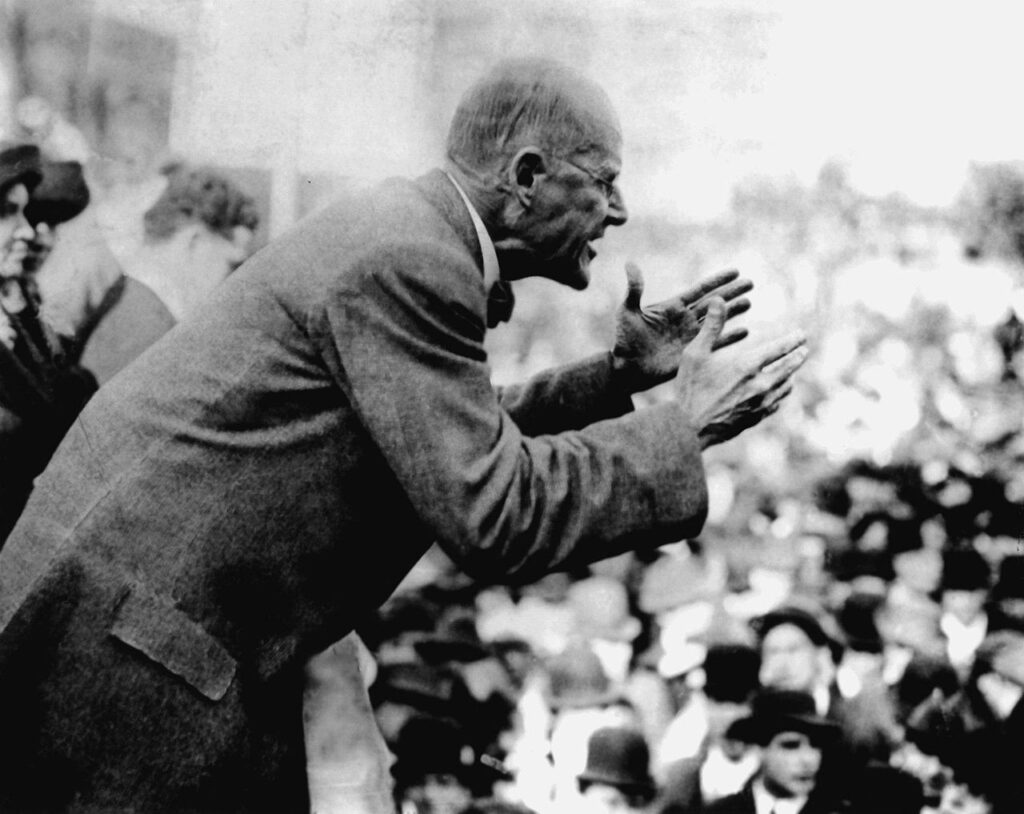
Emerging from prison, Debs became a national voice for working-class dignity, founding the Socialist Party of America and speaking to overflowing halls and fairgrounds. His language blended outrage at injustice with a tender commitment to the common good.
War, Dissent, and a Prison Cell
During World War I, the Espionage Act made dissent dangerous. Debs opposed the war as a betrayal of working people–a sacrifice demanded of the poor while the powerful profited.
In 1918, in Canton, Ohio, he delivered a quiet speech urging resistance to militarism. He knew he would be arrested. He spoke anyway.
At trial he told the court: “I have been accused of obstructing the war. I admit it. I abhor war. I would oppose it again.”
He was sentenced to ten years. At sixty-three he entered the Atlanta Federal Penitentiary, vision failing, health weakened–yet he continued writing letters of encouragement, signing them “Yours for the Revolution.” His faith in human decency never faltered.
The Presidential Campaign from Behind Bars
In 1920, imprisoned as Convict No. 9653, Debs ran for president and received nearly a million votes. His campaign was not a bid for power but a moral declaration: democracy must belong to all, not to the privileged few.
“In the struggle for liberty, the jail is a greater honor than the palace.”
When President Warren G. Harding commuted his sentence in 1921, Debs walked out frail but unbroken. Even prison guards lined up to shake his hand.
Why Debs Matters Now
Debs never held office. He did not live to see the equitable society he imagined. But his life carved a moral path through American politics. He believed that the measure of a nation is how it treats workers, the poor, and the imprisoned–and that solidarity is democracy’s most radical promise.
His words echo still:
While there is a lower class, I am in it;
while there is a criminal element, I am of it;
while there is a soul in prison, I am not free.
In a time again marked by profound inequality, efforts to criminalize dissent, and impatience for easy victories, Debs reminds us: moral progress is often slow, and those who begin it may not live to see it fulfilled.
Carrying the Torch Forward
When Debs died in 1926, the New York Times called him “the most beloved man in America.” He earned that love not through power but perseverance–through the stubborn belief that kindness, equality, and human solidarity are not sentimental ideals, but democratic duties.
The earth for all the people. That is the demand.
When Mamdani quoted Debs this week, he was not reaching backward. He was reminding us that democratic courage has ancestors.
Debs saw a better dawn even when the night was long. We owe his memory not admiration but emulation–to keep faith in each other, to stand where dignity is threatened, and to refuse to surrender the horizon.
[J. Cynthia McDermott, Ed.D., is a lifelong university teacher educator, a consultant for Educators Abroad and a Fulbright scholar to Bosnia-Herzegovina and Poland who has authored 6 previous books all related to democracy and progressive education. Courtesy: LA Progressive, a news portal founded by Dick and Sharon whose mission is to provide a platform for progressive thought, opinion and perspectives on current events.]
❈ ❈ ❈
Who Was Eugene Debs?
Michael K. Smith
Zohran Mamdani’s quoting of Eugene Debs in his recent victory speech (for mayor of New York City) should awaken interest in the man who gained a name for himself as “Mr. Socialism.”
For seventeen years Debs was the Brotherhood of Locomotive Firemen, starving himself of sleep to bone up on politics, economics, and history. With painstaking effort he made himself into a manager’s worst nightmare: an educated union man who could unravel the knots of capitalist contradiction, making the need for revolution plain for all to see.
Unable to ignore workers’ constant pleas for help, he went everywhere he was called, never managing to get his suitcase unpacked. In bad years he donated up to $900 of his $1500 salary to keeping the union and its magazine afloat, steering the workers through strikes, depression, and looming bankruptcy.
Night after night he went tramping through railroad yards, where his constant agitation got him thrown out of the roundhouse (a circular building used for servicing and storing trains) and ejected from trains.
He became a magnificent popular speaker, eventually making socialism as American as the Liberty Bell. He praised the fighting spirit of the workers and heaped scorn on the mining companies and “cockroach” small shop capitalists who exploited them. Even those who had heard it all before couldn’t resist his spell. When he rehearsed his speeches at home his neighbors came out onto their porches to eavesdrop.By the time he ran for president for in 1904 (the second of five attempts, the last one from a prison cell), socialism had elbowed its way onto the national political scene. Schoolteachers warned of its growing menace; workers jammed meeting halls to hear of its glowing promise.
Debs was the unanimous choice to represent the Socialist Party that year. In the wake of a dizzying spate of corporate mergers, three hundred firms controlled more than forty percent of the industrial capital of the country and monopoly quickly emerged as the dominant issue of the campaign. Selling out auditoriums with paid admissions, Debs ridiculed Teddy Roosevelt’s trust-busting schemes for their failure to realign class power, and scoffed at the notion that a state dominated by gigantic private corporations could ever alleviate the workers’ distress: “Government ownership of public utilities means nothing for labor under capitalist ownership of government,” he thundered.
With muckraking journalists continuing to expose the profit system’s massive fraud, waste, and abuse, more and more people inclined to the belief that capitalism was doomed.
The socialist Appeal to Reason boasted a readership of half a million, educating a huge mass of farmers, factory-workers, and railwaymen in the Mid-West alone. Its December anti-trust issue that year piled up three million advance orders, the largest edition of any newspaper in American history. In New York City, The Call was a staple of every working-class neighborhood while red-covered pamphlets of Marx and socialist brochures circulated in the millions throughout the country. Teddy Roosevelt warned that socialism was “far more ominous than any populist or similar movement in times past.” Radicals and reactionaries alike saw the Socialist Party as the future opposition party of the United States.
An army of Debs volunteers solicited contributions, rang doorbells, sold newspapers, talked up strangers, and shouted the political heresy of justice for workers from soapboxes and courthouse stairs, delivering four hundred twenty thousand votes for Debs, quadrupling his support of four years before.
Conceding that charity had a claim on private conscience but strenuously rejecting any worker entitlement to monopoly profits, Teddy Roosevelt rode a tsunami of corporate cash to victory at the polls.
Refusing to be stopped by rheumatism, lumbago, or chronic headaches, Debs ran for president again in 1908.
Touring the country by train in his “Red Special,” he drew huge crowds yearning to see the burning eyes of a prophet and feel the glow of solidarity from a real man of the people. For sixty-five consecutive days he addressed five to twenty rallies a day all across the country. The New York Times called his sold-out appearance in New York’s Hippodrome the greatest political meeting ever held in that city.
As vulgar smears and incendiary slanders failed to stop the rising socialist tide, a note of desperation crept into the voices of Democratic and Republican officials scheming to “Stop Debs.”
Republican William Howard Taft spoke for free at the Music Hall in his hometown of Cincinnati and could barely fill the seats; Debs charged a dime admission at the same hall to poor workers and had to turn many away.
In a spirit of fair competition the socialists proposed that Taft address their rally for twenty minutes in exchange for Debs speaking to the Republican audience for the same length of time. The Taft campaign quickly rejected the offer.
Known among workers as the “father of injunctions” for his success in quashing strikes by court order, Taft won the White House on the strength of vast corporate campaign donations via the National Association of Manufacturers.
Unable to crack the capitalist monopoly of political power, labor’s influence continued to grow in subsequent years through popular organizing and education. Finally, in 1917 it was dealt a decisive blow by Woodrow Wilson, who drafted workers into the industrial slaughter of modern warfare and sent them into Europe’s killing fields (WWI). Rejecting appeals to “patriotism,” Debs refused to go along, and was jailed for obstructing the draft. His speech at sentencing was a masterful appeal for socialism. [We publish his speech at the end of this article – Editor.]
Given ten years in an Atlanta penitentiary, he befriended all his fellow inmates, in the end winning over even his jailers with his unfailing kindness and sincerity.
Only one heart was too hard for him to reach – Woodrow Wilson’s. In his waning days in the presidency the Great Idealist refused a customary Christmas pardon for Debs, whose conduct actually lived up to Wilson’s high-minded rhetoric, which merely rang hollow in the president’s mouth.
Finally released by Republican Warren Harding on Christmas Day 1921, Debs enjoyed the rare privilege of being able to say farewell to his fellow prisoners when the warden waived regulations for the occasion.
As Debs proceeded down the walkway leading away from the jail, a huge roar went up behind him from two thousand of society’s forgotten and despised. Turning to say goodbye, Prisoner 9563, who always refused special privileges and treated them as the men they were, took in the ovation, tears streaming down his face.
● ● ●
Eugene Debs’s famous Statement to the Court made on September 14, 1918, during his trial for violating the Espionage Act. He gave the speech to the court before being sentenced to prison for opposing U.S. involvement in World War I.
“Your Honor, years ago I recognized my kinship with all living beings, and I made up my mind that I was not one bit better than the meanest on earth. I said then, and I say now, that while there is a lower class, I am in it, and while there is a criminal element I am of it, and while there is a soul in prison, I am not free.
“I listened to all that was said in this court in support and justification of this prosecution, but my mind remains unchanged. I look upon the Espionage Law as a despotic enactment in flagrant conflict with democratic principles and with the spirit of free institutions . . . Your Honor, I have stated in this court that I am opposed to the social system in which we live; that I believe in a fundamental change – but if possible by peaceable and orderly means. . .
“I am thinking this morning of the men in the mills and the factories; of the men in the mines and on the railroads. I am thinking of the women who for a paltry wage are compelled to work out their barren lives; of the little children who in this system are robbed of their childhood and in their tender years are seized in the remorseless grasp of Mammon and forced into the industrial dungeons, there to feed the monster machines while they themselves are being starved and stunted, body and soul. I see them dwarfed and diseased and their little lives broken and blasted because in this high noon of Christian civilization money is still so much more important than the flesh and blood of childhood. In very truth gold is god today and rules with pitiless sway in the affairs of men.
“In this country – the most favored beneath the bending skies – we have vast areas of the richest and most fertile soil, material resources in inexhaustible abundance, the most marvelous productive machinery on earth, and millions of eager workers ready to apply their labor to that machinery to produce in abundance for every man, woman, and child – and if there are still vast numbers of our people who are the victims of poverty and whose lives are an unceasing struggle all the way from youth to old age, until at last death comes to their rescue and lulls these hapless victims to dreamless sleep, it is not the fault of the Almighty: it cannot be charged to nature, but it is due entirely to the outgrown social system in which we live that ought to be abolished not only in the interest of the toiling masses but in the higher interest of all humanity . . . .
“I believe, Your Honor, in common with all Socialists, that this nation ought to own and control its own industries. I believe, as all Socialists do, that all things that are jointly needed and used ought to be jointly owned – that industry, the basis of our social life, instead of being the private property of a few and operated for their enrichment, ought to be the common property of all, democratically administered in the interest of all . . .
“I am opposing a social order in which it is possible for one man who does absolutely nothing that is useful to amass a fortune of hundreds of millions of dollars, while millions of men and women who work all the days of their lives secure barely enough for a wretched existence.
“This order of things cannot always endure. I have registered my protest against it. I recognize the feebleness of my effort, but, fortunately, I am not alone. There are multiplied thousands of others who, like myself, have come to realize that before we may truly enjoy the blessings of civilized life, we must reorganize society upon a mutual and cooperative basis; and to this end we have organized a great economic and political movement that spreads over the face of all the earth. . . .
“Your Honor, I ask no mercy and I plead for no immunity. I realize that finally the right must prevail. I never so clearly comprehended as now the great struggle between the powers of greed and exploitation on the one hand and upon the other the rising hosts of industrial freedom and social justice.”
Sources:
Philip S. Foner, History of the Labor Movement in the United States, Vol. 3 –The Policies and Practices of the American Federation of Labor 1900-1909, International Publishers, 1964) p. 306, 349, 356-7
Joseph Freeman, An American Testament – a narrative of rebels and romantics, (Farrar & Rinehart, 1936, p. 36)
Ray Ginger, The Bending Cross – A Biography of Eugene Victor Debs, (Rutgers, 1949) p. pps. 226, 230-3, 281-2
Mathew Josephson, The President Makers – The Culture of Politics and Leadership in an Age of Enlightenment 1896-1919 (Harcourt, 1940)pps. 168-9
Louis Adamic, Dynamite – The Story of Class Violence in America, (Chelsea House, 1958) pps. 128-33
Howard Zinn, Eugene Debs and the Idea of Socialism, August 8, 2022, www.rethinkingschools.org
Debs speech at sentencing quoted from Chris Hedges, America: The Farewell Tour, pps. 107-9
[Article courtesy: Countercurrents.org, an India-based news, views and analysis website, that describes itself as non-partisan and taking “the Side of the People!” It is edited by Binu Mathew.]