❈ ❈ ❈
Why a Question and Satire Unsettled Modi
Betwa Sharma
In the closing narration of the 2004 film, Troy, an otherwise slightly flat, faintly bland retelling of the Trojan War, Odysseus says: “Let them say I lived in the time of Hector, tamer of horses. Let them say I lived in the time of Achilles.”
And, in a comparison that is admittedly a little absurd, I can probably say: I lived through the week when a young Norwegian journalist sent the Indian Prime Minister’s foreign visit into a tailspin, and when a movement, born out of satire, riffing on the invincibility of cockroaches, exploded, amassing more than 21 million followers on Instagram within days, leaving BJP’s nine million in the dust.
Journalist Helle Lyng’s asking the leader of the world’s largest democracy, who has not addressed a press conference at home in 12 years, to take a question upended the tightly managed optics that usually mark Prime Minister Narendra Modi’s appearances and triggered a frenzy among the right-wing ecosystem and their loyal mainstream media.
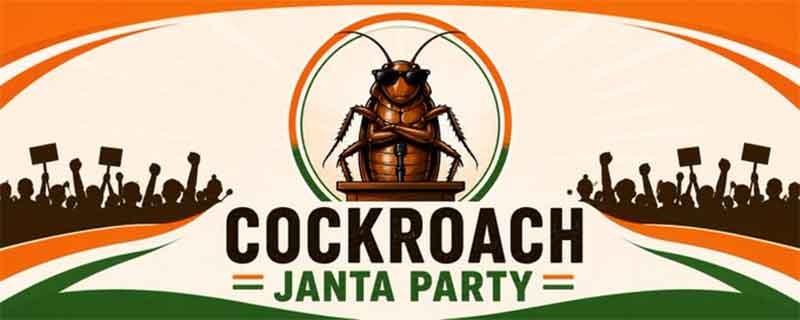
The Cockroach Janata Party (CJP) was a response to Chief Justice Surya Kant’s astonishing remarks, calling unemployed youth “cockroaches” and “parasites” who turn into media figures, social media users, RTI activists, and “start attacking everyone”. (He later said that he was misquoted and that is not what he meant. He wasn’t misquoted).
All this may well be forgotten in the coming days and weeks, but what matters is the swift, spontaneous, mammoth reaction: an urgent, almost primal demand for a free press allowed to question its leaders, and the raw frustration among young people over lack of opportunity, lack of transparency, rising inequality and prices, and an environment consumed by hate, bigotry, bravado, and propaganda, in the absence of meaningful change.
What began as a joke party for the “lazy,” “unemployed,” permanently online generation resonated because there was truth in its absurdity, and the “cockroach” was the perfect symbol: unwanted, hard to eliminate, and surviving every attempt to crush it.
Even as the BJP continues to rack up electoral victories through money, muscle power, control over institutions like the Election Commission, and the strategic tweaking of electoral rolls, an unmistakable wave of discontent has been building for some time now, visible in everyday conversations and across social media.
If anything, the Opposition has failed to effectively tap into or channel this sentiment.
The backlash and crackdown this week have felt less like the response of a government secure in its many electoral victories and more like that of an insecure regime with a thin skin, frightened about real and rising discontent.
The state that claims civilisational confidence somehow finds itself threatened by an internet satire account and by a single question from a journalist on a different continent.
Social media accounts were suspended, furious television debates ensued, and the familiar language of “national security”, “ sovereignty”, and “anti-national forces” quickly entered the conversation.
Helle Lyng was hit with the usual wave of misogynistic abuse and a media pile-on more aggressive than anything that Modi has faced as Prime Minister, as if asking about human rights or press freedom needs some grand qualification instead of basic journalism.
Shortly after her question went viral, and amid intense online backlash, Lyng’s Facebook and Instagram accounts were suspended by Meta, with no clear explanation.
The CJP’s X account, run by Abhijeet Dipke, an Indian living in the US, who reportedly once volunteered for AAP, was withheld after a “legal demand” was issued by Indian authorities over “national security concerns”.
Dipke has claimed there have been multiple attempts to hack CJP’s Instagram account.
The fact-checking website, Alt News, found the claim by BJP leaders and right-wing influencers that most of CJP’s followers were based in Pakistan to be false.
The playbook has become painfully familiar.
If the person asking questions is foreign, they are immediately painted as colonial-minded, funded by some foreign agency, working for another country’s interests or hostile to India’s growing global profile.
And people within India who agree with those criticisms are painted as self-loathing and unpatriotic.
If they are Indian, there are real-life consequences: call them anti-national, accuse them of endangering sovereignty or national security, unleash the social media trolls and media on them, and then start piling on cases under the harshest laws available.
Dipke has said that he and his family are receiving death threats.
Who knows what will happen to him?
His parents are worried that he could be arrested, as so many critics and dissenters have been before him.
The judiciary appears to be faring no better than the government.
Contempt proceedings have been initiated against journalist Saurav Das after he reported on an alleged conflict of interest involving a Delhi High Court judge who was hearing the liquor policy case against Arvind Kejriwal.
His reporting raised questions about whether the judge should have continued hearing the matter, ultimately leading the judge to step away from the case.
Eventually, Justice Swarna Kanta Sharma stepped away, saying she was not recusing herself but doing so because she had initiated contempt proceedings against Kejriwal, who refused to appear before her.
Now, another contempt petition has been filed against Das, Kejriwal and two other AAP leaders by an advocate, one Ashok Chaitanya, before the High Court, alleging a “coordinated campaign” against Justice Sharma.
The High Court issued notice to the journalist.
The contempt case raises serious concerns about press freedom, especially given Das’s record of reporting on judicial accountability and institutional power, including his work with Article 14, where he questioned former Chief Justice of India D.Y. Chandrachud on the allocation of politically sensitive cases, among other hard-hitting stories that have often gone where many in the press don’t.
Earlier this year, a Supreme Court bench comprising the Chief Justice issued a contempt notice against NCERT over a class 8 textbook chapter on “corruption in the judiciary,” ordered its withdrawal, saying it undermined public confidence, and blacklisted its authors.
Contempt proceedings have a chilling effect on the judiciary’s scrutiny by academics and journalists.
Or, as Das put it, “Questions cannot be contempt.”
[Betwa Sharma is managing editor of Article 14. Courtesy: Article 14.com, an independent Indian news platform focused on the rule of law, civil liberties, accountability, and the functioning of courts, police, and state institutions. It is known for in-depth public-interest reporting and is led editorially by Kavitha Iyer.]
❈ ❈ ❈
Cockroach Janta Party Memes Have Sent Everyone’s Antennae Tingling
Ritvi Jain
What began as a satirical political movement after Chief Justice Surya Kant’s comments – likening the country’s unemployed youths to “cockroaches” – exploded on the internet, has catapulted into a full-fledged parody political party with the insect as its symbol. The Cockroach Janta Party (CJP) leveraged absurdist humour and online indignation into protest, using memes, short videos, carousels and a five-point manifesto to mock the Bharatiya Janata Party’s (BJP) acquiescence of and complicity in prevailing national crises, such as corruption, joblessness and political dysfunction.
In the wake of the CJI’s comments and subsequent criticism, millions of users took to the Internet to embrace the cockroach as a symbol of perseverance in the face of harsh conditions. CJP set up its social media accounts on May 16, 2026, quickly amassing over 22.5 million followers on its Instagram page in the span of a week, far bypassing BJP’s 9.3 million followers.
The movement has not gone unnoticed internationally. Global news outlets like CNN, BBC, Associated Press, Forbes, Al Jazeera and The Guardian have covered the CJP extensively, with many interviewing Abhijeet Dipke, a political strategist studying at the Boston University, who founded the party.
A party built overnight by a PR student
Dipke told Live Mint, “I have not slept for the last three days. I never imagined a joke would become such a big thing on the internet.” A google form shared by him on X, with the description: “If you wish to join, hit the link below. Eligibility criteria: unemployed, lazy, chronically online, ability to rant professionally,” gained more than 350,000 registrations within 72 hours.
As the movement gained traction, registering a website and launching a party anthem, questions regarding CJP’s affiliation with political parties came to the fore. Users highlighted Dipke’s past association with the Aam Aadmi Party (AAP) and involvement in its social media and election campaign operations, however, the CJP founder denied any present links to the party.
Dipke, while speaking to Associated Press, clarified that the CJP is not affiliated with any real political organisation, and instead resonates with the broader trend of ‘Gen-Z-led’ political movements in South Asia, wherein youths have spearheaded mass anti-government uprisings over the last few years, including Nepal, Sri Lanka and Bangladesh. “This is the movement that has arrived in India…it will change the political discourse. It will continue online, and if required it will also come on the ground,” he said.
Backlash to the movement
Dipke has been vocal about a flurry of casteist remarks, trolling and alleged death threats he has received since the satirical political outfit went viral on social media. In a post on X, he shared screenshots of threatening messages sent via WhatsApp, implying the senders knew the location of his parents, even offering him a bribe to delete the account and join the BJP. The message further read, “warna America mein bhi marwa denge (otherwise we can get you killed in America as well).”
He also shared a video of a man threatening him and asking him to join the incumbent party. While neither threat has been independently verified, BJP leader Tajinder Bagga disputed the identity of one of the numbers. As part of a growing crackdown on the movement, the party’s official website has been taken down, days after its X account was withheld and its backup Instagram page removed.
A generation with nowhere to focus its anger
Despite the CJP’s explicit disapproval of the BJP, with social media posts asking ‘Godi’ media to not approach them for interviews, it does not automatically flow towards established opposition any more than it does towards the ruling party. Poll strategist Naresh Arora wrote on X, the CJP “should not be seen only as a dissent against the ruling party but also a mirror to the opposition,” pointing out that neither side is listening to their grievances.
The ferocious response to the movement is a testament of the youth’s simmering dissatisfaction and despair, with no productive avenue for redressal. Growing economic precarity, rising fuel prices, falling rupee value, pervasive dearth of employment opportunities, a string of government exam paper leaks and the overall apathy of the government to the youth’s circumstances have catalysed support for the parody political party.
The NEET-UG 2026 paper leak, impacting two million students, has further exacerbated the sense that formal institutions, systems of meritocracy and public recruitment has failed them amid the impending doom of a deepening economic crisis. The CJI’s comments ignited this nascent fire, with people weaponising a self-deprecation rhetoric to transform the cockroach into a symbol of resilience, rather than contempt.
“I signed up on the google form because it was the first time in years that I saw numbers that could translate into something real,” said Muskan Jain, a recent MBA graduate. “I don’t know if anything will happen or the movement will fizzle out in a couple months, but seeing so many people come together for a common cause gives me hope.”
The party’s manifesto pointedly highlights scandals the incumbent party has been under fire for over the past few months, mentioning vote deletion, women’s reservation, a separation of the judiciary and the legislature, Adani and Ambani-owned media houses and anti-defection.
- If the TCJP comes to power, no Chief Justice shall be granted a Rajya Sabha seat as a post-retirement reward.
- If any legitimate vote is deleted, whether in a TCJP or opposition-ruled state, the CEC shall be arrested under UAPA, as taking away voting rights of citizens is no less than terrorism.
- Women shall receive 50% reservation, not 33%, without increasing the strength of Parliament. Additionally, 50% of all Cabinet positions shall be reserved for women.
- All media houses owned by Ambani and Adani shall have their licences cancelled to make way for truly independent media. Bank accounts of Godi media anchors shall be investigated.
- Any MLA or MP who defects from one party to another shall be barred from contesting elections — and from holding any public office — for a period of 20 years.
They have also released a petition demanding the resignation of Education Minister Dharmendra Pradhan.
People-centric political activism
The broader context the movement is pitted in is also significant. South Asia bore witness to a wave of youth-led political activism in recent years, with millions taking to the streets and holding governments accountable. Although India has plenty of stimuli to channel frustrations into a nation-wide protest, activism has been largely fragmented. The massive following the party gathered in a couple of days is evidence of the fact that the appetite for a similar rupture exists within India. The CJP’s numbers reflect the size of a political constituency that currently has no home, with an enormous potential for mobilisation.
Manoeuvring of digital presence and social media trends to back political agenda is not new to the CJP. Zohran Mamdani’s strategic use of pop culture references, a youth-friendly public relations campaign and active social media presence, combined with a pro-active, people-centric manifesto, immensely augmented his chances of victory. Similarly, actor-politician Vijay’s Tamilaga Vettri Kazhagam (TVK) party’s win in the Tamil Nadu state assembly polls cannot be solely attributed to ‘celebrity politics;’ the state has a vast history of cinema-politics overlap. Welfare driven policies, a brewing need for change and digital mobilisation all facilitated this change.
CJP has succeeded in achieving what opposition parties have been struggling to do: capturing the mood of the people, consolidating humour and political dissatisfaction in a way that channels the youth’s anger while appealing to a large public, thus sustaining it. The CJP effectively employed satire to fill a void left by political credibility. That said, several people have raised concerns about the potential impact of the movement beyond armchair activism.
Movement or missed opportunity?
Although seeing numbers after so long has made people desperate for hope, it remains to be seen whether the huge following will stay if the movement is streamlined into something actionable. Some students speaking to The Wire said that although the movement has potential to extend beyond social media posts into something concrete, they were apprehensive of hurtling towards a huge missed opportunity unless a systematic plan is enacted. They added that the party’s manifesto and stances are specific enough to seem liberal, yet broad enough to appeal to a large group of people.
Another troubling aspect of the movement is young people positing reels saying “I was never interested in politics until…Cockroach Janta Party,” accentuating a trend wherein being apolitical is considered ‘cool’ and socio-political issues, including those mentioned in the party’s five-point manifesto, did not gain any considerable public outrage until it was conveyed through ‘meme-able’ content.
Users have also raised concerns about the use of AI tools like Claude and ChatGPT in creating the party’s website, logos, and social media content, when ironically, the party’s alleged target audience is ‘unemployed’ youths of India. Thousands of artists are struggling to make ends meet and find opportunities in an industry severely disadvantaged by the advent of AI tools. The preference given to quick, AI-generated content over authentic artistry further casts doubt over the claims of the party. The social media page has now begun to repost art created by different members. Other users have highlighted that even though the CJP calls for 50% reservation for women in the legislature, it does not follow a single woman and all the founders are noticeably men.
CJP is not alone in expressing discontent over the CJI’s comments. A protest held and documented by Earth Warriors, showed a group of young people dressed in cockroach costumes cleaning the Yamuna river. Similar initiatives have been organised by the Sanskriti Youth Foundation with volunteers cleaning the river every Sunday. However, the foundation has clarified that it is “not associated with, affiliated to, or supportive of any political party, including any so-called ‘Cockroach Janta Party’ or similar political group.”
Nevertheless, the scale of mobilisation observed is beyond anything witnessed in India in the recent years. It indicates a demand for change, one that, if addressed properly, can pave the way for a political reckoning. The party’s genius of turning contempt into community, and de-stigmatising the prevalent narrative of the “lazy, chronically online youth” into a rapidly consolidating force, provides hope for fresh politics, an actively engaged public and a political movement empathetic to its masses.
Opposition parties, especially the Congress remain wary of using the cockroach as a meme themselves. But there is no doubt that the memes, the traction they are getting and the government’s near-paranoid response leading to band and restrictions suggests that even if not endorse or join in, everyone, must sit up and take note.
[Ritvi Jain is a writer for The Wire, where she has written on contemporary Indian politics and youth-led digital protest. Courtesy: The Wire, an Indian nonprofit news and opinion website. It was founded in 2015 by Siddharth Varadarajan, Sidharth Bhatia and M. K. Venu.]