❈ ❈ ❈
Wealth of India’s Top Five Billionaires Rose 400% in Six Years: Report
The News Minute Staff
The combined wealth of India’s top five billionaire families increased by about 400% between 2019 and 2025. Individually, Mukesh Ambani’s wealth grew by 153% during this period, while Gautam Adani’s wealth increased by 625%, reflecting the sharp rise in wealth at the very top even over a short span of time.
The findings were published in a study titled Wealth Tracker India 2026 which examined patterns of wealth concentration and income distribution in the country.
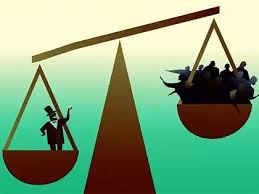
According to the report, the richest 1% now control over 40% of India’s total wealth, while the top 10% account for nearly 60% of national income. In contrast, the bottom 50% receive just 15%. “The share of the top 1% in wealth has increased from 36.5% in 2019 to 40.1% from 2022 onwards,” the report said, adding that the share of the bottom 50% declined from 6.8% to 6.4% during the same period.
The concentration of wealth is also reflected in the growing number of high-net-worth individuals. “The number of individuals with wealth above Rs 1,000 crore increased by 77% between 2019 and 2025,” the report said, noting that their combined wealth rose by 227%.
By 2025, 1,688 individuals held a total wealth of Rs 166 lakh crore, which is nearly half of India’s GDP. The report also observed that the wealth of the top 100 richest individuals rose from Rs 31 lakh crore in 2019 to over Rs 93 lakh crore in 2024, before settling at around Rs 88 lakh crore in 2025.
The gains at the top continued even during periods of broader economic disruption. “Billionaire wealth increased by 35% during the lockdown period,” the report said, pointing to trends during the COVID-19 pandemic when large sections of the population faced economic uncertainty and loss of income.
“In 2022 the number of people in the club only crept from 1,007 to 1,013 but their combined wealth crept to Rs 100 lakh crore. The world held its breath through inflation, rate hikes, geopolitical shocks while the super rich made super profits. Then came 2023, and the dam broke. Three hundred new entrants joined the four-figure-crore club in a single year and their combined wealth jumped to Rs 109 lakh crore,” it added.
At the same time, the report highlights rising financial pressures on households. It said that household debt increased from Rs 69.9 lakh crore in 2019-20 to Rs 136.6 lakh crore in 2024-25, adding that the share of debt in disposable income rose from 34.2% to 42.1%. This indicates that while wealth has expanded at the top, many households have seen an increase in borrowing relative to their income.
The report also draws attention to disparities in wealth distribution across social groups. “Nearly 90% of billionaire wealth is held by upper castes,” it said, noting that Scheduled Tribes have no representation among billionaires, Other Backward Classes hold less than 10%, and Scheduled Castes account for 2.6%. These figures point to uneven access to wealth accumulation across different sections of society.
Alongside these trends, the report flags policy-related concerns. It notes that banks have written off Rs 19.6 lakh crore in loans over the past 11 years. It also points to continued tax concessions for corporates and limited expansion in social sector spending, situating wealth concentration within a broader policy framework.
The report outlines possible measures to address these disparities. It states that “a 2% wealth tax on individuals with wealth above Rs 1,000 crore could generate Rs 3.32 lakh crore,” while a progressive wealth tax ranging from 2% to 6% could generate about Rs 4.67 lakh crore. It further estimates that “an inheritance tax could generate Rs 2.77 lakh crore annually, assuming a portion of wealth is transferred each year and taxed accordingly. Together, these measures could generate Rs 7.44 lakh crore annually.
According to the report, such resources could significantly expand public spending. “Public spending could expand to Rs 10.63 lakh crore annually” after accounting for multiplier effects, it said, noting that this is comparable to the combined allocation for sectors such as health, education, agriculture, housing and rural development in the Union Budget.
[Courtesy: The News Minute, an independent Indian digital news platform founded in 2014, headquartered in Bengaluru. It is known for investigative reporting, human rights coverage, and progressive journalism under editor-in-chief Dhanya Rajendran.]
❈ ❈ ❈
Inequality Is a Political Choice. A New Wealth Tracker Shows How India Could Do Better.
Anirban Bhattacharya, Raj Shekhar and Jacob Joshy
A 2%-6% progressive wealth tax on just the 1,688 ultra-rich families (with Rs 1,000+ crore wealth) along with a one-third inheritance tax, can give us enough to be able to spend Rs 10.63 lakh crore annually on the people.
Over the last decade, people are being simply told to survive without asking questions. No matter what the circumstance, it is the ordinary hardworking Indians who find themselves on the roads, standing in the winding queues.
Demonetisation, for instance, had forced the poor onto the streets as they queued up in front of banks – something that Dhurandhar tried to legitimise on the silver screens in the name of fighting terror. Six years ago, the pandemic-induced lockdown forced millions of workers from the unorganised sector to leave cities and return to their villages. People had hardly recovered when rising prices and stagnant wages burnt whatever remained of their savings and forced them into indebtedness. And yet again, the war on Iran by the US and Israel has meant that the poor in India are once again queuing up. This time for LPG. The worst hit are migrant workers in the unorganised sector in the cities. They are once again on the move to go to their villages.
The only advisory from the government amid the crisis is that we need to endure. In fact, in the latest Economic Survey too, our chief economic advisor had the same advice for us. He said that given the global uncertainty, we ought not to look for “fleeting comfort” (preya) and rather opt for “enduring good” (sreya). The people of the country should not look for “quick fixes to visible, short-term pressures”, but rather suffer dutifully.
The widening gap
The fortunes of those at the top, however, have been markedly different. Oiled and greased by the freebies from the government, they have seen their wealth swell over the same period of time. The ingredients are a generous scoop of corporate tax breaks, a liberal helping of write-offs amounting to nearly Rs 20 lakh crore in just about a decade, slicing up of the environmental laws, and garnishing of anti-labour rules and public sector enterprises being served on the plate for privatisation.
From opulent weddings to brazen political clout, from near complete control over media narratives to mind-numbing net worth figures, what we are witnessing today is truly unprecedented in free India. The number of dollar billionaires in India rose from only one in 1991 to over 358 by 2025. Today, just 1,688 individuals in India hold a net worth of Rs 1,000 crore or more, with their total cumulative wealth surpassing Rs 166 lakh crore, representing nearly 50% of India’s GDP!
It is this grotesque reality that the recently released Wealth Tracker India 2026 seeks to expose. If we look at the five richest families in the country, their wealth rose to about 400% of its original level in just six years – from the time of the COVID pandemic until now.
This, when the share of wealth of the bottom 50% has dropped from an abysmal 6.8% in 2019 to an even lower 6.4%. The government has made major claims about lifting 250 million people out of multidimensional poverty in the last decade – but behind such headlines are convenient changes in methodology. The MPI doesn’t, for instance, include income poverty, which is the standard measure used in India. So while we hide poverty, the super rich display their private forests and public apathy.
Why not tax the ultra rich?
As the gap widens at an obnoxious rate between those at the bottom and the handful at the top, the attempt made in the report is to give a sense of exactly what a minimal tax on these ultra rich can translate into in concrete terms if we were to convert their taxable net worth into what we really need.
Mukesh Ambani’s wealth swelled by 153% from 2019 till 2025. A 2% wealth tax on Ambani’s gains over those six years would have put a free laptop in the hands of every Class 10 student in the country – for three consecutive years. Universal maternity support – Rs 18,000 to 2.85 crore women – costs Rs 51,300 crore a year. Ambani’s 2% could have covered almost two years of it.
Again, Gautam Adani’s wealth alone ballooned by a whopping 625%. The same tax on his wealth could have funded two full years of primary healthcare for every Indian. Or clean air for nearly eight crore families most choked by pollution. Tax Savitri Jindal’s wealth at the same rate, and you could have kept ST students in school – pre-matric, post-matric – for nearly a decade.
The report argues that a 2%-6% progressive wealth tax on just the 1,688 ultra-rich families (with Rs 1,000+ crore wealth) along with a one-third inheritance tax, can give us enough to be able to spend Rs 10.63 lakh crore annually on the people. This, for instance, could translate into immediately increasing spending on health and education by 1% of GDP, and providing Rs 12,000/month pension (half of living wage) to all elderly (who currently receive a shameful Rs 200/month from the Union government).
While the government is reluctant to spend a dime more on social security and welfare, it is crucial that we articulate the demand for taxing the ultra rich in a language that connects with the masses. The compilation is designed to aid that process. More often than not the figures of lakhs of crores of wealth being amassed by the billionaires at an astonishing pace is difficult to even fathom. It is an attempt to make the demand for a wealth tax more tangible, more legible, something that we can all relate to in our day to day lives.
The juju of capital flight
Children in Bengal are often softened to sleep at night by mothers as they say, “Go to sleep, or juju will come!” What’s juju? One can say it’s a boogeyman, a made-up fear. Similarly, every time there is a talk of wealth tax, the response is the juju of capital flight. The most common argument against taxing the rich is that higher retained profits will translate into greater productive investment.
However, in India, rising corporate profitability has not been accompanied by a commensurate increase in employment-generating investment. Even the economic advisor has been seen lamenting the fact that the soaring profits of the corporates are hardly shared in the form of wages. This helps explain the persistence of unemployment and low-paying precarious jobs despite relatively high GDP growth. At the same time, India’s expenditure on research and development remains around 0.6% of GDP, with limited contribution from the private sector. This suggests that the rich elite India doesn’t want to channel their profits into long-term capacity building or technological upgrading, but on short-term financial returns. A wealth tax can in fact boost the economy by boosting demand from the bottom.
[Anirban Bhattacharya and Raj Shekhar are part of the Centre for Financial Accountability. Jacob Joshy is a PhD scholar at Jawaharlal Nehru University, Delhi. Courtesy: The Wire, an Indian nonprofit news and opinion website. It was founded in 2015 by Siddharth Varadarajan, Sidharth Bhatia and M. K. Venu.]
❈ ❈ ❈
Editorial addition: Below is the executive summary of the report:
Executive Summary
- In 2019, the share of wealth of the top 1% in India was 36.5% and that of the bottom 50% was 6.8%.
- From 2022 it holds steady at 40.1% for the top 1% and 6.4% for the bottom 50%.
- Between 2019 till 2025 individuals with 1000 crores and above in terms of headcount grew by 77%!
- In the same time period, their wealth grew by a staggering 227%!
- In 2019, their combined wealth was approximately ₹31 lakh crore. By 2025, it remains around ₹88 lakh crore
- The combined wealth of Mukesh Ambani, Gautam Adani & family, Savitri Jindal & family, Sunil Mittal & family, and Shiv Nadar increased by 400% from 2019 to 2025.
- Ambani’s wealth increased by 153% from 2019 to 2025 while Adani’s increased by a whopping 625%.
- Nearly 90% of all billionaire wealth in India was held by upper castes.
Wealth Tax Equivalents: What can we do with just 2%
- A 2% Wealth Tax on Ambani can translate into free laptops to approximately 1.85 crore Class 10 students three times!
- Providing ₹18,000 to 2.85 crore women would cost about ₹51,300 crore annually, meaning a 2% Wealth Tax on Ambani could finance nearly two years of universal maternity rights.
- A 2% Wealth Tax on Adani could fund over two years of primary healthcare services nationwide.
- A 2% Wealth Tax on Adani could translate into 87 crore free LPG cylinders.
- A 2% Wealth Tax on Jindal can fund nince years of Scheduled Tribe Scholarship and 14 years of Scheduled Caste Scholarlships.
2%–6% progressive wealth tax on 1688 ultra-rich families (with ₹1000+ crore wealth) + one-third inheritance tax = Government can spend ₹10.63 lakh crore annually on the people.
This can work wonders for the people:
Option 1: Strengthen Welfare
Immediately increase health spending by 1% of GDP + Increase education spending by 1% of GDP (Moving closer to our demand of 6% of GDP for both sectors) + Provide ₹12,000/month pension (half of the living wage) to all elderly (who currently receive a shameful ₹200/month from the central govt)
Option 2: Broader Economic & Social Support
Far from scrapping it, we can actually raise MGNREGA wages to ₹800/day + Spend 1.3% of GDP on climate adaptation + Ensure MSP for farmers + Run community kitchens amid the raging LPG crisis + Provide free air purifiers to 3 crore urban families.
[Executive Summary taken from: Wealth Tracker India 2026, https://www.cenfa.org.]