Regime Change in the Iran War, But Which One?
Jack Rasmus
March 4, 2026: Last June 2025 Trump bombed Iran. He said to eliminate Iran’s alleged nuclear weapons development. He then proclaimed he had achieved that goal. So what then is the War about now? What’s the US strategic objective? The endgame?
In the midst of the recent Epstein scandal, Israel’s Netanyahu a week ago visited the White House again demanding the US once more attack Iran. This time he demanded Trump and the US wipe out Iran’s ballistic missile capability, demand that Iran cut all ties with its proxy supporters in the region, dismantle its Revolutionary Guard units, and agree to turn over all its remaining domestic use nuclear fissionable materials.
Trump accommodated him. He mobilized a third of all US air force and naval assets to the region and engaged the Iranians in negotiations. He then declared publicly a ‘deal’ was imminent, and that Iranian negotiators reportedly agreed to all US-Israel demands on nuclear materials. Oman’s foreign minister, who hosted the negotiations, also publicly declared a deal was concluded by the parties on nuclear arms development. He had even prepared the final papers for the parties to sign. The signing was interrupted, however, as Trump ordered a massive military strike on Iran—once again in the midst of negotiations!
While Trump agreed to Netanyahu’s demands, he simultaneously ignored the advice of the US Joint Chiefs of Staff US admiral who advised him the US military could not guarantee a short and successful war with Iran. Not the news he wanted to hear. He and Netanyahu had already agreed to go to war. Trump promptly removed the admiral from his post!
Thus, once again the US went to war in the middle east on behalf of Israel. The objective was and remains regime change in Iran. Not nuclear arms development. Not even ballistic missile development. The objective was and is regime change.
The most fundamental strategic fact of this war is the following:
Trump wants a short war, two weeks or less. His talking heads pro-war retired generals appearing on US mainstream media daily—i.e. Kean, Kellogg and others—parrot the neocon-Zionist view that the war can be won in just two weeks, three at most. All it takes is a massive air campaign, decapitation of Iran leaders, and a call for a popular uprising to topple the Iranian regime. After all, it took less in Venezuela.
In contrast to the US-Trump-Netanyahu strategy of a short war, Iran plans a long war. It knows the longer the war, the weaker Trump and the US will get. Iran believes closing the strait of Hormuz will drive up oil prices, globally and in the US to unacceptable levels before the critical US Congressional elections in November. Higher oil prices will shock a US economy, barely growing 1.4% at the end of 2025 and a European economy virtually stagnant or in recession. Iran knows global oil prices at $100 a barrel in today’s economy will precipitate a global oil supply shock worse than that which occurred in 1973 and 1979, which led to deep recessions in both cases. Closing the strait of Hormuz, which Iran did immediately, will take at least 20% of global oil supply off the market. This will not only lead to domestic inflation and less real economic growth in the West, but will also likely lead to a sharp contraction in stock markets in the US, already showing recent signs of severe volatility. Higher oil prices, inflation and supply shocks will also likely ensure a further devaluation of the US dollar, which under Trump has already fallen by more than 10% this past year. A further devaluation may also in turn convince a number of other countries to accelerate their shift out of the US dollar as the global reserve currency. Gold and Silver prices will accelerate in turn faster than they have, after having quadrupled in 2025 under Trump.
In other words, a long war is the strategic goal of Iran and a short war the strategic goal of Trump.
And Trump’s short war thus far is not going well in terms of regime change. By assassinating Iran’s Supreme religious leader, Ali Khamenei, in the first US-Israel missile strike of the war two days ago Trump has made any uprising in Iran impossible. The Iranian government has not been destroyed. Nor has its Revolutionary Guard. Some military sites have been destroyed. So has a girls school where 100 elementary school children were murdered by an Israeli missile strike. Just think how Americans might react had some foreign power killed 100 American school kids with a missile! And it wasn’t likely an accident. US satellite surveillance can detect facial features on individuals from space; it certainly can determine if a building is a school or not.
If one may use a metaphor, the parties at war—i.e. US & Israel against Iran—are like two professional boxers, champions fighting for the big prize money. Venezuela was a lightweight fighting the US heavyweight for the title. It never even came out of its corner. But Iran is at least a light heavyweight, punching above its weight, as they say. It’s not so easily intimidated and has come out of its corner swinging.
The first round has been concluded. Trump got in some good jabs at first (with Israel is his corner pumping Trump up in his corner with encouragement like “you can go it champ, just go hit him in the head’): Some Iranian government official have been decapitated. Some military sites as well. All jabs not knock out blows. A low blow was dealt by Trump, killing school kids but the referee did not disqualify him. Trump even got in a good ‘right cross’ by killing Khamenei.
But Iran has also thrown some punches as well, although you’d never know it by the western media fight announcer. It has heavily damaged a number of the US military bases in Kuwait, Bahrain and Dubai in the Gulf. It has attacked US ships, requiring them to remain far offshore even if not hit. That means US aircraft if launched have to be refueled in return flight putting them in danger. Iran has also thrown some feints at Israel, sending some drones and old missiles. The idea is to deplete US and Israel anti-missile defenses in Israel which, once depleted, will be followed with tens of thousands of drones and more advanced missiles at some point. Those too are just jabs. But Iran has gotten in a good left hook as well: it has taken out the straight of Hormuz. Over time that ‘body blow’ will wreck havoc on US, Europe and the West’s economies in general. Iran is in no hurry. It plans to drive the US out of the Gulf states. It plans to turn up the long term heat on Trump the closer time gets to the November elections in the US. It plans a long war to Trump’s short one,
Iran is looking at a many months-long conflict, at least to the end of this year. Trump needs a a knockout blow in two or no more than three weeks.
Whoever’s time frame prevails determines who gets a regime change first—Iran or Trump! The US and Trump can’t get regime change without decapitating more of the Iranian government and the Revolutionary Guards and by the CIA engineering another uprising—not likely now that they assassinated Iran’s Supreme Religious leader, Khamenei, making him a martyr around which the country may mobilize. Trump made sure it was a religious war. Iran’s strategy is not tactical-military. It’s strategic, economic and US domestic election. Iran doesn’t need to ‘win’; it just needs to not lose. And to drag it all out as long as possible.
Trump may have his regime change in the end…but it may be his own regime not Iran.
That’s not all the consequences of a long term conflict. Some other consequences should the war in Iran prove long term (i.e. 12 months) instead of short (2 weeks):
The longer the war, the higher global oil prices and US inflation and the risk of US stock market declines and more US dollar devaluation. But also the higher the oil price the more oil revenue Russia can obtain. That will all but negate any of the recent US-Europe sanctions’ effect on reducing Russian oil revenue. The more Russian oil revenue, the more resources it has to continue the war in Ukraine successfully.
The longer the Iran war, the more dependent China becomes on Russian oil and the closer the two countries integrate their economies and deepen their political alliance. China obtained a significant amount of its oil from Iran. With the Hormuz straight closed, it must now (and has already announced) import even more oil from Russia.
The longer the war the more disruption to global supply chains become in general and the more that such a disruption—together with rising oil prices—the faster the US dollar will devaluate. The more the devaluation the faster other countries, led by the BRICS, will move toward introducing their own currency. No country wants to hold a currency devaluing by 15-20%. They’ll substitute it with Gold and Silver at first but then, out of a necessity, turn to a new currency arrangement. And as the dollar collapses, so will the US global economic empire’s decline accelerate.
A long war also means a European Economy, already in deep stagnation and losing competitively to US and China in global markets, will likely fall into recession. Natural gas prices in Europe, already wrecking havoc on European industry, will rise even higher as it gets most of it from Persian Gulf emirates.
The longer the conflict, the more likely Yemen will renew attacking shipping in the Red Sea and close off that other critical global shipping transit point as well. And the more likely that Hamas and Hezbollah will throw whatever resources they have left into what is already becoming a region wide war. They have nothing to lose if regime change occurs in Iran. So they’ll resume the fight against Israel intensely with whatever resources they have left. So too will pro-Iran religious forces in Iraq, which are considerable, and in Syria. Then there’s other Islamic nations like Pakistan, already favoring Iran.
A failed US-Israel regime change operation in the long run will all but ensure that Iran now will do all it can to renew development of nuclear weapons.
The Trump tactic of using negotiations as a deception to lull opponents into thinking a deal is possible, while a military strike is planned and then launched, is a regime change card that will likely never be played again after Iran. Trump may call for negotiations himself again at some point should the conflict continue for more than two weeks. Maybe even sooner. But Iran has already said it won’t negotiate with him again. Trump used negotiations as a deception tactic recently in Venezuela. It’s now a pattern in his bag of regime change tricks. But no one will trust the US again. Russia too will have second thoughts (if not already) about the purpose of Trump negotiations with about Ukraine. Negotiations with the US are never about a deal and always about deception, about buying time, until further military action is possible.
In summary, regime change has always been the objective of the US-Israel war on Iran. It’s now clearly out in the open. It’s what Netanyahu has always demanded of Trump. It’s what Zionist forces in Israel, and US Zionist billionaires who bankrolled Trump in 2024, have always been demanding. As history will someday no doubt reveal, Trump has agreed to Natanyahu’s demands—and did so even above the recommendations of his own US Joint Chiefs of Staff military advisor.
It all turns on how long the war in Iran lasts. Time is on the side of Iran. Trump thinks he can pull off another victory in Iran in the short run, as he did in Venezuela. But Iran is not Venezuela. It has greater stockpiles of weapons and missiles. It has advanced weaponry of its own. It has the assistance of Russia and China and more can be expected. Both countries have publicly declared Iran is strategic and that they will never let it fall. And, unlike what remains today of the Venezuelan government, Iran will no longer play the negotiations deception game, or capitulate, or give the US carte blanche whatever it demands.
Get ready for another ‘forever war’. This time Trump’s. But really Netanyahu’s.
[Jack Rasmus is author of The Scourge of Neoliberalism: US Economic Policy from Reagan to Trump, Clarity Press, January 2020. He blogs at jackrasmus.com and hosts the weekly radio show, Alternative Visions on the Progressive Radio Network. Courtesy: CounterPunch, an online magazine based in the United States that covers politics in a manner its editors describe as “muckraking with a radical attitude”. It is edited by Jeffrey St. Clair and Joshua Frank.]
❈ ❈ ❈
Iran Prepared for an Existential War. How Much Are Trump and Israel Willing to Gamble?
Jeremy Scahill and Murtaza Hussain
March 2, 2026: On Saturday, President Donald Trump went to TruthSocial to announce the U.S. and Israel had been successful in assassinating Iran’s Supreme Leader, Ayatollah Ali Khamenei. “Khamenei, one of the most evil people in History, is dead,” Trump wrote. “He was unable to avoid our Intelligence and Highly Sophisticated Tracking Systems and, working closely with Israel, there was not a thing he, or the other leaders that have been killed along with him, could do.”
The New York Times followed with a breathless account published Sunday purporting to tell the secret story of how the CIA and Israel hunted down Khamenei, “tracking him for months” and “gaining more confidence about his locations and his patterns,” before pinpointing his location so he could be killed. “People briefed on the operation described it as a product of good intelligence and months of preparations,” the report claimed.
Khamenei’s secret location, it turned out, was simply his office.
The U.S. and Israel have consistently claimed Khamenei was in hiding. “This is basically just fabricated drama to make Trump look bigger and more dramatic than he really is,” a senior Iranian official told Drop Site. He spoke on the condition of anonymity because he was not authorized to speak about internal matters.
Iran’s Supreme National Security Council “personally recommended to [Khamenei] that he relocate, change his workplace, and even adjust his living arrangements for safety reasons,” the Iranian official said. “But [Khamenei] had a completely different perspective on moving—he insisted on keeping things as normal and ordinary as possible, without seeking extra security measures or standing out in any way.”
Ali Larijani, the chair of Iran’s Supreme National Security Council said Iranian officials anticipated that the U.S. and Israel would target Khamenei. “They decided to strike him first. This analysis was also circulating among military circles—that they were pursuing exactly this objective,” he told Iranian state TV after Iran confirmed Khamenei was killed.
“This event is an extraordinarily bitter one for us,” Larijani added. “America and the Zionists, through this act, have effectively created a situation for Iran—for the Iranian people—that we must say: You have burned the heart of the Iranian people. We will burn your hearts in return.”
As of Sunday morning, the Iranian Red Crescent and state-linked media have reported preliminary casualty figures of over 200 people killed and more than 740 injured across Iran, though the actual toll is expected to be significantly higher. One strike on a girls’ elementary school in Minab killed 165, according to the state-run IRNA news agency.
Within hours of the U.S.-Israeli bombing, Iran began launching barrages of ballistic missiles at Israel in attacks that have so far killed at least 11 people and injured several hundred. On Sunday morning, an Iranian missile struck a building near Jerusalem, in an attack that is estimated to have killed at least nine people in a bomb shelter.
“The Islamic Republic of Iran considers bloodshed and revenge against the perpetrators and commanders of this crime as its legitimate duty and right, and will fulfill this great responsibility and duty with all its might,” Pezeshkian said Sunday in a statement carried on state TV.
Iran has also unleashed a series of sustained missile and drone attacks against U.S. military facilities across the Persian Gulf, striking the United Arab Emirates, Bahrain, Saudi Arabia, and Qatar, as well as targets in Jordan. The UAE reported three deaths and 58 minor injuries in Iranian strikes, with most of those impacted believed to be foreign workers. Dubai International Airport, the world’s busiest airline hub, was also damaged and partially shut down after an unidentified projectile struck one of its concourses. Two were also killed in Iraq and one in Kuwait.
The attacks have also drawn the first acknowledged U.S. military casualties of the war. In a statement early Sunday, U.S. Central Command announced that three American service members had been killed and five others seriously wounded during “Operation Epic Fury,” adding that several other additional personnel had sustained minor shrapnel injuries. The soldiers killed had been deployed to a base in Kuwait supporting the operation, U.S. officials told NBC News.
Iranian officials have said their initial response to the U.S.-Israeli bombing, while unprecedented in scope, did not represent the full force of Tehran’s potential retaliatory strikes.
Is a Diplomatic Solution Still Possible?
The Saturday strikes on Khamenei’s office wiped out the top echelon of Iran’s political and military structure and killed several of the late Supreme Leader’s family members. Iran, which has spent decades investing in a horizontal leadership structure to defend against this type of attack, announced a new leadership structure. Along with President Masoud Pezeshkian, Iran’s new interim leadership council includes Gholam-Hossein Mohseni-Ejei, the head of Iran’s judiciary, and Ayatollah Ali Arafi, a prominent member of Iran’s Guardian Council and Assembly of Experts—the body that is ultimately responsible for choosing the country’s Supreme Leader.
The White House said President Trump intends to speak with what a U.S. official called the “new potential leadership” of Iran in the coming days and Trump has suggested the war may be shorter in duration than he initially projected. “They want to talk, and I have agreed to talk, so I will be talking to them. They should have done it sooner. They should have given what was very practical and easy to do sooner. They waited too long,” Trump told The Atlantic. “They could have made a deal. They should’ve done it sooner. They played too cute.”
For now, Trump said in a post on Truth Social, “heavy” bombing would continue “uninterrupted throughout the week or, as long as necessary.”
In a pre-recorded message on Sunday afternoon, Trump said, “I once again urge the Revolutionary Guard, the Iranian military, police to lay down your arms and receive full immunity or face certain death. It will be certain death. Won’t be pretty. I call upon all Iranian patriots who yearn for freedom to seize this moment.”
Likewise, Israeli Prime Minister Benjamin Netanyahu said Israel would expand its strikes. “In the coming days, we will strike thousands of targets of the terrorist regime,” Netanyahu said in a video posted on social media. “We will create the conditions for the brave people of Iran to free themselves from the chains of tyranny.”
Trump said he still believes there will be an uprising in Iran spurred by the U.S.-Israeli bombings and assassinations. “I think it’s gonna happen,” Trump told the Atlantic.
“Everyone said that if Ali Khamenei is killed the people will come into the streets to overthrow the regime, and so far that has not happened. Some people have cheered, but overall the system is quite resilient,” said Sina Azodi, director of Middle East studies at Georgetown University. “One thing the Israelis have tried for the past two years is decapitating the top echelon of their enemy and expecting them to implode tomorrow. That works well against non-state actors, but not against a state actor that is quite resilient, has a constitution and other structures in place, and that in its early years already had to go through the experience of total war and leadership assassinations.”
Hooman Majd, an Iranian-American political analyst who served as an advisor to former Iranian President Mohammed Katami, said Iran has been preparing for major U.S.-Israeli attacks since the 12-day war last June, during which more than 1,000 Iranians were killed, including senior military commanders. “Their military leadership is quite deep in terms of both the regular army, the IRGC, and the Navy. They have an ability to sustain a war, perhaps even longer than the U.S. wants to,” Majd told Drop Site. “There will come a point at which Trump may decide Trump is the one who wants the off-ramp, not Iran.”
Majd said that if Iran decided to start targeting oil infrastructure in the Persian Gulf or completely shut off access to the Strait of Hormuz, the economic consequences would be significant. “A financial hit on America and Western Europe is something that nobody wants for a long period of time, certainly not Trump,” he said. “So there’s going to be an advantage for Trump to have [an off ramp]. But if he really believes that Iran is then going to come in and say, ‘Enough, we give up, whatever you want, we’ll do,’ that’s very unlikely.”
Iran, meanwhile, has said it remains open to diplomacy and has denounced the U.S. “deception” in the purported negotiations that preceded the bombings that began Saturday morning. Technical talks were scheduled for Monday in Vienna. Oman’s Foreign Minister, Badr Al Busaidi, the chief mediator of the talks between Iran and the U.S., said Sunday he had spoken with Iran’s Foreign Minister Abbas Araghchi. In a statement, Al Busaidi called for a ceasefire and said that Araghchi told him Iran was open “to any serious efforts that contribute to stopping the escalation and returning to stability.”
In an appearance Sunday on ABC’s This Week, Araghchi was asked by host George Stephanopoulos if a diplomatic resolution was still possible. “You answer this question,” Araghchi shot back. “We negotiated with the United States twice in the past 12 months. And in both cases, they attacked us in the middle of negotiation. And that has become a very bitter experience for us.”
Dr. Foad Izadi, a professor at the University of Tehran, said that Iranian forces still have not used their most powerful weapons systems, including its hypersonic and long-range ballistic missiles, in retaliatory strikes against Israel and U.S. bases and vessels in the region. If meaningful steps toward a ceasefire or a return to diplomatic talks do not emerge soon, he said, Iran is likely to intensify its military responses.
“[Iranian leaders] are getting this idea that you either use it or lose it. Iran has some capabilities and the other side is hitting these capabilities, so the sense is that Iran should use these capabilities as long as they remain available,” said Izadi, a prominent supporter of the Iranian government, in an interview with Drop Site. “They have to basically measure how much they can use, when they can use it, keeping in mind that they may not be able to access these stockpiles if they wait too long. But when you lose senior commanders, then sometimes making decisions on these issues becomes more difficult.”
Iran’s Strikes in the Gulf
The Gulf states have issued strong denunciations of “Iranian aggression” against them, while avoiding explicit demands for an end to the U.S. attacks that are being launched with the use of military and intelligence facilities on their soil.
“To the countries of the region: We are not seeking to attack you,” said Larijani, one of the central figures directing Iran’s current strategy. “When the bases located in your country are used against us, and when the United States carries out operations in the region relying on these forces, then we will target those bases. For these bases are not part of the land of those countries; rather, they are American soil,” he wrote on X.
But Iran has not only struck U.S. military facilities. It has also hit civilian airports in Kuwait, Bahrain, Abu Dhabi, and Dubai, as well as hotels and other buildings in the UAE and Bahrain. “We have begun targeting their military bases. They evacuated their bases and moved into hotels, turning civilians into human shields,” Araghchi charged in an interview with Al Jazeera. “We are trying to target only military personnel and facilities assisting U.S. operations against Iran.”
On Sunday, an Iranian strike also hit a port in Oman, the central mediator in the recent negotiations between Iran and the US. Araghchi said the strike was not intended as an attack on Oman and indicated that it was the result of pre-selected targets developed before the war began. “We have already told our Armed Forces to be careful about the targets that they choose,” he told Al Jazeera. “Our military units are now, in fact, independent and somehow isolated, and they are acting based on general instructions given to them in advance.”
The Kingdom of Saudi Arabia summoned the Iranian ambassador on Saturday and issued a statement condemning what it described as “cowardly Iranian attacks” targeting its territory. In a Sunday interview with CNN, United Arab Emirates Minister of State for International Cooperation Reem Al-Hashimy conveyed a similar combative stance, saying that the UAE won’t “sit idly by.” The UAE also said it had closed its embassy in Tehran and withdrawn its ambassador and diplomatic mission.
In an extraordinary meeting held via video conference on Sunday, the Gulf Cooperation Council (GCC) condemned “treacherous Iranian attacks” on GCC countries and Jordan and stated that it will take “all necessary measures to defend its security and stability,” including the option to “respond to the aggression.” The GCC said that attacks happened despite “repeated assurances that their territories would not be used to launch any attack” on Iran and urged for decisive action from the UN Security Council, “noting that the stability of the Gulf region is not only a regional concern but also a cornerstone of global economic stability and maritime navigation.”
Araghchi said that Iran’s Arab neighbors “should be angry at the United States and Israel,” adding, “They should not pressure us to stop this war; they should pressure the other side.”
Analysts have suggested that some of the targets hit by Iran in the opening phase of the war were selected because Iranian intelligence believed they housed Israeli intelligence and defense companies or personnel. The U.S. embassy in Bahrain evacuated government personnel from hotels and issued a warning for citizens to avoid hotels in the country after an Iranian strike on the Crowne Plaza Hotel in Manama.
“Right after the 12-day war, with the threat of a new regional conflict looming, Iran’s security and military agencies jointly put together a target bank that included potential strikes on American and Israeli personnel and forces if things escalated into a full-blown regional war,” the senior Iranian official told Drop Site. “The fact that they’ve now pinpointed the residences/locations of some of these forces has really caught the Americans and Israelis off guard. And yeah, the precision and targeting of these attacks are getting sharper and more focused by the day.” There has been no independent confirmation that any of the sites hit by Iran housed Israeli intelligence facilities or personnel.
“The UAE is host to a lot of Israeli intelligence companies, arms companies, and Iran considers those offices legitimate targets because they’re Israeli targets,” Izadi said. “The UAE government has allowed Israelis to basically have an unofficial base in different parts of UAE. Part of the Israeli operation against Iran is run out of the UAE. So Iran has been monitoring these places.”
On Sunday, the Israeli Broadcasting Authority reported that an Iranian drone struck an apartment inhabited by Israelis in Abu Dhabi near the Israeli embassy. The UAE is one of the only Muslim countries in the world to have normalized relations with Israel and officials from both countries often publicly celebrate their close ties.
Amid a wave of attacks on targets in the UAE including iconic buildings like the Burj al-Arab hotel, which was reportedly struck by a drone, multiple fires visible from satellite imagery also broke out at one of the berths at Jebel Ali Port after debris from what local authorities claimed was as an “aerial interception” struck the area. Jebel Ali is the largest container shipping port in the Middle East and a critical node in the Emirati economy. DP World, which operates the facility, announced that it was suspending operations at the port temporarily in response to the attack.
The leaders of France, Germany and the UK issued a joint statement Sunday that appeared to indicate they may get involved directly with the U.S.-Israeli war. “We will take steps to defend our interests and those of our allies in the region, potentially through enabling necessary and proportionate defensive action to destroy Iran’s capability to fire missiles and drones at their source,” they wrote. “We have agreed to work together with the US and allies in the region on this matter.“
Faced with an existential war, Iran has long signaled it could retaliate by striking the global economy—including by hitting oil facilities around the Persian Gulf. In addition to the attacks on Jebel Ali, at least two ships, including an oil tanker, in the strategically vital Strait of Hormuz were also hit by projectiles over the past 24 hours. The Iranian government has warned ships not to attempt to cross the strait, through which roughly 20% of global oil and gas production flows. As of Sunday, over 200 ships, including at least 150 oil and gas tankers, are estimated to have dropped anchor outside the waterway, while commercial traffic has plunged 70%. Oil prices have already risen by over 10% to over $80 a barrel and could rise above $100 in the event of further escalation.
“Iran’s strategy and only real option is to continue attacking and increase the costs on the Americans and U.S. allies. Part of that strategy of increasing costs means attacking the GCC countries but also hitting U.S. bases in the region. We have now seen the three Americans killed and the Iranians know that Americans are sensitive to casualties including in a midterm election year,” said Azodi. “For Iran, an ideal scenario might be to fight for three to four weeks after which there is no clear winner at the end—they are trying to increase pressure in every way. They cannot win the war but they can absorb a lot of punishment and can force it to stop.”
[Jeremy Scahill is a renowned investigative journalist, author, and co-founder of the independent outlet Drop Site News (launched 2024). Known for his work at The Intercept and for covering conflicts in Iraq, Afghanistan, Somalia, and Yemen, he has authored the international best-selling books “Dirty Wars: The World Is a Battlefield” and “Blackwater: The Rise of the World’s Most Powerful Mercenary Army.” Murtaza Hussain is a journalist. Courtesy: Drop Site News, an independent news portal on politics and war. It is founded by Ryan Grim, Jeremy Scahill, and veterans of The Intercept.]
❈ ❈ ❈
Iran Attacked by the US and Israel When Peace Was Within Reach
Bamo Nouri
February 27, 2026: US and Iranian negotiators met in Geneva earlier this week in what mediators described as the most serious and constructive talks in years. Oman’s foreign minister, Badr Albusaidi, spoke publicly of “unprecedented openness,” signalling that both sides were exploring creative formulations rather than repeating entrenched positions. Discussions showed flexibility on nuclear limits and sanctions relief, and mediators indicated that a principles agreement could have been reached within days, with detailed verification mechanisms to follow within months.
These were not hollow gestures. Real diplomatic capital was being spent. Iranian officials floated proposals designed to meet US political realities – including potential access to energy sectors and economic cooperation. These were gestures calibrated to allow Donald Trump to present any deal as tougher and more advantageous than the 2015 agreement he withdrew the US from in May 2018. Tehran appeared to understand the optics Washington required, even if contentious issues such as ballistic missiles and regional proxy networks remained outside the immediate framework. Then, in the middle of these talks, the bridge was shattered.
Sensing how close the negotiations were — and how imminent military escalation had become — Oman’s foreign minister, Badr Albusaidi, made an emergency dash to Washington in a last-ditch effort to preserve the diplomatic track.
In an unusually public move for a mediator, he appeared on CBS to outline just how far the talks had progressed. He described a deal that would eliminate Iranian stockpiles of highly enriched uranium, down-blend existing material inside Iran, and allow full verification by the International Atomic Energy Agency (IAEA) — with the possibility of US inspectors participating alongside them. Iran, he suggested, would enrich only for civilian purposes. A principles agreement, he indicated, could be signed within days. It was a remarkable disclosure — effectively revealing the contours of a near-breakthrough in an attempt to prevent imminent war.
But rather than allowing diplomacy to conclude, the US and Israel have launched coordinated strikes across Iran. Explosions were reported in Tehran and other cities. Trump announced “major combat operations,”, framing them as necessary to eliminate nuclear and missile threats while urging Iranians to seize the moment and overthrow their leadership. Iran responded with missile and drone attacks targeting US bases and allied states across the region.
What is most striking is not merely that diplomacy failed, but that it failed amid visible progress. Mediators were openly discussing a viable framework; both sides had demonstrated flexibility – a pathway to constrain nuclear escalation appeared tangible. Choosing military escalation at that moment undermines the premise that negotiation is a genuine alternative to war. It signals that even active diplomacy offers no guarantee of restraint. Peace was not naïve. It was plausible.
Iran’s approach in Geneva was strategic, not submissive. Proposals involving economic incentives – including energy cooperation – were not unilateral concessions but calculated compromises designed to structure a politically survivable agreement in Washington. The core objective was clear: constrain Iran’s nuclear programme through enforceable limits and intrusive verification, thereby addressing the very proliferation risks that sanctions and threats of force were meant to prevent.
Talks had moved beyond rhetorical posturing toward concrete proposals. For the first time in years, there was credible movement toward stabilising the nuclear issue. By attacking during that negotiation window, Washington and its allies have not only derailed a diplomatic opening but have cast doubt on the durability of American commitments to negotiated solutions. The message to Tehran – and to other adversaries weighing diplomacy – is stark: even when talks appear to work, they can be overtaken by force.
Iran is not Iraq or Libya
Advocates of escalation often invoke Iraq in 2003 or Libya in 2011 as precedents for rapid regime collapse under pressure. Those analogies are misleading. Iraq and Libya were highly personalised systems, overly dependent on narrow patronage networks and individual rulers. Remove the centre, and the structure imploded.
Iran is structurally different. It is not a dynastic dictatorship but an ideologically entrenched state with layered institutions, doctrinal legitimacy and a deeply embedded security apparatus, including the Islamic Revolutionary Guard Corps. Its authority is intertwined with religious, political and strategic narratives cultivated over decades. It has endured sanctions, regional isolation and sustained external pressure without fracturing.
Even a previous US-Israeli campaign in 2025 that lasted 12 days failed to eliminate Tehran’s retaliatory capacity. Far from collapsing, the state absorbed pressure and responded. Hitting such a system with maximum force does not guarantee implosion; it may instead consolidate internal cohesion and reinforce narratives of external aggression that the leadership has long leveraged.
The mirage of regime change
Rhetoric surrounding the strikes has already shifted from tactical objectives to the language of regime change. US and Israeli leaders framed military action not solely as neutralising missile or nuclear capabilities, but as an opportunity for Iranians to overthrow their government. That calculus – regime change by force – is historically fraught with risk.
The Iraq invasion should be a cautionary tale. The US spent more than a decade cultivating multiple Iraqi opposition groups – yet dismantling the centralised state apparatus still produced chaos, insurgency and fragmentation. The vacuum gave rise to extremist organisations such as IS, drawing the US into years of renewed conflict.
Approaching Iran with similar assumptions ignores both its institutional resilience and the complexity of regional geopolitics. Sectarian divisions, entrenched alliances and proxy networks mean that destabilisation in Tehran would not remain contained. It could rapidly spill across borders and harden into prolonged confrontation.
A region wired for escalation
Iran has invested heavily in asymmetric capabilities precisely to deter and complicate external intervention. Its missile, drone and naval systems are embedded along the Strait of Hormuz — a chokepoint for global energy — and linked into a network of regional allies and militias.
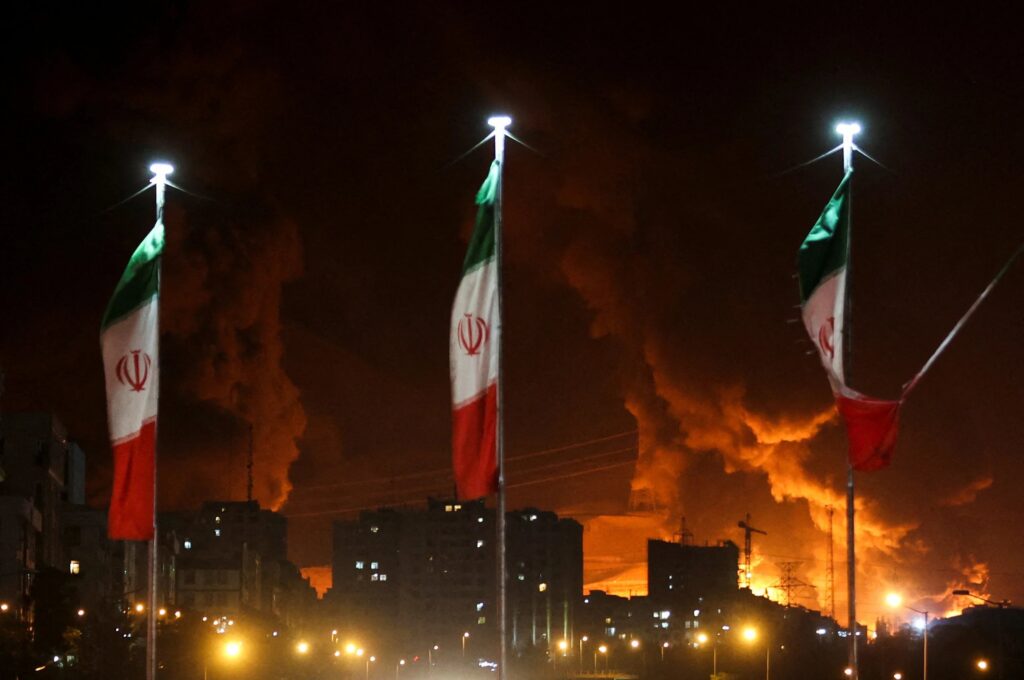
In the current escalation, Tehran has already launched retaliatory missile and drone strikes against US military bases and allied territories in the Gulf, hitting locations in Iraq, Bahrain, the United Arab Emirates (including Abu Dhabi), Kuwait and Qatar in direct response to US and Israeli strikes on Iran’s cities, including Tehran, Qom and Isfahan. Explosions have been reported in Bahrain and the UAE, with at least one confirmed fatality in Abu Dhabi, and several bases housing US personnel have been struck or targeted, underscoring how the conflict has already spread beyond Iran’s borders
A full-scale regional war is now more likely than it was a week ago. Miscalculation could draw multiple states into conflict, inflame sectarian fault lines and disrupt global energy markets. What might have remained a contained nuclear dispute now risks expanding into a wider geopolitical confrontation.
What about Trump’s promise of no more forever wars?
Trump built his political brand opposing “endless wars” and criticising the Iraq invasion. “America First” promised strategic restraint, hard bargaining and an aversion to open-ended intervention. Escalating militarily at the very moment diplomacy was advancing sits uneasily with that doctrine and revives questions about the true objectives of US strategy in the Middle East.
If a workable nuclear framework was genuinely emerging, abandoning it in favour of escalation invites a deeper question: does sustained tension serve certain strategic preferences more comfortably than durable peace?
Trump’s Mar-a-Lago address announcing the strikes carried unmistakable echoes of George W. Bush before the 2003 invasion of Iraq. Military action was framed as reluctant yet necessary – a pre-emptive move to eliminate gathering threats and secure peace through strength. The rhetoric of patience exhausted and danger confronted before it fully materialises closely mirrors the language Bush used to justify the march into Baghdad.
The parallel extends beyond tone. Bush cast the Iraq war as liberation as well as disarmament, promising Iraqis freedom from dictatorship. Trump similarly urged Iranians to reclaim their country, implicitly linking force to regime change. In Iraq, that fusion of shock and salvation produced not swift democratic renewal but prolonged instability. The assumption that military force can reorder political systems from the outside has already been tested – and its costs remain visible.
The central challenge now facing the US is not simply Iran’s military capability. It is credibility. Abandoning negotiations mid-course signals that diplomacy can be overridden by force even when progress is visible. That perception will resonate far beyond Tehran.
Peace was never guaranteed. It was limited and imperfect, focused primarily on nuclear constraints rather than human rights or regional proxy networks. But it was plausible – and closer than many assumed. Breaking the bridge while building it does more than halt a single agreement – it risks convincing both sides that negotiation itself is futile.
In that world, trust erodes, deterrence hardens and aggression – not agreement – becomes the default language of international power. What we are witnessing is yet another clear indication that the rules-based order has been consigned to the history books.
[Bamo Nouri is an Honorary Research Fellow, Department of International Politics, at City, St George’s, University of London. Courtesy: The Conversation, an Australia-based nonprofit, independent global news organization dedicated to unlocking the knowledge of experts for the public good.]
❈ ❈ ❈
The US/Israeli Attack Was to Prevent Peace Not Advance It
Michael Hudson
Last Friday, the mediator of the U.S. and Iranian nuclear negotiations in Oman, that country’s foreign minister Badr Albusaidi, pulled the rug out from President Trump’s deceptive pretense, threatening war with Iran because it had refused his demands that it give up what he claimed was its drive to build its own atom bomb. The Omani foreign minister explained on CBS’s Face the Nation that the Iranian team had agreed not to accumulate enriched uranium and offered “full and comprehensive verification by the IAEA.”
This new concession was a “breakthrough that has never been achieved any time before. And I think if we can capture that and build on it, I think a deal is within our reach” to achieve an “agreement that Iran will never, ever have a nuclear material that will create a bomb. This is, I think, a big achievement.”
Pointing out that this breakthrough “has been missed a lot by the media,” he emphasized that by calling for “zero stockpiling,” it went far beyond what had been negotiated during President Obama’s administration, because “if you cannot stockpile material that is enriched, then there is no way you can actually create a bomb.”
Ayatollah Ali Khamenei – who already had issued a fatwa against doing any such thing, and had repeated this position year after year – called Iran’s Shi’a leaders and military chief to discuss ratification of the agreement to cede control of its enriched uranium in order to prevent war.
But any such capitulation was precisely what neither the United States nor Israel could accept. A peaceful resolution would have prevented the long-term U.S. plan to consolidate and weaponize its control over Middle Eastern oil, its transportation and the investment of its oil export revenues, and to use Israel and al Qaeda/ISIS as its client armies to block independent oil-producing countries from acting in their own sovereign interests.
Israeli intelligence apparently alerted the U.S. military to suggest that the meeting at the Ayatollah’s compound offered a great chance to decapitate the leading decision makers all together. This followed the U.S. military handbook advice that killing a political leader whom the U.S. deems to be undemocratic will liberate popular dreams of regime change. That was the hope of bombing President Putin’s country residence last month, and it was in line with the U.S. recent Starlink attempt to mobilize popular opposition for revolution in Iran.
The joint U.S.-Israeli attack makes it clear that there is nothing that Iran could have conceded that would have deterred the long-standing U.S. drive to control Middle Eastern oil and using Israel and ISIS/Al Qaeda client armies to prevent sovereign nations in the region from emerging to take control of their oil reserves. That control remains an essential arm of U.S. foreign policy. It is the key to the U.S. ability to hurt other economies by denying them access to energy if they do not adhere to U.S. foreign policy. This insistence on blocking the world’s access to energy sources not under American control is why the U.S. has attacked Venezuela, Syria, Iraq, Libya and Russia.
The attack on negotiators (the second time America has done this to Iran) is a perfidy that will go down in history. It was to prevent Iran’s intended move to peace, before its leaders could have disproven Trump’s false claim that Iran had refused to give up its desire to obtain its own atom bomb.
It would be interesting to know how many of Trump’s insiders placed big bets that oil prices will soar when markets open on Monday morning. The markets last week were vastly underestimating the risk of closing the Straits of Hormuz and the Oil Gulf. U.S. oil companies will make a killing. China and other oil importers will suffer. U.S. financial speculators also will make a killing, because their oil production is domestic. This fact may even have played a role in the U.S. decision to end the world’s access to Middle Eastern oil for what promises to be a lengthy period.
The trade and financial disruption, in fact, will be so worldwide that I think we can think of Saturday’s attack on Iran as the true trigger of World War III. For most of the world, the imminent financial crisis (to say nothing of the moral outrage) will define the next decade of international political and economic restructuring.
European, Asian and the Global South countries will be unable to obtain oil except at prices that make many industries unprofitable and many family budgets unaffordable. The rise in oil prices will also make it impossible for Global South countries to service their dollar debts falling due to Western bondholders, banks and the IMF.
Countries can save themselves from having to impose domestic austerity, currency depreciation and inflation only by recognizing that the U.S. attack (supported by Britain and Saudi Arabia, with ambiguous Turkish acquiescence) had ended the U.S. unipolar order – and with it the dollarized international financial system. If this is not recognized, acquiescence will continue until it becomes unsustainable in any case.
[This article is an extract. Michael Hudson is a research professor of Economics at University of Missouri, Kansas City, and a research associate at the Levy Economics Institute of Bard College. His latest book is The Destiny of Civilization. Courtesy: CounterPunch, an online magazine based in the United States that covers politics in a manner its editors describe as “muckraking with a radical attitude”. It is edited by Jeffrey St. Clair and Joshua Frank.]
❈ ❈ ❈
In another article on the US war on Iran, “Israel and the United States Cannot Win the War Against Iran”, Vijay Prashad posts a moving poem by the Iranian poet Behzad Zarrinpour:
The Iranian people know war very well. It has been imposed on them repeatedly, from the Anglo-Persian War (1856–1857) to the Iraqi invasion (1980) to the current hybrid war.
In the poem ‘Lidless Coffins with No Bodies’, the Iranian poet Behzad Zarrinpour (born 1968) wrote about the terror of war, a terror that was inflicted by Bush’s ‘terrible mistake’. I want to share a part of that beautiful and impactful poem with you:
The Wind has filled the city’s nostrils
with destruction’s odour.
No one flees the harsh sun
For the gentleness of unstable walls.
Spread-out inhospitable tablecloths,
Empty promises,
Stomachs that instead of bread
Eat bullets,
And bankrupt salt sellers
Who have dispatched their gunnysacks
To the war front to be swelled with sand.
Grandmother’s tongue is so terror-struck
She cannot remember her prayers.
[Courtesy: Tricontinental: Institute for Social Research, an international, movement-driven institution focused on stimulating intellectual debate that serves people’s aspirations.]
❈ ❈ ❈
Mass Movement Mobilizes Against Trump’s War on Iran
Mark Gruenberg
As Donald Trump and Benjamin Netanyahu launched an all-out war on Iran on February 28, progressive anti-war groups sprang into action against it, starting that afternoon.
They staged mass mobilizations in the streets and demanded people flood the phones to Capitol Hill, opposing the carnage of Trump’s “Operation Epic Fury.”
Epic fury hit Iran, starting at 1:15 a.m. Eastern Time. U.S. and Israeli warplanes launched massive assaults at the orders of President Trump and his rightist ally, Israeli Prime Minister Netanyahu.
Droves of U.S. protesters responded, as grass-roots organizations mobilized thousands of people from Maine to Hawaii to campaign against the carnage and demand Congress halt it. Demonstrations began around noon local time on February 28, with organizers planning further rallies through March 2.
Prime march sites on that first day ranged from Bangor, Maine, and New York City to Federal Plaza in Chicago, plus in front of the White House and in Miami, Los Angeles, San Diego, Seattle, the Twin Cities, St. Louis, and Kapolei, Hawaii, among others.
Demonstrations were planned for Springfield, Mo., and six other cities on March 1 and Anchorage and Cleveland, plus others, including a second protest in Chicago—at Ida B. Wells Drive and Michigan Avenue—on March 2.
The U.S. and Israeli military said their combined forces hit more than 500 targets in 28 of Iran’s 31 provinces, including airfields, Islamic Revolutionary Guard command and control centers, ballistic missile and drone launch sites, military airfields, and Iranian air defense systems.
But they also hit a girls’ elementary school in Minab in southern Iran. At least 50 girls died, and even more were injured. The Iranian Red Crescent said the nationwide death toll was at least 270 and counting, with double that number injured. The deaths of U.S. troops number at least four.
Trump has dropped his claims of concerns about control of nuclear capabilities, replacing them with calls for regime change in Iran. He bragged that the Supreme Leader of Iran, Ali Khamenei, and top government officials have been killed in his attacks. Iran’s official Fars News Agency confirmed that Khamenei, his daughter, son-in-law, and granddaughter were killed.
The launch of the war and the mass casualties catapulted many groups, including unions, the Democratic Socialists of America, the Progressive Democrats of America, J Street, MoveOn, and the Friends Committee on National Legislation, among others, into the streets.
Progressives denounced the war as a manifestation of U.S. and Israeli imperialism, and worse. Besides protests, the Progressive Democrats posted Congress’s switchboard number, 202-224-3121, for connections to lawmakers
New York City Mayor Zohran Mamdani spoke out strongly against the war.
“Today’s military strikes by the United States and Israel mark a catastrophic escalation in an illegal act of war of aggression,” Mamdani said. “Bombing cities, killing civilians, opening up a new theater of war–Americans do not want this. Americans do not want another war in pursuit of regime change. We want an answer to the affordability crisis. We want peace.”
Jeremy Ben-Ami, president of the pro-peace Jewish group J Street, added: “The president is starting this war with no clear plan for achieving his goal, without a comprehensive discussion with the American public about the risks and alternatives; and illegally, without first seeking authorization from Congress or a mandate from the international community.”
J Street is the growing counterweight to the notorious American Israel Public Affairs Committee (AIPAC), a longtime lobbying heavyweight and staunch supporter of Netanyahu and the Israeli far-right. It’s a key piece of the GOP’s right-wing lobbying complex.
While calling Iran “a real security challenge” to both Israel and the U.S., “Iran does not present an imminent threat that requires launching a ‘preventive’ war,” added Ben-Ami.
But Trump and Netanyahu bombed Iran for 12 days last July, drawing a strong denunciation then from the independent United Electrical Workers. That still stands.
“Threats or use of military force are still a regular feature of U.S. foreign policy, under presidents of both major parties,” UE President Carl Rosen and other union officers said then in part. “All of this is done at the expense of the needs of working people in the U.S. and throughout the world.”
UE called Netanyahu’s warnings about Iran’s nuclear potential “a line” the Israeli chief “trots out every time” he wants U.S. support for his aggression. Netanyahu repeated that reason for this bombing, too.
And a decade ago, in a convention resolution, the AFL-CIO publicly repudiated its prior unconditional support of U.S. wars.
“It is vital that the workers and our unions promote a foreign policy independent of the political interests and foreign policy of Wall Street and corporate America,” the resolution said in part.
“Therefore, be it resolved, the AFL-CIO promotes and advocates for a foreign policy based on international solidarity of all workers, mutual respect of all nations and national sovereignty, and calls upon the president and Congress to make war truly the last resort in our country’s foreign relations, and that we seek peace and reconciliation wherever possible.”
Congressional foes were also outraged and demanded an immediate vote on curbing Trump, even if he vetoes a successful anti-war resolution.
They demanded the war stop, and that Congress halt it by passing a bipartisan War Powers resolution sponsored by Sens. Tim Kaine, D-Va., Chris Van Hollen, D-Md., and Rand Paul, R-Ky., and Reps. Thomas Massie, R-Ky., and Ro Khanna, D-Calif.
And the progressives and congressional sponsors demanded lawmakers return to D.C. immediately for votes on the measures. “This is not ‘America First,’” libertarian Massie, a frequent Trump foe, tweeted on X.
Sen. Andy Kim, D-N.J., called on senators to “vote immediately” on Kaine’s version of a war powers resolution.
“Trump once again started a cycle of violence that has already escalated and could spiral out of control,” Kim tweeted on X. “This is unacceptable.”
Anti-invasion Rep. Warren Davidson, R-Ohio, an Army veteran, tweeted: “Surely Congress can be troubled with a vote? Surely any administration can define the mission? Or, more of the same, ‘as much as it takes, as long as it takes’ in another place?” The “as long as it takes” quote was from Trump.
But proponents of the curbs do not yet have enough votes on Capitol Hill to pass the measures, which is where the public pressure would come to the fore.
Initially, as usual, the overwhelming majority of congressional Republicans—and their leaders—cheered the war on. So did renegade Sen. John Fetterman, D-Pa., and, reportedly, three congressional Democrats who always agree with Netanyahu.
And any War Powers resolution would still leave Trump’s troops in the region poised for more attacks and atrocities for 60-90 days, if lawmakers passed that resolution and he signed it, which he won’t.
[Award-winning journalist Mark Gruenberg is head of the Washington, D.C., bureau of People’s World. He is also the editor of the union news service Press Associates Inc. (PAI). Known for his reporting skills, sharp wit, and voluminous knowledge of history, Mark is a compassionate interviewer but tough when going after big corporations and their billionaire owners. Courtesy: People’s World, a voice for progressive change and socialism in the United States. It provides news and analysis of, by, and for the labor and democratic movements.]