❈ ❈ ❈
With the Waqf Bill, the State Brings a Legal Bulldozer to Minority Rights
Ghazala Jamil
For generations, waqf properties have defined the broad contours of Muslim public life – supporting education, healthcare, burial grounds and modest religious establishments in both rural and urban India. These were never just “assets”: they are a form of collective autonomy and faith-based care.
By centralising control, removing recognition of long-term customary usage, and making registration and documentation the litmus test of legality, the state is creating the perfect conditions for dispossession without appearing coercive.
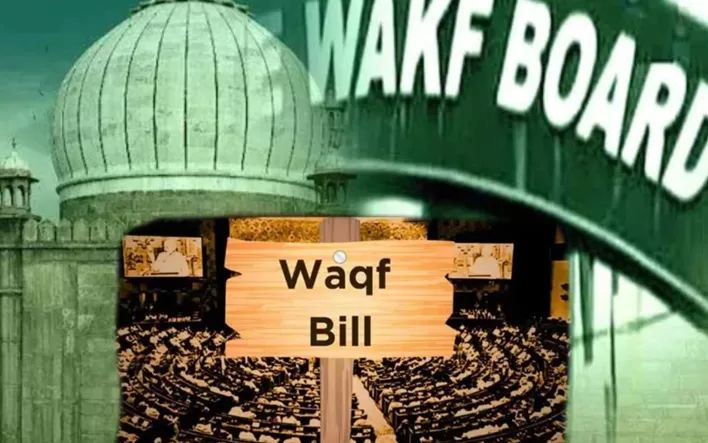
While the Waqf (Amendment) Bill, introduced in Lok Sabha on Wednesday, itself was signalled by Bharatiya Janata Party supporters and leaders as a tool of land-grab and an intention to humiliate Muslims, the Joint Committee report assessing the proposed legislation did little to reassure the community when it submitted its report in January.
Its enthusiastic endorsement of the Bill, in spite of the concerns expressed by State Waqf Boards, civil society groups and legal experts, reads less like a balanced assessment and more like a green light for undermining community control over its faith-based welfare practices.
Fiction of consultation
The report boasts of receiving over 92 lakh memoranda and conducting numerous study visits. Yet, its findings systematically override the most serious objections brought to its attention. Nearly all major Waqf Boards opposed the renaming of the Act and the encroachment of executive power into religious affairs. They also criticised the proposed removal of the “waqf by user” doctrine, which recognises properties as charitable endowments if they have been used continuously for community good, even if formal documentation is not available.
These objections are acknowledged by the committee – only to be dismissed in bureaucratic language. The report thus untakes a form of consultation without its substance – a classic case of manufactured consensus. Dissent is included as spectacle but excluded from outcome.
The report presents itself as a comprehensive, consultative and rational response to longstanding challenges in waqf administration. On closer reading, however, it reveals itself as a document of political obfuscation – one that hides a sweeping reconfiguration of religious governance.
Far from being a neutral assessment of the Bill, the report reads like a meticulously crafted defence of state centralisation, one that is disturbingly comfortable eroding the constitutional and theological foundations of Muslim religious endowments.
Ideologically loaded history
As with all agenda driven by the BJP, several features of the historical framing of waqf in the report suggest a subtle but clear ideological positioning behind the facade of neutrality.
It emphasises centralised control during the period of so-called Muslim rule, with the monarch as the supreme authority. This sets up the narrative that strong, centralised governance of waqf is not only administratively desirable but historically authentic, paving the way to legitimise state overreach today.
Sanitising the portrayal of colonial interference, the report portrays the British era largely as a phase of decentralisation and reform, with legal frameworks introduced to manage religious endowments. However, the report avoids critically acknowledging how colonial courts often deliberately distorted or misunderstood Islamic law.
This erasure allows the report to frame colonial legislation as a neutral administrative step, not as a disruption of indigenous religious governance.
Worst, perhaps, is the report characterising the post-Independence era of waqf administration as negligence. The report repeatedly uses language such as “poor record-keeping”, “mismanagement” and “corruption” to declare waqf primarily as a failed welfare institution. This sets the stage for the current regime to claim that it must step in as the rational, modernising actor.
The report repeatedly describes waqf properties as “underutilised assets” that could be developed for housing, shopping complexes and markets. While the Waqf Act, 1995, already allowed for development under certain conditions, the report leans heavily on this framing. It aligns waqf property with mere economic utility rather than its religious or communal value.
Technocratic and communal capture
This clever trick of the report attempts to shift how waqf is understood – from a religious institution rooted in faith and community, to a bureaucratic system managed like real estate – without ever admitting that such a major change is taking place.
Waqf, as a religious endowment, has a specific legal and theological architecture rooted in Islamic jurisprudence. The report’s defence of renaming the Waqf Act with the vacuous acronym UMEED (Unified Waqf Management, Empowerment, Efficiency and Development) is more than a symbolic erasure. In Hindi and Urdu, umeed means hope.
The report signals that the government’s intention is only to approach waqf as a problem of logistics, property management and bureaucratic efficiency. This strips it of its distinct religious logic and converts it into a state-supervised real-estate portfolio.
In doing so, the report aligns with a majoritarian-technocratic ideology through which this regime has been instrumentalising administrative reasoning to undermine moral and theological authority of a community. This is not mere “reform” – it is a paradigmatic shift that subordinates a religious institution to the operational codes of neoliberal governance.
A provision in the Bill that requires a Muslim who wishes to dedicate their property as waqf to prove they have been practising Islam for five years. There is nothing in Islam, either in theology, jurisprudence (fiqh) or ritual practice, that mandates a five-year requirement of being a Muslim before a person can access religious duties, rights, or legal capacities.
The introduction of such a test is arbitrary. It is an innovation that reeks of stale majoritarian anxieties about conversion.
Data extractivism
One of the most insidious aspects of the Bill, applauded without critique in the report, is the provision for a centralised portal and database managed by the Central government. This digital centralisation of all waqf properties – complete with registration, accounts, and audits – is presented as a tool for transparency. But in practice, it creates the infrastructure for massive data harvesting and surveillance of Muslim institutional life.
There is no corresponding provision for such a database for Hindu religious endowments or Christian charitable trusts. The discriminatory singling out of Muslim properties for this kind of datafication betrays the majoritarian anxieties that animate the Bill.
The report makes no effort to address the constitutional implications of this asymmetry – namely, the unequal treatment of religious denominations under the pretext of reform.
Moreover, once data is centrally stored and managed, the community loses even the residual control it has over the information ecology of its religious properties. In a time of escalating Islamophobia, it is dishonest to frame this as a neutral act. It is nothing but a form of digital disenfranchisement and dispossession.
Legal contortions
The report endorses provisions that directly contravene constitutional guarantees under Article 26 of the Constitution, which guarantees religious denominations the right to manage their own affairs in matters of religion. The inclusion of non-Muslims on Waqf Boards and the transfer of core responsibilities from waqf institutions to district collectors reflects a legal imagination in which the state reserves the right to define and reconfigure the religious affairs of minorities.
This logic inverts the foundational principle of the Constitution – that the state should maintain a principled distance from religious affairs. Instead, it installs the state as arbiter and executor, displacing community-based legal reasoning and erasing the possibility of internal self-regulation. The philosophical consequence is the domestication of religion under state sovereignty. A deeply colonial idea is now dressed in the garb of digital governance and managerial expertise.
It will be important to remember that this process is occurring at a time when it is impossible to convincingly defend Indian bureaucracy for being ideologically neutral. Its record in recent years – particularly the spate of punitive demolitions targeting Muslim homes and businesses, often following communal targeting of Muslims – makes it clear that administrative authority is being used in selective and partisan ways. Despite clear violations of due process, these actions have not been effectively restrained by any court of law.
In this context, the reassignment of critical waqf-related decisions – such as property survey, mutation, and encroachment – to district officials is not just an administrative move; it is a shift in power toward a machinery that has repeatedly and aggressively demonstrated its unwillingness to treat Muslim citizens with fairness.
Political project
Perhaps most telling is the way the report deals with the clause on “waqf by user”. This long-standing recognition of religious usage over time, even without formal documentation, is a core feature of Islamic charitable tradition. Its removal, the report argued, is to prevent abuse and misclassification.
What it actually does is open the floodgates for the appropriation of religious spaces held in the hands of poor and marginalised communities with limited documentation.
The state argues and the report endorses the claim that that ownership must be proven through deeds, legal title and state processes, even though the institution and tradition of waqf pre-dates these mechanisms by centuries. To enforce such rigid property norms is to forcibly fold waqf properties into a narrow capitalist property regime that is quite its very opposite.
Innumerable Waqf properties have actually been lost to the community through political interference and some of the biggest encroachers of waqf land are government departments. The earlier legislations contained responses to some of those concerns which have been voiced from within the Muslim community itself, demanding more transparency and better oversight. The Waqf (Amendment) Bill instrumentalises these concerns to justify a sweeping transfer of power from the community to the state.
The removal of “waqf by user”, the expanded authority of district collectors and the centralised database all point not to a strengthening of accountability mechanisms but to a consolidation of state power over Muslim endowments. In doing so, the state conflates dysfunction with illegitimacy and treats administrative shortcomings as a reason to deny the community its right to manage its own religious property.
The proposed amendments to the Waqf Act represent in reality a systematic weakening of a community’s right to manage, defend, and retain its own religious and charitable properties.
The Waqf Bill reflects the ideology of a state that no longer conceives of minorities as autonomous communities with the right to govern their religious institutions. It reflects a shift in state-religion relations: replacing constitutional secular accommodation of minority institutions to a regime of disenfranchisement and communal impoverishment, unhoming and land grab.
(Ghazala Jamil is an Assistant Professor at the Centre for the Study of Law and Governance, Jawaharlal Nehru University. Courtesy: Scroll.in, an Indian digital news publication, whose English edition is edited by Naresh Fernandes.)
❈ ❈ ❈
A Mad Government’: Ambedkar’s Warning Rings as Modi Dispensation Amends Waqf Legislation
S.N. Sahu
The Waqf Amendment Bill, 2024, scripted by the Modi regime and passed by both the Houses of parliament militates against the constitution at a time when its 75th anniversary is being celebrated.
Orchestrated utterances by BJP leaders inside both the Houses – that the Bill is beneficial to the Muslim community – sound hollow in the context of their deafening silence when blood curdling calls were issued by several top BJP functionaries from the so called Dharm Sansads (religious parliaments) for genocide of Muslims and their comprehensive economic boycott.
Therefore, the Waqf Amendment Bill after its enactment on getting the assent of President Draupadi Murmu would be part of the instrumentality of law devised by the Modi regime to target Muslims and their moveable and immoveable Waqf properties.
It is now part of the BJP’s pattern of assaulting Muslims. It has used ‘love jihad’ legislations in several BJP-ruled states and other intimidatory formulations such as land jihad and UPSC jihad. Such coercion of Muslims caused by actions of the state amount to the declaration of ceaseless hostility towards them.
The situation is evocative of fears expressed by Dr. B.R. Ambedkar who while speaking in the Constituent Assembly on the Objectives Resolution on December 17, 1946, remarked with sadness that several leaders of that time who spewed venom against Muslims talked of launching a war against them and created a false perception that they intended to target the British rulers. In exposing their deception, he warned:
“…If there is anybody who has in his mind the project of solving the Hindu-Muslim problem by force, which is another name of solving it by war… in order that the Muslims may be subjugated…[t]his country would be involved in perpetually conquering them.”
Designated official
Several provisions of the Waqf Bill clearly indicate how Muslims would be treated with hostility regardless of the Modi government’s stand that it would be beneficial to them.
Clause 4 3C (1) of the Bill states that an officer above the rank of Collector (designated officer) would examine if a government property has been declared as be a Waqf property. It proceeds to add that till the designated officer submits the report such property shall not be treated as Waqf property.
The designated officer being a government officer would act as per the thinking or instructions of the government. When high constitutional functionaries such as governors appointed by the Modi regime in non-BJP ruled states act contrary to their oath to “preserve, protect and defend the Constitution” how on earth can anybody expect the designated officer working under a government to act in a fair manner?
In a hypothetical context, in case the designated officer declares that a mosque or dargah is not a Waqf property then the government of the day would take no time to bulldoze those structures in the manner in which, in several BJP-ruled states, bulldozers are employed to demolish dwelling units of many Muslims in clear violation of the Supreme Court guidelines in this regard.
Of course there are provisions to appeal against that decision of the designated officer in higher courts. But once a decision is taken by the designated official the legal route in pursuit of justice would be a long drawn-out exercise and the process itself would be the punishment.
Who is a practising Muslim
It is indeed perplexing that the Waqf Bill mandates that donors dedicating land for Waqf, must have been practicing Muslims for at least five years. This is contrary to the tenets of Islam which do not specify any number of years. The state defining a Muslim in such a manner in contrast to its silence with regards to people of other faiths goes against the very constitution which treats people of all faiths equally.
Constitution of Waqf Council
Contrary to the law mandating that the boards governing Hindu temples would be constituted by enlisting only Hindus, the Central Waqf Council, under the new Waqf legislation of 2024, would have non-Muslims apart from the required number of Muslim men and women. The manner in which the non-Muslims have been included in the Central Waqf Council testifies to the Modi regime’s blatant adherence to the doctrine of differential rights – one set of rights for Hindus and a completely different set for Muslims.
The doctrine of differential rights defined the colonial rule in India and placed Indians in an inferior position in relation to European colonial masters.
Waqf by User
The legislation also dispenses the Waqf-by-user principle, according to which properties are legally held as Waqf based not on documentary declaration but solely on use for public religious or charitable purposes for a long span of time. The Modi regime often invokes the Supreme Court judgement on Babri Mosque-Ram Temple dispute and flags its operative portion allowing the construction of Ram temple. But it ignores the description of the demolition of the mosque as an egregious violation of rule of law. In that judgement it is explicitly held that “Our jurisprudence recognises the principle of Waqf-by-user even absent an express deed of dedication or declaration.”
Kapil Sibal, the legal luminary and Rajya Sabha MP while participating in the discussion on the floor of the House, urged the government to honour the aforementioned Supreme Court judgement outlining the long-held legal and jurisprudential validity of Waqf-by-user principle removed from the Bill.
Inclusive idea of Waqf dispensed with
It is also tragic that the inclusive idea of the Waqf outlined in the Waqf Act, 1995, has been removed in the Waqf Bill, 2024. The 1995 Act stated that “Waqf means the permanent dedication by any person, of any movable or immovable property for any purpose recognised by the Muslim law as pious, religious or charitable.”
Any person in the above definition included, apart from Muslims, the Hindus and people professing other faiths. In the present form the Waqf Bill, 2024 states that only a Muslim practising the faith for five years would do the permanent dedication. Reducing a broad definition to a narrow one speaks of the constricted vision enshrined in the legislation.
On December 2, 1948, in the context of anxieties expressed by some Muslim members of the Constituent Assembly on a Uniform Civil Code, Ambedkar cautioned, “No government can exercise its power in such a manner as to provoke the Muslim community to rise in rebellion”.
He then sharply remarked, “It would be a mad government if it did so.”
(S.N. Sahu served as Officer on Special Duty to President of India K.R. Narayanan. Courtesy: The Wire, an Indian nonprofit news and opinion website. It was founded in 2015 by Siddharth Varadarajan, Sidharth Bhatia, and M. K. Venu.)
❈ ❈ ❈
In an article titled “Malice toward Muslims” published in the Indian Express, P. Chidambaram asks several questions regarding the Bill (extract):
Parliament passed a new Waqf Act in 1995 repealing the 1954 Act. Major amendments were made in 2013. I counted 57 amendments. The Waqf (Amendment) Bill, 2025 has taken a scythe to the existing law and mutilated it beyond recognition.
Hindu religious and charitable institutions are administered by Hindus and Hindus alone. No one would suggest — or accept — that in the administration of Hindu temples and religious/charitable institutions, non-Hindus may have a role.
The same view will be held by millions of believers in any other religion. At present, in no religious place of worship or religious/charitable institution of Hinduism, Christianity, Sikhism or Buddhism does the law allow any role for a believer in any other religion.
Under the Waqf Act, 1995, the principle was scrupulously observed. A waqf means the permanent dedication of property by any person for any pious, religious or charitable purpose recognized by Muslim law. Courts have recognized a waqf that was created by a non-Muslim, and examples are many. Further, under the existing law, a waqf is, by and large, independent and autonomous. The highest regulatory body in a State is the Board of Waqfs that consists of members who are all Muslims and the Chief Executive Officer is required to be a Muslim. The Board in exercise of its powers is required to “act in conformity with the directions of the waqf, the purposes of the waqf and any usage or custom of the waqf.” The only body that has adjudicatory jurisdiction over waqf(s) is a Tribunal which is a judicial body presided over by a District Judge.
The controversial Amendment Bill turns on its head all the time-honoured principles and practices:
- ‘Any person’ cannot create a waqf; only a person demonstrating that he is practising Islam for at least five years may create a waqf. Why? And how does a person ‘demonstrate’ that he is practising Islam? There was no answer.
- The creator of a waqf must also demonstrate that there was no contrivance in the creation of the waqf. What is ‘contrivance’? There was no answer.
- ‘Waqf by user’ cannot be created after the Amendment Bill is enacted (although recognized by the Courts). Why? There was no answer.
- If the property so dedicated is claimed as ‘government’ property, the inquiry will be conducted by a senior officer of the government who will determine whether such property is a government property and, if he so determines, he shall make the corrections in the revenue records. Will it not be a case of ‘judge in his own cause’? There was no answer.
- The requirement that the members of the State Waqf Board shall be Muslims has been deleted. Therefore, non-Muslims will be appointed; in fact, a mischievous government may ensure that the majority of members are non-Muslims. Will this retrograde provision be incorporated in laws governing institutions of other religions? Will non-Hindus be appointed to Hindu religious/charitable institutions? There was no answer.
- The Limitation Act did not apply to recover waqf property; it will now apply. Will this amendment not protect encroachers and usurpers to plead limitation or plead ownership by adverse possession? There was no answer.
- The model of the Waqf (Amendment) Bill is unique. Will it be adopted and laws concerning institutions of other religious communities be amended? There was no answer.
(P. Chidambaram is former Finance Minister of India.)