❈ ❈ ❈
Juan Lenzo: ‘We Need to Integrate the Communal Economy to Face the Capitalist Maelstrom’
Ricardo Vaz
Juan Lenzo is a Venezuelan activist, thinker and member of the Communard Union, having served on the organization’s first elected national leadership. He is also one of the founders of alternative media outlet Tatuy TV. In this interview, Lenzo offers an overview of the Communard Union’s present context, including its challenges on the economic front and approach to contradictions with the state.
● ●
Ricardo Vaz: It’s been over three years since the Communard Union held its founding congress. How do you evaluate the organization’s present situation? In particular, how many communes currently belong to the Union?
Juan Lenzo: Since the Founding Congress on March 4, 2022, the dynamics and activity of the Communal Union have oscillated. Although it has experienced ups and downs, it maintains a growing trend and is consolidating its work on several fronts. The Union has developed an identity and become an organizational alternative to integrate the Venezuelan communal movement. This has been especially relevant in the midst of the reactivation experienced in the last year as a result of the national popular consultations.
There are 117 communes that can be counted today as part of this effort, with the expectation of adding new grassroots organizations through the work being carried out both at the National Training School and through the Argelia Laya Brigade. The latter is an initiative that brings together communard activists to drive processes of territorial activation and building links among communes.
RV: What process does a commune go through in order to join the Communard Union?
JL: The Argelia Laya Brigade plays a central role in this process of bringing new communes into the Communard Union fold. It allows us to explore new territories, to visit the communes that have expressed their desire to join the movement in different ways.
The brigade carries out an integral diagnostic of the commune in question, joins the assemblies, provides spaces for debate and accompanies its organizational processes closely. It evaluates the exercise of self-government, the characteristics of the assembly processes, the degree of legitimacy of the spokespersons as seen by the people, the economic activity, the territorial struggles and the grassroots mobilization capacity.
These criteria serve as a guide for the Communard Union’s regional bodies (these are spaces where the different communes of a particular region get together) to discuss, analyze and approve (or deny) the entry of a commune into the organization.
Beyond merely growing in number, the Union aims to integrate really existing communes with processes that can boost the organic life of the movement. Right now we are about to deploy brigades in six Venezuelan states to evaluate the incorporation of some 40 communes into the organization.
RV: One of the main challenges for the communes is at the economic level. In the Union, for example, we have seen several attempts to establish distribution routes that have not been sustained over time. What are the organization’s main economic initiatives presently?
JL: There have been several attempts to distribute, exchange and trade what is produced in the Union’s communes. Some of those experiences continue, but in general we insist on the priority of building initiatives that manage to integrate all the links in the productive chain.
We are currently carrying out an exercise to measure our economic activity, in order to organize the productive information of the 117 communes and generate useful indicators for economic planning. This information will allow us to have an accurate picture of the current state of the communal productive forces, after years of economic crisis. This in turn will allow us to identify both critical points and the main opportunities to reconstitute and expand the economic fabric at the grassroots level.
On the other hand, in concrete terms, we are advancing projects in cattle rearing, coffee and sugar cane to strengthen the economy of different communes. At the same time, we are beginning to roll out a financing system that will allow the Union to have resources to develop its own productive policies.
RV: You mentioned cattle, coffee and sugar cane. Most of the Communard Union’s communes have primary production as their main economic focus. What are the main obstacles for communal production to compete in the current context in Venezuela?
JL: Most of the productive communes are indeed in the Venezuelan countryside, where primary production predominates, mainly around agricultural output, with some experiences of small-scale industry transformation and processing.
However, there are several critical challenges that they face in their productive activities. Some of these include serious struggles in access to fuel, both for agricultural mechanization and for industrial processes and transporting crops. There are difficulties in distribution and marketing, due to insufficient logistics, production costs that make it difficult to “compete” with imported production, and we also need to take into account the voraciousness of the agro-industrial oligopolies that have consolidated during the economic crisis. Likewise, the context of exchange rate volatility and continuous inflation affects all links in the production chain, depressing surpluses received by the communal economy for its exercise of self-government in the territories.
The communal economy faces the challenge of rebuilding and sustaining its productive capacity, improving processes by updating technological capabilities, optimizing management and administration tasks. There is also a need to link economic activity among different communes and generate aggregation processes to integrate the communal economy as a whole and face the capitalist maelstrom in stronger conditions.
Needless to say, the ultimate goal is to strengthen communal self-governments with the growing resources from these economic activities.
RV: In March, the government announced a large productive project in the “Hato La Vergareña,” in Bolívar state. What has been the Communard Union’s role in this initiative? And what are the challenges and realistic objectives of this project?
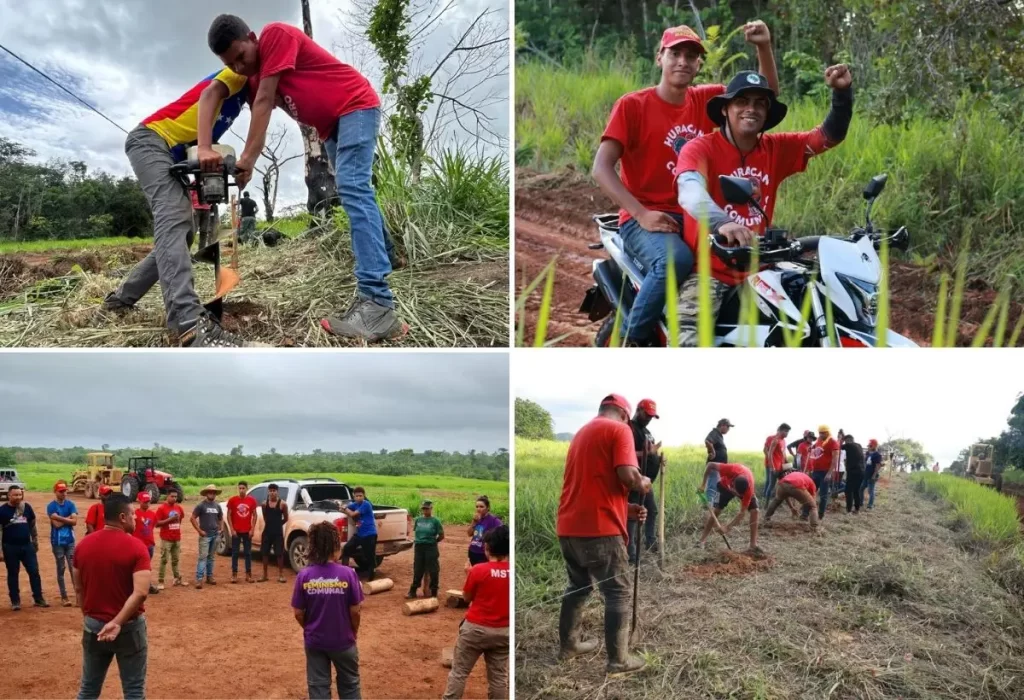
JL: Together with the Ministry of Communes, Brazil’s Landless Workers’ Movement (MST) and other popular organizations, the Communard Union has been participating in this project called Patria Grande del Sur, which we consider to be of great importance.
The estate, expropriated by Hugo Chávez in 2006, spans an immense territory. We are talking about 187 thousand hectares, with great conditions for cattle rearing, cereal and forestry production, as well as growing lots of agricultural produce. If we think about its potential, the sky is the limit.
There we have set up a camp together with the MST, from which we have reached out to the campesino communities that live in surrounding areas to give shape to this construction of the Patria Grande del Sur commune.
Due to its sheer magnitude, the project is being conceived in phases. The first phase includes multiple initiatives to reactivate roadways, build ties with the local communities, set up infrastructure and start launching productive activities. An agroecology school is being built together with the MST, which is the organization that is taking the reins of this project.
It is a process that has its sights set on the integral development of this territory, organized on the basis of a communal system logic and with its productive efforts conceived through the agroecological lens.
Although there is no shortage of obstacles, with plenty of organizations joining hands, there are ever-improving conditions to create campesino family settlements in order to progress to the next stages of the project.
RV: Chávez defined the relationship between the state and popular power as one of “creative tensions.” How do you see the present relationship with state institutions? Has Ángel Prado’s appointment as minister of communes changed the overall dynamics?
JL: The arrival of Ángel Prado to the Ministry of Communes has meant an acceleration and deepening of communal processes in Venezuela. His track record as a communard in El Maizal and then as mayor of the Simón Planas municipality has given him abilities that translate into a political approach that manifests itself in the streets, in contact with the people. He is constantly in the territories, taking part in hundreds of assemblies and in permanent communication and joint work with hundreds of grassroots spokespeople.
In spite of the major efforts from the ministry and the public support expressed by President Nicolás Maduro himself, there are still contradictions and resistance from officials and institutions at all levels of government. The bureaucratic expressions of the old state manifest themselves in multiple ways, hindering the progress and relegating the demands of the Venezuelan communards.
However, at present, the communes are in a much better position to face these tensions in light of the growing protagonism they have acquired.
RV: Another challenge is the absorption of communal cadres in state institutions. In the case of the Communard Union, how do you walk this tightrope without the grassroots work ending up subordinated to institutional priorities?
JL: I think this is an unavoidable contradiction in political processes such as the one we are living. We assume a dual tactic, with one foot inside the state and the other in the street, or rather in the commune. This generates permanent tensions, as expected, due to the asymmetry of power between the different spheres, but fundamentally, because the state we have still runs on a bourgeois structure and essence. So we face the risk that the people who occupy institutional posts end up co-opted and absorbed by the state, distanced and removed from the grassroots.
Still, we are clear that the task before us is not to strengthen the existing state, but rather to use it as an instrument to boost and strengthen a new communal state, and beyond that, a communal society.
In this colossal effort to dismantle the state we have to advance in the radical transformation of society: we have to work from above and from below, from inside and from outside.
The truth is that when it comes to managing this equilibrium that you mention, many factors come into play: the levels of political education of the militants, the degree of organic maturity of the organization, its programmatic foundations, the attitude towards institutions and the very identity of the communal project.
For us as a movement this is something totally new, although many of us who come from prior organizational experiences have already lived this contradiction with troubling past outcomes for popular movements. What is certain is that, as long as the organization understands the dialectic of the relationship, embraces the tensions, promotes a permanent debate, revolutionary consciousness, reflection and self-criticism, we will be able to use this tactical element to continue pushing our political program forward.
RV: Venezuelan communes have regained protagonism in the official discourse, and the popular consultations have been the main policy priority in this area. In the case of the Union’s communes, how do you evaluate the impact of the consultations?
JL: The consultations have been useful to reactivate and strengthen the grassroots assembly spaces. These had been marred by low participation in recent years. It has been an opportunity to rebuild community spaces with renewed organizational dynamics and communal life. After all, there is an opening of spaces to intervene and address the most pressing territorial needs. That is only possible through organization.
However, there is a risk of what Chávez called the “politics of management,” that is to say, that the consultations reduce the communal project to a mere exercise of receiving state resources and executing specific projects, which are furthermore confined to the local sphere. The danger would be diluting the spirit and transformational and revolutionary potential of the commune as an instrument conceived to transform social relations, the way of doing politics and to lead the construction of socialism.
Although, as you rightly point out, the communes have reemerged in the official discourse, there is still a long way to go in order for this recognition to translate into concrete policies to support and boost the communal project.
[Ricardo Vaz is from Mozambique and joined Venezuela Analysis as a staff writer in 2019. He is also a member of grassroots collectives Tatuy Tv and Utopix. Courtesy: Venezuela Analysis, an independent website produced by individuals who are dedicated to disseminating news and analysis about the current political situation in Venezuela.]
❈ ❈ ❈
Venezuela’s Communal Project: An Interview with Ángel Prado
Cira Pascual Marquina
[Ángel Prado is a member of El Maizal Commune and has been Nicolás Maduro’s Minister of Communes since 2024. Prado is also a founder of the Communard Union, an organization that brings together communes across Venezuela. Between 2022 and 2024, he was mayor of Simón Planas township, where El Maizal Commune is located. This interview was conducted in Caracas on March 11, 2025.]
● ●
Cira Pascual Marquina: Let’s start with the most basic question: What is a Venezuelan commune?
Ángel Prado: First, I want to say how grateful I am for your readers’ interest in understanding the political transformation taking place in Venezuela and also how the commune—according to the roadmap laid out by Comandante [Hugo] Chávez—serves as a path to building socialism.
A commune is a grassroots organization within a specific territory, where self-government is established with a political structure that legislates, administers resources, and manages its own means of production.
In a commune, there are many levels of popular organization. There is the communal parliament, the communal bank, and various committees, from economy to sports. At the base of the commune are the communal councils, which are the fundamental organizational cells.
The assembly process is at the heart of the commune—it is the life and soul of our organizations. The assembly is the commune’s highest decision-making body: anyone in the commune’s territory can participate, speak, demand, question, vote, and oversee processes. The assembly has the final say on all matters concerning the commune.
Communes also put great emphasis on symbolism and identity while establishing norms of coexistence and developing plans that solve the problems of the community. Communal life is shaped by these processes, gradually fostering what we call “the spirit of the commune,” which is a collective spirit based on identity and working together.
CPM: Isn’t it also true that, according to Chávez, communes should promote new social relations of production?
AP: Yes, the commune focuses on territory and identity, but also on economic organization. It mobilizes and brings together people’s collective force to solve problems and improve material living conditions. This means generating self-governed economic processes. Through planning and the community’s labor power, the commune builds what we call a popular and communal economy. People need services, food, and other goods, and much of that can be produced internally. In all this, communal planning is key.
There is also an ongoing debate in the communes about property and ownership, which ranges from collective communal property to public, family, and private property. A commune aims for communal and collective ownership to be hegemonic in its territory, but this is still a work in progress. That is why there is a struggle for control of the means of production—land, factories, and all resources essential to developing productive forces in the communes. Another issue that is discussed is the distribution and reinvestment of the surplus. There is a need to balance social investment with productive reinvestment.
CPM: In a country that is under siege because of the U.S. sanctions, the strongest communes have worked to address urgent needs in their communities. In many cases, they have been very successful in counteracting some of the blockade’s effects.
AP: In a commune, it is essential to identify the values and principles that shape communal life. People see the commune as the closest level of government in their community. It is the most immediate institution they turn to for resolving them.
We saw this clearly during the pandemic. Organized communities worked alongside local health care workers, volunteer motorbike couriers, and other community members who, in a spirit of solidarity, took on the task of getting medicines, carried out vaccination campaigns, and ensured people did not go without care. Elected communal spokespeople had an important role in this, demonstrating leadership and genuine concern for the people in their communes. The commune provided a structure, and, in the midst of the crisis, people knew they could turn to communal leaders for support.
Despite the blockade, the pandemic, and the economic crisis, there is not a single barrio in Venezuela without some level of grassroots organization. In many places, there are self-governed communes that engage in planning and carry out mutual aid initiatives. Communes also maintain detailed data on their communities, helping them to better understand and address the needs of the pueblo.
CPM: Today, the communal movement and the Bolivarian government seem to have a synergistic relationship, whereas just five years ago there were moments of marked tension and contradiction. What has allowed for this convergence to happen?
AP: After the physical departure of Comandante Chávez, contradictions grew not just within Chavismo, but also in relation to the national bourgeoisie and U.S. imperialism, which constantly threatens countries that assert their sovereignty.
We recently saw what happened in Syria. It served as a warning to the Venezuelan people, who are largely anti-imperialist. Our historical moment requires unity. Chavismo is diverse, much like Peronismo in Argentina, with various ideological currents. However, in Venezuela, any politician who calls themselves Chavista but is not rooted in the community and lacks recognition from the grassroots contributes nothing to the national front against imperialism—and people know it.
It’s clear what happens when progressive and anti-imperialist governments are overthrown—massacres, repression, and devastation. That is why unity is essential. There will always be internal debates. However, in the mass movement, we are fighting to strengthen communes, to ensure that they become more organized, more robust, and a true expression of self-governance by the people.
Today, there is strong synergy between government leaders and the communal movement. There is a clear willingness from the government to recognize and support the communes. Of course, we will always have reformists and opportunists who do not believe in the commune and lurk in the ranks of Chavismo to sabotage this unity. However, our anti-imperialist struggle keeps us together, allowing us to set an example for other countries and peoples who are resisting imperialism around the world.
CPM: During the most difficult period of the blockade and crisis, the communes grew stronger. Even so, there were many people who sought individual rather than collective solutions to their problems. That is still going on today. What is the correct way to engage with those who fail to connect with the communal project?
AP: There are casualties in any war. In Venezuela, we are enduring an economic war that has lasted nearly a decade. It is a brutal war designed to demoralize and dismantle Venezuelan society and to force people into pursuing individual survival tactics. Indeed, some withdrew from collective action, focusing only on their immediate needs and those of their families, temporarily stepping back from grassroots participation.
But those who held the line—those who remained in the struggle—are many. Despite the hardships, in every barrio and every rural community, a revolutionary vanguard remained active. They stood firm, resisting, leading, and keeping the flame of popular organization alive.
That is why today, the Venezuelan revolution is advancing again. The harshest years—2016 to 2021—are behind us. The country has developed new economic capacities, sometimes accompanied by tough policy decisions that some of us questioned but which ultimately prevented civil war and U.S. intervention.
This resistance has left us stronger. Despite the wounds, we remain morally and politically resilient. Millions of grassroots leaders, who are mostly women, have demonstrated that defending the community is the highest form of leadership.
The communes that emerged or reemerged in the hardest years have become even more robust, controlling grassroots economies, fostering political education, and organizing the youth.
CPM: A good example of close cooperation between the government and the communes are the popular consultations that began in May 2024. Could you explain how they work? How does the consultation process transfer power to the communes?
AP: The popular consultation processes have become an important channel between the government and the communes in this juncture. The first step consists of assemblies that are held in all the communes and communal circuits [essentially communes that are yet to be consolidated] around the country. In these assemblies, people come together to debate and prioritize the most pressing problems. Then comes a nationwide voting process in which the members of each commune select a single project among those that the assemblies have identified as necessary.
After the voting process, funds are allocated to each commune or communal circuit, which then takes responsibility for seeing the project through to completion. For now, funding is limited [10,000 USD per consultation], but the president has indicated that municipal and regional governments should also finance communal projects.
In this way, each project comes out of a planning process that is internal to the community. People have embraced this new practice. It has re-engaged many who had withdrawn from communal participation and restored faith in communal councils and communes. Now everyone can see how communes can indeed address collective problems.
The upshot is that confidence in communal structures is being restored. For almost a year now, popular consultations have been held every three months, and participation grows with each new cycle. People have come to trust this method.
The consultations connect with the aspirations of working people. This process empowers communities and strengthens their identification with the commune. Our task now is to consolidate the communes even more so that Comandante Chávez’s vision—that the people truly govern themselves and take the lead in the great transformations to come—becomes a reality. The organized people must become protagonists in recovering health care and education infrastructure, the improvement of public spaces, and, above all, take charge of planning, management, execution, and oversight of projects.
In short, the consultations are both an empowerment process and a learning experience. Communities are working hard to prevent setbacks while ensuring that the resources they receive are managed efficiently. The fight against bureaucracy and corruption is a constant one, but when the people themselves control those funds and work collectively to safeguard them, that is the best antidote.
With the popular consultations, we are ensuring real participation in Venezuelan democracy: proving that an organized pueblo can achieve more than any state institution alone.
CPM: A constitutional reform is planned for this year, and many have been arguing that the commune should have a prominent role in the updated national charter. The possibility of including the commune in the Bolivarian Constitution brings up many questions regarding the relation of the commune to the state. How do you understand this relationship?
AP: In developing the Bolivarian Constitution of 1999, the Venezuelan people took an important step toward participatory democracy. That constitution established legal frameworks for people to organize in various ways: in factories, universities, and unions, as well as territorially. That alone was a major achievement. However, we failed to get approval for a 2007 constitutional reform that would have recognized communal and grassroots organizations explicitly in the constitution.
In a 2012 discourse popularly known as “Golpe de Timón” [“Strike at the Helm“], Comandante Chávez challenged his ministers. “Where is the commune?” he asked them. Today, the Venezuelan people can respond: “The commune is here, in the territory. It is organized, functioning, and fighting.”
However, we still want the commune to be explicitly recognized in the constitution; that remains one of our biggest challenges right now. That is why we are working hard from both the communes and the Ministry [of Communes] to gain even more legitimacy and trust so that we can build a broad consensus to support the inclusion of the commune in the constitution’s text.
The debate goes beyond just the issue of recognition. It is not just about putting the commune in the constitution. We are also thinking about how the commune should relate to the Venezuelan state. Today, the government acknowledges the commune as a grassroots organization, but we need it to exist on equal footing with other institutions and governance structures.
We stand by our slogan, “¡Comuna o Nada!” [“Commune or Nothing!“], which is now not just words but a reality in the territory. Today, communes are the most tangible and immediate organizational structures in both urban and rural areas. All this is very important, but we want to constitutionalize this vital expression of popular power. Even those who may not fully agree with the government or the revolution recognize the commune’s legitimacy. They do so because they see how the organized community is solving its own problems.
The majority of Venezuelans live in working-class communities, and they require state support to address their needs. Just as townships and the state governments have a constitutional right to receive funding, we demand that communes be granted the same right—one that does not depend on the political will of a particular mayor, governor, or minister but is mandated by the constitution. It should be a constitutional duty of the Venezuelan state to guarantee access to these funds.
Our debates about the constitution are only beginning, but we will reach a decision this year. There is broad agreement that one of our key objectives should be to ensure that the term “commune” is incorporated and recognized in the constitution. However, it is just as important to define the communes’ relationship with the state and guarantee their access to funding.
CPM: Do you have any concluding thoughts on Chávez, the commune, and socialism?
AP: Over the past three decades, Venezuela has been engaged in an all-out struggle against the forces of imperialism that have looted our country for centuries. As Comandante Chávez said, “It is time to stand by the causes of dignity and true liberation, to raise the banners of independence and self-determination.”
In the face of imperialist assault, we cannot be conservative with regard to our political model. We cannot copy their model of false democracy. Right now, in the Sahel region, several countries have risen in rebellion against transnational corporations and neocolonial structures, expelling military bases and opening the path toward sovereignty. Their struggle inspires us, recalling Chávez’s example, who also fought for national sovereignty.
We must continue the battle that Chávez started, a struggle that has intensified and become more polarized. The choice before us is clear: either we advance in building socialism, constructing participatory and protagonistic democracy, while defending our natural resources; or we risk becoming another reformist state with a so-called progressive government that fails to transform existing state structures. If we do not advance with our own political model—the one proposed by the Bolivarian Revolution and Chávez—imperialism will destroy us. If we fail to dismantle the structures they imposed upon us, they will destroy everything we have built.
We are seeing that happen in Argentina, where progressive governments lifted the country out of economic ruin, but they failed to transform the basis of politics. They maintained the old constitution, preserved traditional governance structures, and never transferred power to the people through grassroots organizations. As a result, they were overthrown. Sadly, today, the IMF and imperialist corporations are plundering what was once one of Latin America’s richest nations, while poverty soars at an alarming rate.
Venezuela is committed to transforming the state, building a new society, constructing true democracy, and preserving national independence. We are also committed to building socialism…and the people are driving this forward!
[Cira Pascual Marquina is a Political Science professor at the Universidad Bolivariana de Venezuela in Caracas and a teacher and organizer at the Pluriversidad Patria Grande, El Panal Commune’s educational initiative. Courtesy: Monthly Review, an independent socialist magazine published monthly from New York City since 1949, whose present editor is John Bellamy Foster.]