❈ ❈ ❈
On the Precipice of Authoritarian Rule
Nick Turse
Earlier this month, President Donald Trump threatened to unleash the armed forces on more American cities during a rambling address to top military brass. He told the hundreds of generals and admirals gathered to hear him that some of them would be called upon to take a primary role at a time when his administration has launched occupations of American cities, deployed tens of thousands of troops across the United States, created a framework for targeting domestic enemies, cast his political rivals as subhuman, and asserted his right to wage secret war and summarily execute those he deems terrorists.
Trump used that bizarre speech to take aim at cities he claimed “are run by the radical left Democrats,” including Chicago, Los Angeles, New York, and San Francisco. “We’re going to straighten them out one by one. And this is going to be a major part for some of the people in this room,” he said. “That’s a war too. It’s a war from within.” He then added: “We should use some of these dangerous cities as training grounds for our military.”
Trump has, of course, already deployed the armed forces inside the United States in an unprecedented fashion during the first year of his second term in office. As September began, a federal judge found that his decision to occupy Los Angeles with members of California’s National Guard — under so-called Title 10 or federalized status — against the wishes of California Governor Gavin Newsom was illegal. But just weeks later, Trump followed up by ordering the military occupation of Portland, Oregon, over Governor Tina Kotek’s objections.
“I am directing Secretary of War, Pete Hegseth, to provide all necessary Troops to protect War ravaged Portland and any of our ICE Facilities under siege from attack by Antifa, and other domestic terrorists,” Trump wrote on Truth Social late last month. And he “authoriz[ed] Full Force, if necessary.”
When a different federal judge blocked him from deploying Oregon National Guardsmen to the city, he ordered in Guard members from California and Texas. That judge then promptly blocked his effort to circumvent her order, citing the lack of a legal basis for sending troops into Portland. In response, Trump threatened to invoke the Insurrection Act — an 1807 law that grants the president emergency powers to deploy troops on U.S. soil — to “get around” the court rulings blocking his military occupation efforts. “I think that’s all insurrection, really criminal insurrection,” he claimed, in confused remarks from the Oval Office.
Experts say that his increasing use of the armed forces within the United States represents an extraordinary violation of the Posse Comitatus Act. That bedrock nineteenth-century law banning the use of federal troops to execute domestic law enforcement has long been seen as fundamental to America’s democratic tradition. However, the president’s deployments continue to nudge this country ever closer to becoming a genuine police state. They come amid a raft of other Trump administration authoritarian measures designed to undermine the Constitution and weaken democracy. Those include attacks on birthright citizenship and free speech, as well as the exercise of expansive unilateral powers like deporting people without due process and rolling back energy regulations, citing wartime and emergency powers.
A Presidential Police Force
U.S. District Judge Charles Breyer ruled last month that Trump’s deployment of federal troops to Los Angeles, which began in June, was illegal and harkened back to Britain’s use of soldiers for law enforcement purposes in colonial America. He warned that Trump clearly intends to transform the National Guard into a presidential police force.
“Congress spoke clearly in 1878 when it passed the Posse Comitatus Act, prohibiting the use of the U.S. military to execute domestic law,” Breyer wrote in his 52-page opinion. “Nearly 140 years later, Defendants — President Trump, Secretary of Defense Hegseth, and the Department of Defense — deployed the National Guard and Marines to Los Angeles, ostensibly to quell a rebellion and ensure that federal immigration law was enforced… Yet there was no rebellion, nor was civilian law enforcement unable to respond to the protests and enforce the law.”
The judge ruled that the Pentagon had systematically used armed soldiers to perform police functions in California in violation of Posse Comitatus and planned to do so elsewhere in America. As he put it, “President Trump and Secretary Hegseth have stated their intention to call National Guard troops into federal service in other cities across the country… thus creating a national police force with the President as its chief.”
In the face of that scathing opinion, the president has nonetheless ramped up his urban military occupations, while threatening to launch yet more of them. “Now we’re in Memphis… and we’re going to Chicago,” Trump told a large crowd of sailors in Norfolk, Virginia, during a celebration of the Navy’s 250th anniversary earlier this month. “And so we send in the National Guard, we… send in whatever’s necessary. People don’t care.”
As October began, Trump had already deployed an unprecedented roughly 35,000 federal troops within the United States, according to my reporting at The Intercept. Those forces, drawn from the Army, Navy, Air Force, Marines, and National Guard, have been or will soon be deployed under Title 10 authority, or federal control, in at least seven states — Arizona, California, Florida, Illinois, New Mexico, Oregon, and Texas — to aid and enforce the Trump administration’s anti-immigrant agenda, while further militarizing America. Other Guardsmen, being sent to cities across the country ranging from Memphis to New Orleans, are serving under Title 32 status, which means they will officially be under state control, a measure Trump uses in states with Republican governors.
National Guard forces deployed to Washington, D.C. as part of Trump’s federal takeover of the district in August are operating under the same Title 32 status. But with no governor to report to, the D.C. National Guard’s chain of command runs from its commanding general directly to the secretary of the Army, then to Pete Hegseth, and finally to Trump himself.
In September, a long-threatened occupation of Chicago began with an ICE operation targeting immigrants in that city, dubbed “Midway Blitz.” A month later, the state of Illinois and the city of Chicago sued Trump, seeking to block the imminent deployment of federalized Illinois and Texas National Guard troops to that city. A federal judge in Chicago blocked the deployment of troops in Chicago for at least two weeks. The Justice Department appealed but an appeals court ruled Saturday that while the troops can remain there under federal control, they can’t be deployed.
“They are not conducting missions right now,” a Northern Command spokesperson told TomDispatch on Tuesday, admitting that she didn’t know exactly what the troops were doing.
The president has also threatened to deploy National Guard troops to Baltimore, New York City, Oakland, Saint Louis, San Francisco, and Seattle.
“When military troops police civilians, we have an intolerable threat to individual liberty and the foundational values of this country,” said Hina Shamsi, director of the American Civil Liberties Union’s National Security Project. “President Trump may want to normalize armed forces in our cities, but no matter what uniform they wear, federal agents and military troops are bound by the Constitution and have to respect our rights to peaceful assembly, freedom of speech, and due process. State and local leaders must stay strong and take all lawful measures to protect residents against this cruel intimidation tactic.”
“Living in a Dream World”
Trump’s Portland order drew pushback from Oregon’s Democratic lawmakers, local leaders, and outside experts, who said there was no need for federal troops to be deployed to the city. “There is no national security threat in Portland,” Governor Kotek announced on social media. “Our communities are safe and calm.” Independent reporting corroborated her assessment.
After Kotek conveyed that to Trump in a phone call, the president seemed to briefly question whether he had been misled about an antifa “siege” there and the city being “war-ravaged.” As he recounted, “I spoke to the governor, but I said, ‘Well, wait a minute, am I watching things on television that are different from what’s happening? My people tell me different.’”
Days later, despite countless reports that there was neither a war nor a siege underway in Portland, Trump posted on social media that Kotek was “living in a ‘Dream World’” and returned to peddling lies about the city. “Portland is a NEVER-ENDING DISASTER. Many people have been badly hurt and even killed. It is run like a Third World Country,” he wrote on TruthSocial. “We’re only going in because, as American Patriots, WE HAVE NO CHOICE. LAW AND ORDER MUST PREVAIL IN OUR CITIES, AND EVERYWHERE ELSE!”
Judge Karin Immergut of the U.S. District Court in Oregon issued a temporary restraining order preventing the Trump administration from sending 200 Oregonian National Guard troops for a 60-day deployment in Portland. As she concluded in her opinion, she expected a trial court to agree with the state’s contention that the president had exceeded his constitutional authority.
Trump immediately took aim at her — despite the fact that he had appointed her to office during his first term — saying that she “ought to be ashamed of herself.” He then claimed, without any basis, that Portland was “burning to the ground.” Trump then made further hyperbolic claims about the city and threatened to invoke the Insurrection Act. “Portland is on fire. Portland’s been on fire for years,” he said, describing the situation as “all insurrection.”
The same Northern Command spokesperson told TomDispatch on Tuesday that the federalized troops in Oregon were also in a holding pattern. “They are on standby,” she said.
The president’s Portland order followed a series of authoritarian actions that have pushed the nation ever closer to becoming a genuine police state. In August, reports emerged that the Pentagon was planning to create a Domestic Civil Disturbance Quick Reaction Force that would include two groups of 300 National Guard troops to be kept on standby at military bases in Alabama and Arizona for rapid deployment across the country. (That proposed force would also reportedly operate under Title 32.)
The Pentagon refused to offer further details about the initiative. “The Department of Defense is a planning organization and routinely reviews how the department would respond to a variety of contingencies across the globe,” said a defense official, speaking at the time on the condition of anonymity. “We will not discuss these plans through leaked documents, pre-decisional or otherwise.”
Earlier this month, Trump signed an executive order claiming to designate antifa — a loose-knit anti-fascist movement — as a “domestic terror organization.” He also issued National Security Presidential Memorandum 7, which directs the Justice Department and elements of the Intelligence Community and national security establishment to target “anti-fascism… movements” and “domestic terrorist organizations.” Such enemies, according to the president, not only espouse “anti-Americanism” and “support for the overthrow of the United States Government,” but also are typified by advocacy of opinions protected by the First Amendment, including “anti-capitalism,” “anti-Christianity,” and “hostility towards those who hold traditional American views on family, religion, and morality.”
After referring to the “war from within” during his address to the military’s top officers, he cast his political rivals as subhuman and claimed that they needed to be dealt with. “We have to take care of this little gnat that’s on our shoulder called the Democrats,” he told the sailors during the Navy’s 250th anniversary celebration.
The Trump administration has also admitted that it’s waging a secret war against undisclosed enemies without the consent of Congress. According to a confidential notice from the Department of War sent to lawmakers, the president has unilaterally decided that the United States is engaged in a declared state of “non-international armed conflict” with “designated terrorist organizations” or DTOs. It described three people killed by U.S. commandos on what was claimed to be a boat carrying drugs in the Caribbean last month as “unlawful combatants,” as if they were soldiers on a battlefield. And that was a significant departure from standard practice in the long-running U.S. war on drugs, in which law enforcement, not the U.S. military, arrests suspected drug dealers rather than summarily executing them.
As Brian Finucane, a former State Department lawyer and a specialist in counterterrorism issues, as well as the laws of war, pointed out, the White House’s claims that Trump has the authority to use lethal force against anyone he decides is a member of a DTO is extraordinarily “dangerous and destabilizing.” As he put it: “Because there’s no articulated limiting principles, the President could simply use this prerogative to kill any people he labels as terrorists, like antifa. He could use it at home in the United States.”
Police State USA
The Trump administration’s military occupations of American cities, its deployment of tens of thousands of troops across the United States, its emerging framework for designating and targeting domestic enemies, its dehumanization of its political foes, and its assertion that the president has the right to wage secret war and summarily execute those he deems terrorists have left this country on the precipice of authoritarian rule.
With Trump attempting to fashion a presidential police force of armed soldiers for domestic deployment, while claiming the right to kill anyone he deems a terrorist, the threat to the rule of law in the United States is not just profound but historically unprecedented.
[Nick Turse is the managing editor of TomDispatch and a fellow at the Type Media Center. He is the author most recently of Next Time They’ll Come to Count the Dead: War and Survival in South Sudan and of the bestselling Kill Anything That Moves. Courtesy: TomDispatch, a web-based publication, founded and edited by Tom Engelhardt, aimed at providing “a regular antidote to the mainstream media”.]
❈ ❈ ❈
Massive No Kings Rallies Express Rising Discontent with Trump’s Authoritarian Agenda
James Dennis Hoff
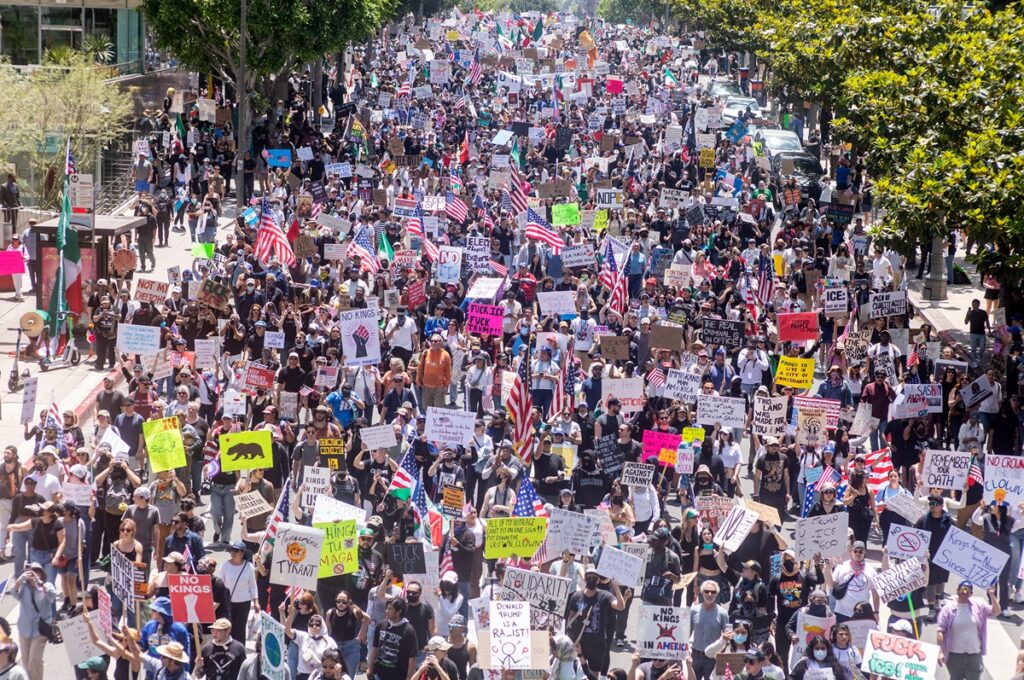
On Saturday, October 18, millions of people took to the streets across the United States and the world for a second massive demonstration against President Donald Trump’s authoritarian policies and executive overreach.
Huge rallies and marches were held in major cities across the country, from New York and Boston, to Detroit, Chicago, San Diego, and Los Angeles. In New York, more than 100,000 people marched from Times Square to Union Square, while a second smaller contingent, largely composed of labor unions, marched north from Lower Manhattan. Perhaps the largest demonstration was in Chicago, where as many as 250,000 took part in a march that filled several dozen city blocks. At that rally, the Democratic Mayor of Chicago, Brandon Johnson, spoke of his city being “occupied” by ICE and said that it was past time for a general strike. Such rhetoric shows the radicalizing pressure that mass movements and even isolated instances of class struggle (like those currently underway in Chicago) can have upon leaders like Johnson. But to go from rhetoric to actually organizing major actions against Trump, we need to organize the working class from below, breaking labor passivity towards Trump’s attacks and we cannot trust any Democrat to do so since even its social democratic wing would generally prefer to pursue their reformist programs from City Hall rather than in the streets.
There were also solidarity demonstrations across Europe, including Berlin, Rome, and London, where protesters rallied outside U.S. embassies. But of the nearly seven million that turned out to protest Trump, the largest percentage were actually those who took part in the thousands of much smaller demonstrations in practically every town and small city from Maine to California. In Boise, Idaho, for instance, which has a population of just 200,000, there were at least 10,000 demonstrators on the lawn in front of the Idaho State Capitol, 3,000 demonstrators turned out in State College, Pennsylvania, and even in Missoula, Montana — hardly a bastion of AntiFa — there were thousands in the streets protesting. Clearly, as these rallies reveal, discontent with Trump’s agenda runs deep and is not limited to the liberal enclaves of the coastal metropolises.
The protests, like the first No Kings demonstrations in June, were largely organized as a response to Trump’s executive overreaches — his “kingly” (Bonapartist) behavior — and as a popular defense of U.S. democracy and democratic process. But while the protests in June were fueled by anger at the unilateral and extralegal destruction of federal programs by DOGE and Elon Musk, this weekend’s protests were in many ways an expression of a broad and growing anger against the Trump administration’s deployment of the National Guard to Los Angeles and Washington D.C. and his use of ICE to terrorize immigrants and citizens alike. Indeed, these protests, which seem to have been even bigger than those in June, were no doubt fueled by the high-profile struggles against ICE in Chicago and Portland, evidenced not least by the large number of protesters who joined marches wearing inflatable animal costumes.
There was also a widespread rejection of Trump’s attacks on labor, trans rights, and federal workers, but also of the United States’ ongoing support for the genocide in Gaza. Even in small cities like Tuscaloosa, Alabama, there were signs calling ICE “Trump’s Gestapo” and others that read “Hands off Gaza.” In New York, like Chicago, there were also calls for a general strike — a demand that seems to be gaining popularity, particularly in the wake of massive strikes for Gaza in Italy and Spain — and many chants in support of Palestine and against both ICE and the police. In this sense, the protests were not only about Trump or his attacks on democratic norms, but were in many ways a sign of the growing discontent with the entire political establishment and, like BLM, with the repressive apparatuses of the state.
[This article is an extract. For full article, please visit Left Voice website. James Dennis Hoff is a writer, educator, labor activist, and member of Left Voice. He teaches at The City University of New York. Courtesy: Left Voice, a US socialist news site and magazine dedicated to fostering a sustained and strategic struggle against every form of capitalist exploitation and oppression.]
❈ ❈ ❈
Seven Million Turn Out for “No Kings” Protests Nationwide. Next Up, Massive Disruptions Backed by Unions?
Luis Feliz Leon
We are on an inexorable trajectory of escalation. As President Donald Trump’s authoritarian attacks are increasing, working people are defying his abuses of power, refusing to live under the yoke of a wannabe strongman who seeks to bend society to the dictatorship of the privately owned Trump Organization. It’s not simply that Trump has the typical bossman’s bullying streak. He’s stranded the country somewhere between the bedlam of his whims and the corruption of a modern-day Gomorrah, down-zoned to the dregs of a Florida swamp. The people have had enough from the madman don in Mar-a-Lago.
Millions of people took to the streets nationwide October 18 as part of a pro-democracy movement rising up in peaceful resistance against President Trump’s authoritarian rule. Under the banner of “No Kings,” more than 2,700 demonstrations were held across every state, from big cities like Chicago (population 2.7 million) to small towns like Bryson City, N.C. (population 1,500).
In all, organizers estimate nearly 7 million people participated. The demonstrations rank among the largest single-day protests in U.S. history, surpassing the turnout of more than 5 million for those held June 14, and the January 2017 Women’s Marches, whose crowd totals were estimated at 3.3 to 5.2 million.
New from June, when union banners and delegations were largely absent (except for highly motivated rank-and-file members donning their union-branded shirts and a few outlier union locals), was the effort to join forces with organized labor.
That’s why the participation of unions in this weekend’s rallies isn’t just yet another Saturday march that leads nowhere. It represents the building of a united front with durable and democratic institutional networks, capable of potentially rejoining the world of politics and work — a fusionism that creates workplace leaders to grind the gears of the boss’s machine to a halt.
But despite the overtures to work in coalition, coordination between unions and liberal groups still proved challenging — even as the coordinated economic disruption that unions are best equipped to organize becomes increasingly necessary against an authoritarian threat.
No Kings Day, October 18
The main organizers of October’s weekend demonstration were progressive groups like Indivisible, MoveOn and the 50501 movement, alongside more than 200 other national organizations and thousands of local groups.
“Authoritarians want us to believe resistance is futile, but every person who turned out today proved the opposite,” said Ezra Levin and Leah Greenberg, co-founders of Indivisible, in a statement. “This movement isn’t about a single protest; it’s about a growing chorus of Americans who refuse to be ruled.”
In New York City, people returned to the streets wearing tricornered hats, colonial wigs, and makeup, holding up handmade signs decrying the country’s slide into, by turns, fascism, tyranny, dictatorship, autocracy, and monarchy. The same irreverent air of the carnivalesque was in full display across the country.
Adults dressed up in inflatable costumes was another common sight, a whimsical rebuke of the Trump regime’s efforts to smear protestors as domestic terrorists. In Alabama, cops arrested a 53-year-old woman for “lewd conduct” because she dressed as an inflatable penis and held a sign that read “No Dick-tator.” The inflatables have emerged as a symbol of resistance through mockery since, at a protest against Immigration and Customs Enforcement (ICE) in Portland, Ore., on October 2, federal agents pepper-sprayed a protester clad in an inflatable frog costume directly through his air vent.
“I’ve definitely had spicier tamales,” the frog-costumed protester said afterward.
Less prominent, compared with the June protests, were calls to take on the billionaire power grab. Palestine solidarity, except for a number of banners in the labor march, was largely absent, as well as remarks about a potential U.S. military invasion of Venezuela.
But the protest’s main themes were also more diverse than the June mobilization — especially the labor march — involving a defense of democracy, immigrants, and health care. The tenor of the messages were mainly denunciations of Trump sending masked federal agents into America’s cities, the Republican shutdown of the country’s government, and the health-care cuts to public programs like Medicaid.
Enter Labor
The rally organizers also partnered with the Service Employees International Union (SEIU), National Nurses United and the American Federation of Teachers, as well as labor coalitions May Day Strong and Labor for Democracy, to drive turnout of union workers and their communities. In New York, a coalition of the city’s biggest unions turned out thousands, including the Communications Workers of America, 1199SEIU, 32BJ SEIU, the United Federation of Teachers and the Professional Staff Congress.
Vishally Persaud is a certified nursing assistant at Staten Island’s Richmond University Medical Center and a member of 1199SEIU. She came to the No Kings labor march after a 16-hour shift in the intensive care unit. “We’re here to support our health-care workers,” Persaud said. “We want to keep fighting so that we don’t get hospitals shut down, nursing homes shut down and Medicaid cut.” She also works in home care and worries whether the health-care cuts will prevent her from working the 130 hours a month necessary to maintain Medicaid benefits.
Since the COVID pandemic, the understaffing crisis has only worsened the working conditions of health-care workers. “We can’t take it anymore,” Persaud said. “We’re all very tired.”
Jamie Partridge, a retired member of the National Association of Letter Carriers Local 82, said the labor feeder march in Portland brought about 1,000 people, joining about 40,000 No Kings protesters. SEIU served as the main organizer of the labor contingent and featured speakers from the Oregon AFL-CIO and the Federal Unionists Network, the scrappy group leading the response to the Trump administration’s attacks on federal workplaces.
“While exciting to see unions step up, the number of union signs and banners were few,” said Partridge. Among the unions and labor groups present in Portland were Oregon AFL-CIO, SEIU, Oregon Nurses Association, AFSCME 88, and the Oregon Federation of Nurses and Health Professionals, which just ended a 5-day strike against Kaiser.
Chicago’s protests were massive, drawing 100,000 people. Isaac Silver, a self-employed repair person who also runs an archive of union buttons, said the march filled 6 lanes of traffic for many blocks. “The march looked much more like a cross-section of the city than the Hands Off rally in April, although it would be great to see a more organized presence by unions,” Silver said via text message. “Most signs were homemade, and like the chants, foregrounded defense of immigrants, trans people, and Palestinians alongside the official messaging opposing the billionaires’ attacks on democracy.”
In New York City, where more than 100,000 marched across all five boroughs, a dozen unions organized a feeder march up Sixth Avenue that ended in Union Square in Manhattan. But the main march, starting from 47th Street down Seventh Avenue, never linked up with the union contingent. Workers milled about waiting until the crowd thinned, as many just went home with no clear next steps.
I bolted to Seventh Avenue, where I saw a huge yellow banner that read, “Our March is Over: Keep Resisting. NoKingsNYC.com.”
“That’s it?” an incredulous man said to the No Kings demonstration marshal at the intersection of 14th Street and Seventh Avenue. “Aren’t there going to be any speakers?” Through a blowhorn, the marshal repeated: “The march is over. Go to brunch!”
Building Power
The “We marched, now what?” attitude is emblematic of the limitations of loosely organized protests without clear next steps for demonstrators to plug into more organizing opportunities. No Kings has knitted together a broad coalition against authoritarianism by harkening back to the country’s revolutionary founding in resistance to the rule of autocratic kings.
But how can it build the organizing infrastructure necessary to stay in touch with these millions of people, involve them enough for them to develop as leaders in their own right, and plug them into efforts that bolster their confidence and understanding of building power?
Fortunately, the liberal groups making up the No Kings coalition already have key partners who can help shift away from the mobilizing model into an organizing approach geared toward disruptive escalations.
Those partners, of course, are organized labor.
Rebecca Givan, associate professor of labor studies and president of the Rutgers chapter of the American Association of University Professors and American Federation of Teachers (AAUP-AFT), points to the increased participation of unions in this round of No Kings protests as part of the maturation of the resistance to Trump. The AAUP-AFT marched with other union contingents in New York City.
“Local unions are turning out their members, and national unions are signing on as supporters,” Givan says. “If No Kings marches are to turn into meaningful change, they will need organizations with roots in neighborhoods and workplaces. Organized labor has a key role to play in translating single-day actions into a sustained movement for change.”
Faye Guenther, president of United Food Commercial Workers Local 3000, notes how, during Trump’s first term, the country saw one of the largest marches in history around women’s rights, then the largest racial-justice marches after the murder of George Floyd. She says it’s not too difficult to feel as though every advance has been beaten back, as women have fewer rights today and federal agents are snatching people off the streets with greater impunity than ever. Federal budgets for repression have increased, while funding is being slashed for health-care and food assistance. Protests are important, of course, but, Guenther wonders, how do we make them work?
“The No Kings protests help work this country’s mass-action muscle, and we’re going to need mass action to disrupt business as usual,” Guenther goes on. “But without strong, permanent infrastructure in place to maintain and build on our victory over this authoritarian regime, then we’ll just be back in the streets next year blowing off steam. That’s why the labor movement is central to this moment — we know how to build durable, democratic power structures.”
As president of the Baltimore Teachers Union, Diamonté Brown thinks a lot about how to build — from the bottom up, rather than from the top down — democratic structures in which members are in command of their union. She bristles at the assumption that unions are already democratic; they need to be transformed to truly become so. She also doesn’t embrace the whole spiel of how what’s needed is a return to normalcy, but an advance for a broader transformation of longstanding systemic issues.
“What labor can do is take it a step further and start talking about, what are the systemic structures, processes, that are creating these situations, over and over again?” Brown says. “Whoever we’re fighting, whoever our target may be at any given time, it seems like they’re always on offense, and we’re always on defense.
The No Kings Day mobilization is also risk-averse, being part and parcel of a reactive-activism pattern that prizes the speed of mobilization over everything else. “We’re not willing to put everything on hold to make sure all of our members turn out for No Kings Day, because that’s just not what’s been bubbling up in our membership,” Brown adds. “What’s been bubbling up in our membership is that people feel like there’s a retaliatory culture within our school system. We have a 45% chronic absenteeism rate and no school-bus fleet for our students.”
“Unfortunately, no matter who the president is, no matter what type of government we’ve had in my 43 years of living, none of those things have changed where I live. The things that we’re seeing now happen to Black people so much that I think sometimes I’ve normalized tragedy. I’ve normalized oppression. I’ve normalized violence just because I’m Black. So seeing it happen on a bigger scale, it’s something I’m reckoning with.”
“Yes, we want to participate in protests, and we want to show our strength and our unity and our solidarity by making sure we are participants in the No Kings rally, but we just want to highlight that there is so much more that needs to be done, and we have to start connecting the dots. Does this action lead us to the outcome we want? Have we even determined what outcome we want? I haven’t heard that.”
Striking Questions
Trump isn’t an anomaly in U.S. history. He’s like a piece of shit traveling down sewer pipes and becoming denser as he’s agglomerated sediments of other excrement. That makes all the special-pleading about democracy sound like a load of crap. “All I’ve heard was we’re fighting for democracy,” says Brown. “We don’t want an authoritarian government. But what do we want? What is it that we want that is important?”
To answer — and to win back members drifting away in search of other political homes, members who often don’t feel their unions are the means to transform their workplace and society — the labor movement needs to make union democracy the cornerstone of what it means to be a trade unionist.
Brown gives the example of bringing questions back to her members from Randi Weingarten, president of the American Federation of Teachers, and how “it never turns out to be what Randi wants when we ask our membership, when we do it from the bottom up, and that’s when we’re always met with that tension — because we asked our members. And I think that should be scaled across all locals, state feds, and even the national and international unions.”
“And that means we have to go slow. You can go fast alone, but you can go further together, and we’re not moving together.”
In other words, if unions are to organize massive disruptive actions with majority participation from their members and the broader community, then they need to find a way to bring members along with them and loosen the reins for them to lead.
That’s what makes unions more than one more letterhead-coalition partner in a demonstration.
“Labor is the essential part of society,” says Dominic Renda, a Verizon call center worker with CWA Local 1101. “So without labor, nothing moves, and we could really put our foot down. We could stop the Trump administration’s worst excesses. If a protest of this size doesn’t succeed, you know, maybe something bigger will: strike actions.”
Unions offer a path to disruptive escalations that continue to grow the movement while remaining nonviolent and oriented to the broad mainstream coalition offering it legitimacy. Jessica Tang, president of the American Federation of Teachers Massachusetts, wants to scale up the resistance by using official union channels to build the institutional infrastructure. She says the union is coordinating efforts across the state, including resource fairs and school safety watches, to sustain activism and resistance.
“I do think that there is a purpose for public actions that bring visibility to an issue, and do let others, who may be more quiet in their criticism at home or thinking that they’re alone, realize that they’re not, actually — and that the majority of people are against the current policies that are harming immigrants, that are hurting the economy, that are stripping away due process rights, rule of law and eroding democracy,” Tang says.
Tang cites the research of political scientists Erica Chenoweth and Maria Stephan, who argue that just 3.5% of a population taking to the streets in peaceful resistance is enough to block an authoritarian takeover. In the United States, that would mean about 12 million people. The 3.5% number isn’t necessarily an automatic prediction, but it reflects the kind of sustained, nonviolent mass mobilization that has worked in the past.
Tang also notes how the AFT passed a resolution to support this weekend’s large-scale protests, including supporting efforts to do more political education within unions and engage members in nonviolent actions. She mentions the possibility of rolling strikes.
The historian Nelson Lichtenstein offers the possibility of teachers’ unions saying that schools have to be shut down because it’s unsafe to hold classes with armed federal agents roaming the streets. “Imagine if the Chicago Teachers Unions said it’s too dangerous to have the kids in school,” Lichtenstein says. “They’re been picked up by ICE, so we’re urging all our teachers and students to stay away for the rest of the week.” Short of that action, No Kings organizers can also call the next mass demonstrations for a workday when there will be more potential for disruption.
In Chicago’s lakefront Grant Park, Mayor Brandon Johnson ended his No Kings Day remarks with a call for a national general strike. “If my ancestors, as slaves, can lead the greatest general strike in the history of this country, taking it to the ultra-rich and big corporations, we can do it too!” Johnson said. Ten days earlier, Trump demanded he be jailed in a post on Truth Social. In his reference to a general strike, Johnson was citing an argument by W.E.B. Du Bois — advanced in his book, Black Reconstruction in America 1860-1880—which made the case that enslaved workers had freed themselves in a great general strike that won the Civil War.
“General strikes aren’t planned three years in advance,” Lichtenstein says. They require a galvanizing occasion, similar to the example he offered about the dangerous environment created by the federal agents in Chicago. But unions aren’t there yet.
“The general strike discussion, while much needed in these authoritarian times, was being put forward not by the unions but by the youth climate movement, Sunrise, with the slogan, ‘Visualize a general strike,’” said retired letter carrier Jamie Partidge. “Despite the most brutal assault on unions in my fifty years in this movement, we have yet to rise to the challenge.”
But the term “general strike” is on more lips than usual. Indivisible’s Ezra Levin told Bloomberg that, in the group’s weekly planning calls, participants often ask about organizing a general strike, perhaps a growing recognition that economic leverage is necessary. “It is possible to execute on that, but it requires a much greater level of planning and infrastructure” compared with weekend rallies, he said. But “I suspect it is where we are going.”
In Solidarity
In his second term, Trump’s authoritarian gyre is spinning faster and wider. But demonstrators and organizers say, to defeat the authoritarian consolidation of power in Trump’s hands and those of a cabal of tech oligarchs, they are building a stronger and more resilient fightback against the escalating attacks on working people, deepening their networks and bolstering their organizations.
Unions are key not only to standing up to Trump, but to offering an alternative economic and social agenda to address what attracts people to Trump’s brand of authoritarian power.
In response to criticisms about a narrowly defensive approach that emphasizes resisting authoritarianism and defending democracy, Tang says: “This is actually about fighting for working people and a working people’s agenda over a billionaire’s agenda, which is what we have now, and making the connections between how this is related to making lives better for working people.”
The largest health-care workers’ union in New York and the country, 1199SEIU — representing nearly 450,000 workers — decried the slashing of health-care funding to give tax handouts to billionaires while also pouring money into ICE raids. A University of Pennsylvania study released in June found that health-care cuts could cause the deaths of 51,000 Americans annually.
Trump isn’t just instituting the largest upward redistribution of wealth in American history for the benefit of his billionaire pals; he’s doubling down on the economic and political repression of the working class by cutting food assistance and health insurance for working people; by eroding collective-bargaining rights for millions; by sending armed federal agents with military-style weaponry to racially profile and abduct workers and children from their homes, workplaces, parks, and schools; and by detaining more than 170 who are U.S. citizens, but of the wrong color.
At the same time, Trump is developing a refugee policy that favors Europeans; murdering Venezuelan civilians in the Caribbean Sea by bombing alleged drug-smuggling boats; starving millions through cuts to humanitarian aid; and bailing out Argentina’s far-right libertarian president with $40 billion (almost the same amount he’s cut from food aid for the entire world). He’s not just tossing the United States, but the whole planet, into a vortex of repression and misery.
Trump isn’t unprecedented in the annals of American history, which is drenched in the blood and sweat of enslaved people, indigenous slaughter, and ethnic cleansing — but he does mark something uniquely malignant in the modern era.
Moving Capital
How best to make sense of Trump’s authoritarian escalation?
Roman emperor Caesar’s rampage gave us the word Rubicon to describe a point of no return. Trump’s autocratic regime hasn’t given us any neologism yet, but his escalating authoritarianism has called back into popular usage old German words like blitzkrieg, meaning lighting war, to describe his administration’s dizzying assaults on immigrants, LGBTQ people, women (especially Black women), democratic norms, labor rights, and public programs.
Among the panoply of signs people held aloft at nationwide protests, a set of words stood out from the bunch: king, tyrant, fascist.
These words indicate a broad but inchoate understanding of a dictatorial political regime tightening its hold on society. There’s also an economic dynamic at play, upending old shibboleths about the capitalist management of the economy and replacing them with an older model of brute political force that appears to subordinate the economic structures of capitalism to the whims of a strongman. Call it authoritarianism, corporatism, or fascism, but we are facing a calamitous onslaught of reaction that is reshaping the world.
At root, it’s about capitalism.
Which is how the involvement of labor unions in these broad liberal coalitions becomes pivotal.
In a review of Melinda Cooper’s book Counterrevolution: Extravagance and Austerity in Public Finance, historian Kim Phillips-Fein wrote in The Nation, “Trump’s politics and his appeal are not only inspired by far-right ideologies, culture-war passions, age-old xenophobic prejudices, and a long-standing Republican animus toward the welfare state. They emerge out of a capitalist order that has ceased to be constrained by any of the institutional, intellectual, or professional limits that defined corporate capitalism in an earlier era.”
If one thing could have been even more prominent at the No Kings protests, it was a recognition of how hollowed out democracy becomes when billionaires rule under capitalism. Forget Trump’s boorish personality antics and hedonistic relishing in spectacles of cruelty; take note of corporate ownership structures — namely, privately owned firms.
As Phillips-Fein continued: “E-mails demanding that workers justify their jobs or face layoffs; scolding and humiliation of underlings who dare to disagree; drastic cuts to programs just because the boss doesn’t like them; arbitrarily lobbing tariffs anywhere he pleases; insisting on payback for those perceived as enemies — these signature Trumpian actions all echo the practices of business owners in their private fiefdoms, who do not have to answer to shareholders or, for that matter, anybody else.”
But if they don’t answer to moral suasion, they do answer to massive and coordinated disruptive actions to stop business as usual.
“Successful and dynamic social movements create a gravitational field that pulls into its orbit a strata of the body politic that would be hostile or disinterested,” according to Lichtenstein. “During the red-state revolt seven years ago, school superintendents, local politicians, parents and students were all mobilized in support of that social movement.”
Earthquake Moments
Might we be seeing a similar shift in the structure of old social hierarchies? It’s not simply that material conditions have been intolerable for the working class; there has to be a social earthquake that makes the existing order intolerable for both the working class and the dominant classes who jockey to re-establish authority and stabilize the quaking social edifice. There’s no guarantee that, in these tectonic shifts, workers will come out on top, but open conflict for a new legitimacy can potentially reorder the battle lines, even if temporarily. That’s the opening we must seize without any illusions that the outcome is already predetermined.
Cooptation occurs in any mass movement. But any genuine mass movement still needs more than the usual suspects who agree on everything. To defeat a greater threat, it sometimes even takes a cross-class dynamic to create the conditions for a social revolt.
As Trump’s attacks on labor rights and unions have intensified and threats to the U.S. constitutional order increase — including pressing misdemeanor charges against SEIU leader David Huerta for observing an immigration raid, unleashing the Justice Department to indict political enemies, and commuting prison sentences for allies — the burgeoning pro-democracy movement must continue to expand its ranks.
Nowhere more than among organized labor.
Unions have largely stayed out of the spotlight, fearful of uttering even the mildest criticisms and incurring Trump’s wrath. Many have preemptively bent the knee to curry favor with the administration in the hopes that their groveling self-abnegation might spare their own members from broader attacks on working people. But that’s beginning to change, and more union leaders are speaking out against the president without mincing words.
At a recent union conference, Brian Bryant, international president of the International Association of Machinists & Aerospace Workers, spoke directly to pro-Trump members who may have voted for the union-buster who has gutted the National Labor Relations Board and the Occupational Safety and Health Administration.
“I know nobody in this union voted for President Trump thinking that he was going to take away bargaining rights for over a million people in the federal government, because that’s just flat-out wrong,” Bryant said. “I know they didn’t vote for President Trump hoping that he would defund OSHA and incapacitate the NLRB and other critical departments that our members need.”
Bryant continued: “If you voted for him, you’ve got to make sure he knows that you don’t agree with what’s happening, because when it comes to union rights, there are no ifs, ands, or buts. There’s nowhere to be but on the side of workers. Unfortunately, President Trump and his billionaire buddies do not like organized labor, because they know we’re the only voice for the working people.”
[Luis Feliz Leon is an associate editor and organizer at Labor Notes. Courtesy: In These Times, an American independent, nonprofit magazine dedicated to advancing democracy and economic justice.]
❈ ❈ ❈
What’s Next After the Historic No Kings Protest?
Daniel Hunter
On Saturday, an estimated 7 million people poured into the streets to say it loud and clear: No Kings. (No Kings pointed out that this turnout is 14 times larger than both of Trump’s inaugurations combined.) From Anchorage to Atlanta, from tiny towns to huge city squares, the message echoed across the nation — a call back to the founders’ defiance of tyranny and forward to a people-powered democracy.
With protests in over 2,700 cities and towns, the movement continues to break further and further into Trump’s support. As Erica Chenoweth’s and colleagues’ data shows, the protests this year — even before No Kings last weekend — have been the most geographically widespread in U.S. history.
The signs at the demonstrations were fun. “Make monarchs for butterflies, not presidents.” “I already have one boss (it’s my cat).” “We the People Means ALL the People.” And of course the many frog memes: “Ribbit. Resist. Repeat.”
We just witnessed the largest protest in U.S. history — more than 2.1 percent of the country mobilized in one day. That’s breathtaking. That’s history in motion.
And despite the threats, the fears and the rumors of chaos, the day was overwhelmingly peaceful, determined and joyful. That’s worth pausing to appreciate.
So, where do we go from here?
Here are four quick reflections on what’s next:
1. Note the growing movement — not only in protests
There has never been this many people mobilized over time and geography in the U.S. We showed the country what a massive, nonviolent protest can look like. Such actions make it easier for people to see themselves aligned with the movement, to consider other actions, and to take courage with this connective tissue we’re making.
Personally, the last weeks had me feeling scared — and being with this many people boosted my courage. I know that’s true for many. It also gives added support for the many other ways people are resisting: Chicagoans protecting neighbors with their bodies, Memphis protesters using tents to talk to people about ways to resist their National Guard deployment, nurses using their voice and actions to protect transgender patients rights, Adelita Grijalva trying to get sworn in, and many many more. (Find many more of these stories of resistance at Resist List.)
As Hardy Merriman put it recently in a podcast with The New Yorker, we are facing a leader who can wake up each morning and do something terrible. If our only yardstick is whether we can stop the next headline, we’ll be depressed daily. We have to steadily shift the landscape beneath the regime’s feet. That means we have to show greater unity, greater discipline in the face of violence (because it will grow), greater numbers and greater ability to provoke defections.
Some of these defections and loyalty shifts are already beginning to take place.
2. Defections are growing
You can already see cracks forming. Institutions and individuals are beginning to say “no” with stronger voices.
- Seven universities, including the University of Pennsylvania, University of Southern California, and University of Virginia, have publicly rejected the White House’s new “funding compact,” refusing to trade integrity for dollars. Many made a big deal when universities “buckled” earlier — but some are now finding their backbone. Recall that Brown University and the University of Pennsylvania had made a deal with Trump to restore research money. Now they have both rejected the compact, showing that even early capitulators can transform into resisters.
- En masse reporters walked out of the Pentagon press corps rather than sign loyalty oaths. This included ABC, NBC, CBS, CNN, The Associated Press, Reuters, Bloomberg News, The New York Times, The Washington Post, The Guardian, The Atlantic, Financial Times, Politico, NPR, and even conservative outlets like The Wall Street Journal, Fox News and Newsmax.
- Major airports are declining to air Kristi Noem’s propaganda videos.
- Joe Rogan, surprisingly, criticized the violence of ICE deportations in no uncertain terms. “Everybody who has a heart can’t get along with that,” he told his massive audience. “Everybody with a heart sees that and goes, ‘That can’t be right.’”
- For the first time, pushback was severe enough that a tech titan had to publicly backtrack. Over at Salesforce, CEO Marc Benioff called for the National Guard in San Francisco. Immediately, he was lambasted by rank-and-file Salesforce employees and his long-time friend and colleague Ron Conway resigned from Salesforce’s board — joining a growing tech-industry dissent. (Salesforce had offered its services to help ICE.) Benioff has now publicly apologized and says he’s changed his mind (hey, it’s a move in the right direction).
- The commander of U.S. Southern Command resigned rather than oversee attacks on civilian boats in the Caribbean. A Marine colonel recently wrote publicly — quite a feat — that he quit rather than violate his oath to the Constitution.
Defections are one of the most powerful ways to erode authoritarian control. They send a signal: the regime’s grip depends on our consent — and that consent is slipping.
Defections often start quietly and then snowball. If we stay organized and keep building moral and social pressure, expect more. Throwing sand in the gears of the system is how it slows down.
3. Expand our noncooperation toolbox
Protests capture attention, create a platform, provide cover and encouragement for defections, and give me courage. Noncooperation changes the balance of power.
As trainers at Freedom Trainers remind us, every regime relies on pillars of support — the institutions, corporations, media and civil servants that make it function. When we refuse to cooperate, those pillars start to wobble.
That can look like workers walking off the job, cities refusing unjust orders, or everyday people disrupting “business as usual.”
We’ve seen how this plays out economically. When consumers and workers together withheld cooperation, such as the Disney boycott, it caused measurable financial pain and forced public reconsideration. A recent report from the Wall Street Journal estimated a doubling of customers leaving Disney+ and Hulu over normal months — suggesting 1.5 million customers boycotted Disney+ and 2 million Hulu over Jimmy Kimmel’s censorship. That’s the power of coordinated withdrawal.
There are also boycotts against deportation airlines Avelo and T-Mobile over its ties with Musk and removing its DEI policies — among others happening right now.
Noncooperation is people refusing to participate in their own oppression. It’s students declining to repeat loyalty pledges, artists refusing government commissions, tech workers refusing to build surveillance tools. It’s being on juries and refusing to put away activists standing up for all of us. Every act chips away at the machinery of compliance — and can lead to large mass noncooperation actions.
4. Expect violence
This weekend’s protest faced very little violence. But this country has deep roots of violence. And the media consistently struggles to name where that violence comes from. We’ve seen this dynamic dramatically in Los Angeles: a few thrown stones and it grabs headlines, while the daily violence of deportations, evictions and police abuse barely registers.
We can hold two truths at once — that we prioritize safety and that courage, not safety, is what moves history forward. All of us will need to dig into our wellspring of courage and find what actions we are prepared to take.
For now, a good first step is to check in with your local groups. Thank your marshals, medics, artists and organizers. Hydrate and celebrate. Let’s make this a stepping off point for more. The next steps — strikes, boycotts, refusals — will need all of us.
Because what we’re doing isn’t just resisting. We’re reclaiming the democracy we always should have had from those who would rule us as kings.
[Daniel Hunter coaches and trains movements across the globe and is a founder of Choose Democracy. He has trained extensively with ethnic minorities in Burma, pastors in Sierra Leone, and independence activists in northeast India. He has written multiple books, including “What Will You Do If Trump Wins,” “Climate Resistance Handbook” and “Building a Movement to End the New Jim Crow.” Courtesy: Waging Non-Violence, a nonprofit media organization dedicated to providing original reporting and expert analysis of social movements around the world.]