❈ ❈ ❈
Manipur Needs No More Repression or Coercion. It Needs a Deeper Understanding
24/Apr/2026: The violence in Manipur is escalating at an alarming rate. However, no one incident can explain the complexity of the situation. We need to see the whole picture, both from the security angle and the humanitarian picture.
The Geneva-based Internal Displacement Monitoring Centre (IDMC) report stated that the violence in Manipur accounted for 97% of displacements in South Asia in 2023.
Three years on, however, the threat of further displacement is imminent.
Within the security establishment, there are important conversations on whether to treat Manipur as a hybrid ethnic-insurgency-border crisis, while some retired intelligence-linked commentators push much more expansive “proxy war” claims.
We can say that the Indian intelligence and security agencies appear to look at Manipur through four overlapping frames:
- Ethnic civil conflict that has revived insurgent networks
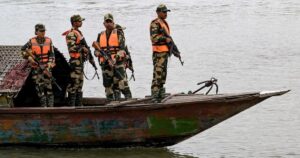
- Border-security crisis linked to Myanmar
- Arms, narcotics, extortion, and militia mobilisation problem
- Possible foreign exploitation, especially through Myanmar-based
The intelligence-security establishment does not see Manipur as a simple communal riot anymore. It sees it as a hybrid internal-security crisis: ethnic violence plus old insurgencies, looted armouries, cross-border sanctuaries, narcotics routes.
The conversations around the “foreign hand” are important in a context but they cannot explain the very real internal divisions within Manipur. Foreign powers can play a serious role only if the internal situation is not brought under control and the people can live in a secure and peaceful atmosphere.
Having said this, in the present scenario the role of foreign interests becomes a factor that needs to be noted, though not over stressed. Especially, since Indian policies, or the lack of it have failed to resolve the Manipur crisis.
Former Army chief General M.M. Naravane said on national television way back in July 2023 that the involvement of foreign agencies in Manipur “cannot be ruled out”, and specifically referred to Chinese aid to insurgent groups in Northeast as something that had existed for years. He also suggested that some actors may benefit from continued instability and may not want normalcy to return.
Over emphasis on the role of China may also be helpful to the camp of those who want to push India closer to Americans. Whereas those who point out that China has leveraged the developments in Myanmar to its advantage may be pointing towards the need to have a more nuanced foreign policy towards China so as not to allow the Northeast to become a theatre for proxy wars.
In this context, Sanjib Baruah, an expert on the Northeast and an author of several books, says caution is important. When he was asked in 2023 what his views were over aspersions that China may have aided the emergence of trouble in Manipur, he replied:
“Even if there was a foreign adversary wanting to create trouble for India in this border state, I doubt that it could create the kind of crisis we have in Manipur today. The crisis is entirely of our own making. But fishing in the waters of your adversary when they are troubled is a staple of international intrigues and power politics. If any foreign development has a bearing on these events.”
However, he adds, that after the February 2021 coup in Myanmar, the Chin state in western Myanmar has become a significant battleground between the junta and the forces of opposition bordering the Indian states of Manipur and Mizoram.
In September 2024, Manipur Security Adviser Kuldip Singh said there were intelligence inputs that more than 900 trained Kuki militants had entered Manipur from Myanmar to attack Meiteis. His statement was given at a press conference and it caused alarm across the state.
The Indian Express later reported, “In an unusual move, Manipur Security Advisor Kuldip Singh and Director General of Police Rajiv Singh issued a joint statement… stating that a recent intelligence input issued by the Chief Minister’s Office on ‘over 900 Kuki militants’ entering the state from Myanmar could not be substantiated on the ground.”
It seems that the “foreign hand” has become an excuse for not seeing the internal causes for the ongoing violence in Manipur. A person was arrested in Manipur in a case which the NIA alleged was related “to a transnational conspiracy by Myanmar and Bangladesh-based leadership of terror outfits to wage war against the Government of India by exploiting the current ethnic unrest in Manipur.”
There is no way of verifying the charges made by the NIA, and the public at large gets distracted believing there is some foreign conspiracy which is responsible for the crisis in Manipur. These cases and media reports then allow the government to communalise an already volatile situation.
In this case, the accused belonged to one community, but all armed groups and certain NGOs have links with foreign forces whether it be through insurgent groups across the border, the church or NGOs backed by Israel or the West.
Foreign interventions
In the debates over foreign interventions, it is often the Myanmar refugees who have genuinely escaped from persecution, who become victims of repression in India. As a result, real issues fall into the background, unresolved.
The Rohingyas, refugees from Myanmar, have become the biggest pawns of such international politics, and in India, it has been used to weaponise the issue of illegal migrants with Muslim background.
There has been a report in Russian media, Sputnik, that the American Central Intelligence Agency, or CIA, is involved in the violence in Manipur. The report quoted Manipur Police’s Inspector General of Police (Operations) I.K. Muivah’s statement that “forensic experts suspected a foreign role in high-tech drone attacks used by Kuki militants”. Further, he said that foreign involvement was also being probed into the use of long-range rockets.
Sputnik also reported that: “There is a growing sentiment in India that the covert US backing for Myanmar ethnic armed organisations (EAO), specifically the Christian groups, is a crucial factor fuelling insurgent attacks by various Kuki militants against civilians and security forces in Manipur, a northeastern state where ethnic violence between majority Meitei and minority Kuki-Zo tribes have left over 200 dead and displaced over 60,000 people since last May.”
Such reports can be misused by communal elements to instigate anti-Christian sentiment and therefore, each report has to be put in context and to ensure the ordinary people are separated from these insidious agents.
Intelligence agencies have played an overwhelming role in the Northeast, including Manipur. Ajit Lal, a retired IPS officer, former special director in the Intelligence Bureau, and former chairman of the Joint Intelligence Committee at the National Security Council Secretariat has taken over from A.K. Misra as the MHA’s Northeast adviser.
A.K. Mishra, Lal’s predecessor, is also a former Intelligence Bureau officer and served as MHA’s Northeast adviser, engaging Kuki-Zo, Meitei civil society, MLAs, and SoO-related processes.
The role of these officers is what may be called “as intelligence-led political management: talks with armed groups, ceasefire rules, inter-ethnic negotiations, and insurgency containment.”
There are the intelligence officers belonging to Northeast and among them is John S. Shilshi, a retired Manipur-cadre IPS officer who later served in the Intelligence Bureau and the National Security Council Secretariat.
Shilshi is a retired IPS officer of the Manipur cadre who served in Manipur from 1990 to 2000, led the civil police commando unit, later served in the Intelligence Bureau from December 2000 to February 2016, and then in the National Security Council Secretariat from April 2016 to March 2018.
His book Vale of Tears: Untold Stories of Violence in Manipur (Blue Rose, 2020) is a first-hand account of violent incidents he handled as a police officer in Manipur during the 1990s. He is much more balanced than other security officers as he criticises Central Reserve Police Force conduct during the 1995 RIMS massacre, recounts an Army-police confrontation over custody of an NSCN-IM suspect, and questions why intelligence inputs and public threats during the Naga-Kuki violence did not lead to preventive action.
What do all these experts of the security establishment say about Manipur?
What is the solution?
Almost all of these men – yes, there are almost no women – lean primarily toward coercive security measures, or dialogue and community-led peacebuilding. This security-centric analysis marginalises or instrumentalises people’s agency.
If the people of Manipur, and not just the token representatives, are not involved in a meaningful way in finding a political solution, each security-centric intervention will make the situation even worse – it has already gone from ethnic clashes to a low intensity civil war to now becoming a hybrid war.
At present, it is giving way for an ideal scenario for various foreign agencies to play their nefarious roles.
It is of utmost importance that the rest of the country take serious interest in the situation in Manipur and the sufferings of the people of all communities.
[Nandita Haksar is the author of Shooting the Sun: Why Manipur was Engulfed in Violence and the Government Remained Silent (Speaking Tiger, 2023). Courtesy: The Wire, an Indian nonprofit news and opinion website. It was founded in 2015 by Siddharth Varadarajan, Sidharth Bhatia and M. K. Venu.]
❈ ❈ ❈
How to End the Sufferings of the People of Manipur?
It is an appeal from the helpless and
Voiceless of our rotten society
Now our society is going from bad
To worse because of the situation
That obtains. The people
Have forgotten to share happiness and
Enjoy their life because of the news of terror,
Massacre, rape, corruption…
How to end this suffering?
This was written by a Manipuri poet for a play called Shooting the Sun in 2020, three years before the violence in Manipur made headlines. The question remains: how to end the sufferings of the people living in Manipur?
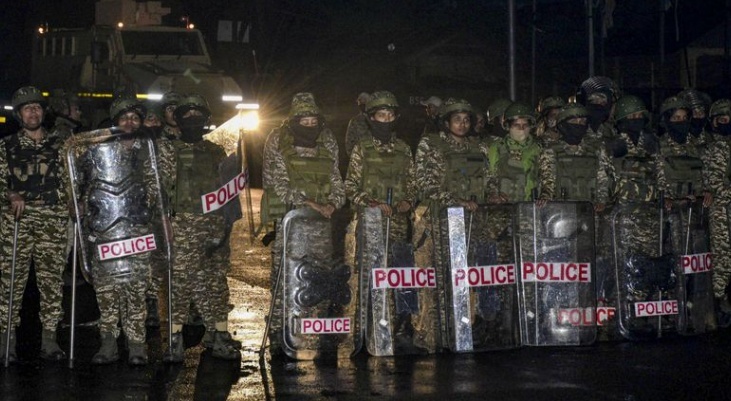
This year began with attacks on Meiteis, and then moved on to deadly attacks on Naga villages and people travelling on the Ukhrul-Imphal road despite security being provided for them. Once again, Manipur is gearing up for another deadly round of violence and this time too there are allegations that the security forces are not neutral and are not protecting civilians.
Manipur has been divided into zones which even the chief minister or a Supreme Court judge cannot cross if they belong to one or the other community. And the communities are armed to the teeth despite the claims that most of the arms looted from armories and police stations in 2023 have been recovered.
But there still are the illegal arms in the hands of insurgent groups, village defence groups, community militias, armed volunteers, criminal groups and armed vigilante outfits (such as Arambai Tenggol, Meitei Leepun) and individuals.
The people have no one to represent their interests and they turn to the armed groups for protection. Civilians going about their daily business fall victims to bullets and firebombs being thrown on their homes and to rocket launchers. Children find their schools and colleges are closed for months on end. Thousands have left Manipur in search of jobs, mostly as migrant workers in cities and towns. Ironically, far from home they share accommodation, help each other and share a meal because they share a bond of being from Manipur.
There are calls for disarming all groups but how can anyone lay down their arms when their very life or the lives of their family or community needs protection? It is a deadly and vicious circle.
For the security establishment, the only way to deal with the spiralling violence is by more repression and security measures with greater militarisation in the name of dealing with the flourishing trafficking in arms and drugs.
Taking advantage of this situation, various foreign interests are taking advantage. This has caused the situation to become even more complex. Even this danger has been weaponised for a narrow political agenda by the government. The issue of Chinese role is used to justify a more pro-American policy, ignoring the role of US and Western interference. In the name of fighting foreign infiltrators, genuine refugees are made the target of state repression.
All this distracts from the decades-old grievances of various communities and the negligence of Manipur, both economically and politically.
The people have no one to represent them. The state has three MPs in the Parliament and none of them can speak for all the communities of Manipur.
The intelligence agencies have an overwhelming role in deciding policy towards Manipur. The main weapon in their arsenal is divide and rule: they have succeeded in splitting the armed ethnic organisations. For instance, the government of India began talks with the National Socialist Council of Nagaland in 1997. At that time. the NSCN was divided into two groups. By 2024, there were an estimated 27 factions of Naga political outfits (not all split from the NSCN), each claiming to represent the Nagas.
With the Naga and Kuki-Zo communities straddling both sides of the India-Myanmar border, there are links between the communities living in each country. This means the insurgents have easy access across international borders and also the possibility of procuring arms and armed actions.
This leads to military action by the states. For instance, last year India carried out a series of drone bomb attacks on Naga villages in Myanmar, apparently with the permission of the military junta ruling the country then. These kinds of cross-border attacks only complicate the already volatile situation by encouraging cross-border actions by insurgents.
The number of people from Myanmar coming into Manipur and settling on land is a cause for concern.
This divide and rule policy has extended to dividing communities against each other, sometimes taking a small section of one community and creating a militia. It could be a Naga militia created from surrendered militants or Kuki commando units for counter-insurgency operations. The co-option of insurgents becomes easier because of the lack of any vision for the future except for identity politics, which has proven to be sterile and leads to nowhere.
I have been witness to the suffering of the people in Manipur: in 1982 when I first went to the newly created Ukhrul district home of the Tangkhul Nagas, the main conflict was between insurgents and the Indian armed forces. At that time, many thought that the cause of their suffering was the fact that the armed forces had too much arbitrary power under the Armed Forces (Special Powers) Act, 1958. All communities were united on the demand for the act to be repealed.
But then even this demand for repeal, which brought people on one platform, was usurped by one community and human rights movement in Manipur also split along ethnic lines especially during the historic protest by Irom Sharmila.(See: Nandita Haksar, Sharmila’s Struggle against Military Repression: A Critique.)
In 2023, the security forces too were split along communal lines with the police protecting the Meiteis and the Assam Rifles protecting the Kuki-Zo. This split has still not resolved.
And then the communities moved further away from each other and the clashes were between communities rather than with the security forces, although that too continued.
In 1988, I took up the case of human rights violations of Naga villagers in Senapati district. At the time we were a team of four lawyers, I leading and three others: one from Tangkhul Naga community, other from Kom and a third a Meitei. We worked well together.
In 1988 there was a national uprising in Myanmar and in 1990 a brutal military crackdown when Burmese refugees poured into Manipur. All communities welcomed them. The High Court was very sympathetic towards the Burmese.
When I returned to Manipur I could see that the communities had developed mutual suspicion but ordinary people still met warmly at least in the market and in public places.
Then came 2021 the military coup in Myanmar. This time when the Burmese refugees came, there was a marked hostility. The Kukis were protecting them, since many shared an ethnicity, though the state was hostile. Even when the Imphal High Court ordered that seven Burmese refugees (two journalists and their families, including three small children), I was representing be allowed to come from Moreh on the India-Myanmar border to Imphal, we were escorted by the commando unit to protect us from a possible intervention by the Assam Rifles, which was determined to deport all refugees.
Burmese refugees had become targets of hate and demonised. Among the refugees from Myanmar, the fate of the Rohingyas has been the worst.
And in 2023 I watched a video, silent but deadly. It was of ordinary civilians blowing up a government colony in the foothills of Langol in Imphal with a two-inch mortar. That was the place where I had lived with so many happy memories.
The homes of people being blown up by weapons civilians in the time of peace in a democratic country.
I was watching a video in the safety of my home in Goa. Others in Manipur were watching all their memories, their homes and their future destroyed.
Today, the chasms within Manipur society are deep, divided by trenches and buffer zones guarded by armed groups with highly sophisticated guns.
But if you walk into a café in Goa, you are likely to see a bunch of North Easterners enjoying themselves, beer and a plate of pork and laughing at jokes only they can understand and a shared sorrow hidden behind brilliant smiles.
They are no longer enamoured with guns or life of insurgents; they want to earn and have a good life. For most, it means a family and friends to share two square meals, a small home and a secure future for their children.
But even these small dreams seem impossible when they lay down their tired heads far from home, they are reminded of the scenes in their home towns, they feel angry from helplessness, from fear for their loved ones left in the villages and then the tears flow quietly.
There seems to be no end to their sorrow and to their suffering. No one to offer solace or succour.
[Nandita Haksar is the author of Shooting the Sun: Why Manipur Was Engulfed by Violence and the Government Remained Silent (Speaking Tiger, 2023). Courtesy: Scroll.in, an independent Indian digital news platform launched in 2014, known for explanatory journalism, investigations, culture writing, and in-depth coverage of politics, society, and human rights. Its English edition is edited by Naresh Fernandes.]