❈ ❈ ❈
What’s Wrong with BJP’s ‘Vande Mataram’ Campaign
Apoorvanand
Any government worthy of its name wishes its country or State to remain free of conflict, that society live without strife, that peace and harmony prevail, that people from all sections feel equal and respected. But there are governments that draw sustenance from discord. They thrive on dispute, continuously inventing ways to sow bitterness and division among citizens. They keep humiliating one section of the people. India’s misfortune for the past 12 years has been rule by precisely such a hate-driven, divisive government—one which finds new ways to insult the country’s Muslims. The recent decision of the government of India—and of the BJP-ruled States—to celebrate the 150th anniversary of the song “Vande Mataram” is yet another expression of this policy of deliberate division.
It is not surprising, therefore, that the most repeated words from the Prime Minister’s address on this occasion were “tukde” and “vibhajan”—words that would linger in the memory of the people of India. He alleged that the Congress party had torn the song into pieces, and that in that very act were sown the seeds of India’s partition. The government now proposes to restore the integrity of the song by rejoining those parts which were removed from the two stanzas we have been singing for the last 90 years. In doing so, it claims it will “redress” the historical injustice done to the song and thereby “restore” the unity of the nation symbolically. Those who heard him could not miss the stress he placed on the two words—“tukde” and “vibhajan”.
Deliberate omission and historical distortion
But the Prime Minister’s story rests on a half-truth—more dangerous, often, than an outright lie. He said that in 1937 the Congress party mutilated the song by deciding that only its first two stanzas would be sung in public. BJP leaders went a step further and placed the responsibility squarely on Jawaharlal Nehru. What he wickedly concealed was that the proposal had come from a committee that included, besides Nehru, Subhas Chandra Bose, Abul Kalam Azad, and Narendra Dev. It was Mahatma Gandhi who presented the committee’s recommendation in the form of a resolution, and the Congress party that accepted it.
The omitted stanzas were those invoking an armed goddess, Durga. It is unreasonable to expect a Muslim to bow before such a representation of the nation. But beyond this religious objection lies another reason, one that in my view is equally significant if not more: the historical and ideological location of the song itself. Without looking at this background, it is impossible to appreciate the reluctance of Muslims, and many secular Hindus as well, to accept “Vande Mataram” as a greeting to the nation.
The history of “Vande Mataram”, its place in the freedom movement, and the many uses to which it has been put, have been studied in depth by scholars. Sabyasachi Bhattacharya, Tanika Sarkar, Sugata Bose, and many others have traced the complex journey of the song—from its creation to its various receptions in India’s modern history. In Bengali, dozens of scholars have explored why Muslims have consistently found it troubling.
The song, written a century and a half ago by the eminent Bengali writer Bankimchandra Chattopadhyay, appears in his novel Anandamath. Though composed in the late 19th century, the novel is set in Bengal at the end of the 18th century—when the region was still nominally under Muslim rule, while the British collected its revenue. The novel depicts the horror of the great famine that had struck Bengal and the rebellion that followed: the “Sannyasi–Fakir uprising”—bands of monks and fakirs who plundered the granaries of the rich and distributed food to the starving poor. But in Anandamath, the fakirs vanish; only the “sannyasis” remain—the defenders and saviours of the people. The famine is blamed on the Muslim ruler, and the ascetics take up arms not merely to overthrow Muslim authority but to annihilate Muslims altogether.
The “santans” worship “Mother”. Those who seek her blessings—the “santans” or sons—plunder and kill Muslims: not only the ruler but the common Muslims as well. The British, in the novel, are portrayed as allies of the Muslim rulers; yet the santans tell them not to interfere, for their battle is only with the Muslims, not with the English. Once the Muslims are vanquished, they intend to establish a Hindu nation. But then a divine presence—called both the “Great Being” and the “Healer”—appears to tell them that their mission has been accomplished with the fall of the Muslims, and that it is now God’s will that the British should rule Bengal. The real purpose of the war, the voice reveals, was to remove Muslim rule so that the British might govern directly.
The “santans” hesitate to accept this divine command, but they are persuaded that it is indeed the will of God. The destruction of Muslims, they are told, was the sacred aim of their struggle. The British, they are assured, will respect the Hindu faith. Under their rule, “Sanatan Dharma” will flourish. The British will teach Hindus the knowledge of the material world, which will in turn strengthen their spiritual power. In living under British guidance, Hindus will grow in strength until the day comes when they can establish a Hindu kingdom of their own.
Much debate has taken place on whether hostility towards Muslims is intrinsic to the patriotism of this novel. But anyone who reads it can hardly doubt the anti-Muslim nature of the nationalism it preaches. How can a Muslim chant “Vande Mataram” after reading—or even knowing—the background of the song? How can she not know that the invocation of the Mother in this song was meant to inflame the desire for the annihilation of Muslims? The Mother India to be liberated here is an India cleansed of the Muslim presence.
Tanika Sarkar in her magisterial reading of the novel says, “the evocation of an armed goddess, ready for the kill, portended a history that Muslims could not possibly accept, given the narrative context of AM. The novel leaves the reader with no doubt that the enemies of the Mother are Muslims, that the weapons in her hands and the strength in her children are directed against them.”
Yet Hindu revolutionaries and many leaders of the freedom struggle adopted this slogan, ignoring its anti-Muslim undertone. As Tanika Sarkar notes, there is ample evidence that in many revolutionary groups, uttering “Vande Mataram” was compulsory for membership. Muslims could not join even if they wished to, since they could not utter these words of worship to the goddess. Thus, the song itself became a barrier to the making of a truly inclusive Indian nationalism.
It is striking that despite their sympathy for Muslims, Gandhi and Nehru long continued to see in the song nothing but a pure expression of patriotism—until Muslims themselves pointed out its disturbing implications. Even a cautious and morally sensitive mind like Tagore’s, so free of nationalist narrowness, felt no hesitation in setting it to music. But when Muslims explained their discomfort, he recognised the legitimacy of their objection. Seeking a middle path, he suggested that only the first two stanzas be adopted, for in them the nation is imagined as nature, not as goddess. Around the same time, Nehru read Anandamath and conceded that it could indeed irritate Muslims. Subhas Bose, Narendra Dev, and Azad agreed.
The real question: why accept it at all?
Yet we must ask: why was even this partial acceptance necessary? Why should a fragment of a novel that glorifies the extermination of Muslims be accepted as the expression of national devotion? Why should Muslims be expected to embrace it? And indeed, why should Hindus themselves sing a song that carries within it the venom of hatred towards their fellow citizens? The question is: It is not a question of two stanzas or complete song: Should we sing “Vande Mataram” at all?
Nevertheless, “Vande Mataram” was accorded a place nearly equal to that of the national anthem. This was, in effect, a concession to Hindu nationalist sentiment. An appeasement of Hindutva. In a secular republic, this song should never have been granted official recognition in any form—but it was.
Perhaps the compulsions of 1937 can be understood in their historical context. The Congress, caught between Hindu and Muslim nationalisms, sought a middle way. Yet the issue should never have been about omitting a few stanzas, that too after objections from Muslims. The real question was: why did our secular leaders feel such attachment to this song at all? That question, tragically, was never asked.
It remains a difficult question. Partha Chatterjee has observed that even the Left found itself confused over “Vande Mataram” and the novel itself. When the Congress made it an issue in Bengal in 1983, demanding popularisation of the novel, the Left too avoided taking a clear stand. The matter, therefore, was never about Muslim sentiment alone; it was about appeasing Hindu nationalist feeling.
We know all too well today that the BJP government’s campaign around “Vande Mataram” does not arise from love or reverence for the song. Its journey has been such that it has become less a hymn to India than a slogan of Hindutva nationalism—a war cry rather than a prayer. Those who cannot even sing a single line of it properly are the ones who shout, “Bharat mein rehna hai to ‘Vande Mataram’ kahna hoga”, using it as a weapon against Muslims.
“Vande Mataram” has ceased to be a prayer; it has become the whip of Hindutva nationalism. As said before, even when it was a prayer, to detach it from the context of the novel, seeking the extermination of Muslims in India to make it a true Hindu nation, is dishonest. Whatever hesitations our predecessors may have had, why should we today remain in confusion? Why can we not say, with clarity and calm, that no nationalist condition can be imposed for living in India? No one has the right to test my love for my country—and in any case, such a test does not exist.
Moreover, when majoritarian communalism has taken a maximalist stance, the secularists too need to make their stand clear: that they would not accept expressions of exclusive nationalism as universal, come what may. “Vande Mataram” is one such symbol.
[Apoorvanand teaches Hindi at Delhi University and writes literary and cultural criticism. Courtesy: Frontline magazine – Digital. Frontline is a fortnightly English language magazine published by The Hindu Group of publications headquartered in Chennai, India.]
❈ ❈ ❈
Bande Mataram Fits the BJP’s Agenda, But its History is Complicated
Tanika Sarkar
Prime Minister Narendra Modi recently announced a year-long celebration of the 150th anniversary of the national song – ‘Bande* Mataram’ (‘I salute the Mother’). Composed first as a free-standing song by Bankim Chandra Chattopadhyay, it was later inserted into his novel Anandamath in 1882.
In a longer essay on this theme, I argued that even though most nationalists, then and now, read the song as an independent composition in its own rights, the novel and the song are actually mutually complementary: without the fictional frame, the real purpose and meaning of the song remain hidden.
‘Bande Mataram’ is a hymn to the Goddess of the Motherland, a deity Bankim had freshly minted himself. She instantly leapt to a central position in the Hindu pantheon. In the 1920s, when Jawaharlal Nehru tried to convince Uttar Pradesh peasants that they themselves constitute the real country, they scoffed at the idea: the country is a goddess, they insisted. “It is your image we worship in all temples,” the hymn had sung, and the words came true in no time.
The novel-time belongs to the late 18th century when a catastrophic famine had devastated Bengal, then ruled by a puppet Nawab, backed by a rapacious East India Company. Even according to its own officials, the Company had so relentlessly extracted peasant surplus for itself, despite repeated crop failures, that the famine was unavoidable. Bankim, however, held the Muslim Nawab entirely culpable: his supposed guilt, moreover, was immediately broadened into a grisly picture of innate Muslim evildoing. There had been fierce battles between Nawabi and Company forces on one hand and armed Hindu ascetics and Muslim fakirs on the other. Bankim excised the fakir rebellions from his narrative.
An imagined band of ‘upper’ caste ascetics instigate Hindu villagers to kill Muslims, to ransack their huts and demolish their mosques, to capture their women and to stamp upon their dead faces. They suspend caste hierarchies as long as the war goes on: but promise to restore them after their victory. The British are relatively minor players and the last edition concluded with their triumph: an ethereal voice consoles the rebel leader that the time is not yet come to eliminate them, Hindus must first learn their skills. The bloodbath against Muslims, on the other hand, is their highest holy duty, ordained by the goddess.
The Goddess of the Motherland is an amalgam of three deities – Jagaddhatri, Kali and Durga, who correspond to her past splendor, present shame and future glory once her sons have crushed the enemy. The song begins gently and tenderly, invoking the bounteous, serene land in the first two stanzas, using lush, soft Sanskrit words. Soon, however, it transmutes into the clanging of swords, into thunderous voices raised to spell doom to the enemy. The land changes into the demon-slaying goddess, lethal weapons in all ten hands. Sound-effects are now harsh, hard and jangling as befits the war cry. Both poetry and prose being rendered in Bankim’s unparalleled mastery over words, they captivate readers with their compressed energy and passionate rhetoric.
The song has had several political habitations. The Congress used it as a slogan at anti-colonial demonstrations whereas Hindu nationalists chanted it during communal violence. Even during Bankim’s lifetime, Muslim critics found the novel and the song deeply distressing. Their grievances were twofold. First, they virtually excluded non-Hindus, especially Muslims, from the nationalist arena. Islam strictly forbids the personification of divinity in a human image, so they are destined to remain outside the patriotic community, they cannot belong to the country. The goddess, moreover, commands war. This made the entire composition – novel and song – deeply threatening for Muslims who also felt debased by the slur the novel threw at them.
Muslim disquiet steadily mounted as the Congress record in their provincial ministries was not always problem free – it made singing the ‘Bande Mataram’ mandatory, even for Muslim students, in its government schools in the Central Provinces. The Muslim League began to express strong reservations in the 1930s and the renowned Bengali poet Jasimuddin expressed his deep anguish to Tagore. Tagore had sung it at a Congress session in 1894 where it became the de-facto national anthem. At the same time, he also underlined its communal potential in his novel Ghare Baire (1915). He added that the country was actually embodied in the land and the people. Its reification in a divine form amounted to a mystifying abstraction. The song had inspired Gandhi in 1915, but he retracted his praise in 1947 after the communal carnage of 1946-47. Nehru started reading the novel in 1937 and, increasingly disturbed, he asked Tagore about its desirable status. Tagore advised that since the first two stanzas merely praised the beautiful land, they could be sung at Congress sessions, but the rest should not be used. In 1951, the Constituent Assembly retained the two stanzas as the national song while Tagore’s ‘Jana Gana Mana’ was elevated as the national anthem, well after Tagore’s death.
Clearly, changed circumstances had revised the perspectives of Gandhi and Nehru. As they read the novel alongside the song, they were alerted to its disturbing communal potential. In a recent article, BJP and Rashtriya Swayamsevak Sangh leader Ram Madhav, however, sees the Muslim hand behind the revisions, and suspects that Congress leaders opportunistically changed their stance, to seek Muslim votes in the 1937 elections. He brands the Congress response as communal while he is silent about the visceral communal passages in the novel, wherein the song is embedded.
The recent BJP decision to celebrate the song with gala events is but natural. Fusing religious and communal passions, and defining the product as authentic patriotism, the song quite precisely prefigures the Sangh Parivar’s agenda. Moreover, the song and the novel overturn the conventional deity-devotee relationship where sacred activism conventionally passes from the former to the latter. The sons of the Goddess, on the other hand, go to war to restore her glory – they are the saviour of the divine, not the other way round. That resonates strongly with Hindutva thinking wherein Ram’s devotees have to return his birthplace to him.
Bankim’s however, was a highly complex mind and Anandamath was not his final word on communal history. His last novel Sitaram imagines a Hindu realm, founded by a heroic and idealistic king who defeats his Muslim adversaries. He however comes to embody, and even exceed, all the evil commonly attributed to Muslims. His Hindu associates abandon him and the last to leave is a pure- hearted fakir who sadly concludes that it is no longer possible to live in a Hindu Rajya.
[*I use Bande instead of the more common Vande because that is how it is pronounced in Bengali and the song is a Bangla one.]
[Tanika Sarkar is a historian who retired as professor, Centre for Historical Studies, Jawaharlal Nehru University. Courtesy: The Wire, an Indian nonprofit news and opinion website. It was founded in 2015 by Siddharth Varadarajan, Sidharth Bhatia and M. K. Venu.]
❈ ❈ ❈
Behind the Official Celebration of Vande Mataram is a Reality That Can’t Be Ignored
Sreejith K.
When Bankim Chandra Chatterjee wrote ‘Vande Mataram’ in the late 19th century, he was giving voice to a new emotion that was both political and spiritual. The idea of the motherland, tender and protective yet wounded and enslaved, took the shape of a goddess. The country was imagined as a divine figure and the act of liberation became an act of worship. Few songs in Indian history have carried such an intense combination of faith and rebellion.
The song came from the pages of Anandamath, a novel set during the late 18th century when famine and rebellion tore through Bengal. The novel imagined a band of Hindu ascetics rising against both Muslim rulers and British power. It turned resistance into sacred duty and the battle cry of the monks became the sound of a divine mission. In Bankim’s imagination, the foreign ruler, Muslim or English, stood as the antagonist in a civilisational drama where the fallen Hindu nation must awaken under the protection of the Mother.
‘Vande Mataram’ travelled from page to street, from hymn to slogan. It was sung in Congress sessions and freedom rallies, written on prison walls, whispered before executions. Yet its religious imagery made it difficult for many Muslims to join in. To bow before an image, however symbolic, was against their faith. The love of land was one thing, the worship of it quite another. Muslim leaders and intellectuals could not accept the idolatrous imagery of the song. For them the motherland could be loved but not worshipped. The figure of Bharat Mata, emerging from the same imagery, carried an unmistakably Hindu form. That distinction was never understood by the nationalist imagination shaped by the Hindu middle class. What began as a song of liberation became a test of loyalty.
After independence the compromise was delicate. The Constituent Assembly, under the guidance of Rajendra Prasad, decided that ‘Vande Mataram’, which had played a historic role in the struggle for freedom, would be honoured as the national song alongside ‘Jana Gana Mana’. The Assembly wished to recognise the emotion it carried without turning the republic into a religious state. Only the first two stanzas were accepted, since these lines were free from the overt goddess imagery of the later verses. The idea was to preserve its historical importance while avoiding its sectarian potential.
Yet the debate never really ended.
In contemporary India that old debate has returned with renewed force. The present government, guided by the ideological influence of the RSS, has turned Vande Mataram into a test of patriotism. The decision to celebrate the 150th anniversary of the song is part of a larger cultural campaign that seeks to redefine nationalism. The celebration is not about literature or music. It is about ownership of history. It asks Indians to prove their loyalty through ritual rather than reflection. Those who hesitate to sing it are branded as outsiders, as if citizenship depends on the ability to worship the nation in a particular language.
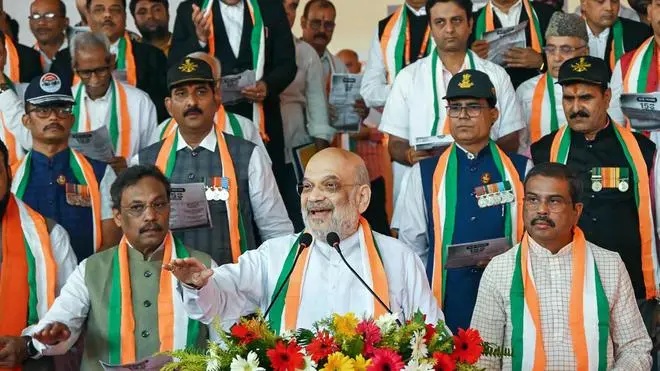
The year-long programme announced by the government reinforces this transformation. Divided into four phases and aligned with Independence Day, Republic Day and other symbolic dates, it invites citizens, students and shopkeepers to sing Vande Mataram, record their renditions and receive certificates. Schools and colleges are instructed to hold mass singing events. The song has moved from the pages of Anandamath to the loudspeakers of the state. The devotion once imagined in the forests is now performed in classrooms and public squares.
Behind the official celebration lies a deeper silence, the erasure of the many Muslim and minority voices who fought for India’s freedom and shaped its composite culture. Their stories do not fit easily within the frame of the goddess mother. A history once shared is being redrawn as a story of one faith’s awakening. The novel that imagined the enemy as Muslim now finds its afterlife in a politics that cannot see the Muslim as citizen. The goddess of Anandamath, once a symbol of spiritual redemption, has become the emblem of a Hindu nation.
That image of the Muslim villain in the novel has never fully disappeared.
In the current political climate, where history is being rewritten and communal lines are being hardened, Anandamath reads less like a 19th century allegory and more like a prophetic script. The portrayal of Muslims as the obstacle to national renewal has quietly shaped the visual and emotional vocabulary of Hindu nationalism. When ‘Vande Mataram’ is sung today under the banners of the state, it carries the unspoken echo of that older conflict. The Muslim, once the villain of a novel, now becomes the silent other in the national chorus.
[Sreejith K. teaches History at Dr APJ Abdul Kalam Government College, Kolkata. Courtesy: The Wire, an Indian nonprofit news and opinion website. It was founded in 2015 by Siddharth Varadarajan, Sidharth Bhatia and M. K. Venu.]