❈ ❈ ❈
Empire in Uniform: A Literary Reflection on Pakistan’s Military State
Baloch Siddik Azad
There are nations where armies defend borders.
And then there are nations where armies devour them.
Pakistan, for seventy-eight long years, has lived under the shadow of a uniformed colossus—an institution that feeds on fear, fattens on national budgets, and survives by inventing enemies the way empires invent myths. It is a state within a state, a throne without a crown, a power that answers to no law except the law of its own appetite.
This is not merely a military. It is a greedy architecture of domination, a machine that requires perpetual crisis to justify its perpetual rule.
The Manufactured Enemy: Fear as Currency
Every empire needs a monster to slay.
The Pakistani military needs one to survive.
Thus India—vast, complex, and distant—has been sculpted into a permanent demon, a convenient specter raised whenever the generals need more money, more land, and more silence from the people.
For decades, the nation has been told:
“Without us, India will swallow you whole.”
But the truth is simpler, darker, and far more cynical:
Without India as an enemy, the Pakistani military’s empire collapses.
Fear is its currency.
Hostility is its oxygen.
And the people—poor, voiceless, exhausted—are the ones who pay the price.
Proxy Flames: When Armies Fight Through Shadows
A curious paradox defines the Pakistani military mindset: it shouts the loudest against India, yet avoids fighting India directly.
Instead, it has cultivated a garden of fire—a network of militant groups, proxies, and ideological militias unleashed across borders to bleed the region without risking the army’s own skin.
These groups are not accidents of history. They are deliberate creations, nurtured in training camps, funded through covert channels, and deployed like pawns on a burning chessboard.
The result?
- A region destabilized
- A nation radicalized
- A military enriched
And a people trapped in a war they never chose.
Afghanistan: The New Theatre of Greed
When one enemy grows stale, another must be invented.
Today, Afghanistan has become the new frontier of fear—a fresh excuse to drain the treasury, inflate the defense budget, and tighten the military’s grip on the state.
Border skirmishes, militant attacks, and diplomatic tensions are not merely geopolitical accidents. They are useful storms, engineered or amplified to keep the military indispensable.
Every bullet fired across the Durand Line echoes in the corridors of Rawalpindi as a demand:
“More money. More power. More unquestioned authority.”
The Army’s Empire: A State Built on Extraction
The Pakistani military is not simply a defense institution. It is a corporate empire, a landlord, a business conglomerate, and a political puppeteer.
It owns:
- Housing societies
- Banks
- Farms
- Factories
- Construction giants
- Transportation networks
It consumes the national budget like a desert consumes rain. It expands its influence the way a shadow expands at dusk—quietly, inevitably, until it covers everything.
And all of this is justified through one mantra:
“The enemy is at the gates.”
But the truth is harsher:
The enemy is inside the gates, wearing a uniform.
Authoritarianism as Doctrine
The Pakistani military does not merely dominate politics; it defines politics.
It has toppled governments, silenced dissent, engineered elections, manipulated courts, and crushed movements from Balochistan to Sindh to Khyber Pakhtunkhwa.
Its doctrine is simple:
- Power without accountability
- Authority without legitimacy
- Rule without consent
It is an institution that fears its own people more than any foreign army.
The People: Forever Sacrificed, Forever Unheard
The tragedy of Pakistan is not that it has enemies. The tragedy is that its rulers need enemies.
The poor, the weak, and the marginalized are the ones who pay for the generals’ ambitions:
- Schools starve
- Hospitals decay
- Roads crumble
- Jobs vanish
- Entire provinces bleed
Meanwhile, the military expands its housing colonies, commercial ventures, propaganda machinery, and myth of eternal indispensability.
Conclusion: The Leviathan and the Dawn
A nation cannot breathe forever under the boot of its own guardians.
A people cannot remain forever hostage to a fear that is manufactured, curated, and sold back to them at the price of their future.
The Pakistani military has built an empire on three pillars:
- A fabricated enemy.
- A frightened population.
- A looted treasury.
But history teaches us this:
No empire built on fear survives the moment its people awaken.
And when that dawn comes—
when the people finally see the monster behind the curtain—
even the mightiest Leviathan trembles.
[Baloch Siddik Azad is the Convener of the Baloch Rights Defender Forum. Courtesy: Countercurrents.org, an India-based independent online journal founded in 2002, publishing articles on peace, democracy, social justice, ecology, secularism, and people’s movements. Edited by Binu Mathew, it is known for giving space to progressive, grassroots, and alternative voices often ignored by mainstream media.]
❈ ❈ ❈
The Women of Huda Jail: Conscience Behind Bars and the Enduring Baloch Quest for Dignity
Baloch Siddik Azad
A Chronicle of Resistance, Human Rights, and the Power of Moral Conviction
There are moments in the life of a nation when the moral landscape becomes so sharply illuminated that even the most carefully constructed narratives of power begin to crumble. The imprisonment of Dr. Mahrang Baloch and her companions in Quetta’s Huda Jail is one such moment—a moment that reveals not only the fragility of authoritarian power, but also the astonishing resilience of the human spirit when confronted with coercion.
For more than a year, these young Baloch women—students, activists, and thinkers—have been held under charges widely criticized by human rights observers as fabricated, politically motivated, and ethically indefensible. Yet the true story lies not in the imprisonment itself, but in the purpose behind it: to compel them to accept a political order they do not believe in, to force them to surrender their identity in exchange for their freedom, and to break their will so that their silence may be used as a symbol of compliance.
But they refused.
And in that refusal lies the entire moral architecture of this struggle.
I. When Power Fails, Conscience Rises
The attempts to pressure these women—through intermediaries, inducements, threats, and psychological manipulation—reveal a deeper crisis within the state’s power structure. When a government must negotiate with the conscience of its own prisoners, it is not the prisoners who stand defeated—it is the government.
The refusal of these young women to accept conditional freedom is not merely an act of defiance. It is a philosophical declaration:
“Freedom without dignity is captivity.
Release without justice is another form of imprisonment.”
Their stance exposes a truth that political power often tries to conceal: moral authority does not come from institutions, uniforms, or weapons—it comes from conscience.
And conscience, once awakened, cannot be subdued.
II. The Daughters of Balochistan: Symbols of an Unbroken People
These women entered Huda Jail as individuals. But they have emerged, across the imagination of their people, as symbols.
Symbols of courage.
Symbols of steadfastness.
Symbols of an unbroken will.
Their refusal to be silenced, bought, or reshaped into something they are not is a reminder that identity is not a negotiable commodity. It is a birthright.
Their courage has become a mirror in which the Baloch people see their own reflection—wounded, yet unyielding; oppressed, yet undefeated; isolated, yet morally resilient.
III. The Philosophy of Saying No
History is filled with those who said “yes” to power, but it is shaped by those rare souls who said “no.”
No to injustice.
No to coercion.
No to the erosion of dignity.
The women of Huda Jail have spoken that “no” with a clarity that reverberates far beyond the walls of their cells.
Their resistance is not violent.
It is not armed.
It is not destructive.
It is moral.
And moral resistance is often the most enduring form of resistance because force alone cannot extinguish it.
IV. The Logic of Coercion and Its Limits
The pressure placed upon these women reflects a broader historical pattern: the use of imprisonment as a means of political conformity.
Throughout history, systems of domination have relied on a simple formula: break the will of the few, and the many will fall in line. Yet that formula collapses when the few refuse to break.
The women of Huda Jail have challenged this logic. Their endurance has exposed the limits of coercive power and raised profound questions about any system that seeks obedience through fear.
V. The Human Cost of Conscience
To stand firm in the face of pressure is not easy. It demands an inner strength that cannot be imposed from outside.
These women have endured isolation, uncertainty, psychological strain, and the burden of a state’s expectations. Yet they have chosen the more difficult path—the path of conscience.
Their suffering is not merely personal. It has come to symbolize a larger struggle over identity, dignity, and the right of a people to remain true to themselves.
VI. A Tribute to Prisoners of Conscience
To the women of Huda Jail:
Your courage has altered the moral landscape of this struggle.
Your refusal to surrender has become a lesson for generations.
Your endurance has demonstrated that the human spirit, when anchored in conviction, cannot easily be subdued.
You are not defined solely by imprisonment.
You have become custodians of conscience, keepers of dignity, and reminders that even in the darkest cells, hope can endure.
VII. A Message to the World
The detention of these women is not merely a political issue. It raises broader questions of human rights, accountability, and the responsibilities of the international community.
Their continued imprisonment demands scrutiny, dialogue, and a commitment to justice.
No society can claim legitimacy while denying its citizens the freedom to preserve their identity and express their convictions peacefully.
VIII. The Unbroken Flame
The women of Huda Jail have shown that chains may restrain bodies, but they cannot restrain truth.
Walls may confine movement, but they cannot imprison dignity.
Power may silence voices, but conscience has a way of enduring.
Their courage remains a flame.
And flames, once lit, travel far.
[Baloch Siddik Azad is the Convener of the Baloch Rights Defender Forum. Courtesy: Countercurrents.org, an India-based independent online journal founded in 2002, publishing articles on peace, democracy, social justice, ecology, secularism, and people’s movements. Edited by Binu Mathew, it is known for giving space to progressive, grassroots, and alternative voices often ignored by mainstream media.]
❈ ❈ ❈
Shattered Bottles, Shattered Dreams: Afghan Refugees in Limbo
Mehrullah Rahmani
In different parts of Pakistan, Afghan refugees live under relentless fear—the sound of police sirens in the streets of Rawalpindi, unfamiliar voices echoing with authority. As soon as we heard those sounds, fear of arrest and deportation surged through every Afghan heart. We could not walk freely in a park or down a street without that looming threat—an invisible chain that kept us constantly looking over our shoulders, haunted by thoughts of being deported back to Afghanistan.
Before we fled to Pakistan, life in Afghanistan held a freedom I did not fully appreciate—an ordinary freedom. I could walk with friends through the streets, ride my pink bicycle to buy necessities, and play games with my friends, filled with joy and a sense of belonging. I attended the education center and drank water from a public well without fear. I spoke my mother tongue freely, laughed with neighbors, and moved through each day with a light heart.
Everything changed when the Taliban took over in August 2021. My father, the pillar of our family, lost his job as a prosecutor. Without his stability and security, life became very difficult to endure in Afghanistan. Safety vanished for all of us. At that time, I was a high school student, filled with dreams—to serve my parents and become a pharmacist. But as the Taliban seized power, that security dissolved. Like countless others, we watched Afghan citizens crowd around Kabul Airport, desperate to leave, grasping at any chance for safety and fleeing a future that suddenly felt impossible.
As my father grasped the gravity of the situation, mounting restrictions and the threat of arrest pushed us to the edge. Fearing capture by the Taliban, we hurriedly packed what little we could into small bags, leaving behind a lifetime of belongings in a tiny, dark room in Kabul. We hoped to find safety overseas.
Leaving our village behind, full of dreams, felt unbelievable. With each step away, my heart pounded, and I dreamed of a better future. Sitting in a bus for the first time, crossing vast deserts and unfamiliar landscapes alongside strangers from many different cultures, I noticed that every Afghan passenger seemed frustrated and hopeless. The constant cries of children filled the air. When we reached the border in the dead of night, my father rented a tiny two-meter room where we stayed until dawn, exhausted and afraid.
In those early hours, I saw many people being sent back. Their faces were full of pain, their voices breaking in Pashto and Persian. The police shouted harsh commands and pushed us back and forth. Our hope of crossing was shattered, and yet we tried again.
At the border between Afghanistan and Pakistan, every second weighed on us like a stone. My father’s rough, trembling hand gripped mine as we stood among hundreds who, like us, had left everything behind. My little sister, only five years old, clung to the metal rice dish we used at home. Her small arms were too weak to carry even that, but she kept walking, hope flickering in her eyes like a fragile candle.
As I walked, I saw a man crying loudly while police officers tried to drag him back to Afghanistan. Nearby, I saw a boy being beaten harshly with a stick. “Chal! Go!” one officer shouted. That scene terrified me. My heart pounded as I prayed that we would somehow make it across the border.
Crossing that border was not easy. Every dream I once held seemed to break apart. Life was no longer about building a better future—it was about surviving one step at a time and escaping the police who pursued us. In every refugee’s face, I saw a plea—a silent scream piercing the night. Hidden behind red curtains inside the bus, we became shadows, no longer treated as human beings but as risks to be eliminated.
When we reached Islamabad, my father found a tiny room—a dark, three-meter space on the second floor. It swallowed us whole. We barely spoke. We did not belong. We did not know the language. I watched my little brother huddle in a corner, his knees pressed to his chest and his head bowed. Fear became a permanent guest in our home. No security, no protection, no future—it felt like a prison darker than any cell.
One morning, I awoke still trapped in that suffocating fear. My father, speaking softly, asked me to go outside. As the eldest son, he trusted me to bring something back for breakfast.
My heart raced as I stepped into the narrow street. The sun pierced the morning fog, and I could barely open my eyes. As I opened the gate, I heard a police car. At the sound, memories of the border rushed back, along with all the fear that still gripped my chest. Still, I walked on. For the first time, I saw an empty street in Islamabad—quiet and unfamiliar, like a fragile new world waiting before us.
As I stepped onto the street, the weight in my chest did not disappear; it only shifted. Every shadow seemed to hide a threat. Still, I held tightly to a small bundle of hope. I reached a tiny shop tucked between two buildings. The shopkeeper, wearing a small black hat, accepted my trembling coins.
As I picked up the bottles of milk, my fingers shook. Each step back toward our dark room felt heavy. Then, a siren—sharp, sudden, and merciless—cut through the air. Cold fear rushed through me, and I suddenly realized I had forgotten the sugar.
My heart sank. Every step back to the shop felt heavier. As I approached the shopkeeper again, my heart pounded so loudly that I could barely hear him. Then I glanced behind me—and saw the police car.
Not far away, I saw a refugee pleading desperately in Persian, begging the officers for mercy. But they did not care. Memories of the cruelty I had witnessed at the border came flooding back. They were cold and indifferent.
As I stood there, the bottles slipped from my hands. The glass shattered like every fragile hope I had left. My legs went numb. My chest felt as though it were collapsing. The officers seized the refugee and forced him into the car. At that moment, one tall officer—thin and dark, with a curled mustache—glared directly at me.
My lips trembled as I stared at the sugar scattered across the pavement. I thought he was coming toward me. I sank against the wall, every breath becoming a silent prayer, begging God to save me. Fortunately, the officer turned away and climbed back into the car. Slowly, the sound of the vehicle faded into the distance.
Finally, they drove away.
I could not move. Frozen for what felt like half an hour, I stood beneath the burning sun, staring at the spilled milk and sugar. Then, a thin boy no older than twelve crossed the street. Wearing a worn T-shirt, he picked up the bottles, handed them to me, and quietly asked, “Uncle, can I help you?”
In that small and fragile act of kindness, he gave me a sliver of hope I thought I had lost forever.
Slowly, I pushed myself up, leaning against the cold wall. Every movement felt heavy. Step by step, I made my way back to our cramped room as though moving through water. I did not feel alive; I felt like a ghost drifting at the edge of the world.
When I finally reached the door, my little brother, waiting by the window, cried out with relief, “He came! He came!”
My father rushed outside and gripped my hand.
“What happened, son?” he asked, his voice shaking.
Inside, I collapsed onto the bare floor of that dark three-meter room. There was no pillow, no mattress. I stared at the cracked ceiling above me. I did not understand what had happened to me; I only knew that I felt broken. My father’s fists clenched helplessly, and my brothers gathered around me. I could not look up. I could not speak.
My experience is not unique.
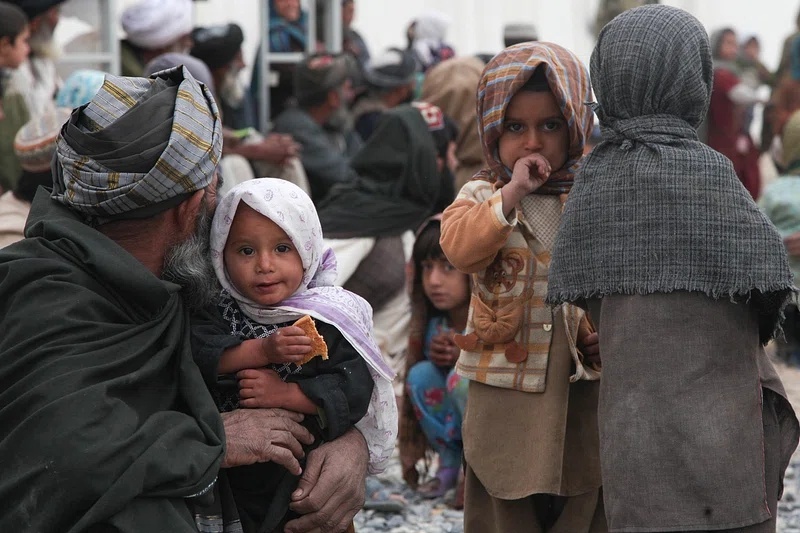
Across Pakistan, thousands of Afghan refugees live under constant threat of deportation, facing insecurity at every step. Researchers such as Aysha Aktar Adhara have noted that Afghan refugees in Pakistan live in constant fear, with each day marked by the possibility of forced return. The United Nations High Commissioner for Refugees reports that many refugees are deprived of education, denied employment opportunities, and forced back to Afghanistan. Human Rights Watch has documented that since 2023, hundreds of thousands of Afghan refugees have been compelled to return, pushing already vulnerable families deeper into poverty, danger, and trauma.
Behind every statistic is a real story—like mine. A boy who lost his dreams, who was forced to leave his home, and who struggled simply to buy bread without fearing that every step outside might be his last.
As Volker Türk, the United Nations High Commissioner for Human Rights, stated:
“Afghan women, children, and men continue to be pushed out of countries where they once sought safety, forcing them to return to Afghanistan against their will and exposing them to grave risk.”
Afghan refugees are not asking for charity. They are asking for dignity, justice, and the fulfillment of their right to security. Even in exile, even in silence, sometimes it only takes one voice to remind us that our future is not over yet.
[Mehrullah Rahmani is an an Afghan author, educator, and researcher. Courtesy: Countercurrents.org, an India-based independent online journal founded in 2002, publishing articles on peace, democracy, social justice, ecology, secularism, and people’s movements. Edited by Binu Mathew, it is known for giving space to progressive, grassroots, and alternative voices often ignored by mainstream media.]