❈ ❈ ❈
Scorched Earth Capitalism: U.S. Imperialism’s Genocide in Gaza
Gary Wilson
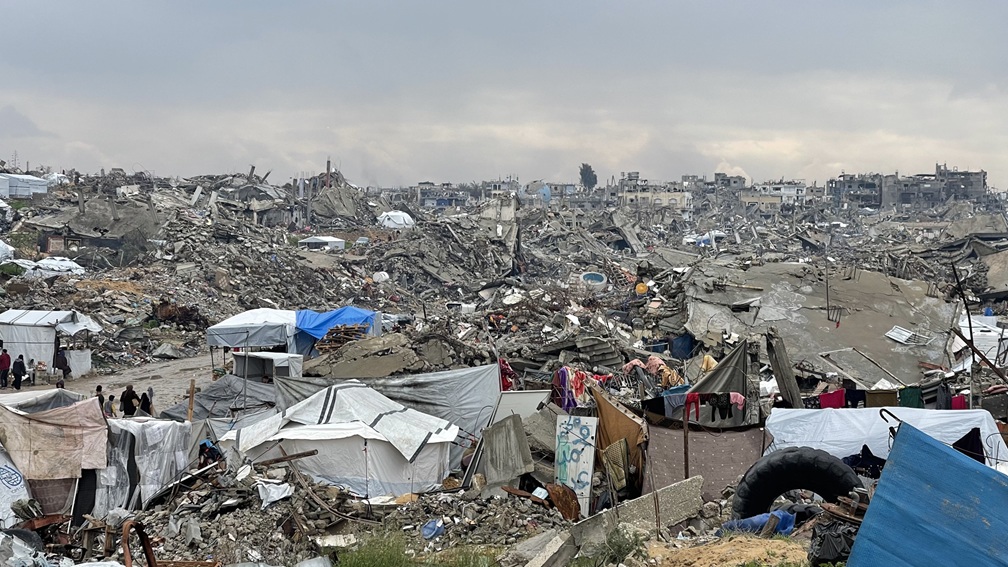
Israeli tanks are now rolling into Gaza City, the last section of the Strip left standing. One by one, buildings are detonated into rubble. Families are expelled at gunpoint. Gaza’s government media office has reported that Israeli forces have deployed more than 80 explosive robots inside residential structures in recent days, part of a deliberate scorched-earth strategy.
This destruction comes in the midst of a famine carefully engineered by siege. Hundreds of Palestinian men, women, and children have already starved to death.
The crisis is no accident of war. It is not chaos but method. Gaza’s famine is engineered, its destruction mapped out long before the latest assault began. What is unfolding is genocide–planned in Washington and Tel Aviv.
A blueprint for ethnic cleansing
With the fall of Gaza City, the entire Strip will be under Israeli occupation. Netanyahu describes this as the “concluding moves”: the mass confinement of Palestinians in sealed camps and their eventual expulsion from their ancestral homeland.
When Donald Trump declared in February that the United States would “take” and “own” Gaza, forcing Palestinians into “other countries,” many dismissed it as unserious posturing. But months later, it is clear his words anticipated the very strategy now unfolding.
A leaked strategy document–developed with input from the so-called Gaza Humanitarian Foundation, the Boston Consulting Group, and the Tony Blair Foundation–lays out this policy in the antiseptic language of corporate boardrooms. Every Palestinian life is treated as a financial liability. Expelling one person is calculated to “save” $23,000. Those who leave “voluntarily” are offered $5,000 and two years’ rent; those who die, the document implies, represent the greatest economic benefit of all.
This is genocide repackaged as financial optimization. The language of return on investment, public-private partnerships, and capital expenditures obscures the brutal reality: a population being starved, bombed, and shot down so that financiers and politicians can balance their ledgers.
Gaza and imperialism’s new geography
The extermination of Gaza is not only ideological but strategic. The document presents two direct benefits for the United States: “massive financial gains” and the acceleration of the India-Middle East-Europe Economic Corridor, also known as IMEC.
IMEC, announced by Washington in 2023, is a geopolitical counter to China’s Belt and Road Initiative. It envisions a trade corridor linking India to Europe through the Arabian Peninsula and Israel. Netanyahu himself made the connection clear at the United Nations, holding up a map of a “new Middle East” in which Israel stretches from the Mediterranean Sea to the Jordan River, erasing Gaza and the West Bank entirely. He called this corridor “visionary.”
Weeks later, Israel launched its genocidal war on Gaza. The timing was no coincidence. The strategy document calls Gaza an “Iranian outpost” threatening the corridor. Its annihilation is described as essential to securing the region for U.S. and Israeli dominance and ensuring access to trillions of dollars in natural resources.
Starvation as a weapon
This is the context for the famine now consuming Gaza. Starvation is not a byproduct of war but a weapon of it. Children with skeletal frames crowd makeshift hospitals. Families scavenge for scraps. Israeli forces open fire on crowds desperate for food aid. This is extermination by hunger, reinforced by bombardment and expulsion.
Public opinion tells a different story. Polls show support for Israel at an all-time low in the United States, including among Jewish Americans. Around the world, opposition to the genocide is overwhelming. Yet Washington and its allies continue to arm and fund the onslaught. The explanation lies not in popular will but in the deeper logic of imperialism.
Zionism and imperialism
U.S. support for Israel cannot be explained simply by the influence of AIPAC or by blackmail scandals surrounding figures like Jeffrey Epstein. It goes back more than a century, to Britain’s 1917 Balfour Declaration, when London endorsed a Zionist homeland in Palestine as a way to fragment Arab unity. After 1948, the United States inherited this role, seizing upon Zionism as a means of dividing and suppressing the Arab world.
The Arab world, stretching across North Africa (e.g., Egypt, Libya, Algeria), the Horn of Africa (Somalia, Djibouti), the Nile Valley (Sudan), the Levant (Jordan, Lebanon, Syria, Palestine), to the Arabian Peninsula (Saudi Arabia, Yemen, Oman, etc.) is home to over 470 million people, vast oil reserves, and critical trade routes like the Suez Canal.
Its sheer potential for unity posed a grave threat to imperialist domination. Pan-Arabism, the movement to unite the region, emerged as a natural response. Imperialist powers answered with relentless efforts to suppress it–backing monarchies, waging wars, and installing dictatorships. Zionism became one of their sharpest tools: a settler colony used to divide and weaken the Arab nation.
Unlike Arabs, Jews in modern times lacked the shared features of a nation–territory, economy, or language. Hebrew was revived from religious use to serve as a national tongue only under Zionist direction. The State of Israel was made possible only through imperialist sponsorship. For Washington, it provided a dual solution: preventing Jewish Holocaust survivors from reinforcing labor and communist movements in the United States, and positioning them as a garrison force against Arab nationalism.
After the Soviet Red Army defeated the Nazis and freed the concentration camps, socialism was seen as a powerful force of liberation. This idea rapidly spread beyond Europe and was brought by war refugees to the United States and the rest of the world.
Reaction without exit
Today, Israeli society finds itself at a historical dead end. Like Afrikaner colonists in South Africa, settlers have become increasingly reactionary. But unlike Afrikaners, who depended on the exploitation of African labor, Israel seeks to eliminate Palestinian labor altogether. Its settler-colonial logic drives toward expulsion and extermination.
For U.S. imperialism, this logic is convenient. Israel’s crimes can be portrayed as uniquely “Israeli,” allowing Washington to deny its own hand while reaping the benefits. In reality, Israel has fought every war since its founding as a proxy for U.S. power.
The logic of finance capital
What is happening in Gaza today is not an accident. It is capitalism in its imperialist stage stripped bare. As Lenin wrote more than a century ago, finance capital does not strive for freedom but for domination. It transforms famine into a weapon, ethnic cleansing into an investment opportunity, and genocide into a growth strategy.
The International Association of Genocide Scholars has already concluded that Israel is guilty of systematic war crimes and genocide. Yet the responsibility does not rest with Israel alone. The U.S. imperialist state has armed, financed, and excused this crime. At home, the same government slashes social programs, busts unions, suppresses wages, and prepares to crush dissent.
The horror unfolding in Gaza is not just a crime against a people–it is a warning of what capitalism has in store for the world. If U.S. imperialism is willing to annihilate millions of Palestinians as the prelude to its confrontation with China and Russia, how many billions will it sacrifice in a global war?
The genocide in Gaza is inseparable from the capitalist system that created it. To fight for the survival of the Palestinian people is to fight against the global dictatorship of finance capital itself. The future of humanity depends on nothing less.
(Courtesy: Struggle-La Lucha, a US based socialist publication.)
❈ ❈ ❈
Nowhere to Run: I am Choosing Death at Home Over Forced Evacuation
Nourdine Shnino
The sky above Gaza has become a ceiling of fear. Every hour, Israeli warplanes roar overhead, and the ground shakes beneath us.
Israel has issued new evacuation orders for the entire population of Gaza City to leave, in preparation for its full-scale ground occupation of the city by October 7, 2025. But for many of us, leaving is no longer a choice.
I am now displaced with my small family—my wife, Somai, and our nine-month-old son, Omar—in the al-Nasser neighborhood in western Gaza City. The war has exiled us from our real home in al-Tuffah, on the eastern side of the city. Israel’s current orders state we must move south, but it’s impossible to do so.
Transportation costs would be around 1,500 Israeli shekels—equivalent to about $446—an amount far beyond our reach. Even if we could somehow gather the money, southern Gaza has already collapsed under the weight of constant displacement and is crammed with families much like ours—tents torn by heat, children sleeping on bare soil, and no safety anywhere. Much of the land in southern Gaza, in cities like Deir al-Balah and Khan Yunis, has already been seized by the Israeli military.
So, my family has decided that we will remain where we are. If death comes, it will find us inside our home in al-Nasser—not on the road and not in another exile. Better to die standing in our place than to wander endlessly, stripped of every dignity.
● ● ●
This is not the first time we have been displaced. When the war erupted on October 7, 2023, we were among the countless who fled to southern Gaza, driven by fear, not knowing what awaited us.
We thought then that evacuation meant safety. But safety never came. We spent more than a year in the south, tasting the bitterness of being strangers in our own land, only to return to Gaza City in January 2025 with nothing but scars.
I still remember the day that should have been the happiest day of my life. My wedding was supposed to take place on December 14, 2023. Instead, it was swallowed by war. Somai and I were both in Rafah, on the southern end of the Gaza Strip, each of us trapped in different houses under bombardment. She found shelter in her aunt’s home. For weeks, we were only a few streets apart, yet separated by fire, rubble, and fear. Neither of us wanted to lose the other, but even attempting to meet became a risk too heavy to bear.
Eventually, we decided: war or not, we would get married. Not in a wedding hall with music, laughter, and family, not with flowers or the white dress she had dreamed of. Rather, I went to her aunt’s house and took her hand. There was no feast, no dancing, no photographs—only a quiet promise between two souls who had decided that even if death came, it should find us together, not apart.
Our first home as husband and wife was not an apartment but a small, cold warehouse in Rafah. There was no kitchen and no cupboard, only a wooden table for our clothes and a small toilet in the corner. But it was ours. It was where we learned to live with nothing but love, where we whispered to each other that survival was still possible.
In May 2024, Israel issued new evacuation orders for the displaced in Rafah. I immediately called a relative in the Nuseirat refugee camp in central Gaza, desperate to find a roof for my family. By some miracle, he managed to secure a spot for us to stay—a small room inside a wedding hall, which became our refuge. And just as in our previous shelter, we salvaged what little dignity we could: a single wooden table, which became our wardrobe.
It was there, in Nuseirat, that hope began to stir within us again. My wife’s belly grew round, carrying the promise of new life. On November 24, 2024, our son Omar was born at al-Awda Hospital. In that moment, despite everything, he became our light—like a ray of sunshine piercing the thickest darkness. We lived in Nuseirat refugee camp for nearly nine long months before finally making our way back to Gaza City in January 2025.
The journey back to Gaza City, however, was brutal. We were forced to walk along the coastal road, stripped of our dignity. I staggered under the weight of two heavy bags and a gas cylinder for nearly ten miles, while my wife carried Omar—just three months old—close to her chest.
Now, as I hold our baby boy in my arms, I think about those early days. I wonder what kind of life he will inherit—a life of constant displacement, or a life rooted in dignity.
Each night, as bombs shake the ground beneath us, I find myself making the same silent prayer: If we must die, let us die together, so that none of us is left behind to weep alone. Because here in Gaza, sometimes the only choice left is not where to go—but how to face the end.
[Nourdine Shnino is a news editor, feature story writer, and freelance journalist from the Gaza Strip. A native of Gaza City, he earned a bachelor’s in English Language and Literature from Al-Azhar University in 2013. Courtesy: The Progressive Magazine, an American magazine and website of politics, culture and progressivism with a left-leaning perspective.]
❈ ❈ ❈
Ex-Israeli Army Chief Admits Over 200,000 Palestinians Killed or Injured in Gaza Genocide
Quds News Network
Former Israeli army commander Herzi Halevi has admitted that more than 200,000 Palestinians have been killed or injured during Israel’s genocide in Gaza. He also said that legal advice never restricted attacks at any point in Israel’s aggressions.
Halevi stepped down in March as chief of staff after leading the Israeli army through the first 17 months of the genocide.
Speaking at a settlement meeting in southern Israel, Halevi told settlers that more than 10% of Gaza’s population had been killed or wounded. “More than 200,000 people,” he said.
The figure matches closely with the toll reported by Gaza’s health ministry, which Israel has often dismissed as propaganda. Yet international humanitarian groups have long considered the ministry’s statistics reliable.
According to official Gaza figures, 64,718 Palestinians have been killed and 163,859 injured since the genocide began. Thousands more remain missing, believed to be under the rubble as Israel continue to hinder rescue teams work.
Leaked Israeli military intelligence showed that more than 80% of the dead in Gaza until May were civilians.
Halevi defended the scale of Israel’s military response. “This isn’t a gentle war. We took the gloves off from the first minute. Sadly not earlier,” he said.
The remarks were made in Ein HaBesor, a farming settlement.
“No one is working gently,” Halevi continued. He claimed, however, that the Israeli military operates within international humanitarian law. Israeli officials have repeated that claim throughout the genocide, often saying military lawyers guide operational decisions.
Halevi, however, denied that legal advice ever affected battlefield decisions. “Not once has anyone restricted me. Not once,” he said.
He added that the military advocate general, Yifat Tomer-Yerushalmi, did not have the authority to stop him. In remarks cited by Ynet, Halevi also implied that the role of military lawyers was more about defending Israel’s image abroad than restraining operations.
“There are legal advisers who say: We will know how to defend this legally in the world, and this is very important for the state of Israel,” he said.
[Courtesy: Quds News Network, founded in 2011, is the largest independent Palestinian youth news network, advocating for freedom, dignity and Palestinian self-determination.]
❈ ❈ ❈
What’s Happening in Gaza City?
Quds News Network
Israeli forces have intensified their attacks on Gaza City as part of plans to occupy it, with Palestinians fleeing amid relentless bombardment and dire humanitarian conditions.
What’s Happening?
Thousands of Palestinians are being forcibly displaced each day by Israel’s ongoing, indiscriminate bombing of Gaza City, which is killing dozens of civilians daily.
Families are fleeing south, following Israeli threats to head to the so-called ‘safe zone’ of al-Mawasi, an area that is overcrowded and has been repeatedly targeted by Israeli forces.
According to the Palestinian Civil Defense, over 6,000 people were forced to flee the besieged city on Saturday.
According to local sources on the ground, Gaza City is being systematically emptied, building by building, family by family.
Sources added that Israeli forces have intensified their attacks on the Tel al-Hawa neighborhood, as well as the Shati and Remal, destroying over 30 residential buildings and shelters.
Intisar Ashour, a resident of Tel al-Hawa who lived in an apartment in a residential building that was destroyed on Saturday, told Quds News Network: ‘The bombardment continues heavily. We heard the sound of tanks near us. The Israeli forces destroyed many buildings. Israel wants to forcibly displace us through fire and killing.”
Several people were killed in the attacks since Saturday, sources reported, adding in one attack in Tel al-Hawa, due to the blast of the strike, shrapnel and debris flew into a displacement camp sheltering families, killing and injuring many inside the tents.
Gaza’s Government Media Office said on Sunday Israel has carried out “systematic bombing of towers, residential buildings, schools and civilian institutions with the aim of extermination and forced displacement” as its offensive on Gaza City continues this morning.
“While it claims to be targeting the resistance, the field realities prove beyond doubt that the occupation deliberately and according to a clear methodology bombs schools, mosques, hospitals and medical centres, destroys towers and residential buildings, destroys displaced persons’ tents, and targets the headquarters of various institutions including international institutions working in the humanitarian field,” it said in a statement.
Ashour noted that Israeli forces issued a bombing threat for the building; however, there was no time to flee or gather any belongings.
“When people rushed to grab their things, they struck the building twice while people were still inside,” she said.
“Not only are missiles raining down on us, but famine is consuming us as well,” Ashour said.
[Courtesy: Quds News Network, founded in 2011, is the largest independent Palestinian youth news network, advocating for freedom, dignity and Palestinian self-determination.]