❈ ❈ ❈
From ‘Howdy Modi’ to ‘Cannot Name Trump’: How Modi Has Taken a Hit from Trump’s Tariffs and Taunts
The Wire Analysis
US President Donald Trump’s announcement of steep tariffs on India, his criticism of the Indian economy as “dead” and his public overtures towards Pakistan have placed Prime Minister Narendra Modi, more than India as a nation, in a uniquely difficult spot.
While the impact on India as a country is tangible, it is a moment of political reckoning for Modi, who has been under pressure since the 2024 Lok Sabha elections when the BJP lost its majority in the house.
Here are the reasons it places Modi in a tough spot.
Destroys Modi’s domestic image of a global statesman
Modi has painstakingly cultivated an image of himself domestically as a top global leader exhibiting close personal friendships with the world’s most influential heads of state, particularly in the US.
Trump’s public insults and punitive tariffs undermine this persona, making Modi appear ineffective or even powerless in protecting Indian interests and standing on the world stage.
Under pressure from the US, he has already succumbed to China, even though Beijing continues to pile on pressure and refuses to make any concessions. This severely erodes Modi’s political brand at home, where he and his party have used images from his foreign trips to project influence domestically.
Political ammunition for domestic opposition
With Trump – the first for an American president – openly criticising the Indian economy and labelling it “dead”, opposition parties such as the Congress have seized upon these remarks to portray Modi’s economic approach and foreign outreach as failures. They argue that Modi’s support of Trump during previous years has unravelled, leaving India diplomatically isolated and economically vulnerable.
Modi’s failure to name Trump in his Lok Sabha speech, despite an open challenge by leader of opposition Rahul Gandhi, has shown him as weak and scared of standing up to the US president. This provides ammunition for the opposition parties to politically target Modi when he is already being challenged by the Rashtriya Swayamsevak Sangh on the issue of the election of the new BJP president.
Setbacks undermine Modi’s central arguments
The new US tariffs threaten to erode the competitiveness of Indian exports, damage investor sentiment and threaten to bury Modi’s faltering attempts to get global manufacturing to India.
Key labour-intensive sectors such as jewellery, textiles and certain electronics face certain job losses. These outcomes create immediate economic pain and threaten Modi’s narrative of making India an economic powerhouse as the “fourth-largest economy in the world”.
If the US also follows through on penalties related to India’s Russia policy, the fallout could be even more severe. Energy prices could rise and India’s fiscal deficit could increase, putting further pressure on the budget and bringing greater distress to the people.
Hyphenation with Pakistan sours nationalist dreams
Trump’s statements and overtures that club India with Pakistan, including praising a new US-Pakistan energy deal and openly patronising Islamabad, are a direct affront to Modi’s narrative of India as a regional counterweight to both Pakistan and China.
The perception that the US is tilting toward Pakistan, or using India-Pakistan tensions for leverage, is particularly damaging to Modi’s core nationalist constituency, which takes pride in a strong, singular global standing for India. It believed that India cannot be equated with its neighbour or seen as needing US mediation to end the conflict.
Modi’s inability to secure even this basic gain of the UPA era damages his “desh nahi jhukne doonga” brand among his core Hindutva supporters.
Loss of bargaining leverage hurts economy
Modi’s strategy had relied on fostering goodwill and leveraging the India-US relationship for favourable trade agreements and strategic cooperation. Trump’s abrupt imposition of tariffs, at rates higher than those faced by competing Asian economies, signals that Washington is willing to use harsh tactics, regardless of personal or diplomatic ties. This despite Modi rushing to meet Trump after his re-election early this year.
New Delhi is now left scrambling for a response, with very limited leverage, and must consider politically costly concessions or risk a further downturn in exports and economic growth.
After 11 years of being in power, Modi can’t shift the blame on anyone else and will be held accountable for the severe economic downturn in the public eye.
In sum, Trump’s actions and rhetoric hit directly at pillars propping Modi’s domestic political strength and standing, in ways that are both visible and hard to quickly repair. The impact on India will be managed, but it is Modi, as a political leader and as an electoral brand, who now faces the greatest challenge in his eleven years in office.
[Courtesy: The Wire, an Indian nonprofit news and opinion website. It was founded in 2015 by Siddharth Varadarajan, Sidharth Bhatia, and M. K. Venu.]
❈ ❈ ❈
Indian Exports Under Siege: US Tariff Gamble
Tajamul Rehman Sofi
The recent imposition of a 25% tariff by the United States on select Indian exports under Section 301 of the US Trade Act, alongside associated penalty threats, signals a troubling chapter in India-US trade relations. This move, primarily targeting sectors, such as gems and jewelry, steel and aluminum, digital services, textiles, and agriculture, is driven by longstanding disputes over market access, digital trade practices, and retaliatory tariffs by India on US products.
Washington has raised concerns about India’s data localisation rules, import duties on electronic goods, and its broader digital sovereignty push, interpreting these as barriers to US commercial interests. In response, India has emphasised the need to protect local industries and maintain regulatory space, particularly for emerging sectors like fintech and digital payments.
Yet, the escalation has not remained symbolic; it directly endangers sectors that are deeply integrated into India’s export ecosystem and serve as lifelines for employment and rural livelihoods. Understanding the consequences of these tariffs requires an assessment of their short-term and long-term ramifications for India’s financial stability, especially as these sectors represent crucial contributors to foreign exchange reserves, fiscal health, and inclusive growth.
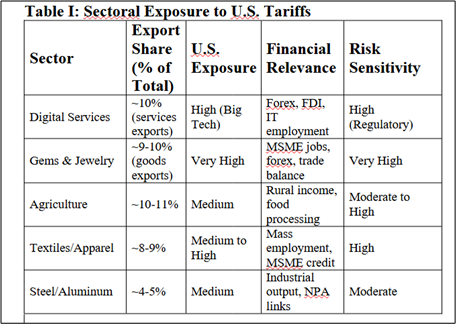
In the short run, India is likely to face immediate disruption in trade flows. Gems and jewelry, which contribute nearly $38 billion annually, or 10% of India’s total merchandise exports, are particularly vulnerable, as nearly one-third of their exports head to the US. Any steep duties here could paralyse MSMEs (medium, small and micro enterprises), jeopardise millions of jobs, and erode forex inflows.
Similarly, the IT and digital services sector, the largest contributor to India’s services exports with a value exceeding $180 billion, will be strained by increased scrutiny and potential digital service taxes. This sector not only ensures a consistent services trade surplus but also anchors India’s foreign exchange reserves and macroeconomic buffer.
Agriculture, with exports like rice, shrimp, and spices valued at over $16 billion collectively, will face reduced competitiveness, especially in the shrimp sector, where the US remains a major consumer.
Steel and aluminum, vital for India’s infrastructure sector, and textiles, employing over 45 million people, are also positioned at risk, with downstream effects expected on employment, bank credit flows, and regional MSMEs. The confluence of these sectoral shocks could stress India’s current account balance, complicate inflation control, and increase rural and industrial distress.
Long-term impacts could be even more structural. As these tariff barriers persist, Indian exporters may lose permanent market share, especially in highly competitive global markets. A prolonged decline in gems and jewelry exports, for instance, could lead to a contraction in urban employment in Gujarat and Maharashtra, regions heavily dependent on the trade.
Persistent digital service restrictions could stall India’s ambitions to lead the global digital economy, stifling innovation and reducing FDI flows. Agriculture’s vulnerability may increase rural indebtedness, weaken cooperative banks, and aggravate the already fragile rural financial ecosystem. Steel and aluminum, if burdened with tariffs and non-tariff barriers, could dampen industrial growth forecasts and derail infrastructure goals.
Moreover, the compounded loss in export earnings would narrow the fiscal space for public investment, disrupt currency stability, and increase reliance on external borrowings. In such a scenario, financial institutions could face heightened non-performing asset (NPA) risks, especially in sectors with large exposure to export credit, further straining the already cautious lending environment.
Among all affected sectors, gems and jewelry and digital services stand out as the most critically endangered. The former is due to its direct export exposure to the US and employment generation capacity in labour-intensive clusters, and the latter is due to its foundational role in maintaining India’s services surplus and currency reserves.
Agriculture and textiles follow closely, though their impact is more pronounced in domestic financial inclusivity and rural livelihoods. Steel and aluminum, while less export-heavy, influence broader industrial health and banking exposures.
To capture the scale of dependence, India’s digital services account for more than 50% of total services exports, while gems and jewelry form around 10% of total merchandise exports. Agricultural products, such as shrimp and spices contribute to about 10-11% of total exports and are essential for rural sustenance. Textiles and apparel contribute 8-9% and underpin mass employment across low-income states. Steel and aluminum contribute about 4-5% and impact corporate profits and capital markets. These figures highlight the sector’s strategic significance to both external and internal financial stability.
India’s response must, therefore, be both tactical and strategic. In the short term, the government can explore trade negotiations and targeted tariff exemptions through bilateral diplomacy or WTO (World Trade Organisation) mediation. It can also offer export incentives, extend interest equalisation schemes, and enhance credit availability to MSMEs in the impacted sectors.
Diversifying export markets beyond the US, such as to ASEAN, the European Union and Africa, will also be essential. Over the long run, India must strengthen its trade infrastructure, invest in high-quality manufacturing, and develop digital trade frameworks that align with global standards while preserving domestic autonomy.
For agriculture, policies should focus on value-chain upgrades and bilateral phytosanitary agreements. In digital services, ensuring clarity in cross-border data flow policies and avoiding unilateral taxes will be crucial.
Most importantly, a financial buffer must be built by promoting rupee internationalisation, strengthening forex reserves, and deepening domestic capital markets. Only with such a multi-pronged strategy can India weather the storm of protectionist headwinds and preserve the integrity of its financial stability in an increasingly uncertain global trade environment.
[The writer is a research officer at Indian Institute of Public Administration, New Delhi, India, specialising in financial stability, banking finance, and public policy. Courtesy: Newsclick, an Indian news website founded by Prabir Purkayastha in 2009, who also serves as the Editor-in-Chief.]
❈ ❈ ❈
What Else Can They Do?
Research Unit for Political Economy
[An article in the context the news (July 31st 2025) of Donald Trump’s ‘25% tariff plus penalty’ announcement on India. This article is a follow-up to an earlier article by RUPE ‘What Explains India’s Response to Trump?’, printed in Janata Weekly in the April 27-May 4 blog.]
The lead headline in most Indian newspapers today reads: “Trump hits India with 25% tariff plus penalty”, or words to that effect. Trump has made this announcement in his usual style, on social media, replete with abuse and entire phrases in capital letters. This makes it unlikely that an interim trade deal between the US and India, preceding the full-fledged Bilateral Trade Agreement (BTA) between the two countries which is being negotiated, will come through.
India’s Ministry of Commerce and Industry said that the Government had taken note of Trump’s statement, and is “studying its implications”:
India and the US have been engaged in negotiations on concluding a fair, balanced and mutually beneficial bilateral trade agreement over the last few months. We remain committed to that objective. The government attaches the utmost importance to protecting and promoting the welfare of our farmers, entrepreneurs, and MSMEs [micro, small and medium entrepreneurs].
The Government said it would take “all steps necessary to secure our national interest.” The fundamental problem, however, is that, if it does not arrive at a deal, it has no alternative course of action.
It is clear that Trump’s latest theatrical move, while introducing additional uncertainty into an already highly uncertain situation, is part of the US’s tactics to apply more pressure to secure its aims in the ongoing negotiations. Various labour-intensive sectors such as jewellery, textiles, garments, and seafood fear an immediate impact. While electronics (mainly phones) and pharmaceuticals have apparently been spared for the moment, they may be drawn in later. Since the negotiations concern trade in physical goods, not services, India’s IT industry are not meant to be directly affected. Nevertheless, in order to apply further pressure, the US could create problems for IT exports from India, through instruments such as investigations, denial of visas, taxes, and so on.
All such measures may create problems for the US and US firms as well, and hence might create a lobby which would force Trump to back down. However, Trump has shown that he believes that a period of turmoil, perhaps with temporary hardship for US citizens, is necessary in order to extract the best possible deal. So it is difficult to predict how things will unfold.
The Indian government, for its part, faces a difficult political situation. The US is evidently demanding concessions in certain ‘sensitive’ sectors, such as imports of cereals or dairy products. These are important sectors of the Indian economy, employing large numbers of people, and are vital to food security as well. Already kisan organisations have mobilised against any concession on these questions. The Government would have to pay a heavy political price for any blatant concession in such sectors.
Normally, the US and other imperialist powers understand these political difficulties of Third World rulers, and provide them some political space for a deal. However, that space has been narrowing in recent years, and today, in his desperation to secure big gains, Trump has virtually done away with whatever space remained. While trade negotiations are usually depicted as beneficial overall for both sides, enabling each side to justify the loss to any specific sector as a result of the deal, Trump has dropped all such pretensions, and depicts the deal as simply benefiting the US alone. This is very awkward for the Indian rulers.
The Indian government appears to be searching for other ways to satisfy Trump. One way is at the expense of other trade partners – take, for example, the Commerce Ministry’s appeal to importers to switch from Chinese goods to US substitutes. Another way is to make concessions whose impact may not be immediately apparent to large sections of the people – such as the concessions relating to intellectual property rights.[1] A third way may be to buy more US weapons, whose purchase does not displace any Indian producer, but only other foreign producers. According to a report of July 25th, the Indian Air Force has strongly endorsed purchase of the US-made Lockheed Martin F-35 Lightning II over the Russian Sukhoi Su-57E.[2] It was the F-35 that Trump strongly pushed during Modi’s visit to Washington in February. One does not know whether even a bouquet of such measures will finally satisfy Trump, given his maximalist negotiating stance. But such measures would harm Indian national interests, whether or not they meet immediate, organised opposition in India.
The fundamental problem for India’s rulers is that, in the recent period, they have staked so much on their export model. (We commented on this in an earlier piece on Trump’s tariffs.) Indeed, in the face of an unrelenting economic slowdown, they are even more committed to it. The Make in India policy of 2014 (which itself was a re-branded version of the 2011 National Manufacturing Policy), the Atmanirbhar Bharat Abhiyan of 2020, and the Production-Linked Incentives scheme of 2021 all were premised on creating a manufacturing base in India for exports, with the help of multinational corporations. Modi said in his first Independence Day speech (August 15, 2014) from the Red Fort: “I tell the world, ‘Make in India’. Sell anywhere but manufacture here. We have the skill and talent for it.”
Leaving aside other grave problems with this model, it is obvious that it requires that the developed world greatly and progressively increase its import of these goods from India. But the chances of that happening were never good, and are getting bleaker: first, because Trump is trying to restrict such imports (for example, pressurising Apple to manufacture in the US, rather than in India), and secondly because the world is rapidly moving toward a recession or even a new Great Depression. Trade blocs might emerge, with barriers against those outside these blocs. To base one’s growth model on exports in these conditions is clearly absurd.
The problem is that the alternative path of development, of all-round development of the home market and employment-intensive industries, accompanied by steady development of trade relations with a range of Third World countries, is impossible for India’s rulers to conceive of, let alone bring about. And hence the frame of discussion is restricted to how to strike a deal with Trump; which means how much of India’s national interests can be safely sacrificed, and how the consequences can be politically managed.
Notes
- See Biswajit Dhar, “What Will It Take for India’s New Free Trade Agreements to Avoid Pitfalls?”, The India Forum, June 4, 2025, https://www.theindiaforum.in/international-affairs/what-will-it-take-indias-new-free-trade-agreements-avoid-pitfalls
- Our attention was drawn to this by a tweet by Pravin Sawhney: https://x.com/PravinSawhney/status/1950576690536526123
(Courtesy: Research Unit for Political Economy (RUPE), a Mumbai based trust that analyses economic issues for the common people in simple language.)