❈ ❈ ❈
The Restoration of the Monroe Doctrine and Trump’s Imperialist Offensive in Latin America
Tiago Nogara
Since Donald Trump’s reelection as president of the United States, the world has watched in shock as US foreign policy has grown increasingly unilateral and aggressive, raising deep concerns about the future of international politics. These concerns stem not only from the record of his previous term but also from the growing resurgence of interventionist and unilateral policies that have gradually regained prominence in recent years—developments that have accelerated during the early days of Trump’s new administration.
Given the campaign promises made under the familiar slogan Make America Great Again (MAGA), such concerns were far from unfounded. And they were only amplified by the administration’s early actions. Within days of taking office, the United States had already announced its withdrawal from the Paris Agreement, the World Health Organization (WHO), and even the global tax deal of the Organization for Economic Cooperation and Development (OECD). In a threatening tone, Trump suggested turning Canada into the fifty-first US state, expressed interest in annexing Greenland, and made illegal and immoral proposals such as relocating Palestinians from Gaza to other areas in order to “cleanse” the region. He fully aligned with Israeli interests in the Middle East, giving carte blanche to the genocide of the Palestinian people in Gaza and even bombing Iranian territory in defense of his favored ally.
It is especially in Latin America, however, that Trump’s threats and directives have taken on an even more aggressive tone. During his previous administration, he had already pursued a policy of encirclement and annihilation against Venezuelan President Nicolás Maduro by recognizing the puppet, self-proclaimed government of Juan Guaidó and imposing a wide array of political and economic sanctions on Venezuela’s legitimate government. In the same vein, he reversed the thaw initiated by Obama in relations with Cuba; added Nicaragua to the list of countries subject to illegal and unilateral US sanctions; backed the coup d’état against Evo Morales in Bolivia; and encouraged the Colombian far-right’s attacks on the peace agreements with the Revolutionary Armed Forces of Colombia (FARC) and the National Liberation Army (ELN). He also pursued an open confrontation against China’s economic presence in Latin America, promoted the rise of neofascist movements in various countries, and intensified discriminatory immigration policies—most notably through the construction of a wall along the Mexican border.
Less than a month into the new administration, Trump’s Latin America policy already clearly signaled a path of radicalized hegemony and interventionism long embedded in US diplomacy. It is no coincidence that Secretary of State Marco Rubio’s first official trip was a tour of Central American and Caribbean countries. Not since Philander Chase Knox’s 1912 visit to Panama, during the construction of the Panama Canal, had Latin America been the destination of a US Secretary of State’s inaugural trip.[1]
From the outset, the president declared that the Panama Canal—managed directly by Panama since 1999—should be returned to Washington’s control in order to curb China’s growing regional influence. He loudly asserted that the United States “doesn’t need Latin America,” announced plans to rename the Gulf of Mexico as the “Gulf of America,” threatened heavy tariffs on Brazilian goods, and signed a decree classifying several Latin American cartels and criminal organizations as terrorist groups—thus opening the door for direct US military intervention in the region.[2]
Pledging to carry out the largest deportation campaign in history, the Trump administration issued several executive orders to that end. These included measures to end birthright citizenship for children born on US soil to undocumented immigrants, resume border wall construction, suspend asylum application processes, declare a state of emergency at the border, and deploy army troops to assist in operations against irregular immigration. In parallel, a mass deportation process was initiated, with military planes transporting hundreds of Latin American immigrants back to their countries of origin.
The way the US carried out these deportations sparked serious diplomatic incidents. In Brazil, deportees arrived in handcuffs—a practice deemed unacceptable and outrageous by Brazilian authorities, prompting official protests from the Lula government. In Colombia, the situation escalated even further. The Colombian government initially refused to allow US aircraft to land, demanding that its citizens be treated with dignity. In retaliation, Trump announced 25 percent tariffs on Colombian goods entering the US market—possibly increasing to 50 percent within a week—and declared that US visas would be revoked and travel banned for Colombian officials and their supporters. Colombian President Gustavo Petro responded by imposing reciprocal 25 percent tariffs on US goods, but soon backed down, agreeing to receive deportees unconditionally in order to prevent further escalation.
The diplomatic clash with Colombia illustrates key features of the strategy Trump’s new administration has adopted for Latin America. The US and Colombia have maintained a Free Trade Agreement (FTA) since 2012, and Trump’s proposed measures would directly violate it. Moreover, Colombia is the only South American country that still considers the US its top export destination, holds extra-NATO ally status, and hosts at least seven active US military bases. These early moves made clear that Trump intended to use tariffs and sanctions to coerce regional governments into aligning with US diplomatic interests—extending such tactics far beyond the usual targets of Cuba, Venezuela, and Nicaragua. Indeed, Trump’s initial threats were directed at the governments of Mexico, Brazil, and Colombia, suggesting that his offensive would not be limited by ideological boundaries—as also evidenced by the confrontations with Canada and Denmark.
In Central America and the Caribbean—historically the most targeted regions of the “Big Stick” policy—the outlines of a renewed political and economic reconfiguration became quickly apparent. Pressure on Panama, including threats of forcibly retaking the Canal Zone, led the country to announce its withdrawal from the Belt and Road Initiative and to transfer management of two canal ports from Hong Kong’s CK Hutchison to the US-based BlackRock. In Costa Rica, Marco Rubio endorsed the government’s criticism of Huawei’s 5G rollout. In an official statement, Costa Rican Foreign Minister Arnoldo André celebrated alignment with the US, stating: “Costa Rica was recognized, praised, and congratulated by Senator Rubio for addressing these issues in accordance with the interests of the new US administration,” echoing rhetoric aligned with the framework of a so-called “New Cold War.”[3] In Guatemala, backed by radical US sectors, President Bernardo Arévalo maintained his country’s subservient diplomatic stance, even continuing to recognize Taiwan diplomatically.
In this same context, the US has made clear efforts to discipline its regional ally Nayib Bukele, President of El Salvador, who—despite his right-wing orientation and personal ties to Trump—has sought to deepen El Salvador’s relations with China. In April, an opinion piece in the Wall Street Journal criticized the US government’s complacency toward Salvadoran-Chinese ties.[4] Meanwhile, the tightening of sanctions on Cuba and Nicaragua has reinforced the goal of consolidating a “sanitary cordon” around those nations—and, of course, around Venezuela.
Further south, pressure on Brazil intensified in the lead-up to President Xi Jinping’s visit, with multiple US officials voicing opposition to Brazil’s potential accession to the Belt and Road Initiative. Though Brazil has not formally joined the initiative, the Lula administration has emphasized synergies between its national programs—the Growth Acceleration Program (PAC), the New Industry Brazil plan, and the South American Integration Corridors—and the Belt and Road Initiative. Brazil–China relations have continued to deepen, with discussions underway on a bi-oceanic railway corridor between Brazil and Peru, backed by Chinese expertise and companies.
The US–Colombia diplomatic crisis in January occurred amid mounting strategic tensions between the two nations, particularly regarding China–Colombia relations. Traditionally a close US ally and the only “global partner” of NATO in the region, Colombia under Gustavo Petro has taken an alternative path in foreign policy—challenging US hegemony and drawing closer to China. In 2023, Petro established a Strategic Partnership with Beijing and spent over a year preparing Colombia’s accession to the Belt and Road Initiative—officially announced during the Fourth China–CELAC Forum.
Unsurprisingly, when Trump announced tariffs on products from multiple countries, Argentina received the lowest rates—an outcome publicly celebrated by Javier Milei. As the foremost representative of the Trump-inspired far right in Latin America, Milei has shown a clear willingness to sacrifice the interests of his people—and even of Argentina’s business class, as seen in his efforts to sabotage lucrative ties with China—in exchange for displays of unconditional loyalty to Washington. Under his leadership, Argentina withdrew from the Belt and Road Initiative, abandoned the BRICS+ accession process, and skipped the China–CELAC Forum held in Beijing.
Two other ideological allies of Trumpism in the region—Daniel Noboa’s government in Ecuador and Nayib Bukele’s in El Salvador—have shown less alignment with anti-China efforts, reflecting the growing tension between the worldview of the US right and the real interests of parts of the Latin American elite. Though they share an anti-progressive agenda and maintain close ties with conservative US sectors, these leaders also represent fractions of national economic elites whose fortunes are increasingly tied to strong relations with China. Even so, it is undeniable that the United States wields far more control over Noboa and Bukele than over their main challengers—the Revolución Ciudadana in Ecuador and the Farabundo Martí National Liberation Front (FMLN) in El Salvador. For that reason, US diplomatic and intelligence services did not hesitate to back the irregular and questionable measures that defined the elections which returned Noboa to the presidency, despite the opposition’s strong allegations of fraud.
Finally, the heavy and ongoing US sanctions against Cuba, Nicaragua, and Venezuela were further intensified at the start of Trump’s new term, with the aim of fracturing their governments and empowering reactionary political and social forces committed to the success of regime-change tactics.
2. The Reasons behind Latin America’s Centrality
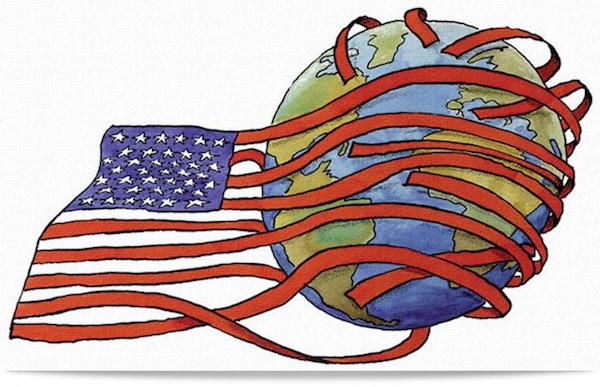
This reconfiguration of US foreign policy is no coincidence. Contrary to Trump’s claims that the United States “doesn’t need Latin America,” the region is, as the Argentine political scientist Atilio Borón consistently argues, the most important in the world for the United States.[5] It was not by chance that the Monroe Doctrine was articulated as early as 1823. Long before Woodrow Wilson outlined the pillars of a new global multilateralism in his Fourteen Points, the US was already seeking to establish a regionally led multilateralism through the Pan-American Conferences, which began in 1889. The Organization of American States (OAS) and the Inter-American Treaty of Reciprocal Assistance (TIAR) later consolidated a decision-making environment in the Americas operating outside of global multilateralism and under the close watch of the United States. Even before McCarthyism was exported or the political conditionalities of the Marshall Plan helped suppress communist parties in Europe, Latin American oligarchies were consistently encouraged by the United States to persecute key leaders of local workers’ and peasants’ movements.
Those who interpret such actions as mere expressions of American “disregard” for what they consider their “backyard” are mistaken. In reality, Trump’s diplomatic maneuvers reflect a determined effort to reorganize the balance of political and economic forces in the region. This objective is directly tied to three interrelated issues: global competition with China, containment of left-wing governments in Latin America, and control over strategic natural resources.
Latin America holds vast reserves of critical minerals essential to the global energy transition and the development of sustainable technologies, including lithium, copper, and nickel. Specifically regarding lithium, the region accounts for around 60 percent of global reserves—most of them concentrated in the Lithium Triangle of Chile, Argentina, and Bolivia.[6] Latin America also produces roughly 40 percent of the world’s copper, thanks to large reserves and mining capacity in countries like Chile, Peru, and Mexico.[7] It also hosts significant reserves of silver and tin, nearly one-third of the planet’s freshwater, and immense biodiversity. In addition, the region holds about one-fifth of the world’s oil and gas reserves, including the world’s largest proven oil reserve, located in Venezuela.[8] Crucially, Latin America is the world’s largest net food exporter and controls almost a third of the planet’s arable land—most of it in Brazil.[9]
The United States’ insatiable appetite for control over these resources has never been a secret. History is filled with examples of how Washington deployed a wide array of tools to eliminate Latin American political and social forces that opposed this agenda. One need not revisit the early days of the Monroe Doctrine, the violent seizure of nearly half of Mexico’s territory, the incursions of filibusters into Central America and the Caribbean, or the CIA-backed coups and dirty wars of the Cold War. It would be enough to observe the more recent cycle of the rise and destabilization of left-wing governments in the early twenty-first century.
Indeed, the marks of Yankee imperialism are deeply etched in the brutal campaign to topple the progressive governments of Latin America’s so-called pink tide—those that buried the Free Trade Area of the Americas (FTAA) proposal at the 2005 Mar del Plata Summit, challenged the Washington Consensus, and sought to build regional multilateralism outside the frameworks of the OAS and TIAR. When needed, the empire resorted to its usual brand of violence, as seen in the repeated unilateral, illegal, and criminal political and economic sanctions against Cuba, Venezuela, and more recently, Nicaragua. This same logic underpinned explicit US support for successive coup attempts in Venezuela and Bolivia, including the kidnapping of Hugo Chávez in 2002, the secessionist push in Bolivia’s Media Luna region in 2008, the violent Venezuelan guarimbas, and the bloody 2019 coup against Evo Morales.[10]
Yet Washington’s reactionary offensive has not relied solely on open violence. It has also refined its tactics of “soft coups,” particularly through lawfare.[11] By fueling Operation Car Wash (Lava Jato), the US managed to dismantle Brazilian construction firms that competed in Latin America, severely undermine Petrobras’s operations—paving the way for foreign companies to access Brazil’s pre-salt oil reserves—and in the process, destabilize and oust Dilma Rousseff’s government and imprison Lula.[12] Even earlier, lawfare had already struck the Workers’ Party (PT), with the “Mensalão” scandal temporarily removing key figures like José Dirceu and José Genoíno from political life. Similar tactics led to the removal of Manuel Zelaya in Honduras and Fernando Lugo in Paraguay; the resignation of Vice President Raúl Sendic in Uruguay; the convictions of Cristina Kirchner in Argentina, and Rafael Correa and Jorge Glas in Ecuador; and the ousting and imprisonment of Pedro Castillo in Peru. It is no surprise, then, that Mexico’s Fourth Transformation governments have consistently emphasized the urgent need to democratize their country’s oligarchic judiciary—a system that mirrors that of many others in the region.
While these tools succeeded in destabilizing and even overthrowing numerous governments, they failed to eliminate the social contradictions that continue to drive Latin American peoples to fight for better living conditions. Despite the immense challenges—hundreds of debilitating sanctions among them—the governments of Cuba, Venezuela, and Nicaragua remain standing. After the 2019 coup, Bolivia’s Movement for Socialism (MAS) returned to power with Luis Arce. Even in Brazil, where the far right once appeared to dominate the political landscape, Lula was re-elected—albeit at the head of a far more conservative coalition than in his previous terms. And not even Colombia—once a cornerstone of US influence in the region—proved immune to the shift, as the election of former guerrilla Gustavo Petro marked a dramatic turn in national politics. The high approval ratings of Andrés Manuel López Obrador and his successor, Claudia Sheinbaum, in Mexico, also speak volumes.
One might argue that the more radical governments have been weakened and the moderates pose little threat to US interests. But this is precisely where many analysts go wrong. In the current historical moment, even moderate solutions seem insufficient to sustain US hegemony in the region or globally. And this is not merely due to the back-and-forth of confrontations with the Latin American left—it is above all due to the structural factor of China’s growing cooperation with Latin America and the Caribbean.
Since China joined the World Trade Organization (WTO) just over two decades ago, its economic presence in Latin America has steadily grown. Today, China is the main trading partner of nearly all South American countries. Chinese direct investment has also increased, financing infrastructure projects with significant regional impact—such as the newly inaugurated port of Chancay in Peru. More than twenty countries in the region have joined the Belt and Road Initiative (BRI), and fewer and fewer maintain diplomatic ties with the Taiwanese province, choosing instead to recognize the one legitimate government of China, headquartered in Beijing.[13]
Furthermore, China’s guiding principle of non-interference in the domestic affairs of other countries has been well received by leaders across the ideological spectrum. This combination of expanding economic synergy and respect for sovereignty has created a major dilemma for US diplomacy. In the Cold War era, counterinsurgency tactics in partnership with Latin American oligarchies were used to contain communism and Soviet influence. But those same tactics are now inadequate to contain China. Today, it is not only left-wing or nationalist-popular governments that seek closer ties with Beijing. Even Peru’s conservative government under Dina Boluarte has shown no signs of jeopardizing its relationship with China. And even puppet far-right governments, such as those of Jair Bolsonaro and Javier Milei, have faced enormous difficulties in executing anti-China policies, because large segments of their national elites rely on strong economic relations with Beijing.
This explains the recent surge in public statements by high-level US officials criticizing growing China–Latin America cooperation. In July 2024, during the Aspen Security Forum, US Southern Command Chief Laura Richardson criticized Latin American engagement with China, saying: “They don’t see what the United States is bringing to the countries. All they see are the Chinese cranes, the development, and the Belt and Road Initiative projects.”[14] She suggested launching a new “Marshall Plan” for the region as a counterweight to Chinese initiatives. Speaking about Chinese infrastructure investments, Richardson claimed these projects were allegedly designed for “dual use,” implying potential military as well as civilian applications. Later, at the opening of the South American Defense Conference (SOUTHDEC) in Santiago, Chile, in August, she declared that a contradiction existed between what she called “Team Democracy” and the interests of “authoritarian and communist governments trying to take as much as they can here in the Western Hemisphere—operating with no regard for national or international law.”[15]
Subsequently, US Trade Representative Katherine Tai warned Brazil to be cautious about joining the Belt and Road Initiative. Echoing Laura Richardson’s tone, she stated, “Sovereignty is fundamental, and that is a decision for the Brazilian government. But I would encourage my friends in Brazil to view the proposal through the lens of objectivity, through the lens of risk management.”[16] Finally, in an April 10 interview with Fox News, US Secretary of Defense Pete Hegseth accused the Obama administration of neglecting China’s growing influence in Latin America and declared that, under the Trump administration, the US would reclaim its “backyard.” He added that efforts were already underway to “take back the Panama Canal from communist Chinese influence.”[17] In sharp contrast, Chinese Foreign Minister Wang Yi responded on April 14 that Latin American countries are “no one’s backyard” and that “the people of Latin America want to build their own home.”[18]
It is within this broader context that the now-familiar anti-China narratives have emerged and proliferated. Updating Cold War–era anticommunist metaphors, these discourses recycle baseless accusations of “totalitarianism,” “Chinese imperialism,” and “debt traps.”[19] Most reflect the worldview of the hardline anti-China camp—those who openly oppose any manifestation of the People’s Republic of China’s success and who hold considerable sway over influential circles of power in the North Atlantic world, as illustrated by recent statements from top officials in Donald Trump’s administration.
Thus, when Trump accuses Brazil of wishing “harm” upon the United States, he does so not because Lula’s government is overtly anti-imperialist, but because it refuses to participate in the dirty game of containing China and suffocating defiant neighboring governments. Alongside his early pressure on the Petro and Sheinbaum administrations over migration, Trump has also paved the way for interventionist measures by classifying various Latin American cartels as terrorist groups. It is no coincidence that these developments coincide with calls from former Colombian presidents Álvaro Uribe and Iván Duque for international military intervention in Venezuela. Meanwhile, the conservative media accuses Petro of leniency toward the ELN and insists on portraying the insurgent group as a mere criminal faction and political tool of Nicolás Maduro’s government.
All of these moves are part of a broader strategy: to weaken China’s presence in Latin America and to fully restore US hemispheric hegemony—a goal that ultimately depends on the ability to defeat progressive Latin American governments and social movements.
3. No Room for Moderation: The Assault on Brazil as a Test Run for What Comes Next
It is this broader context that has led the United States to intensify its unilateralism and the violent imposition of its will in the region. Moderate and compromise-based solutions are no longer sufficient to meet the empire’s interests. More than ever, what the United States now seeks are puppet governments willing to sacrifice not only the interests of their own peoples but also those of significant portions of their national elites. After all, the decline of US hegemony on the global stage is becoming increasingly evident, as demonstrated by its recurring defeats in the technological race against China—most recently exemplified by the staggering $1 trillion loss suffered by US Big Tech following the release of DeepSeek, a Chinese artificial intelligence model.[20]
It is no coincidence that Elon Musk—who held quasi-ministerial status during the beginning of Trump’s administration—is an open supporter of far-right activity in Latin America. He publicly defended the 2019 coup in Bolivia, maintains close ties with Nayib Bukele and Javier Milei, and recently clashed directly with the Lula government in Brazil.[21] Musk has a vested interest in competing with China in several technological sectors, which explains his increasing involvement across the Lithium Triangle and his efforts to politically destabilize Brazil, a country poised to become a hub for Chinese electric vehicle production. The Trump phenomenon and the proposed overhaul of relations with Latin America are not the result of megalomania, but rather the materialization of the interests of American billionaires intent on defending their astronomical profits.
As has historically been the case with US foreign policy, maintaining unrestricted control over Latin America remains a prerequisite for boosting the country’s global projection. The US would hardly dare to engage in large-scale conflict in the Middle East or East Asia without first securing at least partial control over Venezuela’s vast oil reserves. Nor can it hope to export its anti-China directives to extra-hemispheric allies without first succeeding in Latin America.
Thus, the effort to reshape the region’s political landscape is directly tied to the outcome of this year’s and next year’s elections, with decisive chapters in countries like Bolivia, Chile, Honduras, Colombia, and Brazil—where the US will focus on defeating a broad range of progressive governments. Bolivia has long been a target of US interventions, most notably illustrated by Elon Musk’s public remarks on the 2019 coup against Evo Morales. Today, President Luis Arce faces difficulties stemming from internal divisions within the MAS between his own supporters and those of Evo. In this context, the right’s hopes of returning to power through elections—after more than two decades—are visibly reinforced by Washington’s strategic interests.
In recent years, Honduras has taken a markedly different path from its past, establishing diplomatic ties with China in 2023 under President Xiomara Castro. She now seeks to ensure that her successor upholds a progressive political orientation and deepens the country’s relationship with China. In contrast, the likely candidate of the Liberal Party, Salvador Nasralla, has publicly opposed a potential free trade agreement with China and criticized the diplomatic break with Taiwan.
In Chile, the right-wing opposition to President Gabriel Boric includes several prominent conservative figures, notably Johannes Kaiser, who espouses a libertarian, far-right discourse reminiscent of Javier Milei. Meanwhile, in Colombia, the United States has made clear efforts to redirect the country fully toward its strategic and commercial interests. Colombia serves not only as a key trading partner, but also as a central player in Washington’s attempts to isolate Venezuela and curb China’s influence in South America.
Brazil will likely be the stage for the region’s most important electoral battle. President Lula will seek re-election against a yet-to-be-defined candidate who will nonetheless have the backing of Jair Bolsonaro, who is currently ineligible to run. It is worth recalling that under Bolsonaro’s last administration, Brazil officially withdrew from the Community of Latin American and Caribbean States (CELAC), actively dismantled the Union of South American Nations (UNASUR), and undermined other regional integration bodies that had gained prominence in the previous decade. Bolsonaro’s supporters are unequivocally aligned with Trumpism, frequently seen waving US and Israeli flags at demonstrations in Brazil.
As a dress rehearsal for US-backed destabilization of the Lula administration, President Trump has dramatically escalated the unilateral and aggressive posture of US foreign policy, orchestrating a series of joint attacks on Brazil and its efforts to build a new multipolar world order. In the wake of the successful BRICS Summit in Rio de Janeiro—which delivered a powerful declaration defending multilateralism and South–South cooperation—Trump threatened a 10 percent tariff on products from countries aligning with what he called the “anti-American policies of BRICS.”[22] He then launched a new phase of his global trade war, this time explicitly targeting Brazil under the pretext of alleged commercial irregularities and, more pointedly, to interfere in Brazil’s domestic political process in favor of his ideological ally, Jair Bolsonaro. Meanwhile, NATO Secretary-General Mark Rutte warned that Brazil, India, and China could face secondary sanctions due to their ongoing diplomatic and economic ties with Russia.
Contrary to dire forecasts from Western think tanks and media outlets, the BRICS Summit in Rio defied predictions of fragmentation and stagnation. During its seventeenth high-level meeting, BRICS leaders approved over 120 joint commitments spanning global governance, finance, health, artificial intelligence, climate change, and sustainable development. The Rio Declaration raised urgent concerns about global military spending at the expense of development in the Global South. In contrast with prevailing militaristic rhetoric, the bloc reaffirmed its commitment to multilateralism, poverty eradication, and climate action. Among the adopted initiatives were the BRICS Leaders’ Framework Declaration on Climate Finance, the Declaration on Global Governance of AI, and the BRICS Partnership for the Elimination of Socially Determined Diseases. Far from being irrelevant, BRICS emerged as a principal vanguard for a peaceful, multipolar world order.
Additionally, during bilateral meetings held alongside the summit, Brazil and China made progress in discussions and technical studies for the construction of a bi-oceanic railway in South America. The project would cross Brazilian and Peruvian territory, providing a direct land connection to the port of Chancay on the Pacific coast, reducing dependence on the Panama Canal and helping to shorten and enhance trade between Latin America and Asia.
In light of the dire situation of his Brazilian ally—former President Jair Bolsonaro, ruled ineligible for the 2026 election and facing growing legal jeopardy, including involvement in coup plots and even assassination schemes against President Lula—Trump decided to openly intervene in Brazil’s internal affairs. Bolsonaro’s son, Federal Deputy Eduardo Bolsonaro, simply abandoned his seat in Brasília and moved to the United States, where he is actively working with Trump’s team to reverse his father’s political ban and reignite the far right in Brazil. The trade offensive thus goes beyond economics—it is a calculated political assault designed to fracture the coalition that defeated the reactionary and surrenderist forces in 2022.
In President Trump’s and the Bolsonaristas’ view, hitting Brazilian exports to the US—critical to the profits of many industrial sectors—would sever the alliance between Lula and parts of the national economic elite. They believed this would forge a united front of elites advocating for Bolsonaro’s release and eligibility to run for office, in exchange for restored Brazil–US trade relations.
But this logic completely misfired. Instead, the subservience of Brazilian extremists—who went to Washington seeking sanctions on their own country—aroused a robust wave of national pride and pushback. Brazilian social movements and popular organizations mobilized on Avenida Paulista, in São Paulo, occupying more than three blocks to defend national sovereignty and demand progress on social justice issues, including Lula’s recent proposal to increase taxes on multimillionaires. Simultaneously, broad sectors of the conservative opposition lowered their weapons and aligned themselves with the president to form a national unity front against imperialist aggression, condemning the cowardly and submissive stance of the far right.
In response, the government invoked the Economic Reciprocity Law, announcing the imposition of symmetrical trade sanctions to protect national industry. This move was endorsed by Congress, business federations, and even influential private media. Estadão, a traditional conservative outlet, published an editorial condemning Bolsonarista submission to foreign powers, and Jornal Nacional—linked to the right-leaning Rede Globo, Brazil’s main private media oligopoly—gave Lula a prime-time platform to speak directly to television viewers.[23] In Parliament, far-right lawmakers found themselves increasingly marginalized, while conservative sectors shifted in support of the government. Finally, Lula issued a public statement to the country, invoking the unity of broad forces in defense of national sovereignty, economic development, and social justice, while denouncing the subservience of those he called traitors to the nation.
Lula’s leadership redrew the political center, uniting social movements, democratic leftists, middle-class factions, and segments of the industrial bourgeoisie. Recent polling shows a strong surge in government approval and steep declines for Bolsonaro’s supporters. Lula has reemerged as the beacon of a national project centered on sovereignty and social justice.
What simply isn’t understood by Trump and his strategists is how global power dynamics have shifted. While key Brazilian industries still rely on the US market, China has been Brazil’s largest trading partner since 2009. Brazil’s pragmatic, universalist foreign policy enables strategic diversification through agreements across Asia, Africa, and Latin America. The Ministry of Foreign Affairs has already initiated efforts to redirect exports.
Even Brazil’s most conservative elites remain unaligned with Washington’s anti-China campaign and firmly reject interference in national affairs. Under these circumstances, Lula’s reaffirmed leadership has gained renewed legitimacy under the banner of national sovereignty and social justice.
By brandishing his threatening “big stick” against Brazil, President Trump has inadvertently strengthened the very unity he sought to fracture. His approach mirrors the flaws of US global policy: unable to prevent China’s rise, the consolidation of BRICS, or the popular resurgence in Latin America. In attempting to push Brazil—and the world—backward, he only accelerates history in the opposite direction. With Lula at the helm, Brazil’s democratic-popular alliance, the revitalization of BRICS, and the resurgence of South–South solidarity ensure that Brazil will not bow to blackmail—and that the wheel of history will keep turning forward.
4. There Will Be No Victory without Struggle
In light of all the aforementioned developments, the peoples of Latin America must be fully aware of the central role that their lands and destinies play in the current global realignment of power. It is undeniable that two elements—the growing diplomatic pressure on Latin American governments and efforts to reshape the balance of forces by supporting reactionary elements—form the core of the Trump administration’s strategy for the region. The primary goals are to weaken Latin America’s ties with China and to contain the renewed rise of progressive governments.
Recent events, however, have revealed key vulnerabilities in this strategy. The unilateralism, tariff threats, and blackmail deployed by the United States have generated mistrust and discord even among some of its closest partners. Trump allies such as Daniel Noboa and Nayib Bukele have shown hesitation in fully endorsing the anti-China offensive, while other conservative governments—like that of Dina Boluarte in Peru—appear unwilling to embrace the rhetoric of a “New Cold War.” The US offensive has even led some progressive governments to radicalize their positions in response to Washington’s hegemonism, as illustrated by President Petro’s tone when announcing Colombia’s accession to the Belt and Road Initiative. In Brazil’s case, it is undeniable that attacks and threats against the Lula government have, perhaps unintentionally, strengthened it—while solidifying the public image of the Bolsonarist far right as national traitors, for going so far as to request sanctions against their own country at the White House.
Even so, these developments do not mark the final outcome of the conflict. As the case of Panama clearly shows, US pressure has also yielded results favorable to its interests. Although Brazil continues to deepen its relationship with China, it is evident that American pressure played a significant role in preventing the country from formally announcing its accession to the Belt and Road Initiative—a gesture that would have greatly enhanced the symbolic weight of bilateral rapprochement. The United States’ aggressive stance in favor of regime change and the destabilization of progressive governments goes hand in hand with its unwavering support for far-right reactionary forces. US tacit backing of the fraudulent re-election of Noboa in Ecuador, preparations for a coup d’état in Colombia, and the ongoing attempt to destabilize the Lula government are clear indicators that a period of heightened political and electoral challenges for progressive forces lies ahead in the region.[24]
That said, it is equally clear that the world is rapidly undergoing structural transformations that are expanding the political and economic room for maneuver available to developing countries. In this context, the relationship between Latin America and China has become increasingly indispensable, as evidenced by the outcomes of the Fourth China–CELAC Forum, which emphasized a shared vision of development, multilateralism, and South–South cooperation. Strengthening these ties is not merely a matter of diplomatic protocol—it is a vital necessity for securing the region’s autonomy and future.
However, it must also be acknowledged that the definitive defeat of imperialism in Latin America will not come solely through the international actions of national governments—crucial as these may be. It will also depend on the ability of progressive and popular forces to resist, within each country, the historical alliance between surrenderist oligarchic elites and Washington’s hawks, who continue working to keep the ghost of the Monroe Doctrine alive.
Notes
[1] Alonso Illueca, “From Neutral Ground to Strategic Asset: The Shifting Politics of the Panama Canal,” China Global South Project, April 17, 2025.
[2] “Trump on Latin America: ‘We Don’t Need Them, They Need Us,’” Buenos Aires Times, March 9, 2024.
[3] “Costa Rica Aligns with US Under Trump Admin on China, 5G, and Security,” Tico Times, March 21, 2025.
[4] Mary Anastasia O’Grady, “El Salvador’s Bukele Is a China Ally,” Wall Street Journal, April 4, 2025.
[5] “Trump on Latin America”; Atilio Borón, América Latina en la geopolítica del imperialismo (Hondarribia: Hiru, 2013).
[6] United Nations Development Programme, “Lithium in Latin America: A New Quest for El Dorado?” UNDP Latin America Blog, February 7, 2023.
[7] Center for Strategic and International Studies, “Copper in Latin America,” CSIS Features, 2023.
[8] International Association of Oil and Gas Producers, Global Energy Brief: Latin America, 2023.
[9] Global Agricultural Productivity Initiative, “Crop Innovation Supports Climate-Smart Agriculture in Latin America,” 2023.
[10] Linda Farthing and Thomas Becker, Coup: A Story of Violence and Resistance in Bolivia (Chicago: Haymarket Books, 2023); Steve Ellner, “Venezuela’s Fragile Revolution,” Monthly Review 69, no. 5 (2017): 1.
[11] Marcos Roitman Rosenmann, Tiempos de oscuridad: historia de los golpes de Estado en América Latina (Madrid: Ediciones Akal, 2017).
[12] Gaspard Estrada and Nicolas Bourcier, “‘Lava Jato,’ the Brazilian Trap,” Le Monde, March 11, 2022.
[13] Juan Forero and José de Córdoba, “China’s Xi Woos Latin America as US Influence Fades,” Wall Street Journal, November 19, 2023.
[14] “Russia, China Vying for Influence in Southern Hemisphere with US,” United States Southern Command, March 19, 2024.
[15] “South American Defense Leaders Meet to Discuss Regional Threats, Cooperation,” United States Southern Command, August 23, 2023.
[16] “US Trade Head Urges Brazil to Consider China Belt and Road Risks,” Bloomberg, October 23, 2024.
[17] “Hegseth Says US Partnering With Panama to Secure Canal, Deter China,” United States Department of Defense, April 10, 2025.
[18] Wang Yi, “Latin America Is No One’s Backyard,” Ministry of Foreign Affairs of the People’s Republic of China, March 7, 2025.
[19] Tiago Nogara, “Washington’s Anti-China Narratives Debunked by Development Realities in Latin America,” Global Times, May 20, 2025; Tiago Nogara and Jiang Shixue, “Shared Misconceptions in Theories of Chinese Imperialism and Brazilian Subimperialism in Latin America,” Science & Society (OnlineFirst), May 5, 2025.
[20] “The $1 Trillion Shock: How China’s DeepSeek Shook the Foundations of US Tech,” Times of India, May 12, 2025.
[21] “Elon Musk: Remember Other Times the Conservative Billionaire Tried to Interfere in Latin American Politics,” Brasil de Fato, April 8, 2024; “Lula Says Musk Must Respect Brazil’s Top Court as X Braces for Shutdown,” Indian Express, April 8, 2024.
[22] Simone McCarthy, “Trump Is Threatening Tariffs on a Beijing-Backed Group. What’s Got Him So Worried?” CNN, July 10, 2025.
[23] “Bolsonaro, o Patriota Fajuto,” O Estado de S. Paulo, April 15, 2025.
[24] “Gustavo Petro: ‘Lo más peligroso de la estrategia de Leyva es que conectó a dos grupos armados,’” El País, July 2, 2025.
[Tiago Nogara is Assistant Professor in the Faculty of History and Research Fellow at the Center for Latin American Studies at Nankai University. Courtesy: MR Online, a forum for collaboration and communication between radical activists, writers, and scholars around the world, started by Monthly Review, the famed socialist magazine published from New York.]
❈ ❈ ❈
Venezuela Targeted Because it is the ‘Poster Child of Everything the U.S. Empire Fears’: Ben Norton
Steve Lalla
[Ben Norton is a US-born journalist and geopolitical analyst. He spent years living in Nicaragua and currently lives in China. Norton founded the Geopolitical Economy Report (formerly Multipolarista). The entire interview with India & Global Left can be viewed on YouTube. In the lengthy discussion, Norton provides additional context regarding US imperialism in Latin America.]
● ● ●
“Venezuela is the poster child of everything the US empire fears,” said Norton during the interview, “a revolutionary project that is not only trying to seek sovereign control over its natural resources and kick out US multinational corporations, one check… The second box being checked is that Venezuela has always been, since the revolution, a key voice in Latin American regional integration. The third check is that Venezuela has tried to integrate Latin America with Asia and Africa as part of a larger Global South project. The fourth check is that Venezuela, in particular, has very close relations with both China and Russia and military cooperation, not just economic and political cooperation… So the US has been desperate to try to destabilize and overthrow the Venezuelan government for many years.
“This is yet another attempt, and the strategy that Trump is now using is this nonsense about drugs, which is completely absurd. Look at UN data of leading experts on the global drug trade. They say that Venezuela has negligible drug production. The biggest producer of cocaine in the world, is Colombia, Venezuela’s neighbor, which historically has been the closest US ally in the region, which historically has been dominated by right-wing, very conservative oligarchic regimes. For the first time ever in Colombia’s history, right now, since 2022, they have a left-wing president. For the first time ever. There had been left-wing presidential candidates who were assassinated in Colombia’s history. So, Gustavo Petro, the current president, is the first ever left-wing leader, and the US has also been backing coup attempts against him, especially Marco Rubio, who hates Petro and is constantly attacking him publicly. But Colombia, everyone knows, is the global epicenter of cocaine. The vast majority of cocaine production in history has come from Colombia and, at a lower level, from Peru and Bolivia. And Ecuador plays a key role in the transportation of cocaine. Right now, Ecuador is governed by a US citizen, Daniel Noboa, who is the son of the richest billionaire oligarch in Ecuador, a relatively poor country, but the richest billionaire—he personally owns ports—and it is very well documented in Ecuador that Noboa Sr., the oligarch, uses his private ports in order to export cocaine in banana crates… The US is ignoring all of that because Ecuador is now closely allied with the US under this US puppet, who is a literal US citizen, who was born in Florida. It is crazy that Latin American countries allow US an independent news outlet created in 2018 and specially designed to provide relevant progressive information about Venezuela or related to Venezuela.citizens to be their president.”
Venezuela: the larger context
In addition to speaking about current developments and today’s geopolitical landscape, Norton provided a detailed review of Venezuela’s recent history, describing precisely why the country is in the crosshairs of US imperialism and in the headlines of legacy media outlets once again.
“It is part of a larger context,” explained Norton, “and this is related to the US attempt to assert hegemony over the Western Hemisphere. Politico, the major US media outlet, published a story based on a leaked copy of the National Defense Strategy that is allegedly being considered by the Pentagon, which used to be called the Department of Defense. It now has been renamed as the War Department, which is the original name before World War II. And the war department, allegedly, in this new national defense strategy, says that its top priority is the Western hemisphere, is reasserting control over the region, and really, what we are seeing is this attempt to bring back the neocolonial—the old-school colonial—Monroe Doctrine. This is a 200-year-old colonial doctrine from 1823 in which the US government essentially said that Latin America is part of its imperial sphere of influence. When people claim that Latin America is Washington’s so-called backyard, this is this very colonial mentality, and we actually saw, during Trump’s first term, that numerous top officials in the US government invoked the colonial Monroe Doctrine, including Mike Pompeo, who was CIA director turned secretary of state, and also John Bolton, who was the neoconservative war hawk who was Trump’s national security adviser. And let’s not forget that during Trump’s first term in 2019, the US launched yet another coup attempt in Venezuela—one of many which I can talk about—and in this coup attempt in 2019, the US tried to impose a little-known right-wing opposition politician in Venezuela as the so-called president. His name was Juan Guaidó. Guaidó had never participated in a presidential election, so it was completely undemocratic and absurd, yet the US recognized him as the so-called interim president of Venezuela. And the US forced many other countries, primarily in Europe, but also right-wing governments in Latin America, to also recognize Guaidó as part of a concerted coup attempt. The Wall Street Journal reported at the time, in 2019, that the Trump White House had planned this entire operation with right-wing multi-millionaire oligarchs in Venezuela, including Leopoldo López, who is a very far-right figure from one of the wealthiest families in Venezuela. That coup attempt failed, obviously. Still today, Nicolas Maduro is the Constitutional president. He’s still in Miraflores, the presidential palace in Caracas.
Oil and the origins of the economic war against Venezuela
“That coup attempt failed,” Norton continued, ”but as part of that coup attempt, Trump massively expanded the sanctions on Venezuela that had already started under Obama. Trump expanded those sanctions into a full-on economic embargo, like the US blockade on Cuba, which has gone on for over 60 years in blatant controvention of international law—every year in the UN General Assembly, almost every single country on earth votes to condemn the illegal US blockade of Cuba. Even all of Europe votes against it, and the only countries that vote to support it are the US and Israel consistently for over 30 years. Similarly, the Trump administration used that same strategy of economic suffocation against Venezuela, and it massively hurt the Venezuelan economy because Venezuela has been a petro state for a 100 years—well before the revolutionary leader Hugo Chávez was even born. Venezuela has been a petro state, and imagine what would happen in Saudi Arabia if the US put a blockade on Saudi Arabia and tried to prevent it from exporting its oil. It is very likely that the Saudi monarchy would collapse in a week or two. The fact that the Venezuelan government has been able to hold on is a testament to the fact that the revolutionary process started by the previous president, Hugo Chávez, still has a lot of popular support… Now, the US has backed many coup attempts in Venezuela going back decades—in 2002, 2014, 2017, 2019—and now they are backing yet another coup attempt. And of course, part of this, one main reason that a lot of people talk about, which is not insignificant, is the fact that Venezuela has the largest oil reserves in the world. It it used to be a cash cow for major US fossil fuel corporations like Exxon that were exploiting Venezuela’s oil, and Hugo Chávez, the revolutionary leader, kicked out the US fossil fuel companies, and he fully nationalized the oil industry in Venezuela, which is run by the state-owned company PDVSA.”
Venezuela’s key role in the multipolar world
“Since the revolution began under Hugo Chávez in 1999,” detailed Norton, “Venezuela has always been a very progressive force in the region in pushing for Latin American regional integration against US hegemony, which is very important, but also in deepening south–south integration and cooperation. Chávez recognized that from when he entered office in Venezuela in 1999. He wasn’t talking about socialism at that time. He was a left-wing nationalist, but he launched the Bolivarian Revolution influenced by Simón Bolívar, who was the general who led the war against Spanish colonialism, freed South America from the Spanish Empire, and created the modern nation states in South America, including Venezuela, Colombia, and Bolivia. So Chávez was influenced by this revolutionary legacy of Bolívar. Originally he was not talking about socialism. He was influenced by this anticolonial legacy, and he was a left-wing nationalist, but it was the US-backed coups, especially in 2002, and the attacks on his government, his democratically elected government, that kind of radicalized him and moved him more toward the left, and he began talking about 21st century socialism. The point is that Chávez, even before his socialist turn, always recognized the importance of Venezuela in building a multipolar world. In fact, in 1998, the year of the presidential election that Chávez won, he gave a famous speech in Caracas in which he talked about the importance of building a multipolar world.
“Now, if you listen to some people today talk about this this multipolar project, they usually attribute it to China and Russia, but it is very important to emphasize that other parts of the Global South, including, especially, left-wing forces in Latin America, have also been talking about this for decades. Chávez, back in 1998, and Lula de Silva, in his first two terms as president of Brazil, in the 2000s, was also talking about the importance of multipolarity. The Latin American left has made this a significant priority. Of course, Lula was one of the architects of BRICS in 2009, back when he was still president of Brazil, and Chávez was very much part of this movement, in particular, under his leadership in Venezuela from 1999 until his death in 2013. He was really the first Latin American leader who really allied closely with China because, for the historical reasons of the Sino–Soviet split, and especially after Nixon’s trip to China in 1972 … the vast majority of the Latin American left leaned much more toward the Soviet Union, especially Cuba, although Cuba has since had very good relations with China. But the Latin American left, for the most part, in the so-called Sino–Soviet split, in the so-called anti-revisionism argument, most of the Latin American left were condemned by the Maoist forces as ‘revisionists,’ in scare quotes. Obviously, I have a lot of problems with that argument, but the reality is that most of the Latin American left did not have a very positive view of China. It was really Chavez and then, after him, Rafael Correa in Ecuador, who really began looking more toward China. There are academic studies that look at Venezuela’s agreements with China, and they just exploded. The number of agreements signed, the bilateral agreements signed between Venezuela and China just exploded exponentially under Chávez, and this has continued under Maduro.
“So Chávez played a very important part in deepening the integration of Latin America with China and, of course, Russia. The Soviet Union—and also after the overthrow of the Soviet Union in 1991, the Russian Federation—maintained very close ties with the Latin American left and has remained a close partner of Cuba, Venezuela, Nicaragua, and other countries in Latin America. Venezuela has also been a major target of the US because of those relations and also [because of its relations with] Iran. A lot of people, if you think about it simply ideologically, it does seem a little strange. Superficially, you might say, well, Iran is an Islamic republic. It has a religious orientation. Socially, it is kind of conservative, although people often underestimate the progressive economic policies, the strong welfare state in Iran, and the redistributive policies—in particular, the social programs, public housing, these kinds of things… When Ahmadinejad was president of Iran and when Chávez was president, they formed a very close friendship and partnership. Superficially, people say it is kind of weird that the Islamic Republic of Iran allied so closely with the Latin American left, but then, you also see Iran’s foreign policy, which is very much anticolonial—kind of what used to be called third-world nationalist solidarity with the global south, with Latin America and Africa.”
Where the energy sector and multipolarity meet
“Venezuela also became very close to Iran,” Norton continued, “and the partnership with Iran was also very significant because after the US imposed heavy sanctions on Venezuela, Iran provided a lot of technological assistance to help repair and modernize Venezuela’s oil industry because, as I said, Venezuela has been a petro state for a century, well before the revolution began under Chávez in 1999, and in Venezuela’s oil industry, all of the technology was from the US. All of it.
“The US began imposing sanctions on Venezuela, starting under Obama in 2015. Obama signed an executive order in 2015, declaring Venezuela to be an extraordinary threat to US national security, which is completely absurd, obviously. I mean, do people think that Venezuela is gonna bomb the US? It’s complete nonsense. But this was the justification legally needed to impose unilateral sanctions without the approval of Congress… The economic war really accelerated under Obama in 2015, and Venezuela was no longer able to to buy technology to repair and update its oil infrastructure, which really started degrading. So between the sanctions and the inability to modernize its oil infrastructure, Venezuelan oil output collapsed, and Iran actually played an important role, along with Russia and China as well, which have significant oil industries, state-owned oil industries. Those three countries, but in particular Iran, played a key role in helping to repair, update, and change a lot of the actual capital investment in the fixed capital formation, fixed assets in Venezuela’s oil industry.
“The point is that Venezuela has this left-wing revolutionary project, and they started talking about socialism, building Latin American unity, and creating institutions like the Community of Latin American and Caribbean States, CELAC, and including ALBA, the Bolivarian Alliance, which is an attempt to build an economic block in Latin America that eschews the US dollar. Venezuela and Ecuador were the two biggest countries that were selling their oil in other currencies, and they even created a new Latin American currency to try to get off the dollar, which was called the Sucre, named after another South American anticolonialist who fought against the Spanish Empire. They were at the cutting edge of things that are now very hotly discussed issues today in the 2020s: dedollarization, multipolarity, south–south cooperation. Chavez was trying to do this 20 years ago. He was very much ahead of his time.”
[Steve Lalla is a journalist, researcher and analyst. His areas of interest include geopolitics, history, and current affairs. He has contributed to MR Online, Counterpunch, Resumen LatinoAmericano English, ANTICONQUISTA, Orinoco Tribune, and others. Courtesy: Orinoco Tribune, an independent news outlet created in 2018 and specially designed to provide relevant progressive information about Venezuela or related to Venezuela.]