❈ ❈ ❈
China-US “Constructive and Strategically Stable Relationship” Is Epoch-Making
M.K. Bhadrakumar
Narratives in international diplomacy are best formed through an organic process as the variables in any given situation get played out in the fulness of time and a ‘new normal’ accrues as critical mass. Or else, they risk being false narratives.
A classic case is the western narrative regarding Ukraine following the Russian intervention in 2022. No sooner than Biden presidency ended, the globalist agenda began unravelling.
The US’ European allies find themselves abandoned today and are an embittered lot unable to coherently explain their continued espousal of Ukraine’s eligibility for EU membership — leave alone their advocacy of the war itself.
A similar thing is happening over the US President Donald Trump’s state visit to China. Even as the visit got under way, a narrative surfaced that Trump’s Chinese hosts snubbed him by extending a low-level reception when Air Force One landed; that President Xi Jinping dominated him; that Trump uncharacteristically caved in, etc. Some have rushed to pass verdict that we are witnessing another ‘Suez moment’ like in 1956 heralding the decline of a reigning superpower (US) and the ascendance of another superpower (China).
Trump’s detractors in the US and abroad decry that he came away empty-handed without achieving any breakthrough in US-China relations or claiming any ‘takeaways’ and that he allegedly allowed his Chinese host to dominate him.
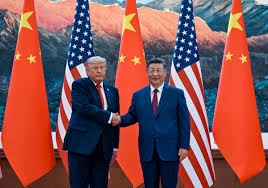
But the fact of the matter is that the Chinese hosts extended an exceptionally warm reception for Trump. Trump’s itinerary included a rare tour of the hallowed grounds of the ancient Temple of Heaven complex, accompanied by Xi, which Singapore-based Channel News Asia noted as, “Peace, prosperity, political legitimacy — and perhaps even “heaven’s will”. There was no shortage of symbolism … in what appeared to be one of the most carefully choreographed moments.”
Seldom do summits descend to ‘working level.’ Besides, in this case, according to reports, Trump and Xi are expected to meet four times this year and, obviously, there is a time and place for conducting business.
If the main agenda was to reinforce the personal equations between the two leaders, to keep the US-China tensions under check and to choreograph a pathway to navigate the US-China relationship in an incredibly complicated international milieu, the state visit seems to have served its purpose.
This comes out vividly in the measured words of Xi, a taciturn politician, while framing his four-hour discussions with Trump: “Basically, this visit has been a historic and symbolic one during which we have established a new bilateral relationship, a constructive and strategically stable relationship. It can be described as a milestone event. Moreover, we have achieved many results in our cooperation and it has contributed greatly to international issues.” [Emphasis added.]
The above carefully chosen words capture the essence of Trump’s state visit. In strategic terms also, Trump’s subsequent disclosure that the ‘Taiwan question’ figured prominently in the talks merit particular attention as a substantive exchange, as it would surely have contributed to the emerging “constructive and strategically stable relationship” that Xi later alluded to.
On his part, Xi spoke in apocalyptic terms that Taiwan is a potential flashpoint. Trump revealed that Xi had spoken emotionally about Taiwan, saying China had possessed the island “for thousands of years and then at a certain period of time it left and we’re going to get it back.” But, as Trump put it, “Xi does not want to see a fight for independence. I did not make a comment on it. I heard him out.” Trump added that he made “no commitment either way.”
Trump also touched on the massive $14 billion arms sale to Taiwan under discussion. As he flew back to Washington after wrapping up critical talks in Beijing in which both leaders said important progress was made in stabilising US-China relations, Trump gently let it be known, after hearing Xi’s concerns, that he has not made a decision yet on whether to move forward with such a major arms package for Taiwan.
Trump let the remark hang in the air but also hinted which way his mind could be working: “I will make a determination. I’ll be making decisions. But, you know, I think the last thing we need right now is a war that’s 9,500 miles away.”
Indeed, Trump’s remarks on Taiwan, especially his refusal to explicitly reaffirm US’ support for Taiwan, has upset Taipei.
Meanwhile, Trump also disclosed the potential for easing sanctions in the coming days affecting Chinese companies buying Iranian oil, signalling a major recalibration of policy that would have a direct bearing on the tense situation surrounding the Strait of Hormuz. Indeed, his remark that Xi also wants to end the Iran conflict and offered assistance needs to be taken seriously.
Evidently, Moscow is anxious to figure out the implications of the talks in Beijing for the US-China-Russia triangle. President Vladimir Putin is heading for a day-long visit to Beijing on Wednesday. Although there is no evidence of Trump trying to drive a wedge between Beijing and Moscow and despite China’s commitment to the ‘comprehensive strategic partnership of coordination’ with Russia and their mutual affirmation of the relations as “Not allies, but better than allies,” etc. it is entirely conceivable that the ground beneath the feet of the three superpowers could be shifting.
Xi welcomed Trump at his official residence, Zhongnanhai, on Friday for their final engagement before the latter’s return to Washington. The two leaders reportedly took a short walk through the grounds that feature ancient trees and Chinese roses, and strolled through a covered passageway with green columns and archways painted with birds and traditional Chinese mountain scenes.
An Associated Press dispatch poignantly captured the atmospherics of it with great sensitivity: “Trump appeared impressed by the bucolic grounds, remarking that the roses were the most beautiful he had ever seen. Xi promised to send him some rose seeds.”
The Kremlin won’t be alone in harbouring a sense of uneasiness. India too is in the same boat. Delhi must now purge the delusional hopes of being a ‘counterweight’ to China in the US calculus. A former Indian foreign secretary, a leading China hawk until recently, has advised the Modi government that a reassessment of Quad is overdue. But it is easier said than done, given the mindset of the Indian elite.
Putin is far better placed in this respect, having no illusions about the long history of US’ betrayals, back-tracking, and hegemonist instincts, which all but preclude the scope for a mutually respectful, equal partnership.
By coincidence or not, Putin announced the deployment of Russia’s new Sarmat strategic nuclear intercontinental ballistic missile at the end of this year after its successful test launch on Tuesday.
Putin disclosed in televised comments that the super heavy missile with a yield four times greater than any Western equivalent and a range exceeding 35,000 kms, “has the ability to penetrate all existing and future anti-missile defence systems.”
“This is the most powerful missile system in the world,” he underscored.
[Ambassador M.K. Bhadrakumar served the Indian Foreign Service for more than 29 years. Courtesy: Indian Punchline, the author’s blog.]
❈ ❈ ❈
A Strong Message from Beijing
C.P. Chandrasekhar
When United States President Donald Trump boarded Air Force One to return home after his much-awaited and once-postponed visit to China, observers where hard-put to describe what had come of the meetings of the leaders of the world’s two most powerful nations. There were some minor takeaways. For example, China promises to order 200 (as opposed to an expected 500) airplanes from Boeing Co of the US. It has also lifted restrictions on imports from US beef plants, imposed in response to the tariff aggression of the US administration that has played out over the last year. But such small gestures of economic cooperation as opposed to conflict were underwhelming, to say the least, given Trump’s reputation for extreme demands on and transactional engagement with the rest of the world.
It did not help that official readouts from the two sides and journalistic reports based on conversations with unnamed, high-level sources presented differing assessments. While the US readout spoke of increased Chinese purchases of agricultural products and energy from the US, statements from the Chinese merely referred to ‘balanced’ and ‘positive’ outcomes from trade talks during the visit. While the US side flagged agreement on the need to further limit the flow of fentanyl precursors, which Trump had named as a major irritant in the relationship between the two countries, Chinese statements made no direct reference to the issue. Clearly, actual economic concessions from either side were few and received mention only as symbolic messages of an improvement in the fraught ties between the two countries.
Hindsight suggests that it was not in the economic but the political and strategic realms that the messages from Beijing in the form of statements or silences were telling. Thus, while the Chinese side referred to an exchange of views on the situation in the Middle East, the US claimed that there was agreement between the two sides that Iran should not acquire nuclear weapons capability. Specifically, while there was no mention of the Strait of Hormuz in the Chinese readouts, the US claimed that there was agreement on the need to ensure the free flow of energy through the Strait and that China was clear that there should be no weaponization of and imposition of tolls on ship movement through the Strait.
But beyond these there were two very explicit statements from XI Jinping that finally defined the visit. One was the Chinese President’s warning that the two countries should not fall into the “Thucydides Trap” of war precipitated by the fears of a ruling hegemon in the face of the rapid rise to potential dominance of a new rival. That statement explicitly underlined the Chinese reading that it saw itself as a threat to US hegemony and that US efforts of containing its principal rival should be reined in to prevent unspeakable consequences.
The second was Xi’s statement that Taiwan, the merger of which with the Chinese mainland was inevitable, was “the most important issue in China-US relations,” which “if mishandled” could result in “collision or even clashes” between the two nations, and push the China-US relationship into dangerous territory.
What was remarkable was not just President XI’s candour on these two important issues. It was also the absence of any strong response from the US side to these statements. In an implicit response to the Thucydides reference, Trump actually said: “The relationship between China and the USA is going to be better than ever before.” And the official White House statement had no mention of Taiwan. According to reports, Trump told journalists aboard the returning Air Force One flight that no commitments were offered by him on Taiwan and that a decision on a contentious $14 billion arms sale to the current government of that territory was still on the table. But, in a uncharacteristic resort to diplomacy, he reportedly retorted “I don’t talk about that,” when questioned whether the US would defend Taiwan in the event of a conflict with the mainland.
Absent any significant results in a host of areas of recent economic, political and strategic conflict, varying from trade in chips and rare earth magnets to the wars in Ukraine and the Middle East, these statements from President Xi are the ones that define the outcome of that visit. The message is clearly that in the reading of the undisputed leader of an ‘emerging’ China, global geopolitics is at an inflexion point. Eight decades after the end of a World War that marked the displacement of Britain by the United States as global hegemon, the time has come Xi seems to think for one more such epochal development involving the displacement of the United States by China as world leader.
Seeing that historic shift as inevitable and irreversible, Xi’s interest seems to be in ensuring that this time around the context of the transition is not as violent as the previous one was. Hence the need to explicitly call for avoiding a Thucydides trap and accept the transition as the normal course of things in a world where ‘change was the only absolute’. That is what Xi possibly meant when he said that Trump’s visit to China, the first in a long while by a sitting US President, marked the beginning of a “constructive strategic stable relationship”. Telling his US counterpart in their first meeting during the visit that the two countries “should be partners, not rivals,” Xi went on to clarify on another occasion: “Achieving the great rejuvenation of the Chinese nation and making America great again can go hand in hand.”
This summit was less one to forge agreement and cooperation between two major world powers, than one for China to make a declaration. Xi may be right or wrong. But he is clear that his understanding is that China’s time as global hegemon has come. It is for time to tell and the rest of the world to experience whether that is true and, if so, what that means.
[[C.P. Chandrasekhar taught for more than three decades at the Centre for Economic Studies and Planning, Jawaharlal Nehru University, New Delhi. He is currently a senior research fellow at the Political Economy Research Institute, University of Massachusetts Amherst, US. Courtesy: Chandrasekhar’s blog at networkideas.org.]
❈ ❈ ❈
Trump’s Failed China Trip Shows His Trade War Backfired, and US Corporations Are Desperate
Ben Norton
Donald Trump’s visit to Beijing this May marked the first time a sitting US president traveled to China since 2017.
To understand this trip, it is important to emphasize that it was the United States that requested the meeting. Beijing did not initiate it.
This begs the question: Why was Trump so desperate to sit down with China’s President Xi Jinping?
The short answer is the US economy is in dire straits.
The aggressive trade war that the US launched against China during Trump’s first term, which he then heavily escalated in 2025, has backfired spectacularly.
Inflation is rising fast in the US, and Trump’s tariffs have only poured fuel on the inflationary fire, while also accelerating deindustrialization and supply-chain dysfunction.
Washington is operating from a position of distinct vulnerability. Even major US think tanks like the Council on Foreign Relations now openly acknowledge that Beijing has “the upper hand”, and Washington “has lost its leverage over China”.
Trump invited the CEOs of a dozen US corporations to travel to China with him
Trump has never been one for subtlety. He constantly “says the quiet part loud”.
On his website Truth Social, Trump boasted about the corporate entourage accompanying him to China. The US delegation consisted of many of the most powerful billionaire oligarchs in the country:
- Elon Musk of Tesla and SpaceX, the world’s richest billionaire oligarch, who spent $288 million to get Trump and his Republican allies elected;
- Jensen Huang of Nvidia, which is now the world’s most valuable corporation, with a $5.5 trillion market capitalization, driven by the AI bubble;
- Tim Cook of Apple, whom Trump calls “Tim Apple”;
- Larry Fink of BlackRock, the world’s largest asset manager;
- Stephen Schwarzman of Blackstone, the biggest alternative asset manager, and Schwarzman was a major funder of Trump’s 2024 presidential campaign;
- Boeing CEO Kelly Ortberg;
- Cargill CEO Brian Sikes;
- Citigroup CEO Jane Fraser;
- GE Aerospace CEO Larry Culp;
- Goldman Sachs CEO David Solomon;
- Micron CEO Sanjay Mehrotra; and
- Qualcomm CEO Cristiano Amon.
In fact, when Trump flew to China, he was physically joined on Air Force One by the billionaires Musk and Huang.
When the US president met with the Chinese leadership, he was flanked by these corporate oligarchs.
The symbolism was unmistakable: these CEOs were effectively being treated as shadow government officials.
It was the clearest demonstration that US government policy is made by and for large corporations, and the rich elites who run and invest in them.
Only further confirming this is the fact that the US ambassador in China, David Perdue, was previously the president of Reebok and CEO of Dollar General.
US trade war backfired: Nvidia’s market share in China went from 95% to 0%
Why were these US corporate executives so eager to travel to China with Trump? The answer is simple: They are desperate to secure access to the world’s largest market.
China has a population of 1.4 billion people, including the largest middle class on Earth. Brookings Institution researchers estimated that there will be 1.2 billion Chinese in the middle class in 2027, which is a quarter of the entire world’s middle class. “China already makes up the largest middle-class consumption market segment in the world and is a priority market for major multinational firms”, the researchers wrote.
US corporations have always been desperate to penetrate China’s enormous market. After Deng Xiaoping initiated the Reform and Opening Up in 1978, he allowed some to do so under the condition that they share their technology and establish joint ventures with Chinese firms. The slogan was “market (access) for technology (transfer)”: 市场换技术 (shìchǎng huàn jìshù).
When Trump launched the US trade war against China in 2018, he put the two countries on the gradual path toward economic “decoupling”. This is a slow process, but trade and investment between the US and China have fallen significantly in the past decade.
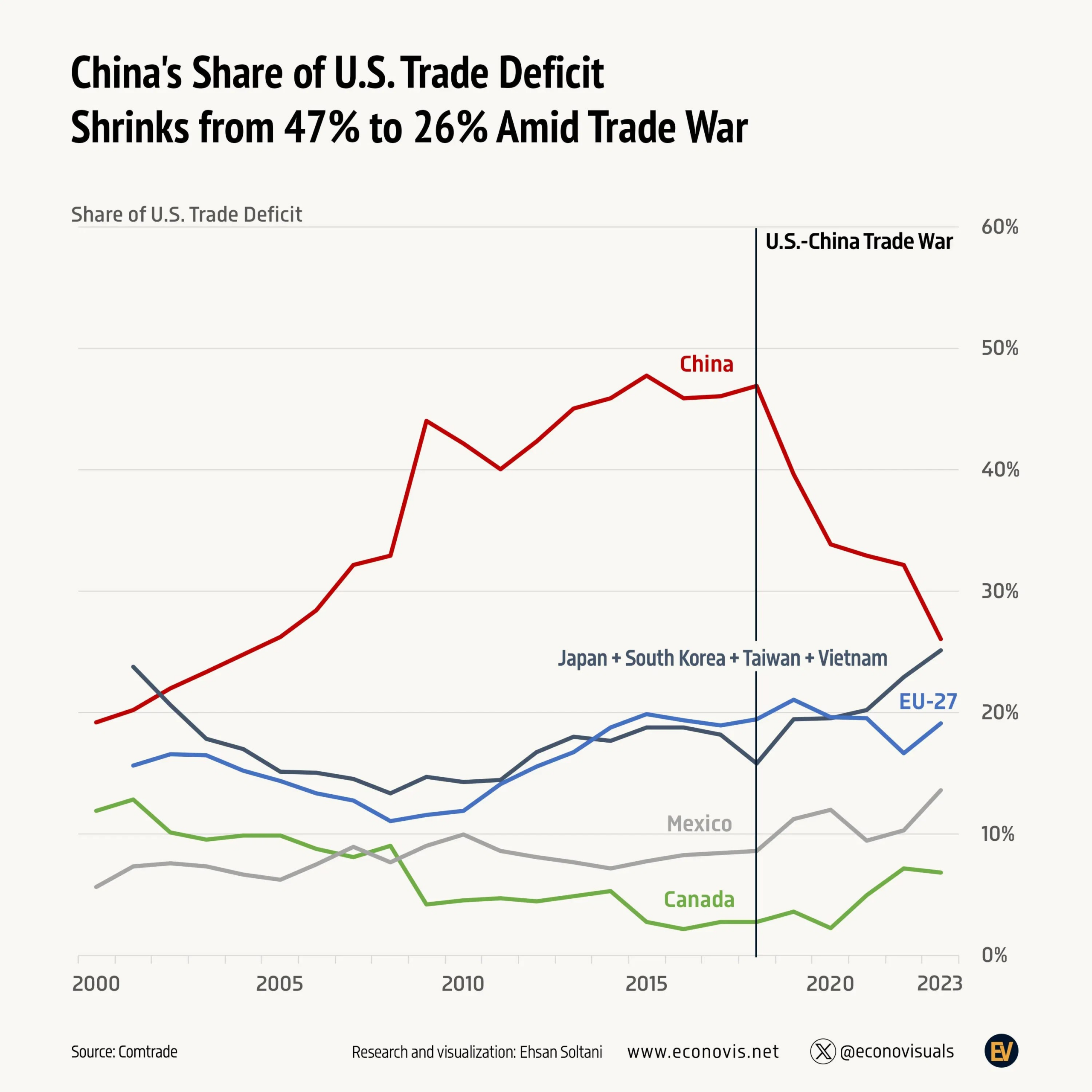
Some major US corporations have been very negatively impacted by this trade war.
In particular, the prominent presence of Nvidia CEO Jensen Huang in Trump’s trip to China highlighted the stark failure of Washington’s tech containment strategy.
In an effort to sabotage China’s AI development, both the Biden and Trump administrations restricted the export of advanced chips.
This campaign of tech warfare — known as the “chip war” — blew back hard on Nvidia. Huang lamented that the US corporation previously controlled 95% of the Chinese market for advanced AI chips, but its market share has fallen to zero.
Instead of allowing the US to monopolize AI and other advanced technologies, Beijing responded by pouring billions of dollars into industrial policy measures, to develop its own domestic semiconductor industry.
China has made rapid progress. It is now dominating the global market for legacy chips, and will likely catch up to US Big Tech companies very soon.
Some US corporate executives have clearly asked Trump to reconsider his strategy. The scorched-earth campaign of economic war and tech war against China has backfired, and they hoped for some kind of grand bargain.
Trump’s trip was a failure: China wasn’t interested
However, Beijing was apparently not nearly as interested as Washington was.
Many Western media outlets acknowledged that very little came out of the trip. Some even called it a failure. Trump returned home mostly empty-handed.
Trump boasted that China will order 200 planes from Boeing, but the US corporation’s stock price actually fell 4% in response to this news, because analysts had expected that it would purchase 500.
The US government did give Nvidia the green light to sell its second-most advanced AI chip, the H200, to 10 Chinese tech companies, but Reuters pointed out that “not a single delivery has been made so far”.
Reuters concluded, “U.S. President Donald Trump left China on [15 May] with no major breakthroughs on trade or tangible help from Beijing to end the Iran war”.
It was easy to predict this outcome. The US government has spent nearly a decade now waging a trade and tech war, aiming to prevent China from developing, seeking to isolate the country.
Why Trump thought he could suddenly play nice, and get China to make concessions to benefit the US at its expense, is a mystery.
Moreover, the US started a war of aggression against Iran, which has disrupted the global economy and caused the largest oil crisis in history, but Trump now expects China to bail him out. It is clearly absurd.
In other words, after years of punching China in the face, Trump hopes Beijing will help to save the US economy. It is obvious why China was not interested.
China holds the cards, not the US
When Trump unilaterally escalated the trade war against China in April 2025, threatening tariffs as high as 145%, Beijing surprised Washington by hitting back, putting proportional levies on US exports.
Trump fumed, “We have much bigger and better cards than they do”. The US president claimed that he could “destroy China” with his “incredible cards”.
Treasury Secretary Scott Bessent was enraged. He went on CNBC and declared, “I think it was a big mistake, this Chinese escalation, because they’re playing with a pair of twos”.
“What do we lose by the Chinese raising tariffs on us?” asked Bessent, a former hedge-fund manager from Wall Street. “We export one-fifth to them of what they export to us, so that is a losing hand for them”.
In reality, the opposite was true: China holds significantly more valuable cards.
The clearest example of this was how Beijing responded to Washington’s unilateral tariffs and tech export restrictions by cutting off US access to rare-earth elements.
This caused a political earthquake in Washington, because US corporations cannot manufacture their products without Chinese rare earths. The US military-industrial complex cannot make its weapons systems without them either.
China dominates the global supply chain for many critical minerals.
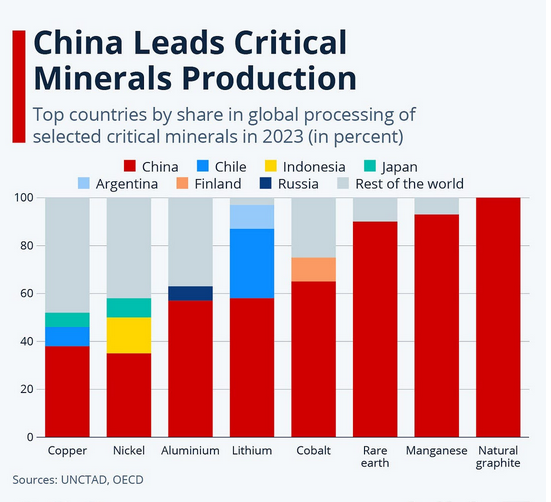
Recognizing this vulnerability, the US government has sought to develop a new supply chain. Under Marco Rubio, the State Department launched a “Pax Silica” initiative, and invited dozens of countries this February to participate in its Critical Minerals Ministerial in Washington.
However, building these parallel networks will take years, meaning the US has no option but to play nice with China if it wants critical minerals.
In terms of Chinese leverage, the presence of Elon Musk and Apple CEO Tim Cook on Trump’s trip was especially telling.
For nearly a decade, Washington has pressured US companies to “de-risk” by moving production lines out of China, “friendshoring” factories to countries like India.
However, shifting these supply chains has proven to be nearly impossible, given the complexity of China’s domestic manufacturing ecosystem.
Apple has tried to make its iPhones in India, but has faced many problems.
Tesla serves as the ultimate case study. More than half of the company’s electric vehicles (EVs) are manufactured at its “gigafactory” in Shanghai.
This is despite the fact that, in 2024, Tesla CEO Elon Musk asked for domestic trade barriers, warning that his Chinese competitors would “demolish” US EV manufacturers. Soon after, the US government (then under Joe Biden) put 100% tariffs on Chinese EVs.
All of this demonstrates the extreme hypocrisy of US policy toward China. Washington wants Beijing to sacrifice its own interests to serve those of US corporations. Some comprador elites in other countries may be willing to do so, to enrich themselves at their nation’s expense; but not China’s leadership, which is dedicated to developing its country.
The United States is learning the hard way that it can no longer push around China.
[Ben Norton is a journalist, writer, and filmmaker. He is Editor-in-Chief of Geopolitical Economy Report. Courtesy: Geopolitical Economy Report, an independent news outlet that provides original journalism and analysis to understand the changing world. It was founded by journalist Ben Norton in 2022.]