❈ ❈ ❈
Trump’s Moment of Truth in New World Order
M.K. Bhadrakumar
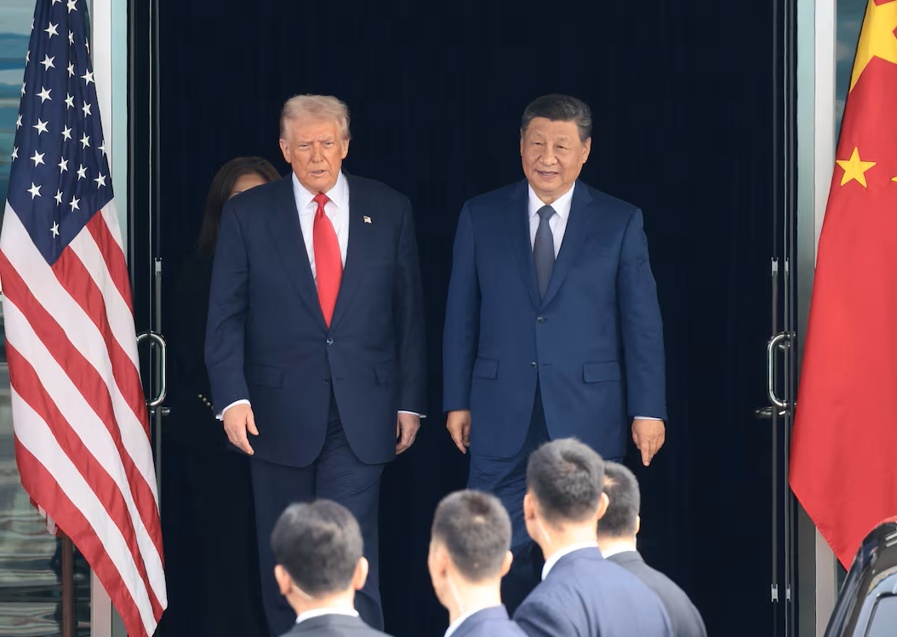
The brevity of the US President Donald Trump’s meeting last Thursday with his Chinese counterpart Xi Jinping at the Gimhae International Airport in the port city of Busan, South Korea, which lasted just 100 minutes, compared to Trump’s anticipated three to four hours, was a sobering reminder that the mistrust between the two world powers still runs deep. The meeting’s outcome appears more like a truce that is fragile.
Beijing is acutely conscious that Trump’s foreign policy is bewilderingly unpredictable. On Friday, Chinese foreign ministry announced the scheduled visit by Russian Prime Minister Mikhail Mishustin on November 3 to Beijing to attend the regular meeting between the Chinese and Russian heads of government.
The Chinese foreign ministry spokesman Guo Jiakun said Mishustin and his Chinese host Premier Li Qiang will “comprehensively review cooperation progress in various areas, plan the next stage of collaboration, and exchange in-depth views on issues of common concern.”
Guo added, “We look forward to using this regular meeting between the two premiers to further enhance mutual trust, build greater consensus, deepen cooperation, and inject new impetus into the development of the China-Russia comprehensive strategic partnership of coordination for the new era.” Mishustin will most certainly meet Xi.
On November 1, Russia’s First Deputy Prime Minister Denis Manturov co-chaired the inter-governmental Russian-Chinese commission on investment cooperation in Beijing. Tass reported that the Russian side has drafted proposals on 27 projects in 18 Russian regions, including plans to establish production of dissolving pulp and viscose fibre in Irkutsk Region, create a scientific and clinical centre for ion-proton therapy in Moscow, and launch a year-round container line via the Northern Sea Route.
Manturov said, “Overall, it is important for the government and businesses of our countries to continue to pool and coordinate their efforts to comprehensively explore cooperation opportunities, as well as to develop effective cooperation formats that mitigate opportunistic and geopolitical risks. I am convinced that coordinated work will enable us to take Russian-Chinese investment cooperation to a new level.”
Simply put, Russia and China are giving finishing touches to a new format of cooperation to address their increasingly adversarial relationship with the US. Yet, Trump still thinks there is daylight possible between Russia and China. He wrote on Truth Social today, “My G2 meeting with President Xi was a great one for both our countries. The meeting will lead to everlasting peace and success. God bless both China and the USA!”
But, alongside the ‘G2’ hyperbole on everlasting peace, Trump also announced on Truth Social that he has ordered Pentagon to prepare for possible military action against Nigeria — another oil-rich country like Venezuela — to wipe out the Islamists who are allegedly attacking the Christian population in that “disgraced country.” Can it be that Trump is delusional or simply naive — or is deliberately indulging in sophistry? It’s hard to tell.
Trump rhetorically rated as a 12 out of 10 his meeting with Xi. However, the big question is whether a durable peace setting stable boundaries for China’s relations with the US can be expected.
Guardian’s diplomatic editor Patrick Wintour pointed out, rightly so, that the crux of the matter here is, “Trump’s strategic objectives in launching the trade war were not articulated –- the balance between protecting traditional US manufacturing, ring-fencing modern technology-based industries critical to US national security, punishing Chinese trade practices, or more broadly generally overpowering China as a competitive threat, was fudged. Gradually the battle morphed … from a trade war into a geopolitical trial of strength between the two world’s superpowers, a trial that left the whole world awaiting its outcome.”
Clearly, China is the winner. Its hardball approach paid off. By simply withholding soybean purchases and rare-earth exports, China extracted relief from US tariffs and delayed more export controls.
Indeed, this is only a framework agreement, which can unravel at a moment’s notice. Basically, Trump and Xi have agreed to restore the status quo ante whereby China would defer for a year the potentially crippling new restrictions on the export of rare-earth materials, and, secondly, will resume purchase of US soya beans (a hugely consequential issue in the mid-western states, Trump’s MAGA base.)
Besides, Beijing agreed to do more to control the export of precursor chemicals used to make fentanyl, the synthetic opioid that has triggered a crisis of overdose deaths in North America. In return, Trump agreed to halve that 20% levy, taking the average of US tariffs down to 45% and also suspended expanded restrictions on export controls over thousands of Chinese companies.
On the other hand, Trump agreed to loosen the licence applications for shipments of Nvidia’s artificial intelligence chips to China — a major climb-down. In fact, Nvidia, whose worth is estimated to exceed the UK’s GDP, is already in talks with Beijing.
Meanwhile, China is sticking to the two key sticking points in the Chinese firm ByteDance’s proposed divestment of TikTok America — size of ByteDance’s continuing stake and control of the algorithm. Significantly, in a notable departure, Trump didn’t raise Taiwan issue, which has been a contentious topic in high-level US-China exchanges in recent years.
Suffice to say, the Beijing meeting has been a moment of truth for the US, which has understood the limits to its leverage and vulnerabilities. Washington underestimated China’s tenacity and resilience, and success to divert US-bound exports to other mainly Asian markets. Facts speak for themselves. Trends show China’s trade surplus is likely to be larger than last year’s; China’s stock market has risen by 34% in dollar terms. On the contrary, the tariff-driven inflation figures touched the politically unacceptable figure of 3% in the US.
No doubt, China flexed its muscle and showed that its $12 billion market for soya beans is critical to US midwest farming interests and a potentially explosive issue for Trump politically. Similarly, US commerce department acted smart by introducing a rule-change in September to add, by some accounts, some 10,000 Chinese firms to Washington’s list of sanctioned companies. Beijing massively retaliated by expanding the scope of its export controls on rare earths, which would have a crippling effect on the US’ hi-tech manufacturing including cars, batteries and military equipment, such as F-35 stealth fighter or advanced missiles.
By some accounts, the US treasury secretary, Scott Bessent, stunned by the imminence of the precipice, persuaded Trump that the price of confrontation with China was proving too high, and led the two sides to the face-saving withdrawal last week. The BBC caustically noted, “China has realised the hold that it has on the US and the rest of the world. How much is it willing to relinquish?”
Significantly, Beijing held back the MFA announcement of the Busan meeting until just a few hours before the event was due to begin.
[Ambassador M.K. Bhadrakumar served the Indian Foreign Service for more than 29 years. Courtesy: Indianpunchline, the author’s blog.]
❈ ❈ ❈
No Big Deal: The Trump-Xi Meeting in Korea
Mel Gurtov
Promises, Promises
The much-awaited meeting in Korea between Pres. Trump and Pres. Xi Jinping promised—according to Trump—a major trade deal. The Chinese seemed prepared to offer much less.
In remarks to Trump, Xi repeated Chinese refrains about the need for cooperation, stressed that the business relationship is the “anchor and driving force” in China-US relations, and expressed confidence that inevitable frictions could be overcome. Xi also made clear that China’s economy is strong: “We have the confidence and capability to navigate all kinds of risks and challenges,” Xi said.
In other words, China is not in any kind of economic trouble that might make it susceptible to outside pressure. A “cycle of mutual retaliation” is unacceptable, he said.
Mutual retaliation was avoided this time, but the accomplishments at the Xi-Trump meeting were modest. According to China’s summary, Xi promised to resume purchases of US soybeans for three years; place more Chinese controls on fentanyl (in return for a lowering of the US tariff related to fentanyl); and suspend China’s regulations on rare earth exports for one year in exchange for US suspension of restrictions on advanced technology exports to China. As always in these exchanges, the devil is in the details, and the details in the US “fact sheet”on the meeting diverge considerably from China’s.
Loopholes and Ambiguities
First, on Chinese soybean purchases, whereas the US specifies the quantity of soybeans China has committed to buy from now through 2028, China’s reporting has no figures and could be far less than Trump is trumpeting. The US fact sheet also notes China’s promise to purchase or end tariffs on numerous US products, from dairy to fruits and cotton. China’s readout doesn’t mention any of them. (By the way, American farmers’ common reaction to the deal, according to press reports, is that “it doesn’t solve anything,” since the promised purchases are no greater than before and farmers also face, because of Trump’s tariffs, higher costs for machinery, fertilizer, and seeds.)
Second, the crucial issue of China’s rare earth minerals exports has by no means been resolved with the Trump-Xi meeting. According to the US fact sheet, China will eliminate all the regulations on those minerals that were enacted starting in 2022 and not just controls imposed this year. Such a comprehensive removal may not be what Xi promised or intended, especially since those minerals are a major source of Chinese leverage on Trump’s tariff policy.
Third, the agreement leaves unclear what technology exports to China will actually be allowed—most importantly whether the latest Nvidia chips, which experts believe would be a strategic mistake to sell to China, will be available. (The House Select Committee on China warned on social media that selling AI chips to China “would be akin to giving Iran weapons grade uranium.”)
Fourth, on fentanyl, the US says, “China will stop the shipment of certain designated chemicals to North America and strictly control exports of certain other chemicals to all destinations in the world.” That is quite a promise, and if China actually made it, it is hard to see how the promise can be fulfilled.
Fifth, questions remain about what the US and Chinese average tariff rates will be as a result of the Trump-Xi meeting. The US seems to expect that China’s tariffs on many US imports will be removed or suspended. Various reports indicate that US tariffs on Chinese goods will still be very high: 47%. The lack of clarity on this issue may affect how much rare earth minerals the Chinese sell to the US, or how much US agricultural products they actually buy.
Sixth, the US fact sheet mentions China’s agreement to “terminate its various investigations targeting U.S. companies in the semiconductor supply chain, including its antitrust, anti-monopoly, and anti-dumping investigations.” China’s readout does not mention such an agreement.
Two other kinds of issues important to US-China relations were apparently not addressed. One is future areas of cooperation. Xi offered a modest menu of joint projects for future dialogue: “combating illegal immigration and telecom fraud, anti-money laundering, artificial intelligence, and responding to infectious diseases.” Trump’s response, if any, was not reported.
Then there are key policy differences that apparently were not brought up at the meeting: China’s support of Russia in the Ukraine war and the US commitment to Taiwan’s defense. Taiwan’s leadership has to be relieved, since some observers were saying that Trump might sacrifice support of Taiwan to gain a comprehensive trade agreement. (In a “60 Minutes” interview Sunday night, Trump said there was no need to bring up Taiwan with Xi since Xi knows what would happen if he decided to invade Taiwan. I guess we can say that Trump endorses the longstanding US policy on Taiwan of “strategic ambiguity.”)
In sum, we can credit the meeting with having eased US-China trade tensions by focusing on the key areas of disagreement and putting off a trade war that would benefit no one. On the other hand, the meeting kicked the can down the road. Promises made and not kept will revive tensions before too long, just as they did in Trump’s first term and in Joe Biden’s term. The bottom line is that the basis for mutual mistrust has not been addressed and is highly unlikely to be addressed until a new set of leaders emerges in both countries.
Nuclear Curveball
Trump threw a curveball into the meeting with an announcement, just minutes before he landed, that the United States would immediately restart nuclear weapons testing after a lull of 33 years. The announcement came after Russia announced that it had also conducted tests of a nuclear-capable cruise missile and sea drone this week.
This is the kind of unpredictable, and unwelcome, diplomacy typical of Trump. In practice, it probably won’t mean US detonation of a nuclear bomb, which would be contrary to the 1996 Comprehensive Nuclear Weapon Test Ban agreement that the US signed but has never ratified. Most likely, Trump wants renewed testing of nuclear weapon delivery systems. Asked whether he believed his directive would create a riskier nuclear environment, Trump offered his usual exaggerated confidence: “I think we have it pretty well locked up.”
Trump added that the United States was already in talks with Russia about “denuclearization” and that “China would be added to that.” I’ll bet that’s news to both Moscow and Beijing.
Besides their display of new nuclear weapons, the Russians have indicated they will pull out of the treaty on plutonium production, hardly an indicator of denuclearization. China has consistently refused to join US-Russia nuclear weapon talks because it is engaged in a nuclear weapon expansion program as it seeks to narrow the gap with the US and Russia.
If anything, Trump’s sudden announcement will spur China’s expanding nuclear program, especially since Trump has also agreed to provide fuel for a South Korean nuclear-powered submarine and—under Biden but with Trump’s endorsement—to providing Australia with a nuclear sub under the AUKUS (Australia-United Kingdom-US) agreement.
Trump Leaves, Xi Stays
After meeting with Xi, Trump returned to Washington in time for a Halloween party. Xi stayed in Korea for a meeting of the Asia Pacific Economic Forum. He used the occasion of Trump’s absence to reinforce China’s message of economic cooperation to ease supply chains, keep tariffs low, and promote adherence to global trade rules—in short, work with China’s rather than the US’s leadership, which he accused (without naming it) of a “return of hegemonism and the law of the jungle.”
“The rougher the seas, the more we must pull together,” said Xi. He held separate meetings with the leaders of Japan, Canada, and Thailand—the one with Mark Carney notable for Canada’s decision to expand trade with China now that Trump is refusing to negotiate.
Trump brought home trade agreements with South Korea and Japan, but Xi has established China as Asia Pacific’s trade leader. Not that countries in the region all welcome that development, since China exercises its own brand of trade pressure. But faced with high US tariffs and constant uncertainty about US policy, most Asia Pacific countries will count increasingly on China’s trade, investments, and loans.
[Mel Gurtov is Professor Emeritus of Political Science at Portland State University, Editor-in-Chief of Asian Perspective, an international affairs quarterly and blogs at In the Human Interest. Courtesy: CounterPunch, an online magazine based in the United States that covers politics in a manner its editors describe as “muckraking with a radical attitude”. It is edited by Jeffrey St. Clair and Joshua Frank.]