❈ ❈ ❈
Syria Comes In from the Cold
M.K. Bhadrakumar
With great prescience, late Henry Kissinger had once said, “You can’t make war in the Middle East without Egypt, and you can’t make peace without Syria.” The adage remains true even today. Syria has been an astute practitioner of diplomacy in its statecraft, which was not surprising given its origin as a modern state out of the debris of the Ottoman Empire, its geography, plural society and tough neighbourhood.
Suffice to say, there is nothing surprising that President Donald Trump sees immense potential in Syria’s interim president Syrian President Ahmed al-Sharaa as an interlocutor, while resetting his compass for a New Middle East. Trump’s seemingly blasé attitude came out in a social media post Monday night, when he wrote that he and Sharaa “discussed all the intricacies of PEACE in the Middle East, of which he is a major advocate.”
Trump is a rare western leader who closely follows Russia’s footfalls with a healthy respect. He couldn’t have missed the quiet confidence with which President Vladimir Putin is restructuring Russia’s interactions with Damascus — and is even exploring a reformed Moscow-Damascus-Tehran triangle as a pillar of regional stability.
In fact, immediately after Sharaa’s meeting with Putin in the Kremlin in October, Alexander Lavrentyev, presidential envoy to the Middle East, visited Tehran to discuss regional security, Syria’s territorial integrity, and further coordination with the Russian delegation. Russia’s Ambassador to Tehran Alexei Dedov also disclosed that Russia and Iran hold regular consultations on the Syrian issue and hold ‘similar positions on key aspects of resolving the crisis’.
Be that as it may, the Russian-Syrian mutual confidence is reaching a point that Damascus seeks patrols of the southern provinces by Russian military police, which could limit Israeli activity in the border areas. Russia has reportedly conducted its first patrol since the change of power – near Qamishli in northeast Syria, which Turkey regards as its sphere of influence.
However, trust the US security establishment to pressure al-Sharaa over his contacts with Russia. After all, the CIA holds the copyright of al-Sharaa’s incubation in the Iraqi jail for 5 years and eventual transformation as an Islamist who got rid of the clutches of the Islamic State and al-Qaeda. Inevitably, the US will exploit al-Sharaa’s keenness to foster closer relations with Washington, which is crucial for the lifting of sanctions that opens the pathway for foreign investment and Syria’s reconstruction (which World Bank estimates will cost $216 billion.)
Al-Sharaa’s induction into the US-led counter-terrorist coalition fighting ISIS and al-Qaeda remnants in Syria burnishes his image in the international community. That said, wouldn’t al-Sharaa know about the US’ controversial record vis-a-vis ISIS and al-Qaeda as its geopolitical tools? Most certainly, yes.
Such pragmatism becomes al-Sharaa’s trademark, which Moscow understood all along. Al-Sharaa’s younger brother Maher al-Sharaa studied in Russia, graduated from the Burdenko Voronezh State Medical University in 2000, and subsequently worked in Voronezh for many years as an obstetrician-gynaecologist. He is married to a Russian national, Tatiana Zakirova whose family is reported to have business interests and connections within the Russian government, further cementing Maher’s ties to Moscow.
Maher today holds the key position as Secretary-General of the Presidency in Damascus coordinating directly with the president, drafting decrees, overseeing the implementation of executive decisions, facilitating communication between state institutions, etc. — all in all, playing a strategic role.
However, this is only a part of the story of Russia’s remarkable rebound through the past 10 months since Assad’s fall. If Russia has been, is and will be a significant presence in Syria, it is for a variety of reasons — not only geopolitical. What prompts al-Sharaa to engage with Russia are principally three considerations: first, the pull of Soviet Union’s huge contributions for Syria’s economy and infrastructure, especially in areas like health sector. Russia has a tradition of never interfering in Syria’s internal affairs even while engaged deeply, which is a touchstone for al-Sharaa.
Second, Russia has an excellent record as a provider of security. Syrian defence minister Murhaf Abu Qasra has visited Moscow thrice during the past 4 months, the last time as recently as on October 28 just a week before al-Sharaa’s scheduled meeting with Trump in the White House.
While receiving the minister, Russia’s Defence Minister Andrey Belousov noted, “The fact that we are here again, at the negotiating table, demonstrates that contacts between our political leaders and contacts between our military ministries are truly meaningful, fruitful, and have great potential.”
Al-Sharra is in the ISIS’ crosshairs and even otherwise, Syria’s security situation is precarious. An estimated 2000 ISIS fighters are still operating in Syria and government forces also have a preponderant share of hardcore Islamist cadres who won’t easily reconcile. Besides, the sectarian divides threaten national unity. The Kurds, in particular, are resisting integration. Curiously, this is one area where Moscow can help, given its long-standing links with Kurdish groups.
Then, there is the threat from Israel’s ‘land grab’. Trump’s priority is to normalise Syria’s relations with Israel, get Damascus to accept Israel’s occupation of Golan Heights and get al-Sharaa into the Abraham Accords. Prima facie, this is all a bit too much for al-Sharaa to accept. Clearly, continued Russian military presence serves a useful purpose for Damascus.
Third, al-Sharaa seeks to diversify Syria’s external relations. He hopes to reclaim Syria’s legacy of non-alignment and strategic autonomy. Slowly but steadily, China is also engaging with al-Sharaa. The Chinese embassy in Damascus remained open throughout recent instability, while Beijing adopted a cautious, “risk management” approach primarily driven by security concerns and a desire to protect its interests.
The topmost priority for Beijing is the prominent role of fighters from the Turkistan Islamic Party within the new Syrian security and defence structures, composed mainly of ethnic Uyghurs from Xinjiang. China refrained from the UN Security Council vote that lifted some terror-related sanctions on al-Sharaa, and instead abstained citing its concerns.
But China is engaging bilaterally with al-Sharaa’s government to protect its interests and keep channels open. The Chinese ambassador to Damascus has held meetings with al-Sharaa and Foreign Minister Asaad al-Shaibani, where the Syrian side expressed a desire for “strategic partnership” and China’s support for reconstruction.
Beijing seems to accept that al-Sharaa has discarded his jihadi pedigree. The Xinhua stated in a dispatch this week: “Al-Sharaa once joined al-Qaeda and was wanted by the US as a terrorist with a bounty of $10 million on his head, but severed his ties with the terrorist organisation years ago and led the rebel forces that toppled then Syrian President Bashar al-Assad in December 2024, bringing the country’s brutal 14-year-long civil war to an end.”
No doubt, the regime change in Damascus was a significant blow to Iran’s regional strategy. Iranian military commanders and personnel, including Quds Force members, were quickly evacuated from Syria as rebel forces advanced on Damascus. All Iranian military bases have since been abandoned.
But there are signs lately of Tehran exploring informal, pragmatic relations with the al-Sharaa government. Al-Sharaa once described the victory over Assad as an ‘end of the Iranian project’ but those were words spoken in the heat of the moment. The litmus test is whether Iran is attempting to destabilise the al-Sharaa government. Here, the answer is a definitive no.
Against such a complex backdrop, the US intentions remain extremely ambivalent. Al-Sharaa’s bid to cement his alignment with the US is buffeted by strong headwinds ranging from Israel’s territorial ambitions in southern Syria and its strategy to keep Syria weak and divided to the Kurdish challenge in the north, and a spluttering economy.
[Ambassador M.K. Bhadrakumar served the Indian Foreign Service for more than 29 years. Courtesy: Indian Punchline, the author’s blog.]
❈ ❈ ❈
Trump Meets with Former al-Qaeda Leader Ahmed al-Sharaa at the White House
Andre Damon
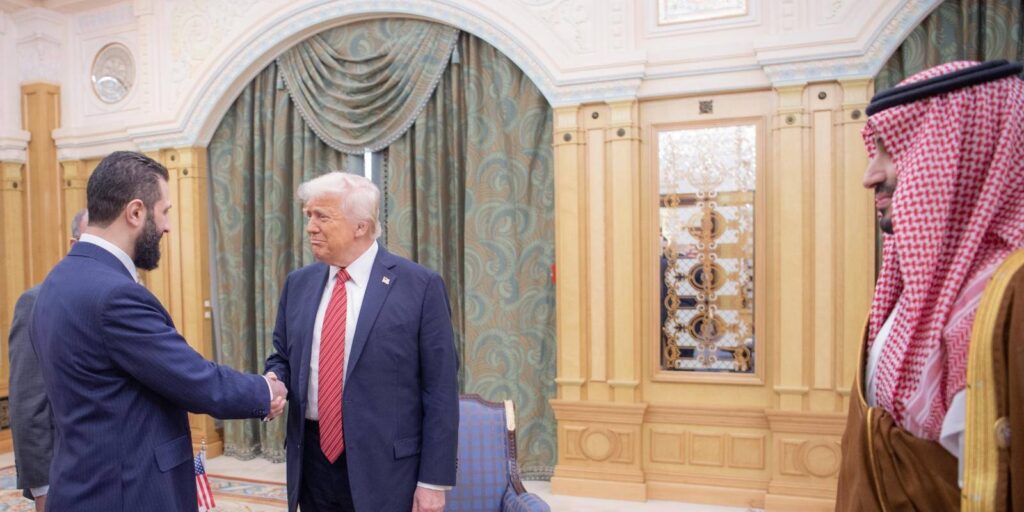
US President Donald Trump met Tuesday at the White House with Ahmed al-Sharaa, the former al-Qaeda leader who led the overthrow of the Syrian government last year. The meeting was a milestone in the long-term relationship of the United States with al-Qaeda-linked forces in Syria.
Commenting on the visit, the Jerusalem Post wrote:
It was a photo few could have imagined even a year ago: the president of the United States shaking hands in the White House with a man who, not long ago, was wanted for terrorism and carried a $10 million bounty on his head.
The visit by al-Sharaa was preceded just days earlier by the announcement from the State Department that it had removed him from its list of international terrorists.
Regardless, al-Sharaa was taken in through the side entrance of the White House with no cameras present. It was the first time that a former member of al-Qaeda has been welcomed to the White House.
In 2001, the United States proclaimed the “war on terror,” citing as a pretext to invade and occupy Iraq and Afghanistan the al-Qaeda attack on the World Trade Center and Pentagon. This “war on terror” was cited to erode bedrock constitutional protections against warrantless wiretapping, torture and, under the Obama administration, the extrajudicial killing of American citizens.
In 2003, US General Wesley Clark revealed that the Bush administration planned to launch “seven wars in five years,” including regime-change wars in Afghanistan, Iraq, Syria, Lebanon and Iran. Ultimately, Bush was able to overthrow only two of those regimes, leaving the rest to subsequent presidencies.
In 2007, US imperialism carried out what journalist Seymour Hersh called a “redirection,” allying with al-Qaeda-linked forces in an effort to reduce the power of Iran in the Middle East. In March 2011, Ahmed al-Sharaa, an al-Qaeda leader in prison in Iraq, was released. He and other Islamist militias then initiated an effort to overthrow the pro-Iranian, pro-Russian Syrian government of Bashar al-Assad.
Under the Obama administration, the United States set up clandestine ratlines of money and fighters in its years-long effort to overthrow the Syrian government, spending billions on an operation known as “Timber Sycamore.” This effort ultimately proved successful in December 2024 in the context of the broader US-Israeli rampage throughout the Middle East. Underlying these decades of war throughout the Middle East was the struggle by US imperialism to overturn the 1979 Iranian Revolution.
Commenting on the meeting with al-Sharaa, Trump said, “He’s a very strong leader. He comes from a very tough place. Tough guy. I like him.” He added, “I get along with the president, the new president in Syria, and we’ll do everything we can to make Syria successful.”
Trump added, “People said he’s had a rough past. … And I think, frankly, if you didn’t have a rough past, you wouldn’t have a chance.”
Congress is currently debating repealing the Caesar Syria Civilian Protection Act, which sanctions nearly all international transactions related to Syria. The Trump administration has suspended enforcement of the measure on a temporary basis.
On Sunday night, al-Sharaa met with members of Congress, including Florida Republican Brian Mast. Mast said in a statement, “He and I are two former soldiers and two former enemies. I asked him directly, ‘Why are we no longer enemies?’ His response was that he wishes to ‘liberate from the past and have a noble pursuit for his people and his country and to be a great ally to the United States of America.’”
The Wall Street Journal hailed the visit by al-Sharaa to the White House, proclaiming in an editorial, “Syria Comes to Washington—at Long Last.”
Commenting on the favor with which the new Syrian regime is seen in Israel, the Jerusalem Post wrote, “Israel may quietly welcome parts of this shift. A Syria linked to Washington is far preferable to one beholden to Tehran.”
The embrace of Ahmed al-Sharaa by the Trump administration demonstrates the complete fraud of the effort by factions within the pseudo-left, including France’s New Anti-Capitalist Party, the Pabloite International Viewpoint publication and the US-based International Socialist Organization, to present the US-backed regime-change operation in Syria as a “popular revolution.”
In reality, the regime headed by al-Sharaa is a bloody Islamist dictatorship, operating in alliance with US imperialism and in de facto alliance with Israel, which is carrying out a genocide against the population of Gaza. Since al-Sharaa’s coming to power, Syrian soldiers have massacred thousands of members of Syrian religious minorities, including Christians, Druze and Alawites. In a report in October, the New York Times documented “at least five separate episodes of men in military fatigues summarily executing Druse civilians, including groups of unarmed men being marched down the street to their deaths by impromptu firing squads.”
[Andre Damon is writer and editor for the World Socialist Web Site. Courtesy: World Socialist Web Site, the online publication of the International Committee of the Fourth International.]