❈ ❈ ❈
Honeymoon Over: Trump Divorces India
Mel Gurtov
Friends No More
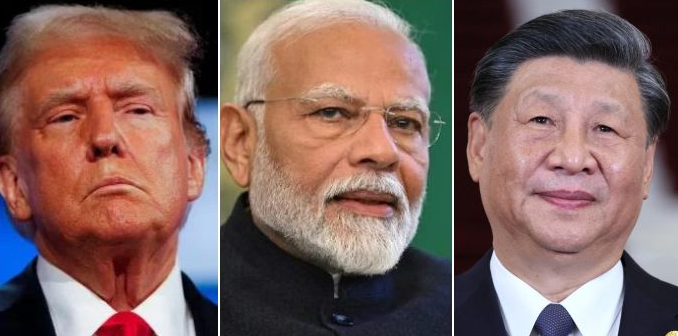
In 2019, Donald Trump and Narendra Modi paraded their bromance with a 50,000-person “Howdy Modi” rally in Houston. They followed that up with a “Namaste Trump” 100,000-person event in India. As recently as February, Trump lavished praise on Modi, saying the two countries had “a mega partnership for prosperity.”
Trump was the darling of the Indian diaspora in the US. He seemed quite willing to ignore Modi’s record as an aggressive Hindu nationalist who has sparked violence against the Muslim minority. The two men share an admiration for strongman rule and an obliviousness to human rights.
That was then; this is now. Trump has replaced the enduring friendship with a 25-percent tariff on Indian goods, and an additional 25-percent penalty tariff to protest India’s purchases of Russian oil. The US trade deficit with India was also mentioned as grounds for divorce.
But the real reason might be, according to Bloomberg, that Trump is miffed that India did not give him credit, which he claimed, for helping India and Pakistan reach a cease-fire in their May war. “Although the US never made a direct request for Modi to acknowledge Trump’s role in the ceasefire,” Bloomberg reports, “India saw a shift in tone from the White House after that phone call, according to the officials in New Delhi.” The report is easy to believe considering how much Trump covets a Nobel Peace Prize for his work as a “peace President.”
Now that India is out of favor, Trump has declared its economy (along with Russia’s) “dead.” This is the same India whose high-tech economy is considered one of the world’s brightest stars. But with Trump, everything is personal: He’s upset with Apple, Eli Lilly, Blackstone, and other US multinationals for setting up shop in India rather than investing more in the US. Trump’s tariffs leave them high and dry. Trump has announced that Apple will invest $100 billion in US-based manufacturing, but Apple has made grandiose pledges before.
Strategic Errors
Failure to think strategically can be costly. India had long been viewed by the US, even in Trump’s first term, as a counterweight to China. Recent India-China border talks suggest a lowering of tensions and an emphasis on diplomacy, following on a history of conflict over the last 60 or so years.
The US-India falling out will help Beijing and New Delhi find new sources of partnership. Modi has already been in touch with Beijing, whose ambassador to India is gloating over Trump’s bullying on social media. Modi will shortly be visiting China for the first time in seven years.
Trump’s team may want to consider whether a trade penalty was worth the cost of driving Modi into Putin’s arms as well. Kurt Campbell, Biden’s deputy secretary of state, had it right when he said: “If you tell India that it has to sacrifice its relationship with Russia, then Indian strategists are going to do the exact opposite.”
So they did. After Trump’s tariff announcement, Modi’s foreign minister visited Moscow and Modi was on the phone with Vladimir Putin. Modi spoke glowingly of the conversation: “Had a very good and detailed conversation with my friend President Putin. I thanked him for sharing the latest developments on Ukraine. We . . . reaffirmed our commitment to further deepen the India-Russia Special and Privileged Strategic Partnership.”
India’s exports to Russia will now expand, and India will dispatch workers to Russia with skills in IT, construction and engineering to help address labor shortages. India’s imports of Russian oil will continue, unaffected by Trump’s threats.
Another Trump strategic error is simultaneously alienating not one but two leading voices in the Global South—India and Brazil, both of which are founding members of the BRICS group (Brazil-Russia-India-China-South Africa). Every one of those five countries is now at odds with Trump, who has threatened all of them with high tariffs if they adopt their own currency for trade transactions instead of the dollar.
Modi will no doubt tell his BRICS colleagues that India’s economy simply cannot take the hit that Trump’s tariffs will create. You can expect that China and Russia will be first to step up and help.
Fighting Back
India does have other ways to fight back against Trump. Its foreign ministry has said the US decision was “extremely unfortunate,” and that “India will take all necessary steps to protect its national interests.” The Indian press has been less diplomatic. One well-known journalist, Barkha Dutt, said in a CNN interview by Fareed Zakaria that no one in India believes Trump’s stated reasons for the tariff increases.
She called Trump “infantile,” “inane,” a “bully.” A boycott of US goods is underway, and India has petitioned the World Trade Organization to act against Trump’s tariffs. Modi may also take a cue from President Lula in Brazil by promising $5.5 billion in credits to exporters and postponement of their taxes in response to Trump’s tariffs.
In any other administration, nothing India has done or said would undermine close ties. But this is the Trump era, in which personal pique and trade have replaced strategic thinking and policy based on the national interest.
Trump is playing a loser’s game.
[Mel Gurtov is Professor Emeritus of Political Science at Portland State University, Editor-in-Chief of Asian Perspective, an international affairs quarterly and blogs at In the Human Interest. Courtesy: PeaceVoice, a program of the Oregon Peace Institute. It is devoted to changing U.S. national conversation about the possibilities of peace and justice and the inadvisability of war and injustice. It believes that nonviolent conflict transformation from destructive to constructive —peace and justice by peaceable means—can help shape public discourse and thus, ultimately, public policy.]
❈ ❈ ❈
Washington’s Nightmare: Modi and Xi Break the Ice
M.K. Bhadrakumar
This week, India and China have taken a great leap of faith in their mutual efforts to incrementally advance the normalization process in their bilateral relationship. This may assume the nature of a rapprochement when Indian Prime Minister Narendra Modi meets Chinese President Xi Jinping on the sidelines of the Shanghai Cooperation Organisation [SCO] summit in the port city of Tianjin in northeast China on 31 August—1 September.
The Sino-Indian rapprochement will be a historic event in world politics. It holds the potential to be a key template in the emerging world order in the 21st Century. From the Indian perspective, what is unfolding promises to be the finest legacy of Modi in a tumultuous political career as his 75th birthday approaches next month.
Wang Yi’s Landmark Visit to New Delhi
No doubt, the two-day visit to New Delhi this week by Chinese Foreign Minister Wang Yi, who is also a member of the Political Bureau of the Communist Party of China (CPC) Central Committee and director of the Office of the Central Commission for Foreign Affairs, will go down as a watershed event. It is a game-changer because Wang, arguably one of the world’s most seasoned diplomats, has turned boundary talks into a mission to harness recent positive momentum and inject a new dynamic into the normalization process.
Wang forcefully argued that China and India are obligated “to demonstrate a sense of global responsibility, act as major powers, set an example for developing countries in pursuit of strength through unity, and contribute to promoting world multi-polarization and democratization of international relations.” Xinhua news agency characterised Wang’s remarks as the “consensus” opinion between him and India’s External Affairs Minister S. Jaishankar.
Wang and Jaishankar noted that a critical mass is accruing in the relationship. The Chinese foreign minister said Beijing—New Delhi relations are “showing a positive trend toward returning to cooperation.” Jaishankar concurred that bilateral relations “are continuously improving and developing” and “exchanges and cooperation between the two sides in all fields are moving toward normalization.”
Interestingly, Jaishankar called for India and China to “jointly maintain the stability of the world economy” and stressed that “stable, cooperative, and forward-looking bilateral ties serve the interests of both countries.” The Indian external affairs minister proposed that New Delhi is willing “to deepen political mutual trust with China, strengthen mutually beneficial cooperation in economic and trade fields, enhance people-to-people exchanges, and jointly maintain peace and tranquility in border areas.” He later said in a social media post,
Confident that our discussions today [18 August] would contribute to building a stable, cooperative and forward-looking relationship between India and China.
Wang’s visit yielded some breakthroughs, too. Principally, the two countries agreed to resume direct flights; facilitate trade and investment flow; cooperate on trans-border rivers; reopen border trade via the Himalayan passes; facilitate visas to tourists, businesses, media, and other visitors in both directions; and expand the visits of Indian pilgrims to the holy places of Kailash-Manasarovar. China is reportedly lifting the ban on rare earth and fertilizer exports to India, as well as heavy equipment for making tunnels in mountainous areas.
Border settlement: Modi’s defining challenge
The most sensational development is that the two countries are exploring an “early harvest” in delimitation of boundaries and have agreed on new mechanisms on border management, which will also work towards de-escalation. This is a highly sensitive issue, as Indian public opinion is shaped by self-serving narratives that emerged after the 1962 war and by the idea of establishing a border that never historically existed.
This is where Modi’s leadership becomes crucial. Modi is probably one of the only leaders today who has the credibility, decisiveness, and vision to navigate a border settlement with China. He has prioritized the normalization of relations with China and is conscious that a truly stable relationship is critically dependent on predictability and stability, which makes it imperative that a border settlement is reached. Modi, during a meeting with Wang on 19 August, emphasized the importance of maintaining peace and tranquility on the border, and also reiterated India’s commitment to a “fair, reasonable, and mutually acceptable” resolution of the boundary issue.
Traditionally, India attributed primacy to its post-Cold War relationship with the U.S. as a hedge against China, which, unsurprisingly, spawned absurd notions that Washington regarded New Delhi as a “counterweight” to Beijing. Suffice to say, the administration of U.S. President Donald Trump’s erratic foreign policies and, specifically, its unfriendly moves recently to curb India’s strategic autonomy came as a wake-up call.
On the other hand, India’s actions have also been partly driven by domestic economic pressures. The point is, India seeks to lift some restrictions imposed on China in recent years, welcome Chinese investment, and increase people-to-people exchanges to boost its economic confidence. Equally, facing U.S. pressure such as high tariffs, India aims to diversify economic and trade ties with countries, including China, which may help to reduce some of the external pressure from the U.S.
Shared interests in a multipolar world
Wang has signaled that Beijing is as eager as New Delhi to improve the relationship against the backdrop of an increasingly reckless and belligerent Trump administration. Both sides sense that they have common interests. Inevitably, a China—India working relationship anchored on a strategic understanding will do wonders for BRICS. This prospect is already worrying Trump, who has threatened BRICS more than once for allegedly working to dethrone the dollar as the world’s currency.
It is still early to tell, but if the positive trends in Sino-Indian relations gain traction and become a driving force in international politics, it can galvanise the dormant Russia—India—China [RIC] process, which Moscow has been promoting since the idea was first mooted in the late 1990s by the great Russian visionary-statesman late Yevgeny Primakov. Indeed, the correlation of forces internationally has shifted over the past three decades more or less in the directions that Primakov had envisioned with great foresight.
The roadblocks ahead
On the flip side, though, there is a strong pro-American lobby in India with influence over the media, think tanks, academia, and even the Indian establishment and elite community that root for the ties with the U.S. as a defining partnership of the 21st century. All sorts of vested interests are in play. Besides, there are phobias regarding China’s intentions, which will take time to wither away. Commensurate with its rise as a global power, China has a growing presence in the regions surrounding India, which is understandable; however, India tends to view it through the security prism—which only adds to threat perceptions. Then there is the complicated Dalai Lama succession issue, where the signs are that New Delhi treads softly to avoid offending Chinese sensitivities.
Typically, an ex-foreign secretary regretted just this week, amidst all the humiliations heaped on India by Trump, that the U.S. has “lost” India. For a country with a century and more of humiliation in its history as a colony, a slavish mentality may seem strange, but the comprador class is a veritable Indian reality. Make no mistake, the Trump administration’s frustration with India is geopolitical. None other than the famous White House counsellor for trade and manufacturing and Trump’s close aide, Peter Navarro, blurted out in a Financial Times (FT) op-ed this week that the U.S. should not transfer “cutting-edge” military technology to an India which is “cozying up to both Russia and China.”
However, a paradigm shift may ensue if Trump indeed proceeds to sanction India, which cannot be ruled out, forcing a profound Indian rethink on its doctrine of strategic autonomy, which had been predicated on the notion that all countries were equal but America was more equal than others.
[M. K. Bhadrakumar is a former Indian diplomat. Courtesy: Defend Democracy Press, the website of the Delphi Initiative. The ‘Delphi Initiative’ is a network of mainly (but not exclusively) European thinkers who oppose the attempt of international finance and international corporations to impose totalitarian control over Europe.]
❈ ❈ ❈
A Reset in India-China Ties?
Stanly Johny
August 26, 2025: “The setbacks we experienced in the past few years were not in the interest of the people of our two countries,” said Wang Yi, China’s Foreign Minister, on August 19, after meeting Prime Minister Narendra Modi on August 19. “We are heartened to see the stability that is now restored in the borders,” Mr. Wang added, summing up the core message of his two-day visit. The visit was significant for several reasons. Both sides showed a willingness to downplay the boundary dispute and take steps towards strengthening overall bilateral relations, which hit the lowest point in decades following the 2020 Galwan clashes. India and China also announced a slew of tangible measures to improve ties, including resuming border trade at three points, restarting direct flights, expanding Kailash Manasarovar slots for pilgrims and relaxing visas. India wants China to ease export restrictions on rare earths, fertilizers and some machinery, while Beijing wants New Delhi to relax the scrutiny of Chinese investments—such discussions, along with the boundary question, will continue. Another significant development is Prime Minister Modi’s upcoming visit to Tianjin to attend the Shanghai Cooperation Organisation (SCO) meeting, where he would meet Chinese President Xi Jinping.
What makes the rapprochement interesting is the larger foreign policy background in which it is unfolding. The India-U.S. relations are going through a rough phase due to the high tariffs U.S. President Donald Trump has imposed on India. The U.S. and India, after multiple rounds of talks, failed to reach a trade agreement, apparently because of differences in opening up India’s agricultural and dairy sectors. The Trump administration has imposed 25% tariffs on India after trade talks failed, and an additional 25%, which is expected to take effect this week, penalty tariffs over India’s energy ties with Russia. India believes the U.S. is singling out and attacking India over energy purchases from Russia, while China, the largest buyer of Russian oil, doesn’t face any penalty tariffs. The Trump disruptions in U.S.-India ties seem to have powered India’s pivot to the east, which was already in the works. On August 21, Chinese Ambassador in New Delhi Xu Feihong seemed to support India’s position against U.S. tariffs. China will “firmly stand” with India to uphold World Trade Organisation principles, said the ambassador. “The United States has long benefited greatly from free trade, but now it is using tariffs as a bargaining chip to demand exorbitant prices from various countries,” Mr. Xu added.
But a thaw in the relationship may not lead to a reset as there are still unresolved structural problems. After wrapping up his India visit, Mr. Wang left for Kabul where he met Afghan and Pakistani senior officials to discuss the extension of the China Pakistan Economic Corridor, which is part of President Xi’s Belt and Road Initiative, to Pakistan—India is opposed to both projects. From Kabul, Mr. Wang went to Islamabad where he met a host of Pakistani officials, including military chief Gen. Asim Munir.
[Stanly Johny is the International Affairs Editor with The Hindu. He has a Ph.D. in International Studies from the Centre for West Asian Studies, JNU, New Delhi, and anchors the paper’s international coverage, besides writing editorials, Op-Eds and other reportage. His latest book is Original Sin: Israel, Palestine and the Revenge of Old West Asia. He is a Visiting Professor at KREA University, Sri City, Andhra Pradesh, an adjunct faculty at Asian College of Journalism (ACJ), Chennai, and a Visiting Fellow at Kerala University, Thiruvananthapuram. Courtesy: The Hindu, an Indian English-language daily newspaper owned by The Hindu Group, headquartered in Chennai, Tamil Nadu.]
❈ ❈ ❈
A Productive Visit: On India-China Ties
The Hindu Editorial
August 23, 2025: Judging by the statements and readouts from both sides, Chinese Foreign Minister Wang Yi’s two-day visit to India this week was extremely productive. While Mr. Wang was in Delhi at the invitation of NSA Ajit Doval for the 24th Special Representatives talk on the boundary question, he also met External Affairs Minister S. Jaishankar for bilateral talks and the normalisation process after the four-year military standoff at the Line of Actual Control. Mr. Wang was also received by Prime Minister Narendra Modi who said that he would travel to Tianjin for the Shanghai Cooperation Organisation (SCO) meeting. Mr. Modi will meet with Chinese President Xi Jinping. In Delhi, India and China agreed to resume border trade at three points, restart direct flights, expand the Kailash Manasarovar yatra slots for pilgrims and relax visas. While there were positive discussions on the lifting of export restrictions by China on fertilizers, rare earth products and boring machinery, it is unclear whether there was headway on China’s demand that India lift its scrutiny of Chinese FDI in Indian companies. The two sides agreed to expedite the process of boundary resolution of the 3,500 km India-China border. Significantly, the Modi government agreed to build on the 2005 agreement of Political Parameters and Guiding Principles for the Settlement of the India-China Boundary Question. Meanwhile, the Chinese Ambassador Xu Feihong said that China opposes the U.S.’s “bully” move of imposing 50% tariffs on India.
The outcomes indicate that Delhi has decided it can now “move ahead” from the PLA transgressions, Galwan clashes and the standoff. While Mr. Doval said that the “borders have been quiet”, the government was made uncomfortably aware that even with a stable border, other long-standing problems will continue to shadow ties. Mr. Wang later left for Kabul to work with Pakistan and the Taliban on a plan to extend the BRI and China-Pakistan Economic Corridor — India is opposed to both — into Afghanistan. He then flew to Islamabad for a strategic dialogue with his Pakistani counterparts. China’s diplomatic support to Pakistan after the Pahalgam attacks and during Operation Sindoor did not come up during Mr. Wang’s visit, but provide an ominous overhang to ties, as did Ambassador Xu’s contention that Pakistan too is a victim of terrorism. While the U.S.’s attack on Indian trade and economy may be spurring New Delhi’s efforts, the reset with China must not come from a perceived position of weakness, and the next steps must be taken keeping in focus the strategic challenge.
[Courtesy: The Hindu, an Indian English-language daily newspaper owned by The Hindu Group, headquartered in Chennai, Tamil Nadu.]