Together March Against the Far Right Breaks Records
Terry Conway
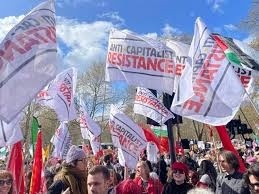
13 April 2026: Organisers claim it was half a million people – it’s difficult to be certain with such a mammoth crowd, but it was over two and a half hours after the front banners left Park Lane before the back did so. Just getting anywhere through the crowd was like swimming in treacle!
This was a crucial demonstration after 100,000 people turned out for far-right activist Tommy Robinson’s Unite the Kingdom protest last September, with a small and demoralising counter-demo.
While Anti Capitalist Resistance (ACR) has criticisms of the Together Alliance organisers for their emphasis on soft slogans against the far right, as well as the inclusion of prominent transphobes amongst its key spokespersons, this historic display of solidarity on London’s streets is a moment to celebrate and seize as an opportunity to build resistance in our communities.
Migrants and asylum seekers are on the front lines in this struggle, and our support must be unwavering. They are joined by disabled, trans, Black, and other racialised people, as well as women in general, as targets of the new far right, who only augment the institutional and structural violence of the state.
Diverse
The mobilisation was enormously diverse. There was great publicity outreach – leafleting for weeks in many communities and workplaces, as well as coverage in the few days before in the Mirror, the Guardian, and the London Evening Standard. People heard about it and came with their mates. The music was an attraction. Others came through contact with Greenpeace, War on Want, and other NGOs, and charities.
There was a Palestine feeder march of several thousand, as well as many Palestine flags throughout the gathering. Democrats abroad brought No Kings papiermache masks marking the massive protests taking place in the United States against Trump, the same day. Again, anti-Trump messaging was common. A substantial Eastern European contingent made an impact on the demonstration. Their message was simple: you have to fight the far right not just in the West but also in the East of Europe. Many on the contingent were Ukrainian whose friends and families are on the front line resisting annexation by Putin or living under a regular bombardement. One of the slogans chanted was “from Ukraine to Palestine, Occupation is a crime”. The Ukraine Solidarity campaign was a very viisible part of this with their flags.
Many unions had worked to bring members and banners onto London’s streets, with NEU and UNISON having the strongest showing. Quite why the turnout for this section of the demonstration was so much more significant – looking like a respectably sized march of its own – than they have mobilised against the genocide of Palestinians is a question that many activists will undoubtedly be raising over the weeks ahead.
Parties
As for political parties, the situation was more complicated.
Rob Marsden reports on the Green Party presence:
I found small groups of Green Party members or individuals walking with friends and family, often with home-made signs referencing Zack Polanski, Hannah The Plumber, or riffing on the ‘Green Menace’ tag.
Many of these people were not only new to the Green Party and to organised politics; in many cases, they had never been on a demonstration before. Hopefully, the breathtaking size and spectacle of the Together March will be a lasting inspiration and a spur to ongoing activity.
Those of us who did make it to the ‘official’ Green Party bloc, way at the back of the march, behind a battalion of Extinction Rebellion samba drummers, still found that it numbered maybe a thousand people and was identifiable by a large number of local Green Party banners, including many of the upright teardrop or feather type. Green Parties from across Britain were represented, but many, maybe most, do not currently have their own banners.
And here lies a bit of a problem for the Greens. There were no centrally produced GP placards or leaflets of any type. This seems not to be a resource issue. Compared to a couple of years ago, the Green Party and its local branches are awash with cash.
Rather, it is a question of GP culture and an over-focus on local electoral campaigning rather than a more general approach to winning wide layers of people to the politics of the GP and building a solid base within social movements.
Your Party also had its own block, on which Dave Kellaway reports:
It was estimated at around 500 participants. Those organising the block have counted more than 50 groups of supporters from across Britain – from Glasgow to Devon, many with their own banners, some never making it to the block, which again was way back in the crowd. Your Party centrally did nothing to argue that members should be visible and organised at the event, sending a mere mention of the march in passing in an email from the chair on 23 March.
The fantastic lead banners and placards – ‘Hate yachts not dingies’, ‘ Capitalism divides, Socialism unites’, and ‘Our solution = socialism’ – were organised by comrades from the All London delegate assembly rather than the elected leadership, which abrogated responsibility. New connections were made with activists from different places, and solidarity was built. A positive experience in the face of leadership abstention.
Meanwhile, Labour had no official role in mobilising for the day. The leadership could have easily pivoted to the demo and sent somebody from the front bench, Starmer could have made some bland anti-Reform message, but nada, nothing.
Even the left, the Mainstream/Momentum alliance, was not prominent. Three or four Labour Party banners did make it – the bureaucracy could not easily repeat the blocking of activists who wanted to take them on Palestine solidarity marches. Labour should be worried – many who turned out are people who used to vote for you, who are no longer doing so, and who are getting more organised.
ACR was present in force, with members from all over England and Cymru/Wales attending on the day, and many of us went on to Croydon afterwards to protest Nigel Farage’s appearance there, making it clear that he is unwelcome on our streets. We handed out our new anti-fascist broadsheet, talked to other protesters, and celebrated solidarity.
As with our popular Palestine broadsheets, many took the broadsheet to carry with them as a placard – some repurposing those they were previously carrying to do so. Our contingent had written its own chants, many of which were taken up by others around us,
What next? We need lots of lively local events, particularly targeted around the local elections in areas where Reform is strong. This requires some organised outreach, as often the left itself is weak in those areas.
One problem for the left is that Reform is often strong where the left is weak, so this would require organised outreach. We need to build on the great vibes on this demonstration – a real boost to people’s confidence and morale – and for another mammoth turn-out by the left against Tommy Robinson on 16 May.
The interlocking crises of capitalism, termed the polycrisis, encompassing social reproduction, economy, and ecology, demand an ecosocialist future. Fascism represents a direct challenge to that future that we must defeat. That means more than demonstrations; it means resistance in our communities and, in the medium term, building a mass party that can take political power from the hands of fascists and their enablers.
[Terry Conway is a British socialist writer and activist associated with Anti-Capitalist Resistance and earlier with Socialist Resistance. She writes on anti-fascism, feminism, Palestine, labour struggles and radical-left politics. Courtesy: Anti Capitalist Resistance, an ecosocialist organisation in England & Wales. It is engaged not just in a struggle to end capitalism and for a socialist society, but also to have a viable planet.]
❈ ❈ ❈
Together: Monster March Takes Back Streets from Far Right
Socialist Worker
13 April 2026: The Together alliance demonstration will go down as the day our side showed it had the power to turn the tide against the far right.
Half a million people took to the streets of central London this Saturday in the biggest march against the far right in British history.
Whitehall had quickly filled with home-made signs, placards and flags and the sounds of chants and whistles. But when the front of the march reached the end, the back was still on Park Lane where it had begun.
Three friends from north London had decided to join the demonstration after seeing Nazi Tommy Robinson’s march of over 100,000 racists last September. “Sometimes the negative voices seem so much bigger,” said Jen.
“I think showing what we stand for and that our country is not like that is how we make ourselves louder than them.”
Aaron said, “We’re here essentially against the system and the investment in our politics that’s funding the far right. Things should be better. Things should be for the people—not big business, not politicians.”
Olivia said, “When I’ve seen all the people out on protests against the far right and against hate, it makes you realise that you’re not a lone voice in it. And look at the number of people here today—how many people don’t agree with the racists.”
At the House Against Hate rave in Trafalgar Square, thousands of people danced to electronic music and chanted, “Free, Free Palestine.”
Shygirl, who performed at the rave, told Socialist Worker it was “a perfect example to show that we can still have unity”. “Music can be at the centre of the community. It makes sense to utilise any medium to spread the message,” she said.
“I’m really proud that people put themselves on the line and in any way contributed. Whether that is a protest in their village or in their cities, they can contribute.”
Banners ranged from the Cambridge Woodcraft Folk and Eastbourne Quakers to Friends of the Earth, the Greens and the GMB union.
The trade union blocs were the biggest on a national demonstration for several years (see list of banners below).
Margaret is a council worker and marched with a delegation from the GMB union. She said it was “absolutely vital” that unions were part of the anti-racist struggle. “We’ve got members who are recent immigrants and carers, and they are being told they will have to wait years longer before becoming citizens,” she told Socialist Worker.
“We have to remind people that it was immigrants that built our health service.”
Perdita was with the actors’ union, Equity. She was marching because she worries about the future of free expression. “I look at what’s happening in the United States, and think about what’s going to happen here, we are already facing massive cuts to arts” she told Socialist Worker.
“Could Britain follow America? If you asked me a year ago, I’d have said no. But today I’m less sure. It seems we have no politicians strong enough to stand up to them in this country.”
At the rally in Whitehall, Green Party leader Zack Polanski had a message for Tommy Robinson and Nigel Farage, “When we turn up in our hundreds of thousands, we are unstoppable”.
“We see what is happening in the United States. We see children snatched in the streets, we see people shot in cold blood. We see the warmongering. The far right see that as their blueprint.
“But people in this country have seen Reform for who they really are. They would have dragged us into this illegal and unpopular war. We say today, this is not in our name. This is not our war.”
Unison union general secretary Andrea Egan told the crowds, “These are our streets and those who want to divide us aren’t welcome. Look at any strike and you will see black and white workers standing side by side against the bosses. That is why the far right hates our trade union movement.
“We have to fight in our workplaces, not just against cuts and for better pay but against racism, sexism, transphobia and for unity.”
She added, “If this Labour government wants to defeat Reform and Farage, the answer isn’t to copy them.”
Ameen Hadi is a Unison branch officer in Salford, Greater Manchester, who is facing attacks from the far right. He said, “There’s two things we’ve got to do now. We are not going to let the new nasty party of Reform UK win the local elections. We did it in Gorton and Denton, we can do it across Britain.
“The second thing is we have to be on the streets on 16 May, we are not going to let Tommy Robinson take Nakba away from the Palestinians. This is our day. We are gonna outnumber them on the streets.”
Lewis Nielsen, anti-fascist officer from Stand Up To Racism said, “Six months ago on 13 September, I stood on this stage and I looked down Whitehall and it was a very difficult day. It was the biggest far right demonstration in British history.
“After that demonstration some people said we were wrong to do counter-protests against him. Some people said we had to adapt to the arguments of the far right.
“But in the past six months up and down the country anti-racists have been organising and mobilising.
“Our message to little Tommy Robinson, if you come for Muslims, if you come for migrants, if you come for refugees, we are going to shut you down.
“We’ve got a message for other people as well. To the man who says he is going to bring Ice to British streets, to Nigel Farage the racist, bigot, the transphobe, we see you for what you are. You’re a private schoolboy, a millionaire. We are going to shut you down too Nigel.
“And to the man in Downing Street over there, to any government minister that attacks refugees, attacks the rights of asylum seekers, that uses the language of the far right, we see you for what you are.
“This has to be the start of something big. A movement this country has never seen. We need a campaign against Reform UK in the May elections. We need anti-racist groups in every town and city, in every workplace and on the 16 May we face a massive test.”
Build the anti-racist left
Malcolm X once said that “we’re not outnumbered—we’re out organised”. The Together demonstration showed that we don’t have to be either—but the fight is on now to build on the success of 28 March.
The demonstration is a game-changer for the anti-racist movement. If you’re campaigning against Reform UK in the local elections, you can mobilise many people to get the message out there.
If you’re organising against far right thugs outside a refugee hotel, you will know many more people to get onto the streets.
If you’re facing far right arguments about violence against women, you know there was a Women Against The Far Right bloc that cut through the lies.
If you’re a trade unionist in a Reform UK-run council, it opens up opportunities to build resistance on a much bigger scale.
The anti-racist networks, which Stand Up To Racism (SUTR) played a key role in bringing together, have to be deepened. The NGOs, the Woodcraft folk, the Quakers, the ravers—we need them all to stay active anti-racists after the demonstration.
And the trade unions, which mobilised much larger blocs, have to be part of building those networks in every town, city, workplace and campus.
The far right is not getting it all its own way. In the past few weeks, it has faced setbacks in the French local elections, defeat in a referendum in Italy and the Trump regime’s unpopularity deepening.
In Britain, too, Nigel Farage was forced to back down over his slavish support for Donald Trump’s war on Iran. And the scale of the anti-racist majority in Britain was on display on the Together demonstration.
But what’s the best way to drive home the advantage? There are important debates taking place in every country.
This weekend, we are likely to see the biggest day of mass protests against Trump in cities across the United States. It is a sign of the revulsion at Ice terror on the streets and how the resistance in Minneapolis inspired millions of people.
But there are different visions of where next for the movement. The Democrats are trying to corral it into “safer” forms of resistance to what we saw in Minneapolis.
Commentator Thomas Friedman, a high priest of the neoliberal centre in the US, showed how it wants to claim Minneapolis. He wrote in the New York Times newspaper that “the real score here is Neighbouring, 1. Trumpism, 0”.
What does this mean? Thousands of people formed networks to help neighbours trapped indoors and to take on Ice on the streets. But Friedman deliberately downplays their militancy and reduces them to, essentially, “people being nice to one another”.
This isn’t what forced Trump to partially retreat. It was the economic shutdown on 23 January—which showed the power of the working class through collective action to disrupt the system—that was decisive.
It gave Trump and the far right an almighty fright, but it disturbed the Democrats too who are running to catch up.
These political differences matter. The Democrats failed millions of working class people and paved the way for Trump’s return—and are not the solution now.
Lining up behind the centre will not stop the rise of the far right. Yes, centrists can win elections against this or that far right candidate because of tactical voting, as happened in France last week. But it is the neoliberal centre’s politics that fuel the far right—and will act as a constant incubator for its rise. Remember after Trump there was Biden—and then Trump was back again.
Look at Keir Starmer. His Labour government is a recruiting sergeant for Reform UK. He has failed to deliver change to working class people and not a day goes by without ministers pushing foul racism against refugees and migrants.
In Britain, too, there is a fight over what is the best strategy to break the far right and fascists.
The far right is growing out of the crisis of the mainstream parties that have devastated working class people’s lives with neoliberalism and austerity. This leads some on the left to argue that austerity is the main driver of the far right and to focus on Nigel Farage’s pro-rich policies.
But racism is the glue that holds together Reform UK’s narrative of “British decline” and we have to break people from the lie that migrants are to blame.
For others, voting in elections is key. It is important. But our power lies at the base as we saw on the streets today.
We need to broaden and deepen those SUTR networks in every town and city with all the forces that came out onto the demo.
SUTR’s Stop Reform campaign in the elections in May is key. It will not duck the arguments about racism. And on 16 May Nazi Tommy Robinson wants to take to the streets once more on the same day as the Palestine movement’s Nakba Day demo. The Metropolitan police is favouring the far right over routes. We need a huge turnout against Robinson’s thugs.
Celebrate the success of 28 March—and fight like hell to build the anti-racist movement.
Alongside that, we need many more socialists at the heart of the movement who organise to tear down the whole system that produces war, climate breakdown, racism, sexism, transphobia and fascism.
[Source: Socialist Worker, a British socialist newspaper and website associated with the Socialist Workers Party (SWP), carrying news, reports and commentary on workers’ struggles, anti-racist movements, anti-war campaigns and international politics.]